
REVIEW: On the Basis of Sex

The film On the Basis of Sex, a celebration of the life of Supreme Court Justice Ruth Bader Ginsburg, is inspiring, educational and thoroughly enjoyable.

The movie opens with a crowd of what appears to be all men – first year law students – parading in to be addressed by the school’s dean, all to the fitting tune “10,000 Men of Harvard.” Then, in the sea of feet clad in men’s dress shoes, the camera focuses on a high-heeled pair marching in their midst – the feet of Ruth Bader Ginsburg (Felicity Jones), one of only nine women in her Harvard Law School class.

In the dean’s address to the students, he speaks of the students using only male pronouns, and it becomes clear that he does not believe that a woman has any place at Harvard Law School. Then, if there was any doubt in viewers’ minds about this fact, at a supposed welcome dinner for the nine women, the dean asks them to “report who [they] are, and why [they] are occupying a place that could have gone to a man.” To suppressed snickers from the other female students, Ruth Bader Ginsburg reports that her “husband is in the second-year class,” and she is at Harvard “to learn more about his work, so [she] can be a more patient and understanding wife.”

In contrast to this, it becomes apparent throughout the movie that Justice Ginsburg’s marriage to her husband Martin Ginsburg, portrayed by Armie Hammer, was profoundly modern for the time period. He was a tax lawyer, and unconditionally supportive of Ruth Bader Ginsburg’s professional aspirations. In fact, he was the one who found her the court case that would become the climax of the movie.

The court case, which involved Charles Moritz, a man caring for his mother who was denied a caregiver’s tax deduction because he was not female, would ultimately be taken to the Tenth Circuit Court of Appeals. In my opinion, though still enjoyable, the actual courtroom scenes were probably among the movie’s weakest, because the way they were portrayed seemed rather cliché. Ruth Bader Ginsburg stumbled severely during the oral argument, and then appeared to save the case in her rebuttal. In fact, Justice Ginsburg herself recalls that “[she] didn’t stumble at the outset.” However, enthusiasts of United States government and politics will certainly appreciate the numerous references to landmark Supreme Court cases sprinkled throughout the movie (I know I did).

Overall, it’s hard to condense a life into 120 minutes, and in my opinion, On the Basis of Sex did an excellent job. I am personally surprised that the movie only has a 72% rating on Rotten Tomatoes. While it may be true that the film offers a glorified, simplified version of Justice Ginsburg’s earlier years, we are, after all, looking back on history through a lens colored by the knowledge that the film’s heroine would become a leading litigator for gender equality, and then a member of the nation’s highest Court. The movie is not a comprehensive biography, nor do I think it was intended to be one. If the movie leaves the audience more curious than when they came, then in many ways, I think that is a victory.

I, for one, could not stop smiling for at least half the movie (“Is that an answer, Mrs. Ginsburg, or a filibuster?”), and watching On the Basis of Sex has only increased my curiosity and desire to learn more about Supreme Court Justice Ruth Bader Ginsburg.

The film is currently showing at the Michigan Theater.

PREVIEW: Ice Carving Festival

Each brutally cold winter, millions of people across the state of Michigan ask themselves the same question: “Why do I live here?”

But then we remind ourselves of the existence of ice carving festivals, and the frostbite miraculously retreats from our extremities.

Yes, that’s right, this Saturday, February 9th is Washtenaw County’s annual ice carving festival! Come on down to County Farm Park from 12-4 PM and watch students from regional colleges compete for ice carving fame. Admission is free, if you needed more motivation to watch amazing art created before your very eyes.

Additionally, there will be refreshments and crafts for kids (though if we’re being honest, I will also be participating), so bring along the whole family!

Related image

REVIEW: Swaranjali

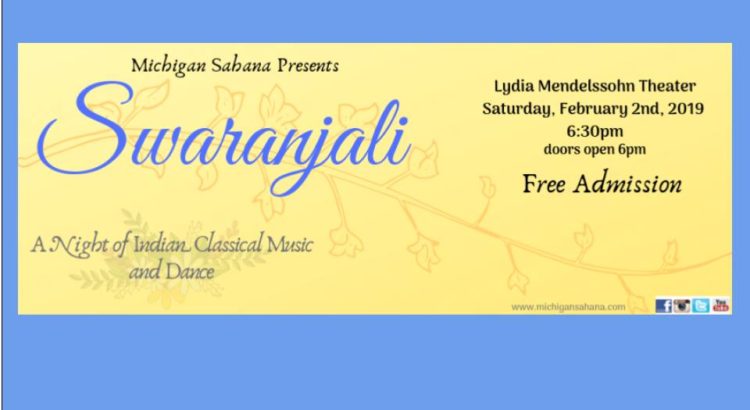
This year, Swaranjali was a little more limited in scope than it has been in the past – I believe there were fewer performances than I’ve seen in previous years. However, the performances were, as always, of excellent caliber. Every time I attend a Sahana concert, I find something different to consider as I watch the performance. This time, there were two things that struck me.

First, one of the performances was a Kathak piece, Kathak being one of India’s classical dances. About 15 years ago, I used to take lessons in Bharatanatyam, another Indian classical dance. I’ve seen multiple performances of both styles of dance and others before, yet it was only last night that I consciously registered that there is a difference in the way Bharatanatyam and Kathak dancers hold their hands. The way you hold yourself – what I know from partner dancing as ‘frame’ – is incredibly telling about the feel of a dance. I’m amazed it took me this long to see the distinction, but after having realized this, it was interesting to think that to experienced performers, the difference, of course, must be a night-and-day contrast.  And yet Sahana often does performances that blend different styles of music and/or dance, and the way they navigate that blend has never been jarring. I think their performances are stronger for it, and in fact, that was the theme of another dance piece at Swaranjali. This one was first danced in Bharatanatyam, then in Odissi (a third classical dance), and then in a combination of the two. It was incredibly intriguing to see two dancers, each experienced in one style, try the other’s style and manage to put their own spin on it. The performance worked very well, showing that interdisciplinary work often produces the most innovative results.

The second thing that struck me as a result of Swaranjali was the very different air around performances of classical music. In India, classical music seems to flow much more freely between improvisational and structured music. It also seems to have a much more collaborative air (although, not having attended very many jazz concerts, I can’t make an authoritative comparison to jazz). When listening to Indian classical music it always seems like a team effort even if there’s only one person playing at the moment – I think it might come from a general sense on my end that the musicians are all very attuned to each other, and that the music they’re improvising is still stylistically cohesive with the piece they’re playing, both of which I find don’t always happen in other improvisations.

And, of course, there’s a certain joie de vivre about an Indian performance that I’ve never experienced elsewhere. Sahana’s performances always evoke for me that sense of tight-knit belonging, humor, and pride that I feel when I am surrounded by my cultural heritage.

REVIEW: Universal Declaration of Human Rights: Linocuts by Meredith Stern

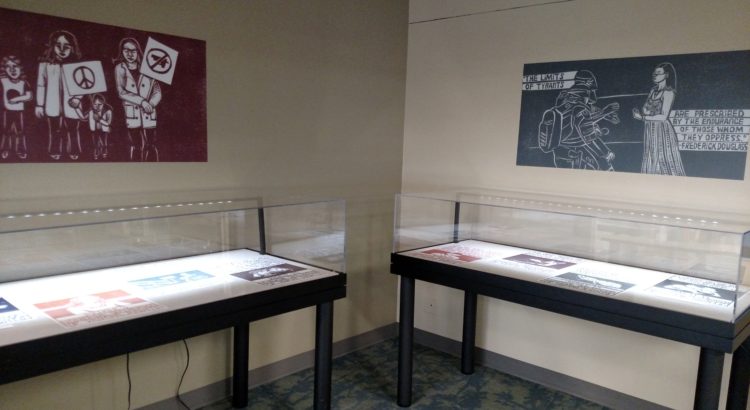
Nestled in the Special Collections Research Center on the sixth floor of Hatcher Graduate Library, Meredith Stern’s set of linocuts inspired by the Universal Declaration of Human Rights isn’t likely to be something that you would stumble upon by accident. That being said, they are well worth the trip.

A total of 14 of her prints, which are made by cutting the design into linoleum, are on display. Each depicts a different article of the Universal Declaration of Human Rights, which was adopted by the United Nations in 1948, due largely to the efforts of former first lady Eleanor Roosevelt (see the preview for this event for more information regarding the document). In each print, the text of the article frames an image representing it, and some of them include text on the image that calls to attention a modern violation of the right that that article was meant to guarantee.

For example, the linocut of Article 9, “No one shall be subjected to arbitrary arrest, detention, or exile,” features an image of a young boy wearing a backpack, with his back to onlookers and his hands on the wall, being searched by a policeman. Article 3, “Everyone has the right to life, liberty, and security of person,” is accompanied with the text “Freedom of gender identity is fundamental for personal autonomy.” The words “Free Palestine,” along with an image of two children, accompany article 15, “Everyone has the right to a nationality. No one shall be arbitrarily deprived of their nationality, nor denied the right to change their nationality.” Issues that, in our time, have become political are portrayed in a non-political context – as rights that every person born is entitled to.

    Meredith Stern’s linocuts both raise awareness of the Universal Declaration of Human Rights, as well as show that the rights defined in it are as relevant as ever. I think that oftentimes, a document such as this seems abstract as words on the page, and we don’t think of the text as having a human face. However, looking at the prints on display, this view is clearly incorrect. It becomes obvious that the rights outlined in the document still aren’t universal 70 years after the Declaration’s adoption, and that there are real, human consequences of this fact. It is up to each of us to work to change this.

  The collection of linocuts was on display from December 10th through February 1st, and they are an excellent example of art as a form of activism. 70 years after the Universal of Declaration of Human Rights was passed by the United Nations General Assembly, we still have a very long way to go, and every one of us must be a part of the solution.


“Where, after all, do universal human rights begin? In small places, close to home – so close and so small that they cannot be seen on any maps of the world. Yet they are the world of the individual person; the neighborhood he lives in; the school or college he attends; the factory, farm or office where he works. Such are the places where every man, woman and child seeks equal justice, equal opportunity, equal dignity without discrimination. Unless these rights have meaning there, they have little meaning anywhere. Without concerned citizen action to uphold them close to home, we shall look in vain for progress in the larger world.”

-Eleanor Roosevelt

PREVIEW: Complex Rhythms

The University of Michigan Department of Dance will present their annual concert, Complex Rhythms, from February 7-10 at the Power Center for the Performing Arts. It feature the re-staging of a “noted twentieth-century masterpiece,” as well as “three new creations.”

Included in this year’s works is Shelter, an “unsentimental commentary about homelessness and disenfranchisement” that was created in 1988 by Urban Bush Women founder Jawole Willa Jo Zollar. Additionally, professor of dance Bill DeYoung sets a new work to Leonard Bernstein’s “Prelude, Fugue, and Riffs” in commemoration of Bernstein’s 100th birthday.

Grab a Passport to the Arts and take it to the Michigan League Ticket Office for a free ticket to this not-to-be-missed event! Showtimes include February 7th at 7:30 pm, February 8th and 9th at 8pm, and February 10th at 2pm.