REVIEW: CMENAS Film Screening: “Rachel”

“Rachel” is a documentary piecing together the nuances and injustices of the death of an American activist in Palestine named Rachel Corrie. Twenty-four year-old Rachel was on a trip to Palestine as a trained activist with a group of other activists in their twenties. At this time in the early two-thousands, the tension in the Israeli-Palestinian conflict was gaining a new wave of intensity with the beginning of the Second Intifada. Rachel and her team were helping Palestinian civilians whose homes were most in danger of being destroyed by Israeli occupation. In an attempt to prevent the destruction of one such house, Rachel stood in front of a bulldozer to obstruct their moving forward; however, the driver of the bulldozer claimed to not see her– though the eye-witnesses to the case speculate otherwise– and ran her over; in a matter of seconds, her body was mangled beneath a mound of dirt and crushed by the metal. Rachel died. Though there seems to be evidence that there was criminal intent by the driver of the bulldozer, the case gained a momentary spark of media attention, only to die down with the injustice of Rachel’s death never to receive due legal attention. This documentary is an exploration of the testimonies of the activists who she travelled with, Israeli soldiers, and many others who were knew her or were related to her death.

The simple, straightforward style of the documentary makes it easy to follow all the intricacies of the evidence presented: testimonies of colleagues and family members, on-site videos and photographs, Rachel’s diary entries. By the end of the film, I felt fully educated about the facts of Rachel’s death– and the thing about the documentary is that it doesn’t ever once say outright that what happened to Rachel unfair or unjust. It just keeps building evidence, slowly but surely, until you’re painfully aware of all the wrong that was done to her. The driver of the bulldozer claimed that he couldn’t see her over the mound of dirt while her team says the mound was hardly a few feet tall; the US embassy failed to send an American to oversee her autopsy even though her parents requested it, probably because the US didn’t want to entangle itself politically; the general of the Israeli forces claimed that there was not enough eyewitness testimony or video evidence, only two opposing viewpoints, which seemed essentially inconclusive. No real legal action could be taken to prove that the driver of the bulldozer had criminal intent.

The documentary works to show that there was a system of injustice present that lead to Rachel’s death. The documentary illuminates the cracks of legality and excuses that Rachel slipped between. The documentary itself works as a bulwark against injustice. The film is modest in its cinematography and aesthetics, but it is large in its meaning and purpose. Rachel was one American activist whose life and injustice has been filmed and commemorated, but it’s a powerful reminder that there are people suffering from crises around the world who won’t get any attention. But there is a small line of hope, perhaps– as we keep talking about these injustices, as long as we make art and conversation about it– we can create a bulwark against it.

I’ll end this post with a beautiful letter that Rachel wrote during her time in Palestine: “You can always hear the tanks and bulldozers passing by, but all of these people are genuinely cheerful with each other, and with me. When I am with Palestinian friends I tend to be somewhat less horrified than when I am trying to act in a role of human rights observer, documenter, or direct-action resistor. They are a good example of how to be in it for the long haul. I know that the situation gets to them (and may ultimately get them) on all kinds of levels, but I am nevertheless amazed at their strength in being able to defend such a large degree of their humanity – laughter, generosity, family time – against the incredible horror occurring in their lives and against the constant presence of death. I felt much better after this morning. I spent a lot of time writing about the disappointment of discovering, somewhat first-hand, the degree of evil of which we are still capable. I should at least mention that I am also discovering a degree of strength and the basic ability for humans to remain human in the direst of circumstances – which I also haven’t seen before. I think the word is dignity. I wish you could meet these people. Maybe, hopefully, someday you will.”

(You can find more of her letters and diary entries here: https://www.theguardian.com/books/2008/mar/02/shopping.extract. I would seriously recommend checking them out– they’re gorgeously written and she’s so wise.)

REVIEW: Poetry Reading by Hannah Ensor + Suzi Garcia

This was the first poetry reading I attended this year. I have not been to Crazy Wisdom in a long time, and I forgot how unique the space is. They sell books, art, jewelry, incense, tarot cards, fair trade products, etc. The tea room is upstairs, just like at Literati.

I did not realize that both Hannah Ensor and Suzi Garcia were reading at the event. Since I gave some background information on Hannah Ensor in my preview, here is some information on Suzi Garcia: she has an MFA in Creative Writing with minors in Screen Cultures and Gender Studies, and she has presented and taught poetry at multiple national conferences. She is a valuable mentor and editor to Ensor and was instrumental to the publication of Ensor’s first book of poetry.

I enjoyed hearing Ensor and Garcia’s unique styles. Ensor made a lot of pop culture references, as the description of the event promised. Her pieces were mostly conversational and captured the mundane to transform into literary pieces. Garcia, on the other hand, utilized a lot of metaphor and analogy. Her poems were emotional, raw, and often explored the theme of earthliness.

During the event, the poets also talked about their sources of inspiration, which were thought-provoking. Ensor talked about writing in a parking lot of Planet Fitness and how a poem was partially inspired by a screening of Jurassic Park. Garcia talked about how one of her poems emerged from three factors: the desire to find a home for a couplet she had written, being inspired by an old song she knew, and a mentor encouraging her to write about her childhood. All these motivations mashed together into one finished product. Another one of her poems came from listening to Carly Rae Jepsen’s song, “Run Away With Me.”

While it may be humorous to hear where both poets found their sources of inspiration, it is also sensible. I often hear people describe inspiration as rare and profound—as if artists are zapped by lightning from Zeus or launched into manic creativity by the use of psychedelics, and then go on to create great literary pieces or famous works of art like “My Papa’s Waltz” by Theodore Roethke or Autumn Rhythm by Jackson Pollock. As an aspiring poet, I know daily enlightenment is unsustainable. Practically, inspiration mostly comes from the mundane. Everything (objects, constraints, concepts) is worthy of a poem or artistic piece upon closer examination. But execution is difficult. I was given the prompt by my 400 level poetry writing class: “write a poem where the movement from one scene to another affects the structure and/or mood of the poem,” and I am currently scuffling with a blank page.

Aside from inspiration, this poetry event also made me consider the difference between hearing and reading poetry. Ensor and Garcia are clearly both written poets first and spoken poets second. It is quite obvious actually. When you read silently, the body of a poem is its layout on a page: the amount of white space, line breaks, enjambment, punctuation, etc. When you listen, the body of a poem is the voice (of the poet, yourself, another reader speaking out loud), rhythm, posture, gestures, etc. In poetry that is spoken, rhyming and rhythm becomes more evident and (arguably) increases in importance. Take Benjamin Zephaniah, a British poet and activist, for example. He is a spoken poet first, a written poet second. Hear his voice and the joy with which he performs “Dis Poetry.” Another example is Sarah Kay, an American poet dedicated to using spoken word as an educational and inspirational tool. See how facial expressions and gestures are essential to her piece “Point B.”

During Ensor and Garcia’s reading, they relied on minimal gestures, rhythm, and word-play to convey their pieces. This does not make them good or bad poets. Rather, it reveals their niche study (and perhaps interest) in written poetry. The event was not a spoken word poetry event; it was a poetry reading event. And a good one at that. I appreciated the casual atmosphere, both physically and intellectually. It was a great place for written poets and enthusiasts to come and celebrate the beauty of language.

PREVIEW: Art Outta Town – Evita

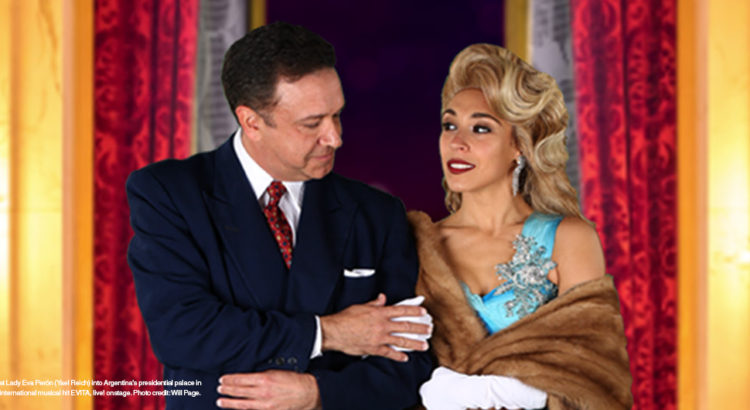
This Saturday, February 2, Arts at Michigan will be taking a group of students on a trip to the Stranahan Theater in Toledo, Ohio to see a matinee performance of the Broadway musical Evita for just $20!

Centered around the life story of beloved Argentinian First Lady Eva Perón, the musical features a Grammy Award-winning sound track by Andrew Lloyd Webber with songs like “Don’t Cry for Me Argentina.” The musical itself was awarded several Tony Awards, including Best Musical and Best Original Soundtrack.

For more information on Evita at the Stranahan theater, click here.

To learn more about Arts at Michigan’s Art Outta Town program, visit their website at http://artsatmichigan.umich.edu/programs/outta/.

REVIEW: SMTD@UMMA Performance: Press A-Flat to Play

I’ll be the first to admit that I’ve never played most of the games referenced at Sunday’s concert “Press A-Flat to Play” at the University of Michigan Museum of Art, but nevertheless, it was one of the most fascinating concerts I’ve been to this year. The event was very well attended, with very few open seats. Centered around Dr. Matthew Thompson’s research of video game music, the evening consisted of performances by the six students that make up his video game music piano studio.

Presented in the museum apse, there was a juxtaposition between the video game scenes projected on a screen behind the piano and the large classical paintings surrounding the audience in gilded frames. In part, I think, this highlighted one of the purposes of the concert – to feature video game music as art.  From the program notes: “Game music is crafted to further plot development, much like music in an opera, a music or for a film…Video game music, native to the Age of the Internet, is relevant, important, and as much art as anything else you’ve heard in this space.”

I particularly enjoyed the concert because, unlike traditional performances where the performers play the pieces in the program one after another, Dr. Thompson spoke in between the pieces, highlighting various parts of the upcoming piece. For instance, prior to the performance of “Stand Your Ground” from the game Final Fantasy XV, he discussed the difficulty of creating a piano arrangement that mimics the sound of the full orchestra that the piece was originally scored for. Before the audience enjoyed “Concert Paraphrase on Dearly Beloved,” Dr. Thompson mentioned that the piece references works by Liszt, Rachmaninoff, and Chopin. For me, these reflections added to the value of the performances, such that even though I was not familiar with most of the music, I still greatly enjoyed the concert.

One of the pieces that I couldn’t not recognize, and probably one of the audience favorites of the evening, was a jazzy version of the Super Mario Brothers theme. As not Dr. Thompson noted, not all arrangements of video game music attempt to be faithful to the original!

Finally, I could not help but notice the acoustics of the museum apse. Underneath the high ceilings and surrounded by stone columns, each note echoed through the space, creating a unique sonic effect that you wouldn’t normally experience in a concert hall!

PREVIEW: CSSA Chinese New Year Celebration Gala

This Saturday, February 2nd at 7 PM, in the Michigan Theatre, University of Michigan’s CSSA will be putting on their annual Chinese New Year Celebration Gala. There will be various acts and performances throughout the night, including well known groups Revolution and Photonix.

From the event page:

“Chinese New Year, known as the “Spring Festival”, is the most important festival celebrated by the Chinese at the turn of the traditional Chinese calendar, when families gather together and embrace the upcoming year. UM CSSA Chinese New Year Celebration Gala is the only formal Spring Festival celebration event at Ann Arbor, and is usually held at local theater during weekends. Since its first appearance in Ann Arbor, the Celebration Gala has turned into an extremely influential event within local Chinese communities due to its exceptional programs presented. The performances include solos, chorus, various different dances, crosstalk, witty skit, Acappella and etc by various student groups and local Chinese American communities.”

VIP Tickets are $15, General Tickets are $12, and Group Tickets (5 or more people) are $10 each. Come by because it promises to be an amazing night!


REVIEW: Yangqin Sonorities and Styles

Shoutout to the Confucius Institute for hosting another awesome traditional Chinese music performance.

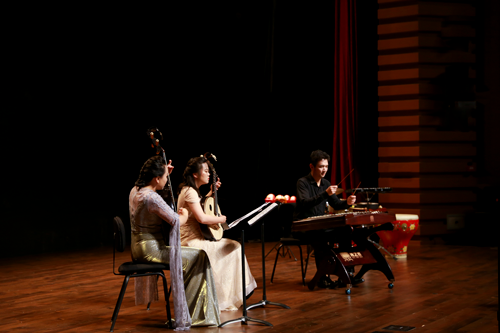
Through 11 beautiful classical Chinese songs I got to hear many beautiful Chinese instruments: the yangqin, zheng, erhu, ruan, pipa, and of course percussion (Look these instruments up they’re all super cool). I was able to hear the instruments play songs on their own, and altogether as an orchestra.

The focus of the night was the yangqin, which is an instrument unlike anything western culture. In western music, most of our classical string instruments just seem to be bigger versions of each other: violin, viola, cello, bass. Chinese music has so many varieties of string instruments and the yangqin is one of the most unique combining a string instrument with percussion. The yangqin’s control over tempo while having the sound of a beautiful string instrument is so special.

I enjoyed that the whole night focused around the yangqin because I was really able to pay attention to the special techniques of the yangqin and listen to how other instruments support the yangqin. The yangqin player Xie Jun is an award winning yangqin player, and I was able to see many masterful techniques I had never seen before. The yangqin is played with a drumstick striking the strings. For the first time ever I saw Xie Jun pluck strings with his fingers, brush the drumstick across the strings to silence them, and use the butt-end of the stick to strum the strings.

Xie Jun really was a master. He didn’t use sheet music for any of the songs and even closed his eyes most of the time that he was playing.  This means he didn’t just memorize the pieces but has practiced them so much he has enough muscle memory to not have to look at the instrument while playing.

This was my first time hearing a zheng live. The zheng is one of the coolest instruments I have ever seen. It is similar to a harp, but it a pressure based. The strings are hoisted by a bridge about halfway of the string and while one hand plucks the strings, on the other side of the bridge the other hand bends the string into the note desired.

My favorite song was the 10th song played Spring at the Heavenly Mountain, because of how the erhu complemented the yangqin. I felt a story being told that involved religion and flying insects. The erhu in Autumn Lyrics had a scratchier and whispery sound, which was also very beautiful. It reminded me of a wailing ghost.

The most disappointing aspect of the show was the audience.  There were around 30 people there, which considering we were in Mendelssohn theater meant we filled about 5% of the theater. It felt embarrassing to have such a small audience for a group of master musicians.  I’d like to say that this was because of the snow and cold weather, but I never students at cultural events void of free food or their friends performing. Half the cultural shows I attend I feel as if I am the lone student there, representing U of M. I know Michigan students like drinking, over studying, and wasting time on their cell phones and it’s disappointing that so much culture is going to die in this next century. I’m so fortunate that the University of Michigan and Ann Arbor still likes to host cultural events for the few of us that appreciate it. The few of us that were at this show enjoyed it so much we were able to get a double encore out of the orchestra.