REVIEW: Bohemian Rhapsody

When I see a biography, I always wonder, why did producers choose this story to tell? There is never just one story. There are multiple perspectives and events a producer could focus on. A 2 hour 13 minute movie can only cover so much of an artist and a band’s legacy. So I wonder about the rhetorical choices made in the production of this movie.

I appreciate that there are a lot of layers to the movie: Freddie Mercury’s (Queen’s lead singer’s) sexuality, AIDS diagnosis, how he passed as white, his flamboyant persona, and his struggle with loneliness, identity, and belonging. Even though the movie covered a lot of ground, it missed an opportunity to explore difficult subject topics like the AIDS epidemic and gay culture and relationships. Mercury is one of the most famous people to ever die from an AIDS related complication. Yet, the movie sensationalizes his battle with AIDS. There’s a brief scene in which he coughs up blood, but other than that, he is not shown to be significantly affected by the disease. In reality, AIDS is an absolutely horrifying and ugly disease that demolishes your immune system.

For these reasons, there’s been a lot of controversy about Bohemian Rhapsody. It sounds like producers tried and succeeded in interview the surviving members of Queen and some important people in Mercury’s life. But the movie, as most movies are not, perfectly historically accurate.

The movie has also been accused of straight-washing. Mary Austin was his lover before he fully realized he was gay. When he came out, he and Mary remained close friends. The film did not dive deeply into his relationships with other men, and instead, foregrounds his relationship with Austin. The movie does however, depict Mercury as being sexually liberated: having a lot of different sexual partners and hosting promiscuous parties. Eventually, he met Jim Hutton who was his romantic partner until he passed away in 1945.

I think it is worth noting that in real life, Mercury was partners with Austin and Hutton for roughly six years each. Thus, I would argue, his connection with Hutton and Austin, are equally important. So it feels a little lopsided that Hutton was not a fully realized character in the movie and that he only showed up in two scenes.

Austin’s character, on the other hand, was much more fully realized and important in the movie. I thought it was very powerful to have her support Mercury when he came out. But I felt her character was eventually used to demonstrate how much of a jerk Mercury could be and how lonely he was. For example, when Austin started dating someone else and eventually became pregnant, Mercury became jealous. This scene showed a selfish and possessive side of him. Even though they could not be together romantically or sexually, he was not willing to fully give her up and have her pursue other relationships.

Overall, I thought it was an entertaining movie that gave the audience a taste of Queen’s rise to fame and Mercury’s personal struggles, but it missed a great opportunity to explore the AIDS epidemic and gay culture in America.  


PREVIEW: Big Band Holidays Jazz at Lincoln Center Orchestra with Wynton Marsalis

On Wednesday, November 28 at 7:30 pm, jazz legend Wynton Marsalis & the Jazz at Lincoln Center Orchestra will be performing at Hill Auditorium!! This is a University Musical Society event, so students may purchase discounted tickets online or at the League Ticket Office.

If you are a fan of jazz, or just ready to get into the holiday spirit, this is a once in a lifetime that event you cannot miss. I have listened to recordings of Wynton Marsalis, and I cannot wait to see him perform live. He has won Grammy awards, the National Medal of Arts, the National Humanities Medal, and the Pulitzer Prize for Music, among many other impressive accomplishments, and this performance promises to be a virtuosic and engaging performance of holiday classics that will be a treat for all ages.

See you at Hill Auditorium on November 28th!


REVIEW: Boy Erased.

After reviewing Beautiful Boy, Boy Erased seems to follow as another dose of a dysphoric mood. They are films of similar tones, based on memoirs, iterations of the same loneliness growing up and the tremendous struggle of an unfamiliar new world. The films are similarly understated in many ways, often slow and cyclic, but Boy Erased properly gives us significance where it is needed, emotion where it is craved, and a genuineness that is never lost.

An impressionable Jared Eamons (Lucas Hedges) only wants to reconcile his faith and his sexuality, to live in his realm of familiar things despite a lingering discomfort that’s been tucked away. He’s a basketball player, he has a cheerleader girlfriend, works part-time at a car dealership, on his way to college — and now far away from his old life, he begins to occupy another significant space, another world that becomes more corporeal as time passes.

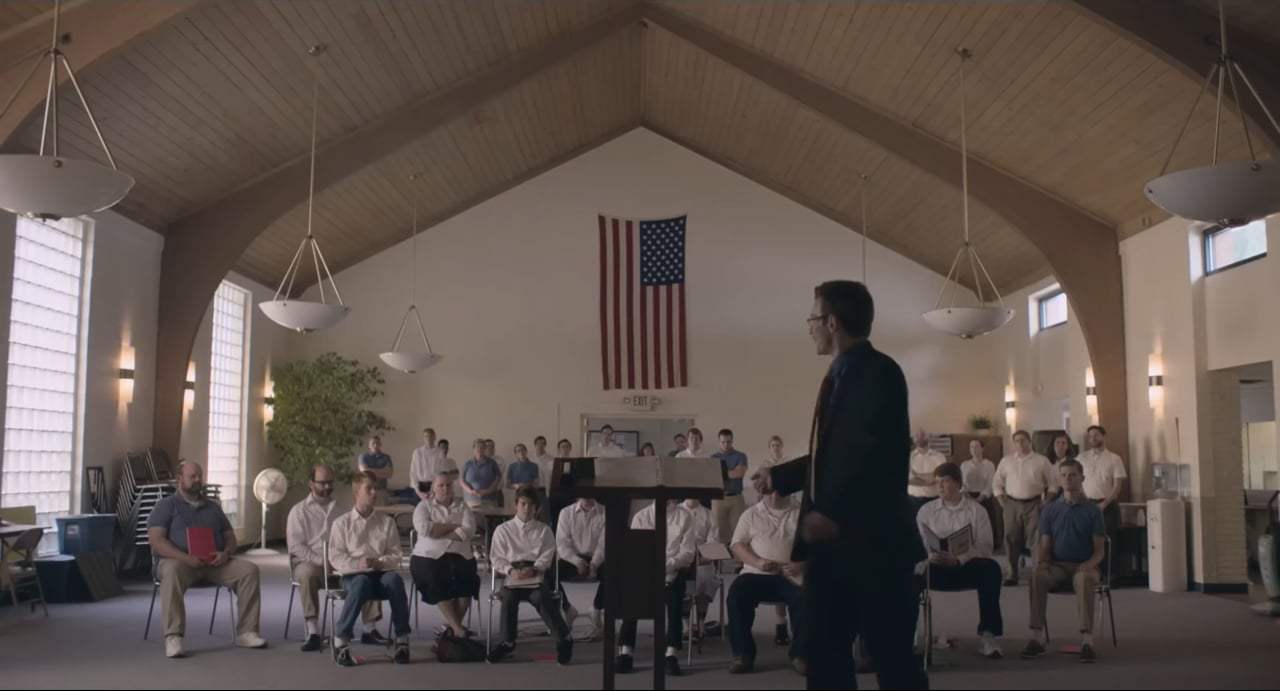
But nothing is certain, and when Jared is unwillingly outed to his parents, he still has an earnest conviction that he is able to shed this sin. He dutifully agrees when his father (Russell Crowe), along with with other higher ministers of church, suggest that he participates in Love in Action, a gay conversion program.

The Miseducation of Cameron Post is a film similar in topic, where the titular character Cameron is characterized by her rebelliousness, skepticism, and an overall faith in herself during her time at conversion camp. But here we differ in that Jared is compliant and eager to please, if not to change. He is a good son, one who sits expressionlessly supportive of his father’s ordainment as a Baptist minister and his vows to eliminate homosexuality. After his first day at Love in Action, he tells his mother he’s excited for the things to come — maybe even believing this sentiment himself.

Boy Erased’s importance comes from Jared’s delicate uncertainty and the fragility of his worlds. His parents are conservative and misinformed, but do ultimately care for him. He believes in his faith, but has a doubt that he cannot shake. The film presents itself in a fairly reserved manner, not explicit in the way it condemns the program staff or his parents. But slowly, we grow to see the way Love in Action is sinisterly manipulative, emotionally taxing, built on the basis of a poorly worded handbook — the same time that Jared also begins to realize the flawed chassis of its goals and who he is.

We go back in time to understand the things written on Jared’s “moral inventory” of past behaviour. In flashbacks, we see that sometimes, he was thrown into a violent confrontation with his sexuality, dangerous and non-consensual, with the collateral aftermath of shame. And other times, it was gentle, soft moments of clarity that changes the way Jared connects his two realms of being at his own pace. The way he consolidates his worth is slow, highlighted by painful moments of realization during his time at Love in Action and, in retrospect, outside of it.

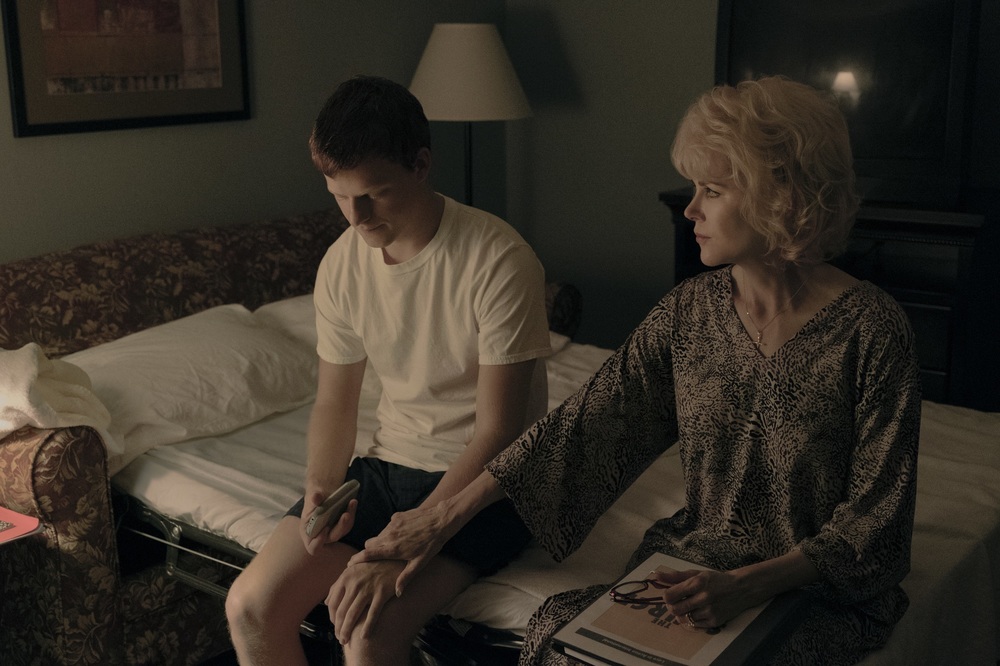
The film climaxes after the abuse of one of the kids at Love in Action, when Jared is called upon to perform an exercise of confessing his sins and channeling his anger, the upsurge resulting from Jared’s gradual development into certainty in his own skin. This resolution is foreshadowed when Jared’s mother, Nancy (Nicole Kidman), tells him the first time she drops him off to call her if he ever needed to. And above her husband, above rule, above God, his mother rushes to Love in Action, puts program leader, Victor Sykes, in his place, and drives off with her son when Jared tearfully calls her. In a very beautiful moment, his mother gives him her love and support as foremost, above all.

Boy Erased is not without its flaws. The secondary characters lacked development; from the astute Gary to the solemn Sarah, we seldom saw more of their inner world, our cinematic gaze fixated on Jared. Even for Jared himself, things were kept subtle, difficult to decipher his exact thoughts —although it often seemed like he didn’t quite know either, filled with conflicting ideas and doubts, a mess of diverging ideals pooling together that clarifies with his growth. Despite its tonal softness, Boy Erased finishes on high hopes, carried by the relationship between Jared and his family as well as the terrific job done by the cast, giving just enough to avoid falling flat.

PREVIEW: Here Be Sirens

Were you the weird kid in middle school who was obsessed with Greek mythology? Can’t believe that anyone hasn’t seen the Percy Jackson movies? Love listening to people scream-singing while wearing large wigs and formal clothing?

If you answered “yes” to any of these questions, you’ll just love Here Be Sirens, an opera telling the tale of the lives of a trio of sirens. Oftentimes, these creatures are made out to be one-dimensional monsters, evilness being their only characteristic. Composer, performer, and playwright Kate Soper approaches her main characters with a more open mind, giving them internal desires and dreams that conflict with the caricature that outsiders typically see.

Come on down to the Kerrytown Concert House this Thursday, November 29 at 8 PM to experience Soper’s masterpiece. Tickets are absolutely FREE with your passport to the arts ticket, or $10-35 if you are PTTA-less.

REVIEW: Master’s Recital–Jordan Smith On Flute

It’s amazing the little worlds we discover throughout the course of this life. I’d never thought that the flute could stand so tall as a solo instrument, instead of a part of an orchestra or a marching band. But its soaring, cascading voice held a truth deeper than I had thought was possible.

The flute is far more nuanced than it seems in a sweaty middle school gym while performing with the school band. Far from being the out-of-tune, squeaky instrument students and their parents grew to hate, Jordan Smith’s recital was moving. He pushed past the limits of the sound barrier like it was nothing, pulling out sweet music from only the air.

But the performance was not your standard recital; though it began with Mozart (whose brilliance at age eight makes me incredibly jealous), it dove into the contemporary, first paired with the standard piano, then percussion (drum, clapping, sticks), then a wondrous video of life emerging from a fallen tree. Smith brings life and youth to what is more commonly the property of old folks ancient enough to have known Mozart personally.

If I had to say anything negative about his performance, it would be the occasional loudness of his breaths in between long musical phrases. This is understandable given the air required to play these passages, though I must admit the sound did distract from the melody quite significantly.

There were a few things out of his control that were less than desirable. The first was a technical difficulty that mangled the audio of the video that was projected behind Smith as he played (though his show-must-go-on attitude and beautiful timing still allowed the video to play a part in the performance). Secondly, all of the selections that incorporated percussion repeated the same tune of a few beats over and over. A livelier, more varied beat could have worked well with the flute’s melody.

I assume Jordan Smith started playing quite young, by middle school at least. Seeing him perform at the level he does now, it is almost impossible to imagine his own off-key first foray into the band geek world, torturing his parents with hours of painfully bad practicing in his bedroom, obligating them to attend all of the soul-crushing school performances.

For most of us, the end of the flute road comes with middle or high school graduation–most of us don’t have the dedication it takes to develop talent like Smith has. For most of us, quitting the instrument was the highlight of our musical careers. Thank god Jordan Smith is not like most of us.


PREVIEW: The Room

Although described as a cult classic, I have never even heard of this movie. Its description is beyond bizzare, warning that I will “never see a football the same way again,” which is terrifying, and brings me to a very specific memory of this poem I read from a book I picked up for 50 cents at a used book store. Reviews of this movie range from calling it a masterpiece to the worst movie ever made.

Basically, I have no idea what watching The Room will do to me, but I will die from curiousity if I don’t see it.

You should join me in this odd venture into the unknown. It’s showing one night only, Friday, November 30 at 10 PM, in the auditorium of the Michigan Theater.

One last thing: the Michigan Theater website requests that audience members do not bring metal spoons or footballs to the show (???), so be sure to remove the spoons and footballs you normally carry before arriving.