
REVIEW: Jack and Jacob

The art of clowning may be funny, but it’s no joke.

On Friday night, I had the pleasure of attending Jack and Jacob: The World Tour in the Walgreen Drama Center’s Newman Studio. This piece, part magic show, part clown show, was all entertaining. Conceived by Professor Malcolm Tulip and senior acting major Jack Weaver, this one-hour laugh fest follows the journey of professional performer Jack as he grapples with the abandonment of his partner, Jacob, on the last leg of their comedy-magic fusion world tour.

The performance itself was led by Weaver, who played a heightened, fictionalized version of himself. The show also featured the voice and stage talents of Priscilla Lindsay, Mark Colson, Malcolm Tulip, Hugh Finnigan, Caitlyn Bogart, Amilia Fontaine, Ella Lewis, and Tate Zeleznik. The ensemble was delightful, and Weaver’s performance was nothing short of wonderful. He possesses a unique sense of humor with exceptional improvisational and audience interaction skills, and it was clear that this performer was in his element, utilizing the training he has received both in and out of the classroom over the past four years.

I was immersed in this highly interactive, comical experience before even entering the performance space. Upon arrival at the Newman Studio, audience members were stopped by a bouncer who demanded they reveal personal information about Weaver before answering. After a sufficiently comical interaction, the bouncer ultimately allowed the audience members to enter the performance area. I looked behind me as I entered the darkened space and saw the same routine being repeated with the group entering behind me, giving me the sense that we were all in for the same experience. The highly interactive nature of the bouncer’s greeting continued throughout the performance itself, which begs the question of when the performance began in the first place – a truly engaging and exciting way to spend my Friday night that kept me locked into the performance from the moment I entered the building. Throughout the show itself, audience members were consulted, questioned, spoken to, and even pulled up onstage.

The fictional conflict of the show, the abandonment of Jacob, created a clear arc for the fictionalized Weaver, who subsequently attempted to run the show himself and take on the role of Jacob when needed. It provided the perfect level of storytelling that sparked a sense of empathy in the audience towards Weaver while still allowing us to enjoy the spectacle and physical comedy of the performance itself.

It’s performances like these that remind me of the power that live theatre can have. At Jack and Jacob, I truly felt in community with the audience and actors alike. This production was conceived as a part of an independent study housed in the Department of Theatre & Drama, which only excites me for future projects that have the potential to be created and produced as an academic escapade. In the future, I would love to see more performances that could strike audiences as a more untraditional theatre-going experience, such as Jack and Jacob. Weaver’s passion for clowning, magic, and comedy shone through during this production, and I sincerely hope that other arts students will feel inspired to bring their creative minds to life onstage in a similar way.
REVIEW: “Tales Told in Brick and Stone”

Taking Time with “Tales Told in Brick and Stone”

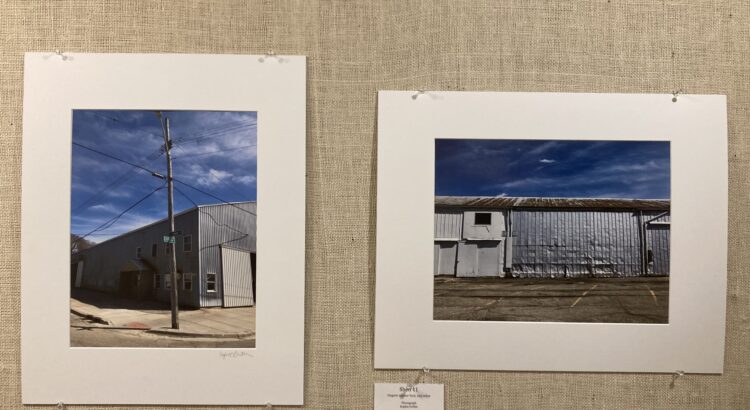
This week I took a walk to The Argus Museum to check out “Tales Told in Brick and Stone” a photography exhibition centered on the emotional resonance of abandoned buildings. The show is a group exhibit featuring the work of Sophie Grillet, Susan Lawless, and Sasha Mykhailova. Themes of shadow, neglect, and decay bring our attention to what we abandon, and express reverence for the echoes of the past found in the structures of our present.

Sophie Grillet is an English artist turned Ann Arbor local.  Her collection “Shadows of the Past” reflects on impermanence. Often her compositions pair buildings with the shadows of figures, contrasting the fleeting nature of people with the intention of buildings to last.

“Orvieto Italy” and “Shadow on Glass”

Susan Lawless’ work is a photography essay titled “Asylum”. It features photos of the abandoned  Northern Michigan Asylum for the Insane. “Asylum” reflects on what it means to be on the outskirts of society. There is a haunting quality to a location like an abandoned insane asylum, and Lawless’s collection brings a respect to the place. We are asked to spend time with something that so often we turn our eyes and minds from, and in doing so we spend time with the memories of the people who once lived and worked there.

“Warning”

Sasha Mykhailova is a Ukranian photographer. Her collection is a series of photographs taken of the aftermath of the Chernobyl nuclear disaster. The photographs are of rooms abandoned and in states of disrepair, gymnasiums with floors warped beyond being a floor, dormitories with rusted out bed frames, papers yellowed and scattered across floors. The presence of disaster and decay warns us to turn away, go back, find another way to go. Mykhailova holds our hand and says, “It’s okay, look”.

“Chernobyl” 6-9

The stories that buildings tell are subdued and often quietly complex. To listen to them requires us to slow down and spend time with emotions that aren’t usually comfortable. We are eager to be distracted from the past, the marginalized, the fleeting, and the abandoned. Maybe in part because it puts our present moment into the context of history. After spending time with “Tales Told in Brick and Stone”, I felt like I had gained a reverence for the past, and an awareness of how the structures around me will continue on long after me. I looked around The Argus Museum with a new perspective, appreciating a space dedicated to remembering.

The Argus Museum is on the second floor of the Argus building on William Street, a few blocks away from the Ann Arbor District Library. It is a museum about the Argus Camera Company, which was founded in Ann Arbor in 1931. In addition to the current arts exhibition, the museum is full of old cameras and artifacts about camera making, documenting the history and development of the Argus camera company. The museum hosts photography exhibits and conferences throughout the year in their gallery space.

“Tales Told in Brick and Stone” will be available for viewing at The Argus Museum until April 5th.

REVIEW: Perfect Days

I walked into the screening of Wim Wenders’ Perfect Days expecting an idyllic film, something easy to pass my evening time. I hadn’t expected to leave the theater, with the girl sitting next to me sobbing profusely, unable to stand.

The movie follows the daily routines of Hirayama (Kôji Yakusho), a toilet cleaner in Tokyo. He wakes before light, tends to his plants, drinks his morning coffee from the vending machine, and drives off to begin work at his first public bathroom. We listen to his cassette tapes, featuring the likes of The Velvet Underground, The Animals, Sachiko Kanenobu, Nina Simone, and of course, Lou Reed’s Perfect Day. He eats his sandwich on his lunch break, staring up at the sunlight peeking through the canopy, and snaps a shot on his film camera. Before bed, he reads his current book he picks up from the same bookstore he visits from the time before. I was enthralled by the pure simplicity of these scenes. A gentle, yet profound storytelling, executed beautifully by Yakusho.

I was there with him, feeling the anxieties, shyness, frustrations as he moved about his day. There is drama, but it never feels excessive. I had talked about the movie with friends afterwards, and the main thing I felt, I think, was hope. A hope for some sense of contentment in the solitude of Hirayama’s life, a peace in the bustling city of Tokyo, an earnest appreciation for nature. All the quiet moments and details we may have missed, constructed this hope within me. Hirayama barely spoke throughout, and yet he touched my heart so dearly.

The ending scene, which I won’t spoil for those of you who haven’t watched it yet, had devastated me. It was a hollowness that I wasn’t expecting to feel when I read the synopsis (and I’m sure the person sitting next to me didn’t expect it either). What I had initially felt as somehow romantic is actually so deeply rooted in our reality. The movie is so human, in its simplicity, beauty, and loneliness. The same joy derived from routine, the little moments, and even from old habits, can be the same ones that break us down. And yet, we keep moving forward.

I’ll definitely be going back in to watch this movie again. I can’t help that it became one of my favorite films of the last year, even if it sends me into a mild existential crisis.


124 minutes. Rated PG for drinking, smoking, partial nudity. Original language in Japanese, with subtitles. In theaters now.

Image thanks to The Los Angeles Times.

REVIEW: Poor Things

Welcome to the fantastical world of Yorgos Lanthimos’s Poor Things. The 2023 film is based on the 1992 book by Scotsman Alasdair Gray, a riff of the well-known Frankenstein  with some rather venereal counterplots. With an abundance of Golden Globe, BAFTA, SAG, and Academy nominations, Poor Things has thoroughly charmed modern cinemas.

Bella Baxter (Emma Stone) is the culmination of a creepy science experiment by a uniquely kind mad scientist, Godwin Baxter (Willem Dafoe), giving a woman driven to suicide a second chance—with the brain of her unborn infant. Bella matures quickly, first discovering her balance, gravity, and empathy, and eventually philosophy, sex, and personal fulfillment. Her developmental journey is natural, but odd perceived from a fully developed women’s body. Godwin maintains a careful grip over Bella’s freedom, supervising her alongside his collegiate assistant, Max McCandles (Ramy Youssef).

Bella ultimately winds up following the conniving lawyer Duncan Wedderburn (Mark Ruffalo) across Europe on an expensive bender, fueling Wedderburn’s desire for passive companionship and Baxter’s ache for adventure. The two create quite the disruptive pair, while Bella meets a selection of romantic partners and friends, and sees true inequality for the first time.

The narrative consistently intrigues with its quasi-realism, engrossing the reader completely in a sci-fi-coated London. Each character is extremely animated, like that of a children’s book. Stone effortlessly captivates Bella’s inner yearning for adventure and search for truth. She is curious and unafraid—a portrait of young women without society’s ruminating judgment. Bella has a fearless curiosity and confronts the world as such. It left me in a state of reflection watching a young woman discover life with (mostly) her own free will without the knowledge or care of society’s judgment placed upon her.

(Ramy Youssef (left) and Willem Dafoe)

The design presents a nod to the Victorian elements of Frankenstein while exploring fantastical sci-fi embellishments that separate our reality from that of Poor Things.  It brought home Academy Awards for Best Costume Design, Best Design, and Best Make-Up and Hair, (as well as Stone for Best Actress)—an unsurprising selection of accolades, in my opinion. The Academy clearly agrees that Frankenstein never went out of style.


141 minutes. Rated R for nudity, lots of sex, and disembowelment. In theaters now.

Image thanks to The New York Times and Fast Company.

REVIEW: Color Cabaret

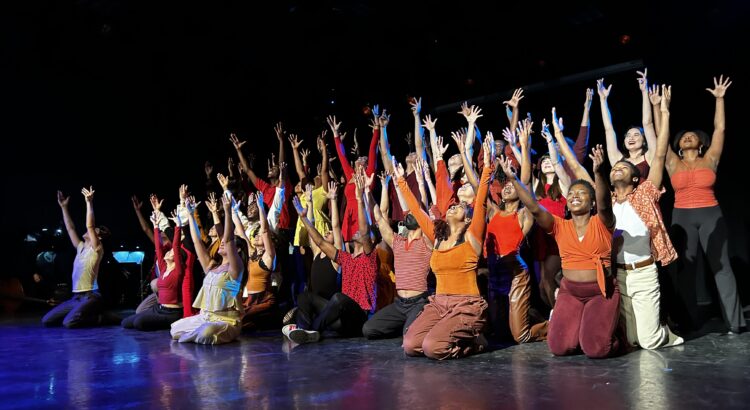
Biennially, the students of the SMTD Department of Musical Theater put together a cabaret to uplift the diversity within their department. Color Cabaret features BIPOC performers from all four years of the department performing many Broadway Classics and music from the Musical Theater canon. The group hosted two shows on February 22nd at 7p and 11p; around 60 minutes and II Acts. The Towsley Studio in the Walgreen Drama Center was packed to the brim with some of the most eager family members, students, and colleagues I have seen at a student production.


The directors of this performance were Oluchi Nwaokorie and Haoyi Wen, along with music director Caleb Middleton and choreographers Abigail Aziz, Keyon Pickett, and Logan Saad. The show consisted of a collection of Musical Theater numbers, fully choreographed dances, lighting, and orchestrated with a five-piece band. The performers hosted infectious energy that bled through the room—vibrant dance numbers, satisfying harmonies, and one-of-a-kind arrangements.


Many of their numbers used Broadway tunes with rewritten lyrics by the performers describing the experience of People of Color and the stereotypes placed upon them. Arrangements, lyrics, and poems were re-written by many of the members of the Cabaret, including Alyssa Sunew, Ryo Kamibayashi, Brendan Johnson, Drew Perez Harris, Aaron Syi, Angeleia Ordoñez, Anna Zavelson, Aidan Jones. (Along with two additional arrangments by Stephanie Reuning-Scherer and Catherine Walker/Henry Crater).

Every single aspect of this performance was led and created by Students of Color. Directing, marketing, arrangements, lyric re-writes, choreography, lights, band and music direction (etc.). Each number was truly unique—from Part of You World performed in different languages, to a witty Book of Mormon rewrite and medleys from Once On This Island, Falsettos, High School Musical & Rogers & Hammerstein’s music, I was on the edge of my seat after each performance. This group truly created a beautiful piece of theater on a rather bleak February night.

Color Cabaret is an enormously special part of SMTD and a thrilling way to amplify BIPOC voices in the Musical Theater Department. Be sure to catch Color Cabaret in 2026 (if you’re still here!). Next, The Department of Musical Theater will perform A Little Night Music  April 18-21, 2024. Tickets are available here.

REVIEW: Michigan’s Got Talent

Wolverine’s Prove “Michigan’s Got Talent”

On Tuesday February 20, I used my Passport to the Arts to attend Michigan’s Got Talent, a talent show for the University of Michigan student body. The event was hosted by MUSIC Matters, a student organization that organizes music events on campus. Performed for the Lydia Mendelson Theatre’s packed audience and a panel of three judges, the night was act after act of inspiring creative force.

The event was MCed by two members of student improv troupe ComCo and judged by former president of MUSIC Matters Anna Lair, as well as the University of Michigan’s Vice President for Student Life Martino Harmon, and Mark Clague, an SMTD musicology professor whose scholarly interests center on the role of music in community building.

Student Band “Mahogany”

The range and variety of talent in the Michigan student body was on full display, from the upbeat k-pop covers by Korean American band Seoul Juice to the rhythmic flair of the Michigan Ballroom Dance Team. Individual talents and student organizations alike shined their light on stage. The audience was moved by vocal performances by Jeheil Butt, who also performed with DJs Acapella, and singer-singwriter Jacqueline Dianis whose buttery smooth rendition of Tennessee Whiskey was powerful and sincere. Student jam band Toast gave a zippy and energetic performance, and nine man band Mahogany connected to the audience with upbeat grooves.

Apparently on a whim, the ComCo MCs asked if anyone in the audience had a talent they’d like to share, and a brave audience member climbed onto the stage to perform an impromptu tap dance. After that, several other audience members volunteered their talents at the piano during set changes. There was a magic in the air of rooting for someone to make the change from audience member to performer at a second’s notice.

Outrage Dance’s Final Pose

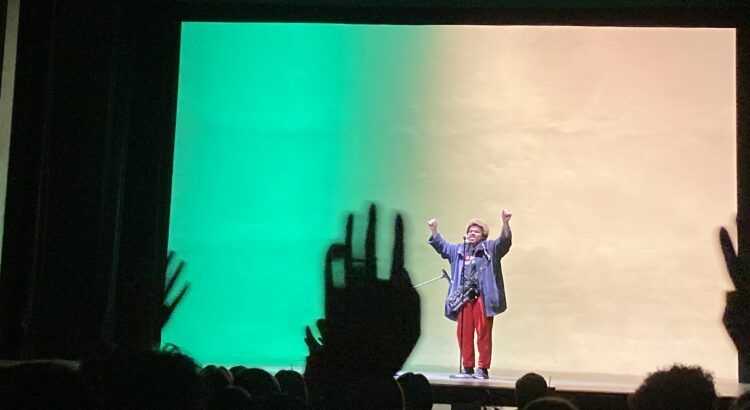
Outrage Dance gave an energetic and technically impressive performance that knocked the audience’s socks off, winning the Crowd Favorite Award. Trenton Michael (featured image) and his saxophone performed an upbeat, spunky, and honest original song that had the audience clapping along, winning him Most Original Performance.

My favorite act was probably Tola Kilian and Miguel Retto, who represented the Michigan Ballroom Dance Team with a performance of Pink Panther. The suave and sassy dance was truly a pleasure to watch, and reminded me of my days studying abroad and dancing the Tango in Argentina.

Tola Kilian and Miguel Retto of The Michigan Ballroom Dance Team

I left Michigan’s Got Talent moved by the talent of my peers, and glowing from the chance to catch and reflect the shine of my classmate’s creative expression. The opportunity to see students in the audience sit up from their velvet seats and show that they too had something to share, imparted a whispered awareness of the energetic creativity that hums in the people around you. Michigan’s Got Talent was a celebration of music, and of life. I think performers and audience members alike walked out of the theater feeling inspired, and a little more talented.

Music Matters hosts other events to promote the arts and music on campus. You can check out their instagram to learn about upcoming events like Spring Fest in April.