
REVIEW: Fall Film Series: Contemporary Cinema from the Islamic World (Wadjda)

My girlfriend and I have this joke between us, where I’ve compiled my top 25 favorite movies of all time, but actually the list is ever-growing and has long since left behind a number anywhere close to 25. This is not to say I am so easily influenced by any old sappy rom-com, but instead is only evidence of the seriousness of my Netflix addiction.

In any case, I consider all of my movie-watching experience enough to transform me into a reliable source for a good movie recommendation, and thus a solid judge of a film’s emotional quality.

In short, Wadjda was beautiful. The title character can only be described as spunky, with her Converse high-tops and the broadness of her grin, the quickness of her smart mouth and her mind for entreprenuership. I find that I no longer want to be like others when I grow up; rather, Wadjda is who I wish I was as a child. If I had had half that moxy at her age, who knows where I would be now.

The film goes on to document the girl’s dedication to saving up for a bicycle, a toy that she is repeatedly told is not for girls, as it is believed to harm the reproductive system, and is generally considered umseemly. Nevertheless, she schemes and studies her way to success, learning to recite the Quran for a school competition (with a cash prize, of course). All the while, subplots form, showcasing the female life in the midst of a male-dominated society: her mother’s fears of her husband leaving to take another wife; the principal’s rumored interactions with a non-relative man; the rule-breaking, magazine-reading girls at school.
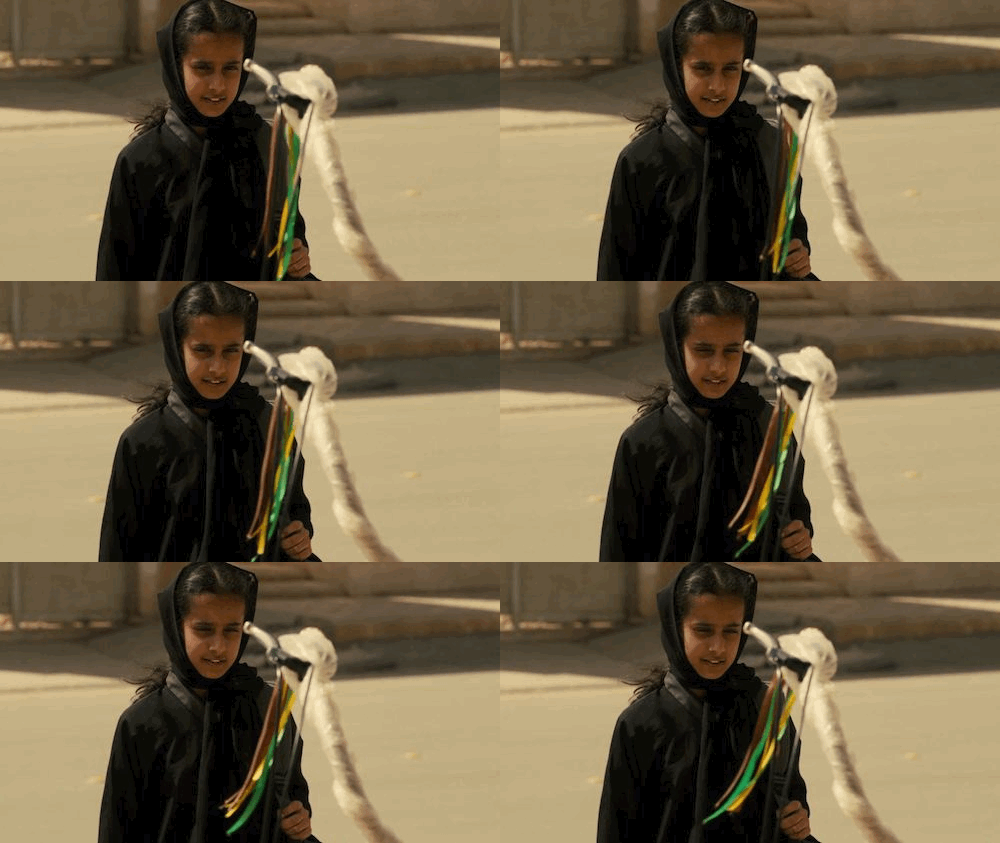
If you’re a devout Wes Anderson fan, you’ll appreciate the monochrome quality of the movie–the pale yellow-cream is omnipresent, from the sand and sky to homes and buildings. This calmness of hue contrasted nicely with the small chaoses building in the film’s plot, and only made Wadjda stand out more starkly, racing her friend Abdullah down the dusty street or walking home from school. In a part of the world that restricts many of womens’ freedoms, the brashness of this little girl is striking.

A lot went into Wadjda‘s creation. In Saudi Arabia, women cannot be seen in public interacting with men outside the family, so the director Haifaa al-Mansour had to give directions to her male crew via walkie-talkie from the back of a van. She had to get govermental approval before she could film, and though she recieved funding from a Saudi company, much of her funding was from a German source. Not only was it the first feature-length Saudi film to be directed by a woman, it was the first to be shot entirely within the country, in which the first cinema opened just this past April following a decades-long ban.

This truly is a historic film. If you haven’t seen it yet, I urge you to do so! You will feel changed.

REVIEW: Luzinterruptus: “Literature vs. Traffic”

After hundreds of volunteer spent hours putting lights into 10,000 used and discarded books, the books found their way onto the aptly-chosen Liberty St., paving a section of the road with the illuminated written word demonstrating the power of free thought.

Unfortunately, I missed the actual art installment of the books opened up, peacefully resting on the road. By the time I arrived, a giant crowd of people was pushing their way through the street that was blocked off, on a giant Easter egg hunt for used books. I think it is interesting to think about the installment and how it went from a project people admired from a distance to one they actually got to bring home with them, taking a piece of this major art installation with them to read and remember forever, or until the the words fade from memory, if the words even get read in the first place. Many people walked away with armful of new books ready to be read. I wonder how many people will actually read every book they picked up.

This art installment made me rethink our interaction with art and how we engage with it. As a volunteer who spent three hours taping the lights into the books and having fun looking at all the books floating through my hands, it was kind of painful watching people trample over the open, illuminated books carelessly as they searched for a book that appealed to them. The event title “Literature vs. Traffic” seems very appropriate. People would pick up an open book, look at the title, and then throw it back down onto the ground. While the installation demonstrated the power of the written word, it also showed that some words are valued more than others.

I’m sure seeing the books untouched and just chilling on Liberty St. was a powerful and cool thing to witness. And I’m glad people got to enjoy the wide variety of books that was donated for this project and give them to new eyes. However, I definitely think I got more out of this project by volunteering than by walking through the streets, and I thank Luzinterruptus and the University of Michigan Humanities department for bringing this to Ann Arbor.

PREVIEW: The Aizuri Quartet

On Friday, October 26 at 8pm, the New York City-based Aizuri Quartet, grand prize winner of the 2018 M-Prize Chamber Arts Competition, will be performing at Rackham Auditorium.

Notable for their unusual collaborations, the Aizuri Quartet was also String Quartet-in-Residence at the Metropolitan Museum of Art for the 2017-18 season, among other achievements.  The Friday night program includes works both new and old by the likes of Vartabed, Bartók, Caroline Shaw, and Paul Wiancko. The pieces by the latter two composers were written specifically for the Quartet.

Don’t miss what is sure to be a fresh, exciting, and virtuosic performance! Tickets may be purchased online at https://ums.org/performance/m-prize-winner-2018/ or in person at the Michigan League Ticket Office.

REVIEW: Luzinterruptus “Literature vs. Traffic”

Attending Luzinterruptus: Literature vs. Traffic was a different experience than I had originally thought. After volunteering on the project and researching a bit about the organization itself, I was really excited. For the first time in my life, I was going to get to be a part of an urban intervention. I was going to make social change. While that of course was ultimately true, I didn’t feel as fulfilled as I expected.

My friends and I arrived at Liberty Street ten minutes before 8pm. Unbeknownst to us, at 8pm Luzinterruptus permitted people to start taking books for themselves. Obviously I support this idea because I advocate for free reading and what it represents for society. What I didn’t expect was that I never even got to see the installation in all its glory because bodies were blocking the lights. People swarmed over the installation, stepping over books they did not want. We even climbed up the State Theater to try and see a glimpse of the promised spectacle from a higher window and all we saw were people.

This was all well and good, as Luzinterruptus was trying to promote their message. Free thought, the written word, and the importance of literature were all shining through in the book frenzy. While I was upset I never got to see an illuminated Liberty Street, I understand why that ended up being a good thing for the project.

Be that as it may, I can’t give you a full review of Literature vs. Traffic. What I can do is tell you about my volunteering experience. I was skeptical about giving up 6 hours of my Saturday – a game day, no less – to spend time in a room with people I had never met before. It was a cold and rainy day, so getting to Ruthven also was not fun. But when I arrived, the staff was welcoming and very apparently excited to have us there. The free t-shirts were also a bonus, but that’s beside the point.

My friend and I sat next to a very enjoyable couple. They were both alumni and still lived in the Ann Arbor area. The man – Joe, I think his name was – had a gorgeous leather-bound book saved off to the side because he was wrestling with the idea of gifting it to his nephew. His wife, Lisa, was discussing cookbooks with my friend, who had hoarded seven of them by the time our shift was over. Our goal was to put 20,000 lights into the pages of 10,000 books, which we accomplished in two days as opposed to the expected five.

Overall, Lisa and Ben were what made my experience memorable. I was happy with myself for choosing to volunteer my time for Luzinterruptus, a group whose goals I fully support. While I didn’t get to see the installation itself, I’m really glad I was able to contribute.

REVIEW: Hubbard Street Dance Chicago

I attended the Saturday show (they performed two different programs). I haven’t gone to contemporary dance performances before, so this was a new experience. This one was environmentally themed, centered on things that are debilitating: plastics, overdependence on electronic devices, and habitat degradation. They performed two dances, punctuated by an instrumental piece performed by Third Coast Percussion, who also provided live accompaniment for the dances.

I liked the first one best. A poem narrated the evolution of the universe, from elements to the creation of the earth, the evolution of humans, and finally the disconnect between humans and nature. The dancer portraying the Earth was beautiful: she exuded strength and grace. What I loved about this piece was the interplay between dancers. Movements that would have been chaotic on their own made sense when they danced as one, and they were so attuned to each other here it was an extraordinary sight to watch. At one point the dancers recreated the classic human-evolving-upright-stature diagram, so subtly it took me a moment to register it. They also took time to dance in pairs. There is something breathtaking about the intimacy created by two people dancing together, sharing their bodies and space to create something  greater.

The instrumental piece was pretty, but I had a hard time staying engaged. There were so many things happening in the music at once that it was impossible to focus on all of them.

However, I liked their performance, and I was happy to find that in the third piece they were integrated into the beginning, moving around the main part of the stage and interacting with the dancers. Musical accompaniment can make or break a performance, and so it was good to see this relationship acknowledged here. The dance I found somewhat incomprehensible and disjoint. The dancers were attached to each other in ribbons for reasons I couldn’t perceive, the choreography had a strange juxtaposition of angry, almost feral movements, and languid ones, and there was a plastic bag that kept appearing, adding arbitrarily crinkling noises into a performance that was otherwise so controlled. Confused and slightly concerned (the dancers kept putting it over their heads), I only found out its significance because I stayed for the Q&A (it was one of the items that debilitate us). The one thing I did love here was that the dancers seemed almost to be experimenting with each other’s bodies, making the dance seem exploratory and almost childlike instead of the highly choreographed sequence it was.

My thoughts on the choreography aside, the dancers were incredibly talented. Unsurprising, I know, but I was still astounded at their ability to move what seemed like every bone of their bodies separately from the others. As a dancer of Brazilian Zouk, I am more adept at such isolations than most, yet this level of control is one I could only dream of achieving. So if I have a chance to see another performance of theirs, I definitely will be taking it.

REVIEW: A Star is Born

We encounter people only in the present. We may inquire about the past, scroll through Facebook timelines, even read a Wikipedia page if they are famous enough, but all we gain are snippets of who they were before. These bare wisps of information cannot be sustainable and certainly cannot compare to the living, breathing persona in front of us now. So, all too easily, we brush aside the remnants of history and only see how someone appears in the moment that we interact with them. Even as we get to know someone on a deeper, more intimate level, we cannot clearly imagine how they were as a child, as a teenager. The journey is lost in translation and only the destination is seen. Perhaps that is why A Star is Born feels as relevant as it does despite being retold for the fourth time. It dwells on the unseen events and how they can’t be merely brushed away.

We first encounter Jackson Maine (Bradley Cooper) as he prepares to mount another performance. He pours pills heedlessly into his palm and then into his mouth. He grabs his guitar and the audience cheers, unknowing and overwhelming. Later, after the splitting lights and the pounding sound, he sits alone in the back of an expensive car and drinks until he runs out of alcohol. The film excels at these secret insights and personal moments. The characters dominate the camera and their point of view drive the film with little outside interference. Even the screaming audiences that Jackson, and then Ally, command are little more than smudges on the periphery. This is not a film merely about fame or even stardom, as the title proclaims. Instead the film is relentlessly focused on two people who love and damage each other.

We first encounter Ally (Lady Gaga) as she prepares to mount another performance. She has tucked away her waitressing apron from her first job. But as she leaves the restaurant, unseen by anyone, she spreads her arms and twirls. It is a perfect moment and Gaga inhabits every moment of her performance. Young, inexperienced, but more than willing to stand up for herself, she is the perfect foil for Jackson. In her, he hears something special, a voice with something to say. In him, she sees someone whose caring and kindness has been rendered invisible by fame. But even without all the explanatory factors, Ally and Jackson belong with each other. In a credit to Gaga and Cooper’s acting, their characters have an electric chemistry that never wavers. For a film that is over two hours long, it is crucial. We remain invested in Ally and Jackson’s relationship as they reveal their little chips and flaws to each other, because of the quirks. Cooper, as the director, manages to make a story that could easily devolve into romantic melodrama, grounded and intriguing. So, we see as Ally and Jackson develop into something more than a meet-cute. They are meant for each other, yet there are equally many things driving them apart. The more they try to be together, the more the past interferes. Unlike the typical romantic movie, the film doesn’t posit that love can solve all their problems. In the end, both Ally and Jackson are separate people, who cannot understand every essential element of the other, as much as they try. In the end, they are still flawed.

For all the pomp of its title, A Star is Born is a film ultimately about two people. We may glimpse the occasional trappings of stardom, the dance rehearsals, the awards ceremonies, but they never last long. What truly embeds itself in the memory is a look, an embrace between two people.