REVIEW: Black Panther

All movies owe a debt to their predecessors. It is impossible to watch a film without noting the various influences that have inspired it. This is even truer for genre films which often share entire story structures, churning out movies that are indistinguishable from each other. Superhero flicks, especially, have been accused of blurring together into a colorful, entertaining, and infinitely duplicable pictures. Each superhero, no matter if he (and it’s almost always a ‘he’) can fly, lift cars with a single hand, or just run really, really fast, seems like the same combination of bravery and self-sacrifice. Iron Man may quip a little bit more often than his stoic counterpart, Captain America, but their stories are told in a similar fashion with the familiar notes of a origin story, a challenging villain, and ultimately, total victory. It is these notes that Black Panther manages to sidestep almost entirely in favor of depicting something new and inventive. In doing so, the film separates itself from other Marvel efforts in both its plot and imagery.

Although the audience is being introduced to Wakanda for the first time, for T’Challa (Chadwick Boseman), this is a country and a culture that he has been immersed in his whole life. After his father’s death, he immediately begins assuming the proper rituals and customs that come with the ascendancy to both the throne and the title of the Black Panther. He has been raised to be a king and it shows in his carefully reserved grief, in his every deliberate movement. It is this quiet confidence and familiarity that infuses the movie with a sense of purpose. This is not a superhero in the making, someone slowly coming to terms with his powers. This is a man who was born into the responsibility. However, even though he may have always expected the throne, he perhaps never considered coming into power this early. And there are some challenges that Wakandan tradition cannot prepare him for, especially the centuries long isolation that has kept Wakanda’s technological advances secure. All these challenges are represented in the character of Killmonger (Michael B. Jordan).

Killmonger is not the typically bland Marvel villain craving world domination or the vague concept of power. Instead, he is a deeply wounded human being who has seen the oppression regularly endured by Wakanda’s African brothers and sisters. The reality of this oppression is never far from the movie on the screen which regularly references slavery, colonialism, and the continuing racism that has ravaged the continent of Africa. The proposition of a country unaffected by all of this is an opportunity to explore what could have been and what is still at stake. Although movies, especially those in the superhero genre, are seen as an escape from the headlines displaying the latest tragedy, Black Panther actively chooses to engage in these issues through the frame of a fictional country. This is how the movie transcends the usual clichés and tropes. It is how it moves from interesting to compelling and impossible to ignore. The movie always treats it’s subjects and their decisions as crucial and impactful. None of their actions come without consequences. Even the world of Wakanda demonstrates this with everything from planes that flare their wings like hawks to soaring skyscrapers that arch and twist. Everything speaks to a defined history. Contrasting this careful treatment with other examples in the genre where death is defied at every turn and injuries are brushed off without explanation is like the difference between watching a Saturday morning cartoon and a documentary. Both are entertaining and may present value, but in radically different ways.

Of course, it helps that this vision is carried out with grace by Ryan Coogler and his cast. T’Challa fights alongside a team of strong characters, especially strong women. Shuri (Letitia Wright), T’Challa’s younger sister, and Okoye (Danai Gurira), the leader of the king’s bodyguard, are particular standouts. Like Okoye, the movie is strong and emotionally complex. Like Shuri, it is unafraid to spit in the face of tradition and have a little fun. And like T’Challa, it is willing to examine the past and bring about a new future, not only for superhero films, but for all movies.

PREVIEW: First Date

We’ve all been there — first dates. The first date that brings dread or butterflies to your stomach. The first date that is either endless torture or an instant click. The first date that has you already setting up your next blind date or planning your wedding. And then there’s the first date that is perfectly average and leaves the future completely uncertain.

Meet Aaron and Casey, chronic singles meeting for their arranged blind date. Featuring characters such as Facebook, Snapchat, YouTube, Google, Instagram, Pinterest, and Twitter, this original comedy musical set in the modern technological age explores the possibilities of love and chemistry at a certain point in life between two people and all the doubting voices carried along the way. Do the sparks fly? Is love in the air?

A2CT is putting this production on at the Arthur Miller Theatre March 8-11 with showtimes at 7:30pm on Thursday, 8pm on Friday and Saturday, and 2pm on Sunday. Student tickets are $14 and can be bought online at www.a2ct.org or at the door. This event is also FREE with a Passport to the Arts voucher!

PREVIEW: Darkest Hour

The Oscars are almost upon us, and all the buzz surrounding recent movies is finally going to come to a head. Lady Bird turned heads last fall for its run as the best-reviewed film ever on review aggregator site Rotten Tomatoes; Three Billboards Outside Ebbing, Missouri has proved both stunningly unexpected and stunningly controversial; and Call Me By Your Name has received praise for its intimate presentation of a 1980s gay romance in Italy.

One of the few Big Picture nominees that I actually haven’t heard that much about, surprisingly, is Darkest HourDarkest Hour stars Gary Oldman — a longtime seasoned actor, who may be recently remembered for his role as Sirius Black in the Harry Potter franchise — as Winston Churchill during his early days as Prime Minister of the United Kingdom. It promises to resemble both a character study of Churchill himself as well as a document of many of the political conversations behind World War II and the spread of Nazi Germany. This will be an interesting angle because one of the other big films this year, Dunkirk, portrays the other side of those conversations: the actual military conflict.

Darkest Hour looks to be a serious and impressive political drama, and I look forward to seeing whether it will live up to its peers. It is currently showing at the Quality 16 in Ann Arbor.

REVIEW: The Oscar Nominated Short Films 2018 — Animated.


List:
Dear Basketball – Glen Keane and Kobe Bryant, USA, 5 min.
Negative Space – Max Porter and Ru Kuwahata, France, 5 min.
Lou – Dave Mullins and Dana Murray, USA, 7 minutes
Revolting Rhymes – Jakob Schuh and Jan Lachauer, UK, 29 minutes
Garden Party – Victor Caire and Gabriel Grapperon, France 7 minutes
Lost Property Office (additional film) – Daniel Agdag, Australia, 10 minutes
Weeds (additional film) – Kevin Hudson, USA, 3 minutes
Achoo (additional film) – Elise Carret, Camille Lacroix, Charlotte Perroux, Lucas Boutrot, Maoris Creantor, Pierre Hubert, France, 7 minutes

Somehow, The Boss Baby is now an Oscar-nominated film – and so maybe it’s sufficient to say it’s been a darn slow year for animation.

But even with an unexpected nomination in the category, there’s no lack of talent featured in the animated Oscar Nominated Shorts of this year. Dear Basketball, Negative Space, Lou, Revolting Rhymes, and Garden Party are all contenders. Lost Property Office, Weeds, and Achoo are additional, highly-commended films you can catch in theatres alongside the Oscar nods.

In 2018, Kobe Bryant is now both a star basketball player and a star film producer, with Dear Basketball penned as a love letter to the end of an illustrious career. It’s sweet and simple, pleasant to watch, but probably more touching for basketball fans than for the uninterested layperson.

Despite a narrative that perhaps borders upon just being a highlight reel of Kobe Bryant’s career, Glen Keane does what Glen Keane does – just as he had in many other short films like Duet and Nephtali, and just as he did for Disney. His animation style in undeniably compelling, sketches full of a motion and fluidity that fills us in where the film may come up empty in terms of a more captivating story.

Opposite of what Dear Basketball may lack, Negative Space gives life to a suitcase, to the simpleness of Ron Koertge’s poem with clothes like a tidal wave, belts slithering like snakes into the sides of a bag. The premise is easy, but the execution is sophisticated.

A boy floats in an ocean of clothes and emerges between of the buttons of his dad’s shirt. A taxi cab drives onto wooden floorboards and becomes a toy car circling around the living room. These are beautiful transitions done through stop-motion, a creative practice in breathing tone and vision into a script. It’s uncomplicated at only five minutes long, but the visuals are delicate, creative, and with an incredible punch line.

The obligatory Pixar nomination of the year is Lou – cute and heart-warming and absolutely beautifully rendered. It follows the story of a pile of lost and found objects that becomes the guardian of the playground, rising from its box to set things right when a bully begins to terrorize the other kids.

The film is interesting and very endearing, but is also very standard Pixar-fare. Not a bad thing at all, considering the general consistency and quality of films produced over the years by the studio. And Lou is no exception to that. It’s engaging and sweet, but it is also nothing ground-breaking.

Much less feel-good, much less full of those clear-cut morals of Lou, Revolting Rhymes is an adaption of Roald Dahl’s poems, featuring the nominated first episode. Having read these fairytales a long time ago, the film does measure up in some ways by wrapping up the story with a terrific ending and some very tongue-in-cheek story-telling. However, it still comes second to the charm of the original rhymes. It feels a bit lacking in some ways, but the characterization, the animation details, the picture-book perfect palette, and the satirical material it’s built upon prove to be still very appealing to watch.

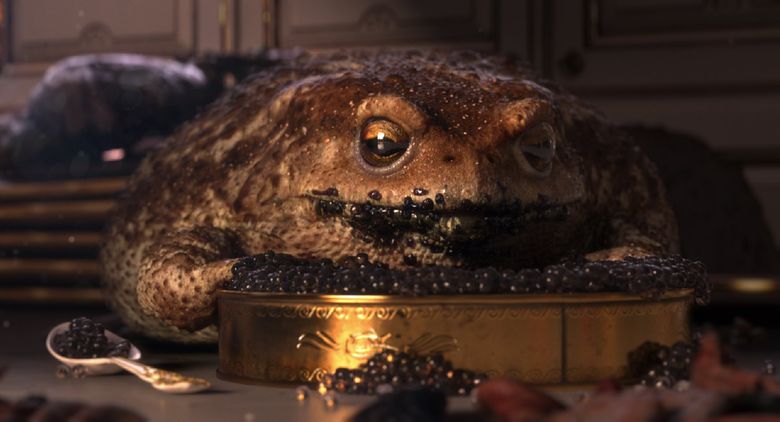
When we move away from the obvious comedy of Revolting Rhymes, we have Garden Party, a pic that is much more subdued and sinister in its humour. It’s a gorgeous, hyper-realistic film, full of lush colours and gaudy scenery. And while Garden Party is a visual banquet, it’s an understated story of macabre undertones, an apprehensive underbelly to the stunning animation. Amphibians from the garden follow their instincts into an extravagant house. A fat toad feasts in a rotting kitchen on multi-coloured macarons. Two frogs find themselves underneath the plush covers of a bed in disarray, and countless croaking creatures lounge about, swimming in the murky depths of a pool. As night falls, the lights come up, the garden is lit with fountains, music, and a terrible twist.

There’s an interesting selection, from realistic CGI frogs to the organic pencil and pastel sketches of basketball players. And while I have my opinions, it’s difficult to predict a winner from the fact that Dear Basketball, Negative Space, Lou, Revolting Rhymes, and Garden Party are pretty much nothing alike.

So catch the Oscar Nominated Shorts at Michigan Theater and other select places before March 4th, and decide for yourself.

Student tickets are $8.

REVIEW: Black Panther

Black Panther is the newest addition to the Marvel Cinematic Universe. The movie takes place after the events of Captain America: Civil War. T’Challa (Chadwick Boseman) returns home to the fictional African country of Wakanda to rule as their new leader. Wakanda is very much separated from the rest of the world and although it is the home the most advanced technology, it is still unknown to anyone outside the country. The Black Panther soon has his new throne challenged and he must face a formidable enemy in order to save his country and their way of life.

The strength of Black Panther is in its characters. Throughout the whole movie there isn’t a single weak character. T’Challa is strong, likeable, and has the ideal characteristics of a leader. The supporting cast, from T’Challa’s genius sister (maybe the new smartest person in the MCU) to his badass posse of women warriors, is so good that they almost outshine him in this movie. Killmonger, the villain in the movie, has one of the most empathetic stories and goals of any villains we have seen in this universe before. His drive and mission are so easy to get behind that it makes his struggle with T’Challa much more high stakes. This makes him incredibly powerful as a villain and makes the movie much more stressful.

Black Panther is also successful in breaking the script from the typical Marvel superhero movie. Now that we are in phase 3 of this series of films in the MCU, we have all gotten a little use to how they introduce new heroes and the struggles they face. This movie was incredibly unique in this sense and didn’t just follow the pattern that was lined up in the movies preceding it. From its world building and villain, to the rap beats and thematic soundtrack, this movie separates itself from the rest of the movies in the MCU.

In my opinion, this is the best first movie for a superhero in this series of Marvel films and is a must-see.

PREVIEW: Black Panther

Most audiences, by this time, don’t need a preview for Black Panther. The movie grossed $202 million in its first weekend alone. It has already surpassed being a mere superhero movie. It has become a celebration of blackness in a medium that has rarely been welcoming of such diversity. For those who have somehow eluded the intensive promotional campaign, the shiny Lexus commercials, and the innumerable think pieces, Black Panther is the newest entry into the Marvel Cinematic Universe. As the Black Panther, T’Challa (Chadwick Boseman) is the protector of Wakanda, a highly advanced country in Africa hidden from the rest of world. However, at the same time, T’Challa has also become the king. Under the double responsibility of these roles, he must face rising threats and decide what is best for his people and his country. Ryan Coogler directs an all-star cast, with standouts such as Michael B. Jordan, Lupita Nyong’o, and Letitia Wright. This film has already undoubtedly changed the film industry with its overwhelming success. I am interested in seeing if it can change an entire genre by transcending its comic book origins. Either way, I am looking forward to a thoroughly fun time at the movies. Black Panther is currently showing in the State Theater. Purchase tickets ($8 for students with ID), online at the Michigan Theater website or at the box office.