REVIEW: Natasha, Pierre & The Great Comet of 1812

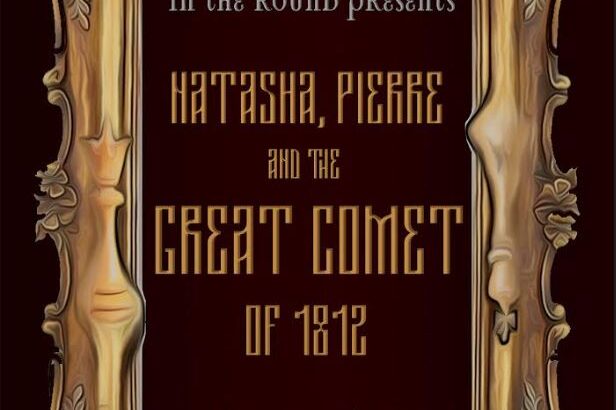
On Sunday Afternoon, I went to the matinee showing of Natasha, Pierre & The Great Comet of 1812. The show was produced by In The Round, an inclusive student theater group on campus. It was in the Arthur Miller Theater, a relatively small venue, but the closeness of the space made all the wonderful performances of the night feel much more personal. Seats were right up against the stage, with some audience members sitting on the edge of the stage itself. Most of the big performances of the night happened in the middle of the room, including the opening number which involved every member of the cast singing and dancing in unison. The actors would sometimes sing directly out into the audience, which made it all the more captivating and engaging. I’ve never seen theater so up close!

The show itself is a self described long and complicated Russian novel, with a laundry list of characters. In The Round provided virtual programs, including a chart (with pictures) of every character in the show and how they’re related. Natasha and Pierre are the two main characters of the play. Natasha is young, in love, and devoted to her fiancé. Pierre, on the other hand, has resigned himself to devoting his life to his studies. A main theme of the play is love, and making the right choices when you’re in the thick of it. Even though the play is based on War and Peace, which was written almost 150 years ago, the things the characters struggle with are similar to a lot of the things young people struggle with today. Falling in love and preserving it, knowing when someone loves you in earnest, and reconciling with people you’ve wronged are all things universal to the human experience, but I found myself relating to the characters way more than I thought I would. Great Comet does a wonderful job of describing these feelings in a way that feels new.

Overall, I’m so glad I went to see Natasha, Pierre & The Great Comet of 1812. The performances of the cast is what stands out to me as one of the most compelling aspects of the show. But the performance by the pit orchestra, the songs sung by the actors, and the inclusion of electronic music in the score, made Great Comet a fun and worthwhile watch, and a great way to spend a Sunday afternoon.


Picture from Michigan Union Ticket Office website 

REVIEW: Imogen Says Nothing

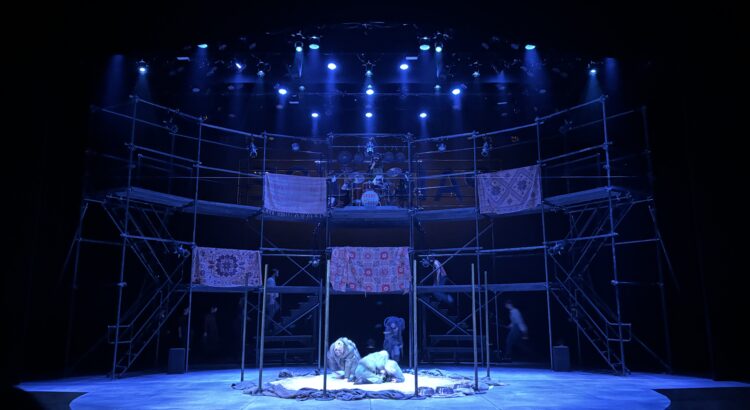
The School of Music, Theater and Dance production of Imogen Says Nothing this past weekend was ferociously compelling. The play, written by Aditi Brennan Kapil, imagines the story of Imogen, a character listed in an early manuscript of Shakespeare’s Much Ado About Nothing who has no voice and appears to be a printing mistake. In Kapil’s absurdist revisionary take, Imogen (Brynn Aaronson) is a bear passing as a human who travels to London to request that her village’s name be restored from “Quaere” to North Burcombe on a map of the Theatre of the Great British Empire. Instead of the mapmaker, Imogen finds the literal theater in which William Shakespeare works. What follows is a creative, satirical critique of the misrepresentation, silence, and absence of marginalized identities in written word. 

My favorite element of the production was Imogen’s unapologetic, fierce presence. Imogen lumbers, she growls, she is blunt and direct and makes demands. In Imogen’s character, I saw the functioning of “pariah femininity,” a term coined by feminist scholar Mimi Schippers: a form of femininity which is constructed in opposition to traditional, “hegemonic femininity” (forms of femininity which uphold the gender order/patriarchy) and characterized by stereotypical forms of masculinity like authority, physicality and non-compliance made reprehensible by their female embodiment. 

Throughout the play, characters repeat the phrase: “It’s a frightful thing, to be absent.”  Many elements bring forward the idea of absence in the play. Quaere, the village Imogen comes from, is a play on the Latin word for query, suggesting that the mapmaker simply neglected to return to the location and find out its name. This brings to the fore the experience of people from lands which are constantly, often intentionally, overlooked, and the importance of being seen. There is an ongoing conversation which picks up in different forms throughout the play, about the tyranny of “ink,” and the significance and permanence of what is laid down in ink. Imogen struggles with William Shakespeare to be eternalized in the script of Much Ado About Nothing for her appearance in the first act of the play. In the end, her friend and client Henry Condell (Rohan Maletira) re-writes Imogen’s name into the play out of a sense of guilt, but as Kapil makes abundantly clear in the final scene of the play, his choice is not the point. Imogen’s subjectivity is the focal point of the play, and she reclaims her personhood (bearhood?) by meting out justice upon the men who tried to erase her. 

REVIEW: Ann Arbor Symphony Orchestra Handel’s Messiah

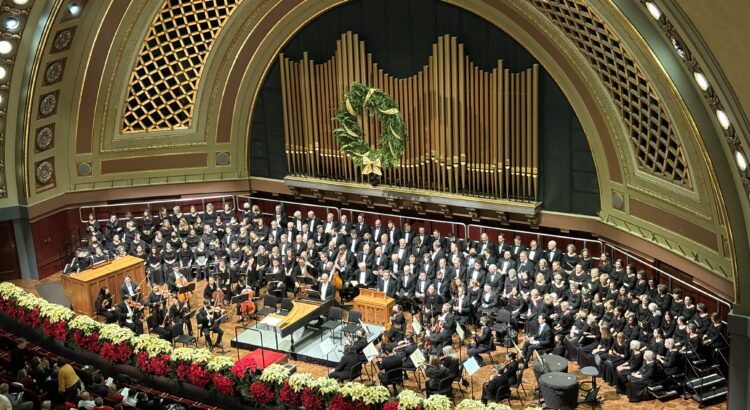
Handel’s Messiah is undoubtedly one of the most well-known choral repertoires, and the Ann Arbor Symphony Orchestra and UMS Choral Union’s performance of it was very lovely. As Handel’s Messiah is a Christmas tradition, there was a bed of red and white flowers circling the stage that was a nice visual addition. It was packed with a large choir accompanied by a small chamber orchestra, which also had a harpsichord and organ.

I enjoyed listening to the harpsichord because it added a playful quality to the music. The harpsichord is the predecessor to the piano but has a string-like quality, so the sound stood out amongst the rest of the instruments. When the organ played it took me aback because of how loud it was, but I loved the heavier atmosphere it layered onto the orchestra. The strings did a really good job recreating the baroque sound, which is much more airy and uses trills to emphasize notes whereas romantic music uses lots of vibrato.

When Hallelujah played, the audience all stood up to sing along, and the singers around me were very talented, perfectly blending in with the choir on stage. My favorite part, though, was the 48th Air which featured a trumpet solo that traded off with the choir soloist. I don’t think I’ve heard a trumpet solo that was unaccompanied before. The trumpet had a very clear bell-like sound that traveled well through the large hall. I was also a big fan of the ending of the Messiah; it immediately captured my attention with the organ’s entrance and had a wonderful buildup that demanded the audience’s attention.

I’m not religious and wanted to attend this event purely for the music. I do think it’s more targeted towards vocalists than instrumentalists, but it was still fun to see a different side of the strings that had that baroque quality since many baroque pieces played now have adapted a more romantic style. It was a super long concert: almost 3 hours long, so I don’t think I’d attend another playing of Handel’s Messiah. However, I’m really glad I had the opportunity to see it live once.

REVIEW: Imogen Says Nothing

Imogen Says Nothing by Aditi Kapil is a spinoff story of the character Imogen in Shakespeare’s Much Ado About Nothing. She’s a character some have interpreted as a typo because she says nothing. However, Kapil turns this character, who serves no purpose in the original, into the main character of a “revisionist comedy in verse and prose” that SMTD describes on their website as a “feminist hijacking of Shakespeare that investigates the voices that have long been absent from the theatrical canon and the consequences of cutting them.” It highlights how women have historically been only seen as an image and deprived of their words. The play not only puts a big emphasis on the power of speech but the power of writing too. 

The premise is a bit confusing: Imogen is a bear disguised as a woman and has been living as a woman for a few years. She travels outside of her small village to the bigger cities and along the way gets dragged onto the stage in the middle of a performance of Much Ado About Nothing. In Elizabethan England, all female characters were played by men because only men were allowed to act. As a result, Imogen has to pretend to be a man playing a woman, and that woman is Imogen herself. In other words, she’s a bear disguised as a woman who pretends to be a man acting out a woman.

It has heavy themes of violence and animal abuse and there are explicit drinking and sex scenes. Furthermore, Imogen is constantly degraded for being female and fat; she even says that her only talent is “whoring”. When she is praised, it’s for her ability to make others laugh but it’s usually because she’s mocked for her background and intelligence. 

Nevertheless, it’s still a comedy and masks the darker content with humor and fun character dynamics. My favorite character was Nicholas Tooley; in the beginning, others always teased him because he was so innocent and pure, but in the end, he was so sassy and dramatic. It was also really funny when there were modern versions of objects on set. For example, for the alcohol they used White Claw, and when checking their contact information they would pull out their cell phones. 

Overall, I highly recommend watching it. It’s a play that’s hard to grasp but fascinating, especially the ending which was the best part. It took a sudden abstract twist that circled back to the underlying message with a single chilling line directed at the audience: “Exit man.” 

REVIEW: Natasha, Pierre & the Great Comet of 1812

In The Round is a student-run theater organization that produces two theatrical productions in an academic year. Last year, the organization produced Mart Crowley’s Boys in the Band and Stephen Stater’s Spring Awakening. This year, In The Round presents the ambitious and timely, Natasha, Pierre, & the Great Comet of 1812. 

NP&TGC is a 2012 electro-opera musical that was adapted from Leo Tolstoy’s War and Peace. It was written by Dave Malloy and won the Tony Award for Best Musical, Book, Score, and Orchestrations in 2012. It features vibrant, eclectic music with sudden shifts reflecting the turbulent situation between the characters and the state of 19th-century Russia. The music was extremely unique, with powerful, sweeping vocal moments and striking EDM-like dance scenes. I adored the creativity and thoughtfulness behind the score.

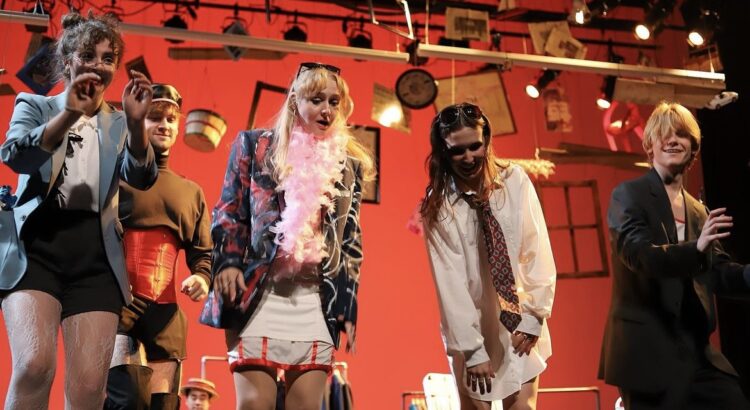
The actors maneuvered through this piece well. There are some incredibly difficult moments in this show that I commend the actors for working through and creating their own. The sustainably sourced costuming was another lovely addition that is appreciated in a time of dire need for increased sustainable options.

This production was performed in the Arthur Miller Theater, a thrust space. Some pictures of the staging/tableaux that were created in scenes were lost to me because of my stage-left seating. From my seat, some events that were happening in the plot were lost because of the dancers or levels the actors were creating. I wondered if my experience would have been different sitting in the upper mezzanine center. Pierre’s ‘home’ in the left-hand corner of the stage was visible to me, and his intentional manic scribblings throughout the musical were a compelling acting choice. Select moments between Anatole and Natasha were visible, and what I could see was beautiful, the two portrayed electric chemistry.

In The Round states that it is an organization “dedicated to queer stories and queer storytellers…we produce performances, relating the themes of our shows to themes of queer culture.” I admire that a theatrical organization is taking the initiative to amplify queer voices, but I seem to have missed the intention behind this production of NP&TGC specifically representing and amplifying an LGBTQ+-based story. There is evident relevance that anything could be a queer story, but I found myself longing for a more direct interpretation of the queerness in the show. I note that this is certainly a point up to interpretation by each audience member.

NP&TGC is an ambitious choice for any theater with its intense level of technical production, difficult musical excerpts, and involved direction. This gripping score is a vocal and emotional challenge and I commend everyone involved for creating this challenging piece of theater. 

Congratulations to everyone involved in Natasha, Pierre & the Great Comet of 1812. In the Round will be performing bare: A Pop Opera next semester March 7th-9th in the Arthur Miller Theater. Auditions will be early next semester. 


Image thanks to In The Round on Instagram. 

REVIEW: Attempts On Her Life

Rude Mechanicals is a student-run theater organization founded in 1996 specializing in producing plays. This semester’s performance of Attempts on Her Life (1997) by Martin Crimp was bold and thought-provoking, an experimental masterpiece of theater. Director Tiara Partsch crafted this perplexing script into a chaotically constructed gem. 

The most fascinating aspect of this show is how there are no named characters in the script. The dialogue exists on its own and remains completely open to interpretation by the director and the creative team. There are no set characters, and there is no plot. The actors exist as thoughts, people, or concepts that are never truly defined. From what I understood, Crimp was emphasizing the deconstruction of theater, focusing on independent facets of a named ‘Anne’ or ‘Anny’s’ life. It’s important to note that Anne is not just a defined person but also a heroine of a film, a porn star, a conversation piece among friends, a car, or a concept. This piece surely demanded lots of attention and open-mindedness from the audience.

At some points, the drama was difficult to navigate as an audience member who is not as seasoned in experimental theater. Although, the originality of the dialogue was clear through the lack of a storyline. Overall, Crimp’s urge to condemn a coherent identity in society through this text was understood. There are beautifully crafted monologues in this piece that were delivered exceptionally by the troupe of actors. Their attention to small details and their meticulous handling of the material were admired by the audience. 

The design for this show was brilliant. The objects hung over the stage were a perfect implication of the abstract nature of the show. I loved the eclectic colors and textures throughout the costumes, while the minimal set pieces did not wash the actors out of the Mendelssohn stage. William Webster was in charge of the scenic design with Ellie Van Engen cultivating the costume design for the show. 

Attempts on Her Life ran December 1-3 at the Lydia Mendelssohn Theater. Next semester, Rude Mechanicals will present Diana Son’s Stop Kiss directed by Reese Leif. The show will perform April 19-21st with auditions mid-semester. 


Images thanks to @UMRUDES on Instagram.