
REVIEW: Gook

Gook is a remarkable film, one that manages to balance both art and emotion. From the eerie beginning of Kamilla, the young black girl, dancing jerkily and strangely in front of what appears to be the burning shoe store, to the end of the movie, Gook is beautiful and poignant. It shifts tones deftly, and will go from making you laugh to inducing rage within seconds without any of that awkwardness one is used to feeling. Furthermore, the film explores the lives of poor Korean-Americans and the strife between their community and the black community whom they share the streets of LA with–in this way, the film already stands out from other films that focus on the lives of those in the ghetto and seeks to tell a story that hasn’t been told before.

Perhaps the film’s greatest strength is its characters. Each character has his or her own set of motives and desires that feel fully fleshed out despite having little if anything to do with the plot (such as one of the brother’s desire to become an R&B singer). None of them are stereotypes, and though viewers are going to be most sympathetic towards the brothers and Kamilla, the “villains” of the movie remain sympathetic, for the film shows how their anger comes from a place of hurt, how no one in this movie has been or will be capable of moving on from an unshown tragedy that happened years before this day, how grief and violence go hand in hand.

Though the movie describes itself as following this set of characters on the day of the Rodney King riots, the riots intersect with the characters only rarely. The drama of the movie is more personal than that. While the riots drone in the background, the characters rush towards their own startling and tragic confrontation, this sort of mirrored image of the riots. To use history in this way is a bold decision–it is easy to make films where the drama lies in a big event that everyone already knows the conclusion of–here, the historical elements are another layer to an already well-made film and not the substance of the story. Still, though the scenes we encounter that have to do with the riots are limited, they are impactful enough that no one would accuse this film as adding them in to give the movie more substance.

It is impossible to talk about Gook without comparing it to last year’s Moonlight. Both are films focusing on race and class matters, adolescence in the ghetto, and both have similar styles in scenes, preferring to hit viewers with dramatic images accompanied by violins, and each work well with their palette of choice. Gook, despite its black and white aesthetic, is probably more approachable for most people–unlike Moonlight, it has a cohesive and limited (the events of the movie occur in one day, instead of over a lifetime) plot and the artistic elements don’t detract from the emotional scenes. Unfortunately, Gook had a limited release and shows no signs of taking off like Moonlight did.


REVIEW: Pigpen Theatre Co.

Singer-songwriter David Luning entered the stage as the opening act. The audience came to a hush and the lights dimmed as he plugged in his acoustic-electric guitar and began picking away gently at the strings. The venue reminded me of The Listening Room Cafe in Nashville, Tennessee with its small stage, intimate lighting, and attentive audience. David stood on stage naturally, tuning his guitar and telling stories. He warmed the audience with his banter and humility. When he began to sing, you could feel the emotion in his voice and recognize the authenticity of his words. The personal stories he would tell between songs brought the audience into his life. He enraptured the audience with his adeptness on the guitar, his compelling voice, and his ability to engage people.

                                 10.20.17

The main act called themselves the Pigpen Theatre Co. and the group consisted of seven men and more instruments than I could count. Growing up, I was never a fan of boy bands. I didn’t have posters of the Jonas Brothers or One Direction on my walls. However, last night I think I learned what it feels like to be a so-called “fangirl.” Pigpen Theatre Co. is exactly what a boy band should look (and sound) like with their flannels, facial hair and folk music. Their harmonies were unparalleled and their musical prowess was inspiring. After each song, the band members would rotate instruments and start up again like it were nothing. They vibed really well with one another and with the music. A few songs into their performance, they all hopped off of the stage and found a place to stand in the middle of the audience. Without microphones or amplification, they brought the show to another level of intimacy. They played a few songs that way, and it felt like we were spectators looking in on their living room rehearsal. Pigpen Theatre Co. was an energetic and incredibly talented band, and I aspire to see them again! To check out their music, visit: http://www.pigpentheatre.com/

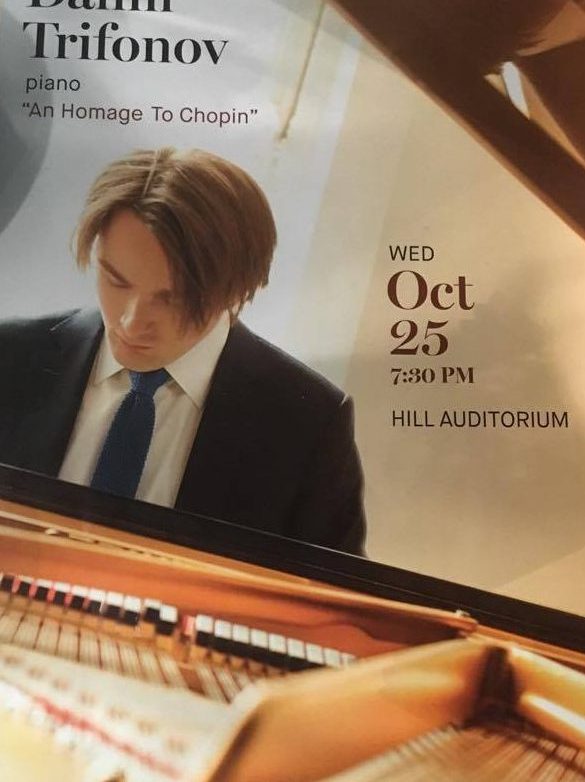
PREVIEW: Daniil Trifonov, piano “An Homage to Chopin”

“He is, no other word, a phenomenon. Like Rachmaninoff, he is both a dazzling pianist and composer.” (The Guardian)

Chopin was a musical genius. The effects of his legacy can be found in the works of Mompou, Schumann, Grief, Samuel Barber, Tchaikovsky, and Rachmaninoff, all of whom are amazing musicians. Now, you can experience all of their music in one breathtaking night.

Six years after winning first prize at the Tchaikovsky and Rubinstein competitions at the age of 20, Daniil Trifonov is set to captivate Hill Auditorium in his UMS debut. Dedicating an entire night of music to Chopin and the works he inspired, Ann Arbor is about to be blown away with music beyond words.

Prepare to be mesmerized by the beauty of both the music and the musician on October 25 at 7:30 PM. Tickets can be purchased on https://ums.org/performance/daniil-trifonov-piano/ or by calling the ticket office at 734-764-2538.

PREVIEW: Blade Runner 2049

Blade Runner 2049 has gotten a lot of hype recently, with critics lauding the lead performances of Harrison Ford and Ryan Gosling. I first became interested in the movie when Ryan Gosling promoted it by hosting SNL, and since then it’s only come up more and more in conversation. Blade Runner 2049 is the follow-up to the 1982 film Blade Runner— thirty-five years have passed and a lot has changed, so it should be very interesting to see how the film responds to the franchise’s preexisting legacy. Most good sequels—of which there are notoriously few in the world—have to find a balance between remaining faithful to the original and taking the franchise in new directions. It should be very exciting to see whether or not Blade Runner 2049 delivers on this.

Blade Runner 2049 is currently showing at the Rave Cinema theater in Ann Arbor, and will be for much of the rest of the season.

REVIEW: Amir ElSaffar’s Rivers of Sound Orchestra

Pretty UMS promotional picture
My view of the orchestra

I came into the auditorium not knowing what to expect. I was excited to watch the show but that was probably because I had never seen an orchestra play live before and I wanted to see what all the hype was about.

At the end of the show, I was definitely hooked. I’m not going to pretend to know how to describe ElSaffar’s musical genius using technical jargon, so instead I’m going to dump this perfectly phrased quote from the UMS performance booklet here.

“The highest ideal in maqam music is to reach a state of tarab, or “musical ecstasy,” which results from the melting away of borders between a notion of self and other, as performers and audience revel together in the music.”

These words are no exaggeration. I SWAM in musical ecstasy. Whatever physical barrier stood between me and the music was washed away by their compositions. Not only was I bopping my head and swishing my body to the music’s rhythm, my body would also act up to the music’s dynamics. Whenever the performance built up a crescendo or when all the performers started to madly improv, my throat would clench, my heartbeat would quicken, and my back would go rigid. I only realized these effects after the performers slowed down, when I started to be aware of my surroundings again. (And the midterm I needed to study for fast.)

In that auditorium, I lost my sense of form: I became a serpent lulled by 17 snake charmers; a marionette pulled by tendrils of tangled rhythms; a grain of sand carried by a roaring river of sound.

Random highlights of the show and some of their recordings:

Jason Adasiewicz playing the vibraphone (like watching the Mad Hatter play the vibraphone)

IMG_6960

Rajna Swaminathan and her mridangam (Whiplash vibes)

IMG_6946

Amir ElSaffar’s trumpet solos (I now see trumpets in a totally different light)

(I forgot to record this part)

Orchestrated madness

IMG_6964

PREVIEW: Ragamala Dance Company

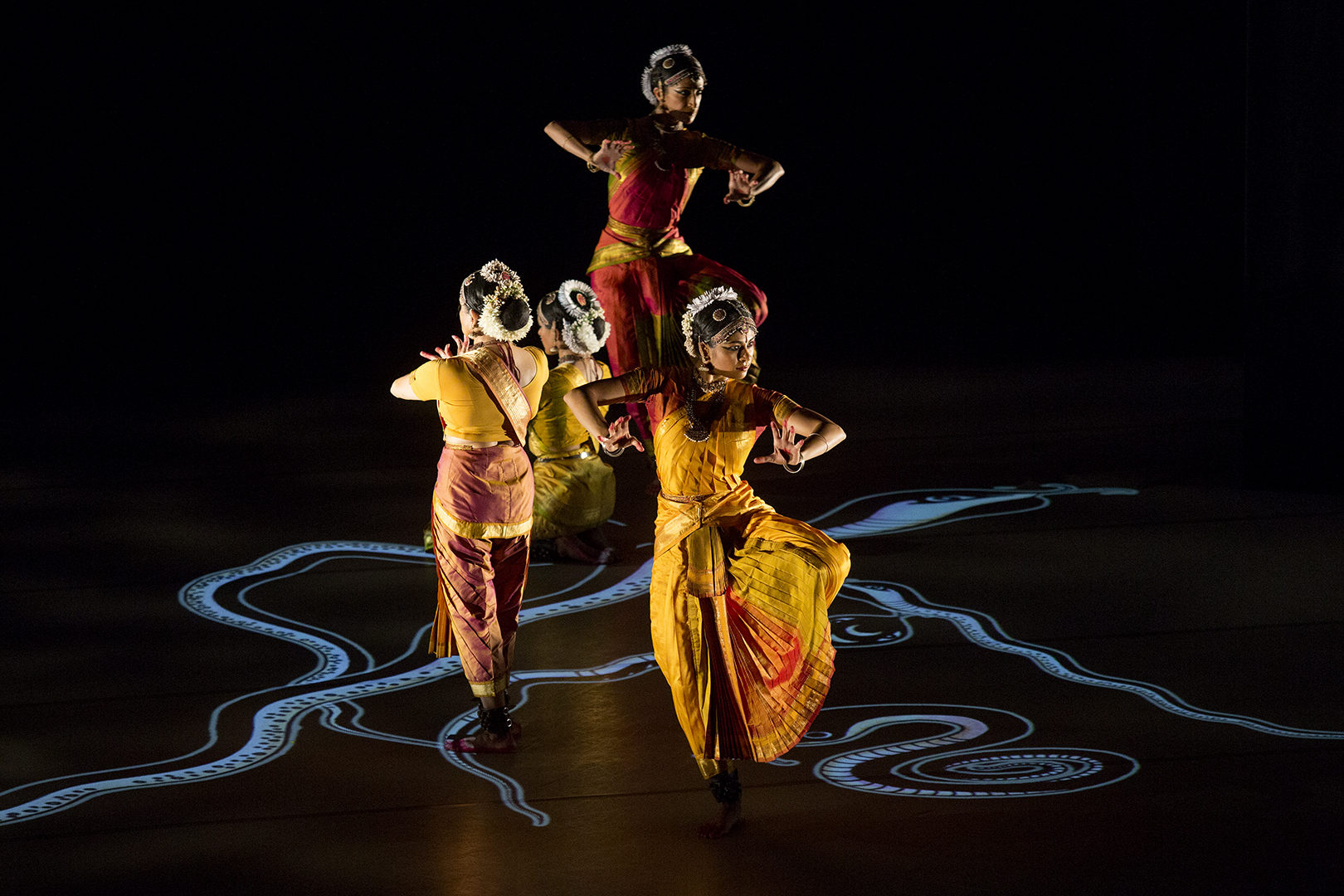
The Ragamala Dance Company is a group that performs the South Indian classical dance bharatanatyam. This performance will be based around the game Paramapadam (from which Snakes and Ladders originated) as well as the 12th-century Persian epic The Conference of the Birds. The board game will be represented by paintings projected on the floor, done by Chennai-based visual artist Keshav. “The live music for Written in Water is composed and performed by Amir ElSaffar, interwoven with original South Indian Carnatic compositions by Prema Ramamurthy” (UMS).

I have never been to a bharatanatyam performance with live music before, and ElSaffar’s music is a really beautiful blend of different styles. Furthermore, the fact that they are blending visual arts, music, and dance is so exciting. I can’t wait to see how they blend those types of art into the Hindu and Sufi traditions that form the context of the performance. The performance is Friday, October 20, at 8pm in the Power Center. Tickets are available at ums.org.

(Photo credit: Bruce Palmer/UMS)