REVIEW: SMTD Jazz Ensembles Concert

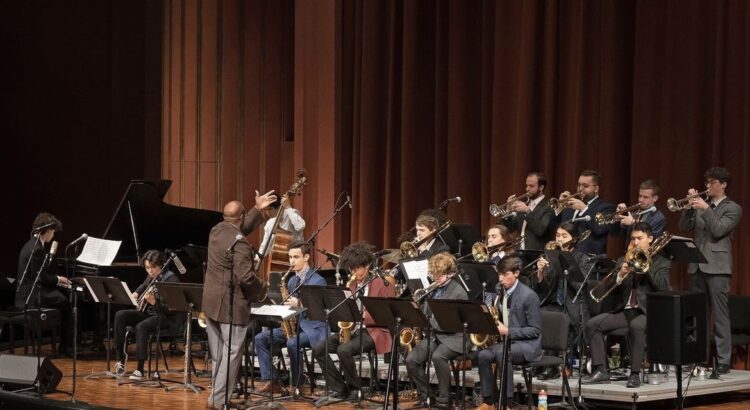
The University of Michigan SMTD jazz bands came together last Thursday night to present a double-bill performance containing early jazz music, student arrangements, and classic big band repertoire. The two ensembles are led by Chris Smith (Early Jazz Ens.) and Dennis Wilson (Jazz Lab Ens.). This musically diverse concert contained a wide spectrum of jazz music.

The first hour and a half of this concert showcased 13 tunes, most of which were transcribed and arranged by Chris Smith, the interim band leader. None of these tunes were written any later than 1929, which intrinsically implies a specific style. The band was sensitive to the ensemble sound and rendered nuanced improvisational solos that supported the style. Two band members from the horn line (Callum Roberts and Houston Patton) lifted their voices in song during the tunes “Mr. Jelly Roll”, and “Six or Seven Times”. The audience adored this unexpected performance.

The Lab Band brought us back for the second half of the concert. The band’s repertoire was developed 10-20+ years later than the early jazz set, bringing a much different sound into the mix. They included two student arrangements: “This Little Light of Mine” arr. by Gavin Ard and “Dinah” arr. by Liam Charron. Both arrangements were equally impressive and enchanting—it’s inspiring to see such polished original student work within SMTD ensembles. 

The Lab Band later featured singer Stephanie Reuning-Scherer on the tune “The Song is You”. Ms. Reuning-Scherer wonderfully adhered to the jazz style and was a satisfying performer to watch. It is wonderful to hear vocalists with the jazz bands continuing the tradition of vocal jazz in community settings. 

The final song of the concert was a world-premiere piece written by director Dennis Wilson, entitled “Rhythms From The Flint Hills”. Additional players joined in, including tablas, bassoon, violin, flute, and electric bass. This was a long and harmonically complex work and offered a unique sound texture that contrasted the music before the concert.

The entirety of the performance allowed the audience to indulge in a historical journey through jazz history, including compositions spanning over 100 years of music.

There are numerous events around campus hosting jazz music. The Blue Bop Jazz Orchestra’s annual holiday concert is on Friday, December 8th at 6 pm in the Michigan League Ballroom. The next concert for the SMTD Jazz Ensemble will be back at Rackham on February 20th at 8p.  


Image thanks to @UMICHSMTD on Instagram.
REVIEW: Gianni Schicchi

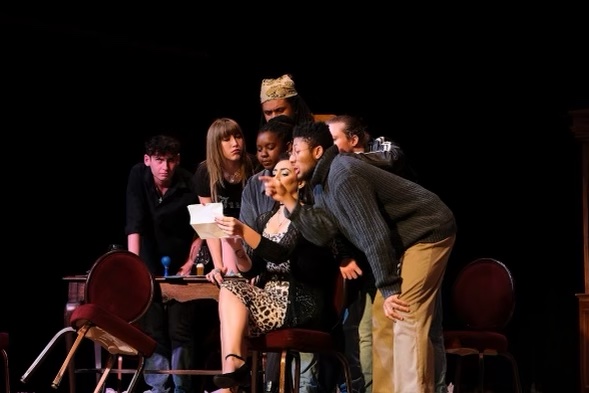
The University of Michigan’s Voice and Opera Department features two fully-staged operas per semester: one large production at the Power Center for Performing Arts and one “Chamber Opera” at the McIntosh Theater in the Earl V. Moore Building. The Chamber Opera is a semester-long commitment that students audition for at the start of the term. This results in a performance of two shows at the end of the semester. This year, the class performed Giacomo Puccini’s Gianni Schicchi (1918) directed by the famous and well-respected Mo Zhou. The show was minimal in production but grand in performance. The show boasted many great triumphs in the often-overlooked realm of Chamber Opera performances at SMTD. 

Gianni Schicchi is a one-act farce that revolves around the scheming family members of the wealthy Buoso Donati. When Buoso dies and leaves behind a substantial inheritance, his relatives are desperate to claim their shares. However, they discover that Buoso has bequeathed his wealth to a monastery. In a clever twist, the family enlists the help of the cunning Gianni Schicchi to impersonate the deceased Buoso and rewrite the will in their favor. The opera explores themes of greed, deception, and the consequences of manipulating legal matters for personal gain. The music follows the trend of Puccini’s rich melodies and clever attention to lyricism. This story sparked Puccini’s writing— implementing challenging and chaotic Italian phrases to match the disorganization of the family. This requires virtuosic singers with immense attention to detail, which was apparent in this production.  

This cast was filled with a variety of ages, from first-year voice majors to the highest level of education for vocal students at SMTD. Each student brought an eclectic, originally developed character into the performance. The characters had clear intentions and balanced the comedy of the opera with virtuosity and vocal integrity. Opera productions do not use microphones, and it remains astounding to me to hear the raw opulence behind these skilled voices. This production reminded me of the balancing act of opera: maintaining masterful singing while implementing physicality and strong acting choices. The cast handled this skillfully, producing a performance that demanded attention from the audience.    

This opera includes the famous aria “O mio babbino caro”, sung by Schicci’s daughter, Lauretta (Cinderella Ksebati). Ms. Ksebati brilliantly maneuvered through the octave leaps and expressively romantic musical lines. Her aria was an unforgettable moment in the show. The avaricious Zita (Aria Minasian) dazzled the audience with her hearty contralto voice—a rare gift to hear onstage. Simone (Xavier Perry) conducted some of the most hilarious and memorable moments in the show. Perry’s attention to detail and capacious vocal quality were well-received by the audience, along with his sensitive comedic timing.

The set design was effective for the minimal space in the McIntosh Theater. The moment the show began, the scene and characters were immediately understood from the set before a thing was said. The crumbled papers, assorted clutter, and vintage furniture informed me of the disorganized and materialistic qualities of the family. The production could have been further enhanced with specific lighting design that was unfortunately unavailable in the McIntosh Theater. 

The successful and admired production of Gianni Schicchi brings the 2023 SMTD Voice and Opera Department productions to a close. Next semester, a 2017 opera entitled Elizabeth Cree will be performed March 21-24 at the Lydia Mendelssohn Theater. 

Aria Minasian (left), Jabari Kacim (center), Xavier Perry (right).


Image thanks to Lydia Qiu with University of Michigan SMTD.

REVIEW: Impulse III: Triple Threat (hosted by: MEMCO, WCBN, & A/SQUARED)

Yay!! Another Memco event! This was their third Impulse event, and it was a collaboration with WCBN (the student radio) and A/Squared (a student fashion and culture magazine). There were two DJs from Detriot, Max Watts and Miguel Cisne, part of the Limited Network, a Hamtramck-based recording label that focuses on Detriot-based techno, echoing the pioneering of the Underground Resistance. The event was at Club Above again, which, as I’ve mentioned in my previous posts about Memco, is my favorite club off campus. There is always ample space for dancing, talking, laughing, playing pool, and more. 

Photography by: Noah Jackson

It is apparent the more I come to Memco events, the more comfortable I feel at them, or rather the less self aware I am. Triple Threat enticed a massive crowd of people to come, and it was easy to get lost in the mass of people. Usually, the thought of this scares me, but going with a group of close friends I feel comfortable with ultimately eases my fear. There weren’t any strobe lights this time, which I was mainly happy about, but I did wish there was more exciting lighting throughout the night–it seemed to stay the same the whole night. I will say if you go to Club Above, it is always fun to wear white because it is glow-in-the-dark there! 

I ended up spending most of the night on the platform with the DJs and speakers, which has taken me a while to build the courage to do so. I guess I felt especially comfortable that night, probably because I knew what to expect (other than the music). If you can’t tell, I am a creature of habit. It is also fun to go to Memco events to see people’s outfits, especially the kids from A/Squared, who have a particular interest in fashion. Although I am not a part of the club, I will say my friends and I love to dress up. It’s nice to look and feel good about yourself, especially as the weather gets colder and finals draw near.

I will say, hands down, my favorite part of the night was watching the crowd dance. Some parents in the back danced without a care in the world. It was sweet. Something about watching the parents dance reminded me of my parents. I sat there admiring their enjoyment in a space heavily dominated by college students. I wished my parents could find some sort of break from work to dance and enjoy themselves. Take themselves a little less seriously and let go of all the tension in their bodies by moving to some quick techno beats. I hope everyone can do this, take themselves less seriously, and dance. I promise when you let go and close your eyes, the music becomes stronger, and your body starts to take control over your brain. You find freedom in that moment, away from school or work, and I may be simplifying one’s problems, but I believe the sentiment remains. Try a Memco event and dance, and let me know how it goes!

REVIEW: Maxim Vengerov with Polina Osetinskaya

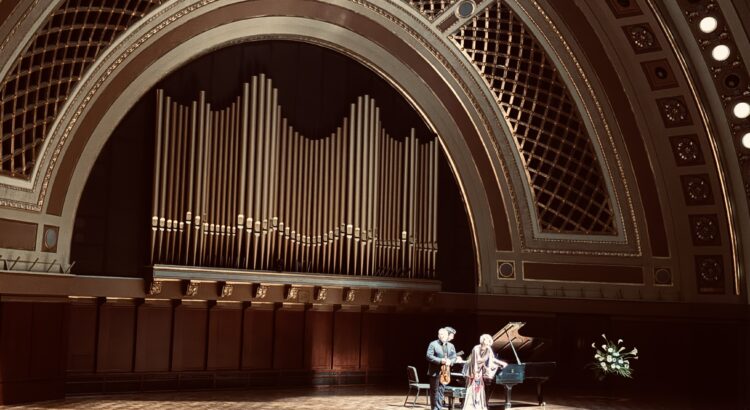
Sunday, November 26th, violinist Maxim Vengerov and pianist Polina Osetinskaya graced Hill Auditorium. It was a full house with a diverse audience, as both of them are world-renowned musicians in high demand. Maxim Vengerov is a Grammy award winner who began his career as a solo violinist when he was just five years old, also the age Polina Osetinskaya began her piano career. With repertoire from four different composers, the music expressed all kinds of emotion, a fitting ambiance for Sunday being the first day of snow and the last day of break.

They opened with Clara Schumann’s Three Romances for Violin and Piano, Op. 22, a bittersweet melody that the piano weaved together and the violin brought to life with a strong vibrato on every note. Vengerov and Osetinskaya balanced each other well by taking turns crescendoing or decrescendoing, neither ever overwhelming the other: it was literally the dynamic of a tug-of-war in love.

The next few pieces, in contrast, were striking and sprightful. Whenever there was pizzicato, a technique where the player strums the strings with their fingers, Vengerov would use his whole arm with flare. With every musical line, he played with a full bow that led to a few passionately broken bow hairs. In general, I was enamored by the skill he handles his bow. A lot of the pieces have spiccato, which is a technique where the bow bounces off of the string, and Vengerov transitions seamlessly between the spiccato and legato. The piano creates a similar dialogue by interchanging staccato (a technique of playing notes short but is fundamentally different from spiccato) and legato too.

Since it was only the two playing, the usually cramped stage looked bizarrely empty. People often talk about stage presence when it comes to dancers and singers, but this pair’s stage presence was enough to fill up the whole space. It’s always exciting whenever famous musicians come to town, and this was my second time seeing Vengerov at Hill Auditorium.

This was their concert program:

Clara Schumann
Three Romances for Violin and Piano, Op. 22

Johannes Brahms
F-A-E Sonata (Scherzo excerpt)

Robert Schumann
Violin Sonata No. 3 in a minor, WoO27

Sergei Prokofiev
Five Melodies for Violin and Piano, Op. 35bis
Violin Sonata No. 2 in D Major, Op. 94bis

 In addition, they included three encore pieces. 

It was a wonderful show and definitely something I recommend classical music lovers attend!

REVIEW: Complete Solo Violin Sonatas of Eugene Ysaÿe Presented by SMTD Violinists

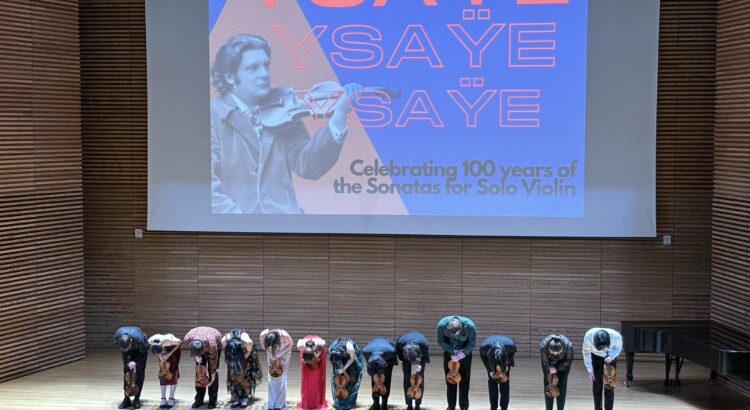
To celebrate the 100th Anniversary of Ysaÿe’s Six Sonatas for the violin, 13 students studying under Professors Danielle Belen, Aaron Berofsky, David Halen, and Fabiola Kim gave an outstanding performance of the complete set on Monday, November 20th in the Stamps Auditorium on North Campus.

The violin is most commonly seen in an orchestra or accompanied by a pianist. Ysaÿe’s sonatas, however, only showcase the violin. His work highlights the raw beauty and power a talented musician can bring out of such a small instrument. The music made full use of what the violin has to offer through double stops, chords, harmonics, and more, all techniques difficult to master because the slightest tilt of the bow or millimeter difference between the fingers can taint the sound. When Professor Belen and Professor Kim opened the event, they said this was a rare performance only made possible because of the talent that SMTD has.

It was my first time listening to Ysaÿe’s sonatas except for a brief video clip I saw of Maxim Vengerov playing a passage in Sonata No. 3 in D minor, “Ballade,” op.27. It’s a gorgeous movement that has a consistent melodic theme with different variations, but unlike Vengerov’s fierce interpretation, the student soloist Yuchen Cao had a much more gentle and relaxed approach, almost as if he were stroking the strings with his bow.

Sonata No. 2 in A minor, op. 27 had a few elements that pleasantly surprised me. In the II movement, Malinconia, the soloist uses a mute, a tool that string players put on the bridge of their instrument to create a fuzzier sound. Similarly, the III movement, Danse des Ombres, began with pizzicato, a technique where the player strums the strings with their fingers. Both were fun and interesting additions that contrasted the heavier or brighter music that violinists tend to emphasize in solo works.

The last act performed by Tianyu Lin simply blew me away. His technique, the vibrato, the intonation, and the tone, were perfect, making his double stops and chords beautifully ring and synchronize. The precision he had when scaling the fingerboard from its lowest to the highest range was flawless. I honestly feel like I was more enamored by his skill and talent than the music.

Symphonies and concertos are all lovely, but it was a nice change of pace to listen to a collection of Sonatas live. I’ve always been aware that the music department at UofM is top-tier, but this event let the individuals who make up the department shine.

REVIEW: Digital Engrams by Gabriela Ruiz

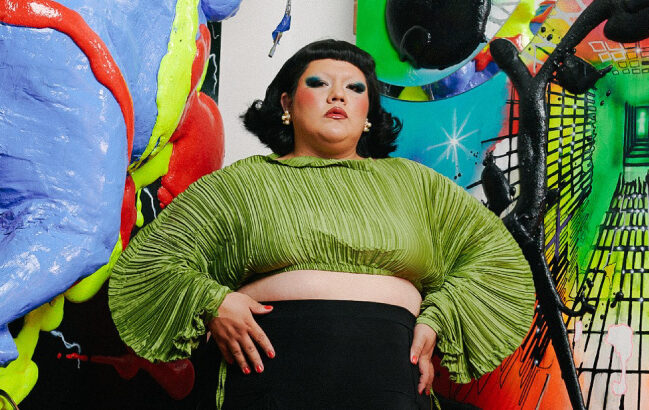
L.A. artist Gabriela Ruiz is a self-taught multimedia artist whose sculptural pieces blur the line between the virtual and the real. I watched Gabriela talk at the Stamps Distinguished Speaker Series earlier this month and I was immediately captivated by her distinctly Gen Z artistic voice. Ruiz is unafraid to confront questions that are still emerging in our culture, such as: what does identity look like for digital natives? Decorated in vibrant colors, lush textures, and a tangle of animated pixels, her art captures the experience of being online, particularly the struggle of navigating memories and identity amidst virtual chaos.

An engram is a trace of memory; a digital engram, then, is a memory stored in an artificial code. Digital Engrams is an exhibition tucked into the Institute for the Humanities Gallery, occupying one beautiful room. Red walls drench the space in color, contrasting against the bright greens and psychedelic lights of Ruiz’ geometric sculptures. Built into and around the sculptures are swirls, soft grassy forms, collages of screens, and interactive audio-visual tools, forming an immersive experience that teeters between the natural and unnatural. Not only is her work multimedia, but it is multidimensional— it is in two, three, and four dimensions, containing everything from time-based media to stationery sculptures. It’s a satisfying installation because of the sheer variety of forms Gabriela Ruiz incorporates into the space.


As I walked around the space, watching the screens’ surreal montages and cryptic messages, I felt immersed in the hypnotism and strangeness of Ruiz’ digital world. The colors, textures, and sounds were overstimulating in a way that was familiar, echoing the feeling of everything happening all at once in digital space. The decontextualized montages and projections lend the exhibition a feeling of absurdity and disorientation. Still, these feelings are overwhelmed by fascination; I resonate with the organic, grassy forms lying near the digital structures because I am always trying to reconcile my “organic” identity with my digital identity; I resonate with the confused chaos and ephemerality of the mosaics of screens, representing moments passed and immediately forgotten but always preserved in a web of data; really, I resonate with Ruiz’ ever-changing sense of belonging in a world of overstimulation and non-stop movement.

My only complaint about this exhibition is that it isn’t bigger— I would have loved to explore an even larger room, a maze full of abstract structures and glitchy footage, as if exploring the depths of Gabriela Ruiz’ mind. I personally believe it is hard to make art about the digital world without the vastness and clutter of it drowning out the meaning; Gabriela Ruiz, on the other hand, approaches the subject beautifully. Her art is abstracted enough to be open-ended, simple enough to be digestible, and just colorful enough to be entrancing without being nauseating. She finds the balance between the tangible and the digital, creating a physical map of a futuristic generational struggle.

Digital Engrams by Gabriela Ruiz is a free exhibition at the Institute for the Humanities Gallery at 202 S. Thayer. It can be seen through December 8th and is open 9-5 on weekdays.