A Dangerous Experiment, apart of U-M’s Bicentennial Semester, follows the college careers of the fictional first class of women at Michigan, beginning in 1871 and concluding in 1875. It tells of their trials, triumphs, and the different paths they choose to take. All the women choose a varying way, emphasizing the factions within one movement. Imbued with school spirit, it took a different form than the usual maize and blue rally cry, acknowledging both the strengths and pitfalls of the University’s history.
As I waited in line for the doors of the Keene Theater to open, I looked around and realized the awaiting audience – including myself – was 95% female. While it was not entirely unexpected, being a play about women, it always strikes me that this seems to be the theme in contemporary culture: if the plot is composed of women, it is likely the audience will too.
Emma McGlashen, a U-M student as well as the writer and director, proved to write a script that featured the female-empowering speeches I want to wake up to and drink my coffee over, steeping myself in the fierce words of other women. The play opened to a stage full of men, unintelligibly rumbling about the future of women – not so different than what our country looks like today. As I talked with my friends over intermission, we had to keep reminding ourselves that this was taking place 150 years ago, butalso only 150 years ago. It sometimes seems as though the extent of our progress surpasses the decade and half timeline, yet the dialogue was simultaneously present and poignant. One of the points emphasized in the play was that these women, fighting for the right to study alongside men at the University of Michigan, were not only fighting for themselves, but for the women who would come after them. The play’s sharp and timely dialogue hit the center of an ongoing injustice against women; the statements were composed of a century-plus discussion without being trite.
Walking out of the theater, I realized that almost three hours had passed, and yet it felt as though we had just begun to hear this history. I suppose I’m just a sucker for any story about women supporting women. Within the main female characters, I saw the same fears and determination of female students I know today. This play only reaffirmed my love for portraying a female-studded history within the arts.
While it confirmed that I have no wish to return to the roots of Michigan, where women are subject to wearing corsets and attending class behind a curtain, I discovered a nostalgia for one aspect of the past: petitioning every male on campus to return to wearing suits and ascots to class. This, though, is a one-sided street; I will continue to wear pants.
If you get the chance, I could not recommend going to see this show more. If you’ve missed both Friday and Saturday nights’ showings, there is one more performance on Sunday afternoon!
Consent. Relationships. Although these two topics occupy a certain space on university campuses, Valentine’s Day makes these subjects more relevant than ever. SAPAC — the sexual assault prevention and awareness center of the University of Michigan — will be addressing these topics through a zine that has compiled student art and written work showcasing these topics. The release party will be celebrating the publication of this zine.
SAPAC has been working all year to compile this zine of artwork and poetry, and is proud to celebrate its release. Come support SAPAC and attend the event! Details are on the image above, but also in text below!
Details When: Monday, February 13th
Time: 7:00 to 9:00PM
Location: North Quad Room 2435
TEDx UofM 2017 was as busy as ever, adding to the disruption part of this year’s theme: Dreamer’s and Disruptors. The army of volunteers running the independent conference have by now created a finely-tuned machine with the perfect mix of emotional roller-coaster, thought-provoking ideas, and blissful entertainment.
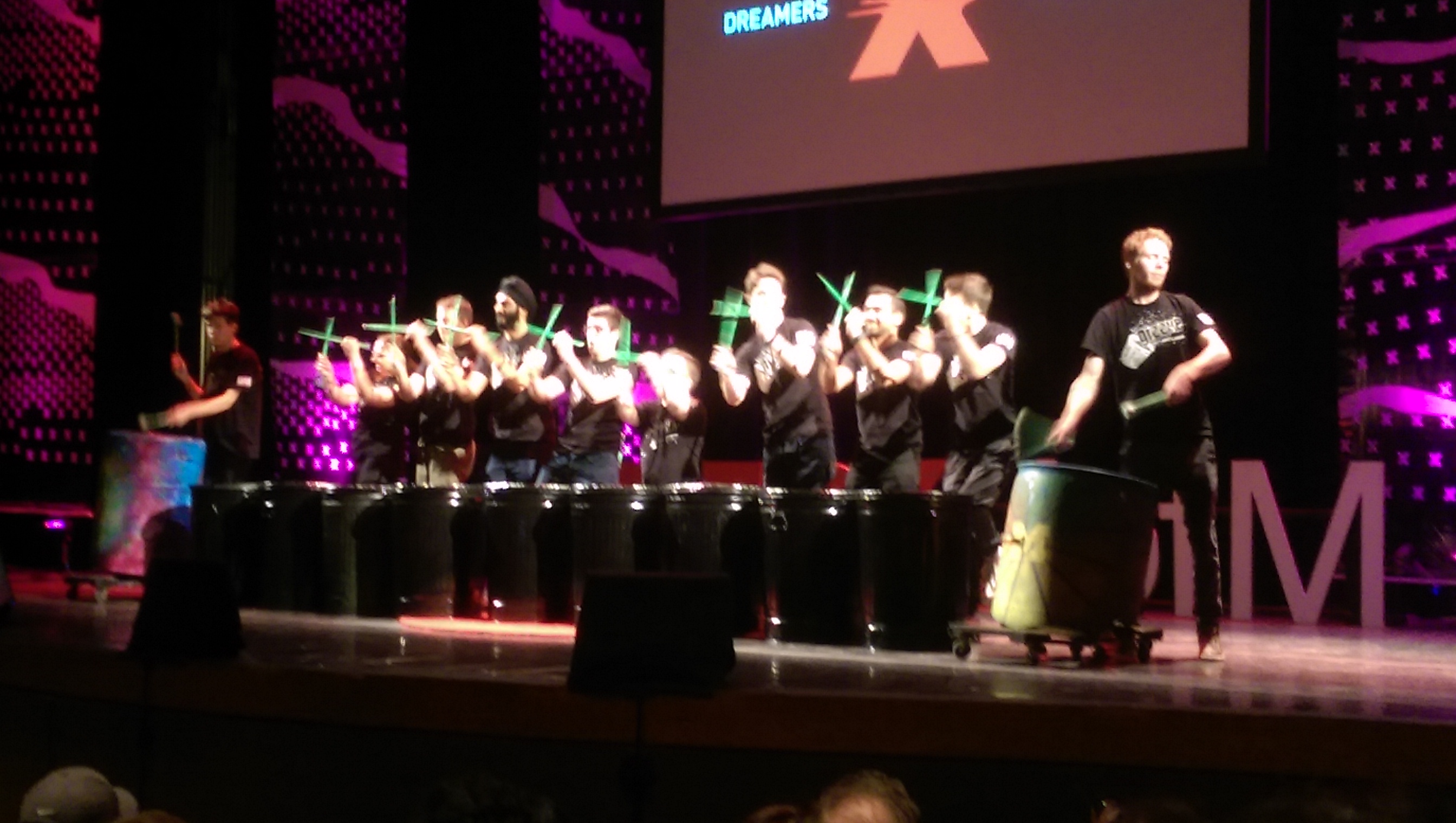
The student group Groove = bliss
A student jazz band played in the minutes before the conference started. Their grooving, polished performance was a reminder that so many students at this university are talented and sound like professionals even before they’ve graduated.
Then the first speaker took the stage. Koen Vanmechelen came all the way from Belgium to talk about chickens. Specifically, about how breeding various species of chickens can be used to teach us important lessons about human nature.
Next was Sophia Brueckner, a brilliant woman who was a preeminent software engineer at Google until she suffered an injury that prevented her from using computers for two years. She argued that we as a society have developed a dichotomy of looking at technology as either a complete disaster, or as completely awesome. Instead, she asserted, we need to approach technology with critical optimism.
Ironically, Sophia Brueckner pointed out that making an app to solve all our problems is a fallacious idea, but the 2017 TEDx prize went to a student that developed an app called FoodFind. Meant for low income families to find free food, you have to wonder how many families can actually afford and use the smartphones that the app runs on.
Caitlin Holman proposed three things we need to learn: autonomy, competency, and belonging. Videogames, she suggested, provide all of this. With that in mind, she founded GradeCraft with the purpose of making learning more “gameful.”
Erika Newman–a pediatric surgeon–talked about both clinical and personal experiences with cancer. She was introduced to the lack of information on neuroblastoma when one of her patients asked her about the disease and she realized how she didn’t have any answers. The only surprise here was that she was having trouble getting funding from the NIH to treat the cancer using DNA repair mechanisms.
Rollie Tussing and the Midwest Territory Band played during the break. Although they were a stereotypical band you’d hear in Ann Arbor (at least one instance of well-manicured beard, a cello, and music reminiscent of vintage records), they were entertaining. Their sound was both stripped down and full, and antique without feeling archaic.
Next was Abdul El-Sayed, the current Executive Director of the Detroit Health
Department. In case that didn’t already tell you what a monumental task that entails, he cited several facts about the city of 600,000+ people such as a life expectancy of 70, an asthma rate of three times that of the rest of the country, and vision and other problems that far surpass the rest of Michigan. His argument was to think about pathophysiology in the social realm so that we can help people prevent health problems from developing. Abdul was also one of the best speakers of the night and I highly recommend watching his talk at least.
Next was Jeffrey Veidlinger, a historian who went to Eastern Europe to interview survivors of the Holocaust as a way of preserving their culture via understanding Yiddish. He challenged the audience to “Ask your loved ones about their life. Ask them about their dreams. Ask them about what they cherish.”
The most heart-wrenching talk of the night came from Scott Matzka, who was a talented athlete and is now a husband and father battling ALS. This is another talk to watch, and to check out his organization MyTurn.
Documentary filmmaker Sophia Kruz was the last speaker of the evening. Showing clips from her latest documentary Little Stones, she showed how sharing individual stories is important, as well as using culture to address problems in society.
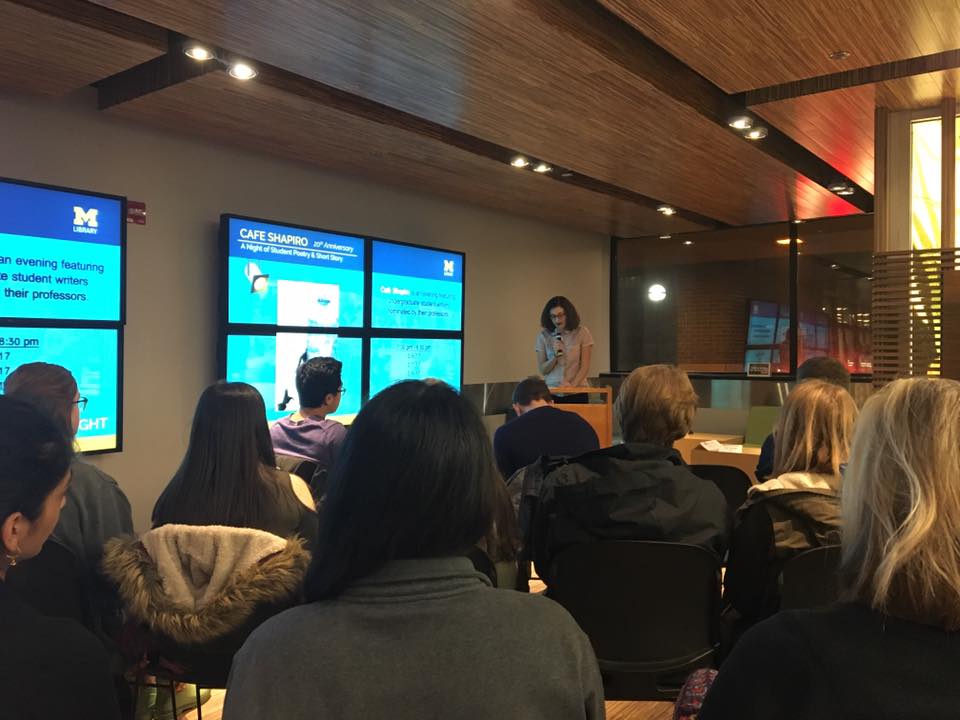
Café Shapiro always inspires the writer in me to go home and create something worth reading in front of an audience. That being said, reading in front of an audience is difficult for me. The director of the event last night made sure we knew that this was the first time some of the authors had ever read in front of a group of people, and that made the experience all the more admirable from where I sat.
My only issue with Café Shapiro was that there wasn’t a collective list of the readers printed anywhere. There are screens in the lobby of the Ugli that alternate from author to author on a slideshow, featuring a picture of them and a bit about their lives. There is not, however, a collective program for the event. From the standpoint of someone looking to write an article about the event, it made the prospect of spelling everyone’s names and catching everyone’s majors a bit daunting.
Despite this, Café Shapiro is definitely a tradition that should continue. Matching the university’s bicentennial with the event’s 20th anniversary was a cool parallel. The director told us at the beginning of the reading that Café Shapiro was originally meant to serve as a “coffee break” for students… before, of course, a café was built in the same lobby.
Laura Dzubay was the first reader, a sophomore majoring in English and one of my friends. She read an excerpt from her short story “Paradise.” It is set in the 1960s and is about a small town about to be bought out by a major company looking to monopolize the town. The story features a group of young people looking for their friend Michael, who went missing a few months back. All of the families were moving away due to job loss, including Michael’s. Some of the dialogue in the story, however, really spoke to me about one’s loyalty to their home (being from a small town myself, I can relate). “‘It’ll poison the air,’ they said. ‘It’ll poison every one of us.'” In spite of this threat, the kids still don’t want to leave their home (or their friend).
“Paradise” also drew attention to the classic nature vs. machine narrative we’re seeing so often nowadays in regards to climate preservation. The story progressed to the kids exploring the forest, traveling so far that the familiar trees seemed “sinister” and “alien.” Even something as familiar as home can suddenly turn hostile with the introduction of the outside world.
Laura Dzubay reading “Paradise”
The second author was Zoya Gurm, an undeclared freshman, reading “Marcy.” It was a story about a girl who was clearly an outcast in society. Marcy was in an uneasy friendship with the narrator, and the narrator’s guilt at their relationship’s lack of substance was apparent when Marcy died. The story detailed the efforts of the community to remember Marcy, if anything “just so [they] could say [they] did.” The romanticism, of sorts, of Marcy’s death echoed, again, my experience with small town life. If something happens to someone in the community, even if we don’t know them that well, the entire town shows their (albeit temporary) support.
Thirdly, Luc Le Pottier, a freshman majoring in physics, read his unfinished, untitled essay. I enjoyed listening to him read just because he was so familiar with his words – it was apparent in his voice. His tone matched the stream-of-conscoius way the narrative was presented. The piece was about the narrator’s experience working as a cook for a restaurant and how he had a different (temporary) perspective about his job there compared to his coworkers (who absolutely needed the job). The author managed to keep the reader in the moment while occasionally interrupting the story to insert an analysis, a talent which I admire for critical writing.
The fourth author was a senior studying biochemistry and English, Pei Hao. He read a series of poems based on Chinese poetry. I’ve never heard poetry in Mandarin before, and I noticed the differences in the rhythm patterns. There was still a distinct rhythm, but it showed up in different ways and inflections than it does in English. The English translations were rich with description but did so without too many words. For instance, “the birds are silent; the people are few,” was a line from one of Hao’s poems that I enjoyed for its tangibility.
After Pei Hao, Josh Mandilk read a piece of fiction titled “You Can’t Drown a Fish.” Mandilk is studying English and health fitness. His delivery was strikingly matter-of-fact despite the sensitive content of his piece. It was about a boy whose brother struggled all his life with drugs and mental health, but detailed how important the brother’s art was to both him and to his family, who suffered along with him. As children, the brothers would act out war scenes and “turn the forest we knew so well into something menacing.” That quote outlines the power of a child’s imagination, and maybe served as a foreshadowing of what was to come.
Alexa Zielinski, a freshman studying psychology, read an essay afterward. The essay was inspired by a They Might Be Giants song, which was an interesting tidbit of backstory. The essay itself was about a father’s struggle with alcoholism, and was written with vivid language and tangible emotion. Zielinski split the essay into parts, and although it caught my attention, it was difficult to follow verbally.
Grace Morris read next, an undeclared freshman. She read both fiction and a poem. Her fiction piece was witty and metaphoric, detailing the narrator’s experience with God in the form of a rabbit. Despite the creativity, I was lost about whether or not God became a rabbit in the progression of the story or if God was the rabbit the whole time and I missed it. Her poem was more whimsical, entitled “Red.”
Bharat Nair read his poetry next. He is a junior in the School of Information. He had a fantastic handle on poetic language, using oxymorons such as “luscious putridity” in a way that made sense. The two poems he read seemed to contrast in tone, which served as a refreshing thing to focus on as a member of the audience but left me confused about how to analyze it.
Tommy Hawthorne, a senior majoring in double bass performance, read more poetry. His poems were clever, using common sayings like “just keep swimming” in an aggressive, mocking way. It was written about octopi… from the perspective of an octopus. Despite that, he glossed everything over with a cute ending: “The coat on my back is yours and I will bend it to whatever color most pleases you.” He read a few more poems, among those were “Sound” and “Silver.”
Lastly, Erez Levin, a senior studying musical arts, read poetry. His tone was playful and reminded me of a narrator for a medieval TV show (for example, Merlin). He did this, however, with a modern twist, claiming at the end of his performance (for it was, truly, more a performance than a reading) that it was all a true story. His humor was an entertaining finale to a good night of literature!
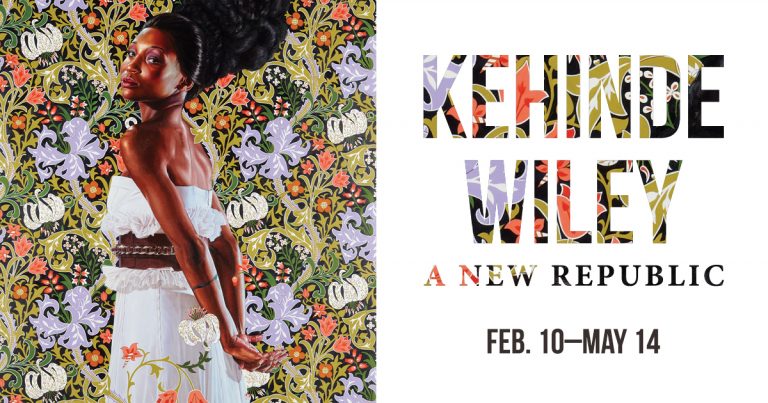
Art Outta Town is headed to the Toledo Museum of Art, an institution will a globally reputable collection, for Kehinde Wiley’s exhibit A New Republic. Wiley’s work draws attention to the lack of African American subjects in historical artwork and narratives. His exhibited pieces feature contemporary men and women modeled after the work of the “old Masters”, whose work heavily featured white European aristocracy. This is but one exhibit currently on display at the Toledo Museum of Art, only an hour from Ann Arbor. The museum houses pieces from almost every continent, ranging from medieval to contemporary works.
Saturday, February 11 / 11am-4pm / $5, Registration required here.
This play takes us back to 1871, to U-M’s first class of female students to enter into the exclusively-male student body. Written and directed by current U-M students, the play is based on both historical and fictional accounts of five female students as they work their way through the world attempting to assert themselves to their male counterparts, faculty, and the city of Ann Arbor itself.
The issue of women in male-dominated spheres remains an issue almost 150 years later. While U-M looks very different today, it’s revealing to look back at its origins to see how far we’ve come, as well as the bounds the University has left to make.
…
February 10 and 11 at 8 pm, and February 12 at 2 pm