Jackie, starring Natalie Portman, gives a unique perspective on the assassination of President JFK. This national tragedy is shown through the eyes and mindset of his wife, the iconic first lady, Jackie Kennedy. The movie follows her through the assassination and its aftermath as she struggles personally; while still portraying herself as strong to the media.
This movie is still showing at Michigan theater until Thursday, February 2nd. Student tickets are priced at $8.
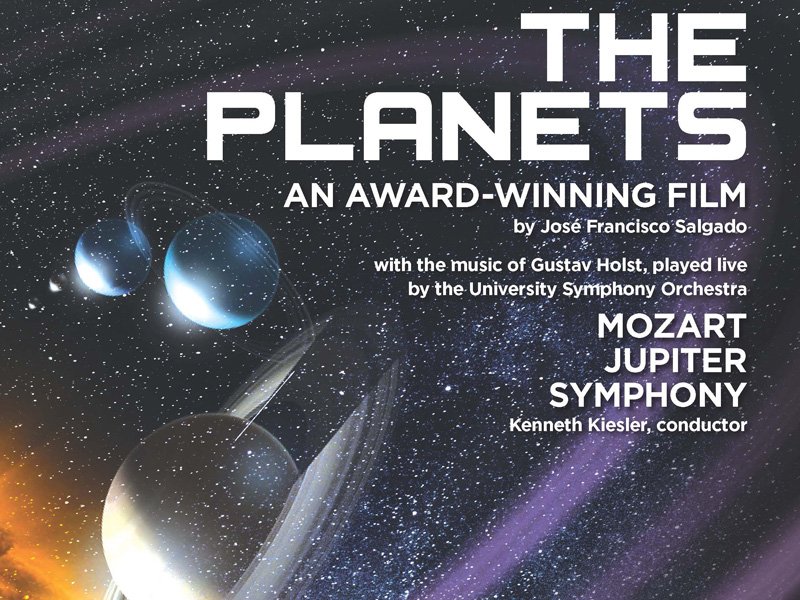
The University Symphony Orchestra, UM’s most selective orchestra, is playing Holst’s “The Planets” and Mozart’s “Jupiter” tonight. I’m a fan of both Holst and Mozart, so I’m excited to go hear their work live in concert for what I think is the first time. I am also intrigued by the fact that this performance will be accompanied by a film made by José Francisco Salgado, an Emmy-nominated artist who explores the connections between art and science in his work. I have never attended a concert with a visual accompaniment before, so I can’t wait to see how the two parts complement each other. I also like the intersection of art and science myself, so I’ll be interested to see what scientific connections and principles make their way into the performance.
The concert is tonight (January 25, 2017), in Hill Auditorium at 8pm. Attendance is free. There will also be a panel discussion with Salgado at 7pm in the lower lobby.
Most likely, the events that took place on April 15, 2013, the day of the Boston Marathon Bombing, are still relatively fresh in your head. This act of terror and its aftermath were broadcasted widely to the public at the time. However, the investigation behind the bombing is not too well known. Patriot’s Day (in theaters now) tells this story; the story of the bombing and the investigation that ensued in midst of the aftermath. Besides the fictional main character played by Boston native, Mark Wahlberg, the movie’s story is very accurate to the real events. If you are at all interested with these events or the investigation behind it, then I would suggest seeing the movie.
Patriot’s Day is currently showing at theaters all around Ann Arbor and student tickets are $8.50
My high school English teacher once said that if you want to convince someone to care about a certain thing, defensive argument never does the job. The best way to convince another person that something matters, he said, is to sing an ode to the thing.
That’s how I would best describe “On Behalf of Nature” (notice how it isn’t called “In Defense of Nature”): it is a work that praises the fundamental elements of our existence. By expertly weaving together unique vocalization techniques, fluid dance movements, and instrumental music, Meredith Monk and her ensemble successfully reimagined essential human experiences using their bodies as instruments: capturing emotions like the hypnotic power of fascination, the joy of working together, the frustrations of learning to communicate one’s desires, and the serene beauty of being with a loved one.
Ms. Monk composed all of the music for this 75-minute work, in addition to directing, choreographing, and performing in it. Nothing about the piece was obtrusive or aggressive. It was clearly not meant to force an agenda on its audience. It would’ve been difficult for it to do so even if that were the creator’s intention–no words were ever spoken or sung for the entire 75-minute work. Many moments came across as improvised, because they sounded and seemed as natural as they would have been difficult to coordinate perfectly. Like the natural world, many elements of the piece seemed simple on the surface, but were teeming with complexity underneath. Meredith and her ensemble have worked together for years, which was made evident by the coordination of body and mind that they achieved.
The instrumentation was completely unique. One ensemble member played keyboard, violin, and french horn; another played a variety of woodwind instruments; and the percussionist constantly switched between vibraphone, marimba, and an odd collection of cymbals, sticks, pans, and other objects that helped create shimmering textures. The instrumentalists played off to the right side of the stage, and were boxed in on two sides by the marimba and keyboards, but this setup did not prevent them from taking part in the vocalization and dances that took place onstage. They moved fluidly between their roles as musicians and dancers, sometimes bringing their instruments out to center stage with them. The ensemble was also accompanied by electronic textures that blended incredibly well with the live textures created onstage.
The set was minimal––the stage was bare, save two strips of white cloth flooring material that stretched across upstage and downstage, and the instrumental ensemble setup on the right side of the stage. This would come as no surprise to one who was familiar with Monk’s other pieces––she tends to make minimalist design choices in order to draw the audience’s attention to the music and movement. Because Monk’s goal was to create an art piece that wasted little money or materials, she had her costume designer create the cast’s outfits from their own clothing. Shirts became quilt-like coats, dress shirts became skirts, and the mismatching patterns somehow created a muted, earthy tone overall.
There was constant activity onstage, but it never felt overwhelming. There was always something to look at, but the work did not come across as showy or flashy. It was well-paced, balancing tender scenes with joyful ones, and progressing gradually between the two moods. The piece overall seemed to embody a living organism. It breathed. It sang. It wept. It danced.
The thing I enjoyed most about the work was that the composer in me was constantly wondering where each sound was coming from. One moment, the ensemble would be playing and singing something live, and the next you would discover that they had been seamlessly replaced by a pre-recorded track; the vocal textures often sounded like a synthesizer, or had the warm quality of a woodwind instrument, electronic drone textures crept in unnoticed––it was a delightful experience to be continuously proven wrong about what I assumed was going on underneath everything.
The collage-like arrangement of scenes and music in this piece reminded me of a hand-stitched quilt––every element of the work, while it may have seemed disconnected or strange at first, was lovingly hand-selected and crafted into a beautiful covering of love for the world it portrayed.
After the performance, one of my friends shared with me that within hours of being inaugurated, our nation’s 45th president removed “climate change” from the White House website. It was disorienting for me to receive it at first––Monk succeeded in creating a completely new world, as she said she tries to do with every work, and this world was so pleasingly simple, innocent, and natural-feeling that this information served as a rude awakening. As a recipient of the National Medal of Arts from President Obama, Meredith Monk is a living, breathing example of the impact artists can make in the world. “On Behalf of Nature” invites the audience to experience empathy, which is one of the most powerful forces for peace in existence. That’s why art gives me hope.
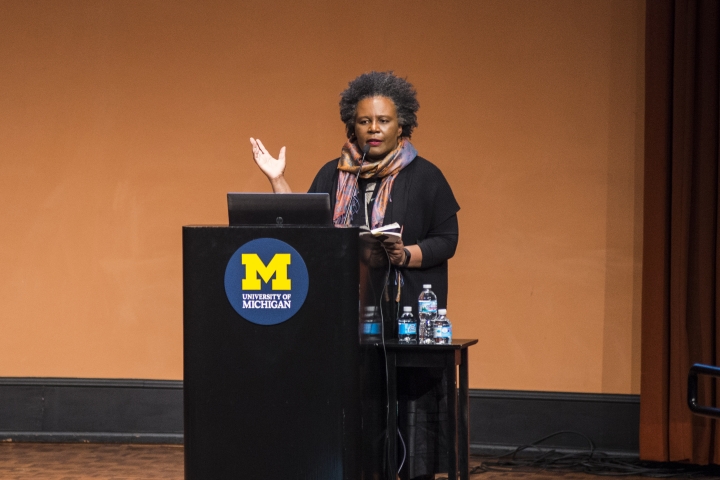
Rackham Auditorium was nearly a full house for Claudia Rankine’s reading/lecture. She was introduced by a professor, who gave a wonderful recount of Rankine’s work, along with the state of race relations in America. On Rankine’s Citizen, which focuses on various incidents which might be described as “microagressions,” the professor commented that “the way racism structures our world, there is nothing micro about it.” This combinatorial discussion of both Rankine’s work and racism would be the status quo for the rest of the talk.
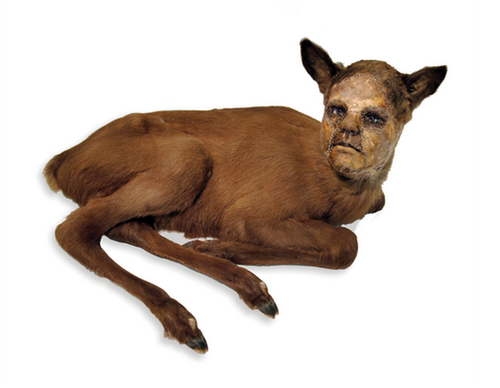
With images of Citizen projected behind her, Claudia Rankine began her talk. It consisted of readings interspersed with discussions about why she chose to do this or why she used this image or who this artist is. The audience got a feel for not only what the work consisted of, but how it came to be.
When she read, she sounded as if her voice was reaching out from the void, as if there was a great distance between her and you. It was like listening to someone speak from a underwater cave. By all means, it was fascinating simply to listen to listlessly–doubly fascinating when you considered the words she was speaking. She read a few sections from Citizen, which is made up of stories and anecdotes, some hers, some stolen, about being black in America. The end of one of these vignettes, which described her driving while her passenger said some offensive things, struck me as particularly beautiful: “it is also that you have a destination that doesn’t include acting like this moment isn’t inhabitable, hasn’t happened before, and the before isn’t a part of the now as the night darkens and the time shortens between where we are and where we are going.”
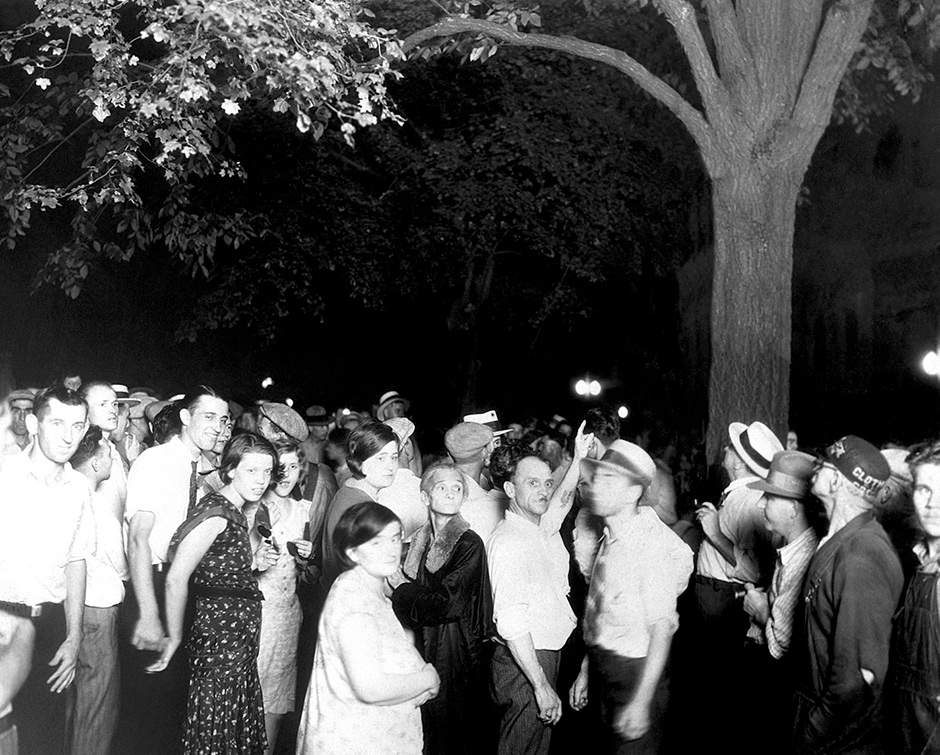
One of the more interesting stories she told about how the artwork in her book ended up there was the story of the image depicted above. If you do not recognize it, this is an edited photograph and in the original, several black men were hanging from the tree. When Claudia Rankine first attempted to use the photo, she found the process not as easy as for other historical photos. The owners of the photograph do not allow for it to be republished and distributed just to anyone out of fear that those people will use it to condone lynchings. So, Rankine had to call them up and explain to them that she was not a white supremacist, and after some back and forth, they let her use the image. Then, when she called back to ask if her she could edit the photograph to take out the black bodies, they agreed readily–to them, the black men hanging were the sight, the point of the photo, but to Rankine, it was the white people gathered beneath that are the real sight. It is the celebration of death, not the death itself, which makes this image so awful.
To end her lecture, Rankine played this video (note: contains graphic imagery).
The movie opens with a traffic jam on an L.A. highway which quickly turns into a song and dance performed by those stuck in the traffic, before settling quietly on our two main characters as they also wait in this traffic. This kind of grand outburst, followed by relative normality is the modus operandi for the film. Like most musicals, this singing is not commented upon, but otherwise, La La Land is not like most musicals.
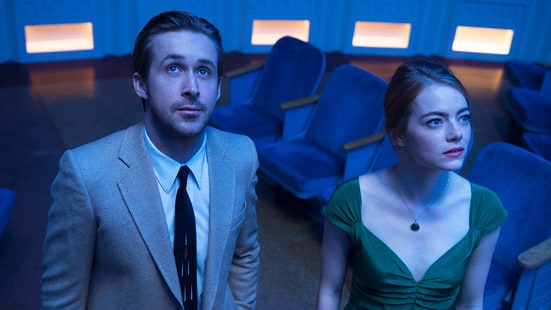
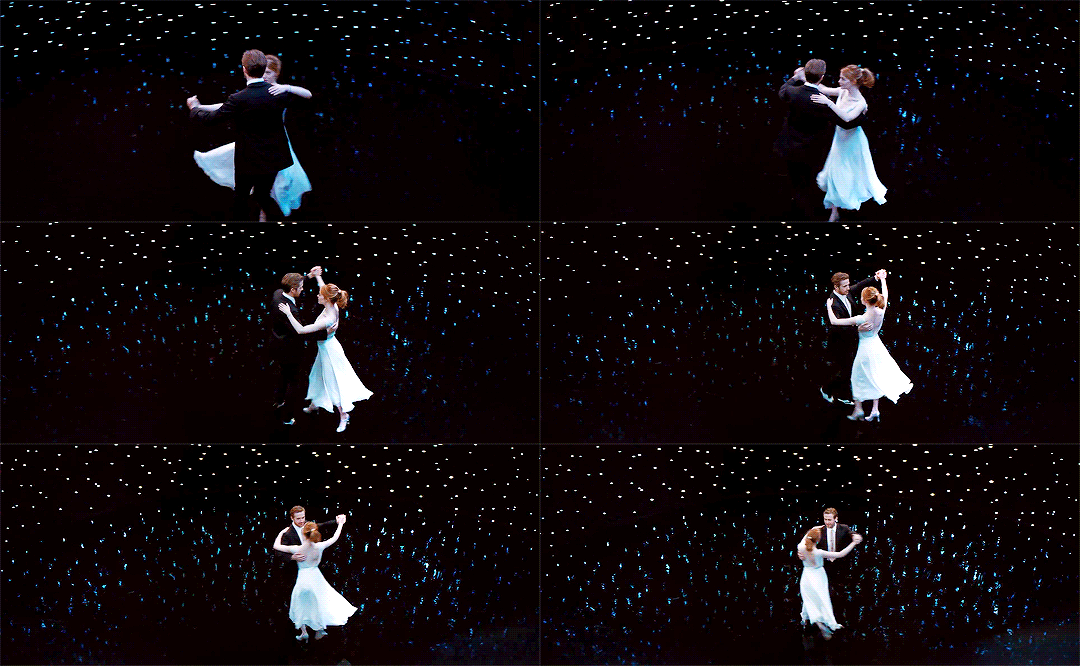
Everything is vibrant. Every outfit is a color that pops. Every setting is swathed in bold hues. Nothing in this movie is ever dull. It can be harsh on the retinas–they don’t get a break for two hours–but otherwise this color madness works to La La Land‘s advantage. One of the great strengths of the film is how it manages to portray emotions not as some inner, personal machinations of the mind, but outside the body and into the world. In the first half of the film, what we see is how falling love feels. And though Ryan Gosling and Emma Stone’s acting is stupendous, the great, sweeping emotions of the film are portrayed in great, sweeping gestures. There is nothing subtle, nothing quiet about this work. It is like listening to a lovely scream for two hours straight.
But while wonderful to watch, this lack of moments where viewers can take a moment to breathe, to digest can leave us feeling overwhelmed. Worse, it can leave us feeling unattached to these characters. We are not a part of what is happening. This movie exists outside us, outside of our reality, in a world that plays by different rulebook. We are disconnected from it. This is Hollywood reality–this is where two people with big dreams can fall in love and continue to pursue, continue to work for their passions. The hopelessness of such pursuit never fully sets in, never becomes the main focus of the film. Though we might see Emma Stone crying about how she’s not sure she’s good enough to make it, we can only shake our heads and think Emma, you’ve already made it. It’s a movie about love and it’s a movie about dreams, but most of all, it’s a movie about Hollywood, and in true Hollywood fashion, this fact supersedes the rest. Ultimately, this film is a love letter to Hollywood…from Hollywood.
Your own reception of the film will probably depend on how much of a romantic you are. If you have fallen in love, truly fallen, or at least dream of such things, then you might find yourself swept along with the madness. If you haven’t, then well, be prepared to find yourself standing outside the hype.
The movie will continue to play at the Michigan Theater. Student tickets are $8.