REVIEW: Beethoven’s Mass in C Major

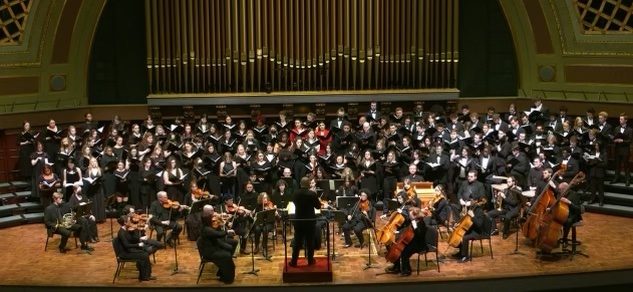
The evening of November 16th at Hill Auditorium allowed for a beautiful night of music from the University of Michigan’s SMTD Choirs. University Choir, Orpheus Singers, and Chamber Choir dazzled audiences with Beethoven’s Mass in C major, Op 86. This performance was conducted by Eugene Rogers and featured many soloists from the chorus.

The majority of this was performed by the Chamber Choir, with additional support from Orpheus Singers and the University Choir joining during grandiose moments. The Chamber Choir is the most advanced choir at the University, featuring some of the best singers in Ann Arbor. [From smtd.umich.edu] “The Chamber Choir performs 6-8 concerts annually in both Hill Auditorium and in special settings, such as the University of Michigan Museum of Art (UMMA), and is often featured at high profile U-M special events. The Chamber Choir has been featured on GRAMMY-winning and GRAMMY-nominated albums; sung with the Detroit and Ann Arbor Symphony Orchestras; performed at conventions of the ACDA and NCCO; and has toured internationally. They perform standard, classical, and contemporary choral works and often perform commissioned works in world premieres.” They remain a high-profile collegiate choir with free concerts throughout the year! 

The orchestra that played this evening with the choir was lovely. A full choir performing with an orchestra is always a treat—the sound was unmatched. The combined choirs emit a mighty sound, with well over 100 singers from the music school present.  I appreciated the sound provided by the space in Hill Auditorium—it was properly fitting for the group. The blend was well-balanced from the balcony, and I received most of the Latin diction throughout. The work sounded regal in its orchestration, which was fitting for the period and intention.

I’d like to name each soloist from the mass to commend them for fantastic work: Tyler Middleton (MM 25), Amante Pando Girard (BM 24), Juliet Schleffer (MM 24), Amber Rogers (MM 25), Bryan Ijames (DMA Choral Conducting), Jabari Lewis (MM Vocal Performance 25), Genevieve Welsh (MM Choral Conducting 24), Pelagia Pamel (BM Voice 24). Each voice dazzled through the orchestra’s texture, presenting a nuanced sound to the traditional work. I admired their preparation and stamina throughout the performance!

I appreciate Dr. Roger’s thoughtful selections for the choirs, I always find them appropriate and culturally educational. This performance wraps up the 2023 season for the SMTD Choirs. They will be back in January performing at The School of Music, Theater, and Dance’s biggest event of the year, Collage. This will take place on January 20th at 8 pm, in the historic Hill Auditorium. This annual concert is a showcase of all the brilliant work throughout SMTD. It is a “collage” of the music student’s “collage” experience, if you will. It is a highly anticipated event throughout the community and often attracts over 3000 audience members. Get your tickets early!


Image thanks to The University of Michigan’s SMTD Livestream. 
REVIEW: The Inspired Show

Every fall semester, Kappa Phi Lambda Sorority, Inc. hosts the Inspired Show; this year it was on Saturday, November 11th from 4-6 PM at the Ross Robertson Auditorium. On Instagram (@umichkpl), the sorority said this event “seeks to showcase a variety of cultural performances, mixing modern and traditional elements to bring Michigan exposure to various Asian performing arts,” which it certainly did.

There were 8 performances. In order they were:

Female Gayo (@femalegayo)

Photonix (@umphotonix)

Kappa Phi Lambda Sorority, Inc. (@umichkpl)

DB3 (@db3_umich)

Seoul Juice (@seouljuice.umich)

VeryUs (@veryus.umich)

Revolution (@revolutionyoyo)

Moli (@moli.umich)

K-Motion (@kmotion)

I’ve watched and reviewed the majority of these groups before, many of which performed at Celebrasia. However, although the Inspired Show was only a week later, Female Gayo had a completely new set that ended with an original choreography they made to the song Money by Lisa from Blackpink and had the fun addition of shooting dollar bills into the air at the end.

Photonix is a crowd favorite and I wish I got to see more of them. They use glow-in-the-dark items to create rhythmic visual art by manipulating neon lights to music in pitch blackness. Much of the choreography involves teamwork, which is super impressive since the team must work together without being able to see. My favorite parts are when they hit the floor to change colors on a beat drop. Unfortunately, I couldn’t capture their performance well enough on camera, so take the chance to see them in person if you can!

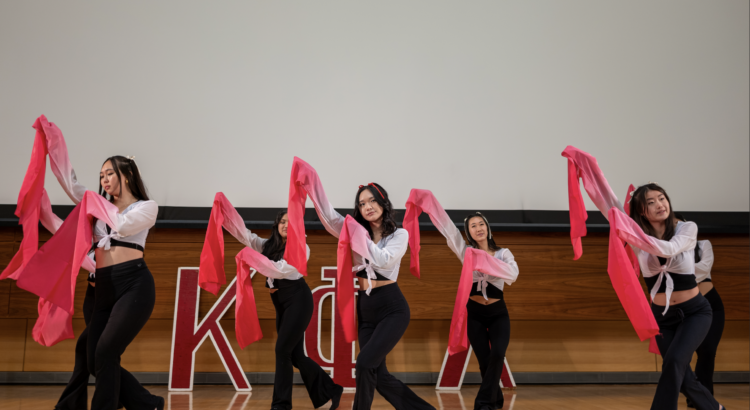
I saw the sisters of Kappa Phi Lambda perform at the Yardshow, but they prepared two additional choreographies for their event: hip-hop and cultural. Their cultural dance is pictured above and it was the highlight of the show for me. Many groups use fans or umbrellas as props, but it was the first time I’ve seen the beautiful white and red long sleeves they wore. In addition, the music they used was purely instrumental, which was a nice contrast to the other music throughout the show. It truly felt like a cultural dance rather than a dance that just uses cultural props.

The Ross Robertson Auditorium is a nice venue; the only thing I wish is that the lighting had a spotlight on the stage to give it a more immersive atmosphere. Nevertheless, it was nice being in a new and comfortable environment.

Although there are a lot of parallels to Celebrasia, I recommend attending the Inspired Show. It’s a good opportunity to see different performers, such as Photonix and Moli, and new choreographies like Female Gayo’s. All proceeds are donated to the Ann Arbor Community Center, so you can make a difference and have fun at the same time.

REVIEW: Father Who Art in Heaven; Jason Cianciulli’s MFA Culminating Thesis

“Father Who Art in Heaven” was Jason Cianciulli’s culminating senior MFA thesis. As both a student at the University and a grad student professor, I’ve watched Jason grow and worked with them over the past two years. They work with many physical theater practices as well as floor work and partnering–needless to say; their movement is extremely experimental and paves the way for the upcoming generation of dancers. I find his work especially interesting because of the merging of styles and genres, highlighting theater work, dance, music, and the visual arts. 

What distinguishes Jason’s work from other dance works, is its innovation and commitment to fusing styles and genres. With a dark and mysterious undertone, the piece began with dancer Ruby Clay, sitting at a table alone, moving extremely slowly. An otherworldly lighting bathed her body from a strategically placed television and showcased the depth of the space. The curtains were set up in a way I had never seen before; it looked like the stage was cut into a “U” shape. Although showcased only at the beginning and the end, her character stayed on stage the entire time, sitting emotionless. As subtle as it was, her addition became one of my favorite parts of the piece. 

Photography by: Kirk Donaldson

Two senior acting majors, Jack Weaver and Molly Felsher, had a couple-like relationship on stage with a sort of disdain toward one another. Their relationship added complexity to the narrative and paved the way for the overall tone. Although their acting was extremely interesting to the work, the moving of the curtains and the changing of the lighting really captivated me. Smaller curtains were seamlessly pulled on and off stage to take away, change, or add characters on the stage that set entirely new environments in the same stage space. Rather than blacking out the space, the curtains served as a continuation of the dance but altered it simultaneously. I have never seen this before in a dance performance! Jason created new shapes on the stage instead of the “normal” stage set-up that utilized the theater’s physical capabilities, unlike previous dance works I’ve seen at the University. Needless to say, I am inspired! 

Photography by: Kirk Donaldson

There were two figures with large black cloaks with a ring at the bottom and large old people masks. Because of the circular bottom, it appeared as if the figures were floating, which, again, was an interesting way to play with fabric and movement in space, that I have yet to see at the University. The two figures kiss at one point, which seemed quite absurd in the moment but in the best polarizing way possible. They remove their masks and dance with the other cast members toward the end. There was an incredible stage fighting scene with red lighting covering half the space and a strobe light section from the television with dancers moving throughout it, looking like they were traveling through space and time in real-life stop-motion animation. Again, it is extremely inspiring and innovative. 

Jason presented themself as a really intriguing figure with long fingers and an extremely pale appearance. At one point, they hid in a small box under the television (which I didn’t see happen) and crawled out like it was magic!! Clearly, playing with the audience’s focus/attention and keeping the audience on their toes. Jason uses the word “decay” when describing this piece, which is the perfect illustration of the work. I watched people decay over time, in relation to one another and alone. It was a beautiful performance art, and I hope Jason continues to show this work–as I don’t feel it is the end of it! Or I hope not, at least…

Photography by: Kirk Donaldson

REVIEW: Heathers: The Musical

MUSKET’s production of Murphy and O’Keefe’s Heathers took place at the Power Center for the Performing Arts this past weekend. MUSKET impressively holds the title of the oldest and largest student-run theater troupe on campus. They produce one fully staged and orchestrated musical each semester with an entirely student-led cast, crew, and production team. It serves as an essential platform for non-musical theater majors to participate in musical theater, offering endless opportunities for leadership, production, and performance to university students.

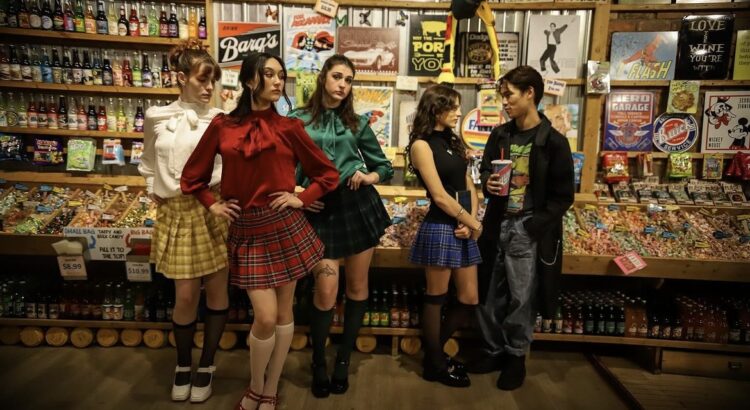
I observed several standout aspects of this performance. Firstly, the costume design (by Katy Sanchez) was beautifully crafted, immediately conveying the identities of the characters to the audience. The costumes adhered to the expected classic “Heathers” outfits, featuring heavy pumps, short skirts, and the distinctive red, green, yellow, and blue colors defining each character. Katy honored the original looks while bringing her flare into the mix.  

Secondly, the jocks, played by Ram Sweeney (Dylan Bernstein) and Kurt Kelly (Sohil Apte), had me chuckling at their scenes throughout the show. I appreciated their physicality, and even from my seat towards the back of the house, I could pick up their movements very well. Sohil, wrapping up his third production with the troupe, has become a frequent MUSKET actor.

Additionally, the dance numbers were an exciting aspect of the show, with choreography by Marcus Byers Jr and assistant Kate Player. The numbers were bright and intentionally crafted for the scene, adding significantly to the storytelling rather than existing as a mere spectacle. At times, the choreography compromised good vocal quality, but overall the actors handled this well. 

“Dead Gay Son” stood out as my favorite number in the show. It brought a blazing burst of energy immediately after intermission, and a bleak ending to Act I. The crowd responded accordingly to this excitement. Kurt’s Dad (Evan Hoefer) and Ram’s Dad (Zoltan Berensci) hysterically and passionately committed to the campiness of the scene.

Music direction was led by Madeline Nolen, and the band featured 7 players. This pit was mighty for the minimal orchestration in the score. They played together well—this score is not easy for anyone! Likewise, Madeline conducted with passion and kept the ship running smoothly. The vocal harmonies dazzled in select moments, and some other times were a tad uncoordinated, possibly due to the stuffy mics.  

The licensed version of Heathers is the official West End version, which differs slightly from what I usually remember in a production of Heathers. Some songs in this revised edition felt superfluous to the plot, and some songs were removed or changed from the original Broadway version. Because of this, the pacing suffered a bit. However, I understand the tricky nature of navigating changing dark and often insensitive themes while trying to convey an aggressive message on mental health awareness through the music.


Image thanks to @UMMUSKET on Instagram. 

REVIEW: The Silence of the Lambs

Every so often, the Michigan or State Theater will screen a classic— last Thursday, it was The Silence of the Lambs, the quintessential 1991 psychological horror, directed by Jonathan Demme and starring Jodie Foster and Anthony Hopkins. I went into the screening without any expectations, knowing only that the film involved a cannibalistic serial killer fittingly named Hannibal and I could probably expect gore. The horror was done incredibly well, but the genius of The Silence of the Lambs is that the gore and terror of murder were only a fraction of the film’s emotional appeal. Demme fills each scene with the psychological unease of reality as the story follows an FBI trainee, Clarice, who is constantly shown to be looked down upon or disrespected because she is a woman. The script declares this outright with creepy remarks from higher-ups and even from Hannibal himself, but this is also accomplished with careful framing: throughout the movie, close-ups force us to stare into the eyes of men as Clarice sees them, hauntingly blank or grotesquely hungry, eyes either pointing condescendingly down at the camera or unnervingly straight into our own. Clarice is often alone, often being hit on or disregarded by serial killers and FBI agents alike, and cannot avoid it despite her skillful maneuvering of misogynistic encounters. This inspires a very real fear rooted in our awareness of her vulnerability. We’re quick to doubt the intentions of the film’s men— which is where the character of Hannibal becomes complicated, who should be the easiest to distrust.

Clarice and Hannibal are expertly crafted, and their relationship keeps us on our toes. Close-ups of Hannibal, played perfectly by Anthony Hopkins, reveal his sunken features, his icy and unblinking stare, and the sense that every word is part of a secret, sinister plan; close-ups of Clarice reveal unwavering confidence and sly intelligence. The interrogation scenes between the two are laden with tension and electricity, the investigation unfolding to be double-sided as Hannibal and Clarice race to break each other down. As the film progresses, this relationship becomes tangled and unclear; despite being the most clearly deranged and untrustable character, Hannibal treats Clarice with more respect and curiosity than the rest of her peers. The psychological horror of the film lives largely in this relationship as we struggle to decode Hannibal’s intentions and predict his next move.

The Silence of the Lambs is evenly polished: the score is haunting but not overbearing, each scene is intentional, and moments of crude humor balance the gore. I can see how this film earned so many awards and became a classic— it has a cinematic simplicity familiar to the 90s, attaining the perfect balance of explaining some while leaving some to the imagination. Besides the more fast-paced third act, our fear relies on insinuations about what happened or what’s going to happen, close shots of corpses and bloody nail marks down a wall. The only point of the film that left a sour taste in my mouth was the film’s handling of Buffalo Bill, a serial killer who believes he is transgender and who multiple characters claim isn’t truly transgender, but rather psychologically confused and tormented on a more complex level. As much as Buffalo Bill is distanced from the transgender community, described as obsessed with transformation and envious destruction rather than conventions of gender, his portrayal aligns too closely with common stereotypes about transgender women being deceitful predators. The social commentary is fitting for the time of its release, and it is nuanced, but given this film’s insane popularity, it’s inevitable that some audiences would fit this portrayal into pre-existing biases and fail to critically analyze the character.

I loved the experience of watching this movie for the first time in a small theater; the audience was visibly excited, gasping at gory shots and laughing at absurd one-liners. The big screen amplified the intensity of close-ups and the architecture of the old theater amplified the nostalgia of the early 90s. Keep your eyes peeled for the next screening of a cult classic in downtown Ann Arbor, and keep a weekend night open so you can catch one; student tickets are only $8.50!

REVIEW: Heathers the Musical

Pictured from left to right: Emelia Hughey as Heather McNamara, Bianca Garfinkle as Heather Chandler, and Lila Harris as Heather Duke taken from Musket’s Instagram (@ummusket)

On November 10th, the University of Michigan’s student-led organization, Musket, put on its opening night performance of Heathers: the Musical. The musical follows Veronica Sawyer (played by Kaylin Gines) as she navigates her senior year as a part of Westerburg High School’s class of 1989 while trying to avoid the titular Heathers, the cruel popular girls of the school. Heather McNamara (Emelia Hughey), Heather Duke (Lila Harris), and the queen bee Heather Chandler (Bianca Garfinkle) make high school a living hell for the other students including Veronica and her best friend Martha Dunstock (Ellie Omori-Sampson). Along with the Heathers, Kurt Kelly (Sohil Apte) and Ram Sweeny (Dylan Bernstein) torment them with their inflated jock egos. It’s not until Veronica becomes a Heather herself and meets JD (Aaron Syi) do her plans of a quiet senior year under the radar go awry.

Heathers: the Musical satirizes the high school experience, portraying it as a battlefield of hostile personalities. It describes high school as a mimicry of the outside world with all of the hierarchies of adult society, posing the question of why childhood had to transform into this. Themes of gun violence, sexual violence, suicide, and grief of loss pervade the story, understanding that, here, the perils and dangers of adult society are inseparably coupled with the insecurity, longing, and anxiety of coming of age. As Kate Ivanov, the director of the musical, puts it in the Director’s Note, “there is a constant need to change, fit in, and be loved and accepted for who you are, when you don’t know who you are yet.”

The production itself is masterfully crafted in the Power Center’s proscenium stage. The set remains simple yet dynamic, always portraying Westerburg High, comprising a catwalk with two movable staircases that lead up to it. Still, in scenes that weren’t set in Westerburg High, there were parts of the set that were present that helped immersion while not detracting from the immersion of other scenes, including the gas station for “Freeze Your Brain” and the pier for “Kindergarden Boyfriend”. This use of the set, by not having any major set changes, streamlined the viewing experience and made it easy to follow the constant stimulation that the musical provides. The catwalk also gives good visual symbolism whenever the Heathers, but especially Heather Chandler, enters, demanding attention to their presence through the fact they are physically and socially above everyone else.

This experience wouldn’t be possible without the amazing performances from each of the actors as well. The way that the Heathers seem like one indomitable unit with their synchronization make the play as they set the tone of power hierarchy to which all of the play centers around, especially in “Candy Store”. Chandler especially commands her presence showcases devotion to the precision of her character work as in every scene she’s in she steals the show with her attitude and poise. When they eventually break off too the actors play faithfully to each of their individual characters’ emanating their respective traits: Duke’s envy and conniving nature  shown through “Never Shut Up Again” and McNamara’s dumbness that gets deepened by the anxiety and vulnerability she shows in “Lifeboat”.

Kurt and Ram play their parts well as the comedic relief, their energy was outstanding, while still showing their ignorance and ego as almost perpetrators of sexual violence in “You’re Welcome” where they really expressed the childish entitlement they felt to sexual favors. Martha, although not playing the largest role in the play, stood out as not only someone with fantastic heart but an exceedingly impressive vocalist (I’m pretty sure “Kindergarden Boyfriend” held the largest applause of the night).

Of course, the leads Veronica and JD were the stars of the show, faithfully executing their characters to a caliber that exemplified the quality of their performance. As the leading lady, Veronica was intelligent and contemplative, executing the larger themes of the musical with ease and immersion. JD was a contemplative character that showed all the warning signs of his unhinged nature, yet the audience can’t help but fall in love with him the same way that Veronica does. They certainly complemented each other with several musical numbers that showed their exceptional vocal performance such as in “Dead Girl Walking”, “Our Love is God”, and “Seventeen” which I especially enjoyed.

Still, each of the members clearly showcased their love of the show of which I noticed their exceeding amounts of energy and the small details they implemented helped the immersion into the world of Sherwood, Ohio. Additionally, to provide a special shoutout, the production couldn’t had reached as high as it did without the performance of the pit orchestra. The score was excellently executed with each of the musical motifs highlighting each and every scene, not just with the musical numbers.

With my experience, I was overall blown away by the sheer skill, energy, and love of the show the cast had. The musical was comedic yet contemplative, energetic and fun yet satirical, tonally all over the place yet being able to ground itself when it needed to. Quality-wise, it was almost like watching an off-broadway production, and to think that Musket is a student-led organization speaks to the amount of time, skill, and effort it took to put out such a performance. I would definitely recommend to keep the productions UofM’s Musket in one’s mind if one wants to see great performances.