REVIEW: The 25th Annual Putnam County Spelling Bee

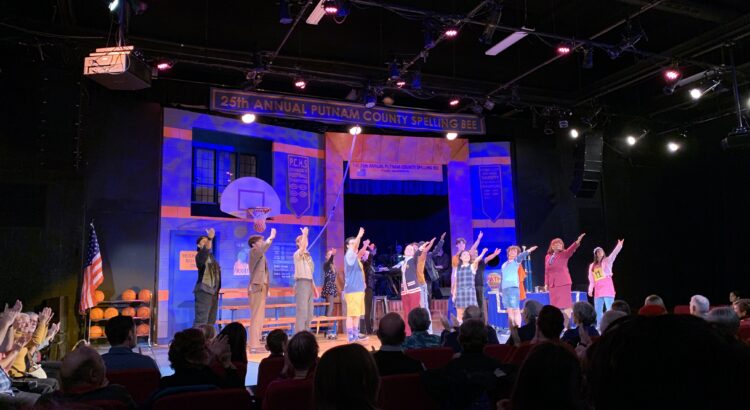
SMTD’s performance of The 25th Annual Putnam County Spelling Bee was so good: it was immersive, hilarious, and well put together. It sounds like it’d be a wholesome musical since the main characters are children but to my surprise, it wasn’t child-friendly at all. The script made use of sexual innuendos, exaggerated stereotypes, and religious satire to crack jokes. The audience, me included, ate it up. As described on the SMTD website, it truly is a musical that “charms audiences with effortless wit and humor, making the Bee one unforgettable experience”.

One part of the experience I loved was how they included the viewers in the spelling bee and gave each of them fun and quirky personas, such as “being raised by wolves” and having “denim as their favorite color”. The actors looked so natural when interacting with the audience members that it took me a bit to realize it wasn’t staged. If the participants spelled their given word wrong, they were escorted off the stage with a juice box and were serenaded with the song Goodbye that poked fun at their failure in the bee. The funniest part was when to proceed with the plot, it became time to kick the surviving participants off the stage by challenging them with ridiculous words. Despite their efforts though, one of them actually managed to spell something incomprehensible from a Scottish dialect, shocking everyone. The actors did a great job of improvising by calling her back to the microphone and giving her another word, which this time she failed to spell. As a reward for being the last one standing though, she got her own special rendition of Goodbye sung to her. 

The characters that stood out to me the most were William Barfée, a snotty (quite literally) nerd, Logainne Schwartzy, a girl with a heart of gold, and Leaf Coneybear, who for some reason always had to spell the names of South American rodents. However, my favorite character was actually Vice Principal Douglas Panch. The actor did such a good job of portraying the classic slightly odd and suspicious adult figures I remember from my own elementary school days. Although these characters left the biggest impression on me, I genuinely loved everybody because they all had so much personality to them.

An inconvenience though is that it took place at The Encore Musical Theatre Company, a performance venue in Dexter that’s an eighteen-minute drive from central campus. Once I got there though, I realized how big of a role the stage set-up and background played in really bringing this musical to life. Most importantly when performing Pandemonium, a song and dance that really showcased the crazy and wild side of children. They were running around, jumping on tables, spinning seats, and even hanging from the basketball hoop. 

This was truly a musical I’m so lucky to have seen, and I highly recommend others to see it if given the opportunity!

REVIEW: The 7th Annual Multicultural Yardshow

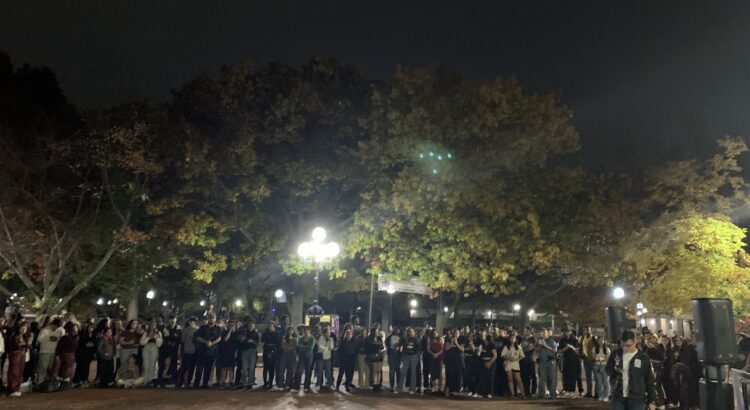
At 8:06 PM on Friday, October 27th, the Imperial Zeta Chapter of the Sigma Lambda Beta International Fraternity, Inc. hosted their 7th Annual Multicultural Yardshow in the Diag featuring eight multicultural Greek organizations:

Lambda Theta Alpha Latin Sorority, Inc.

Lambda Theta Phi Latin Fraternity, Inc.

Delta Tau Lambda Sorority, Inc.

Phi Iota Alpha Fraternity, Inc.

Kappa Phi Lambda Sorority, Inc.

Chi Upsilon Sigma National Latin Sorority, Inc.

Sigma Lambda Gamma National Sorority, Inc.

Sigma Lambda Beta International Fraternity, Inc.

I was super excited to see this year’s performance because I attended last year’s Yardshow as well. Similar to the 6th Annual Multicultural Yardshow, the crowd was enthusiastically supportive of each group and that’s what truly separates the Yardshow from other showcases. Because this event places a strong emphasis on expressing and having pride in one’s background and culture, there was a diverse selection of music. I was unfamiliar with most of the songs but that didn’t take away any of the enjoyment; I appreciated getting to explore new genres of music and sharing the experience with others. What brought the various communities together and incited the most cheers was when the groups incorporated elements of a stroll into their choreographies. 

Strolling is a dance form that was created by the National Pan-Hellenic Council (NPHC), also known as the Divine 9 (the nine historically Black fraternities and sororities who are a part of the NPHC). The Multicultural Greek organizations also practice strolls as a way to pay homage to the NPHC who paved the way for ethnic minorities to start their own Greek organizations. Movements in a stroll are meant to represent the Greek letters in their fraternity or sorority’s name; for example, sharp diagonal arms may represent the Greek letter kappa. It’s often hard to pick up on what dance moves count as part of a stroll as well as what Greek letter they signify, but one way to tell is if the audience suddenly goes wild. A key part of a stroll that’s easy to identify is when the performers start to dance synchronously in a line and circle the stage. This part is heavily influenced by African-American culture and African roots to show power and unity against racism. 

Some of the organizations practice salutes instead of strolls. Similarly, salutes are performed in a line but instead of dancing, they chant together. It’s a powerful form to watch since they synchronize their speech in a fierce yet poetic manner, expressing the history and passion they have for their sisters or brothers through not only words but strong movements. Being in sync is extremely important since the members are very close to each other, making it much more obvious to tell if someone is out of rhythm. Each group nailed it and I was super impressed by how much hard work they must have put in to accomplish that.  

Overall it was a great event featuring groups, music, and forms of art I couldn’t see anywhere else. 

REVIEW: The Holdovers

There was no better way to spend my afternoon like catching the Sunday matinee of a film I have had on my mind ever since I saw a trailer for it this past summer – an early screening of Alexander Payne’s latest film “The Holdovers.”  An apparently highly anticipated screening, as the Michigan Theater was practically swarmed with Ann Arbor-ites of all ages, passionately discussing the ins and outs of their virtuous presumptions. Afterwards, it was difficult to say if their expectations were met – but surely, smiles of perhaps off-duty professors and trend-outfitted undergrads had endured.  And for me, as I left the theater, I left the film inside.  There was no lingering impression that was tied to me, which is infrequently my experience after an Alexander Payne film, but there was an inexplicable warmth that carried through the theater. Ultimately, this overdrawn, meandering, melancholic comedy is made lovable, in part, by touching performances and tender moments, if frustratingly fleeting. 

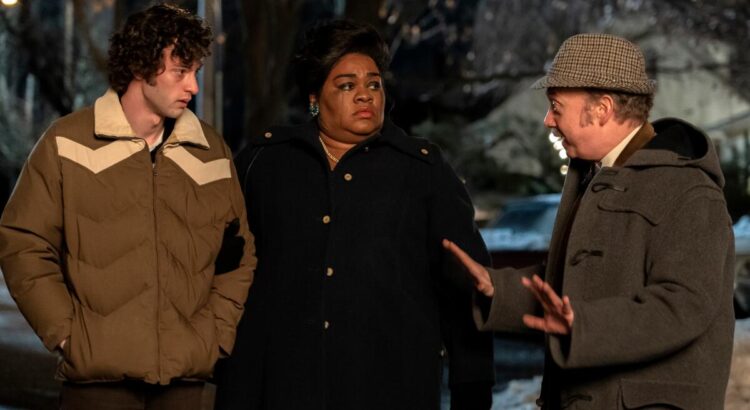
In the film’s opening, Payne situates us in the snowy outskirts of 1970s Massachusetts, our plot following a whiskey-drinking, fish-smelling, scrooge of a classics teacher, Paul Hunham (Paul Giamatti, “Billions,” “Sideways”) at Barton prep school, who is forced to watch over the students who have nowhere to go for Christmas.  Soon, we see our main group of students disassemble – departing via parent-dispatched helicopter – except for an irreverent and awkward junior, Angus (Dominic Sessa.) Leaving Mr. Hunham, Angus, and the school cook, Mary (Da’Vine Joy Randolph,“High Fidelity,” “Only Murders in the Building.”) The three form a makeshift family, bonding through mealtime small talk, clandestine excursions, and ritualistic midnight-viewings of the “Newly Weds” game show.  As their bond tightens, so begins the unraveling intricacies of their own stifled grief – and the solace they find in one another’s company. 

Visually, the film brings a warm, saturated flare to a muted, wintery landscape that envelops the rigid collegiate architecture – and could be easily mistaken for the Law Quad, come January.  And our eyes savor the composition of every long-held, establishing shot, each tempting the bound between effortless realism and dreamlike uniformity – a very Wes Anderson-esque framework. But this aesthetic isn’t contained in these few scenes, instead it remains a lingering presence in the air – just as tangible as the actors breathing it in.  Embedded with true 1970s visual stylings, the film is riddled with covert film flickering, wide zoom outs and ins, making the viewer feel like they are in the middle of a “Columbo” episode. This stylistic undertaking of recreating that “70s look” in modern films is often its own character – giving into gimmickry and performativity.  Yet Payne manages to distill the sweet oddities of the distinctive 1970s cinematography into an illusive, atmospheric mood. 

And while this film’s clear aesthetic certainly builds an intimacy with viewers, the script doesn’t necessarily.  “The Holdovers” at its core, is a film about the impermanence of youth and the grief that accompanies its passing – and this is where it shines – however briefly. 

For example, we have Mr. Hunham who is at a standstill in his life; working for the school that he attended in his youth, and under the command of one of his previous students.  And despite his hard exterior, he softens – sheepishly sharing and diminishing his dreams of writing a monograph.  In a later scene, he and Angus run into a former classmate of his at Harvard.  During their interaction, we see Mr. Hunham lie through his teeth about his employment and accomplishments, keying in the audience to what he dreamed his life could have been.  Arguably, Mr. Hunham is simultaneously the most wretched, but also the most developed and sympathetic character in the film. This is, in part, ascribable to Paul Giamatti’s wonderfully evocative performance.  Sincerely, the best role I have seen him in, thus far – and an undoubted Oscar-nominee.  And speaking of Oscar worthy performances, it would be remiss not to discuss the force that is Da’Vine Joy Randolph’s evocative portrayal of Mary – whose warmth is palpable and was often the perpetrator of the laughter in the audience. In Mary’s case, she is grieving the loss of her son who had previously attended Barton, but enlisted in the military to save for college, which led to his death. However disjointed in the script, she frequently muses over the prospect of what could have been his future – what would have been the rest of his youth.  This is, I think, a poignant commentary (and one that I am sure is relatable to many of us at Michigan) of you can go to the best schools in the world, but there will always be a barrier between opportunities if you are at a financial disadvantage. 

Lastly, we have Angus who has no shortage of privilege – except when it comes to his familial relationships.  In the film, he is ostensibly abandoned by his mother who decides to spend the holidays with her new husband, and pays him off as a desultory apology.  Meanwhile, Angus’s biological father is in a mental hospital, suffering from (herein lies a plot shortcoming) maybe schizophrenia and early onset dementia? This is explained at the end, quite haphazardly.  Nonetheless, this leaves Angus with a fractured household – one that he tries desperately to revive and derive affection from throughout the film.  With that being said, Angus has the propensity to be highly childish, but he is often stifled from doing so as he internally reckons with his neglect, and the imposed independence that is required with no parental guidance.  One of my favorite scenes from the film is when Angus becomes captivated by a snowglobe.  Perhaps insignificant at first glance, but I believe this scene shows his longing for the sanctity of childhood – a childhood which is quite literally trapped within an object that  is unable to be revisited – but only looked upon with admiration.  Though unspoken, Dominic Sessa’s subtleties are what makes his performance memorable.  Fascinatingly, he was reportedly scouted from a nearby school’s theater department.  That and his empty IMDB page give a naturalistic mystique to his performance.  Yet, it wasn’t clear if he has the acclaimed, “it.”  Great actor, yes, but he was lackluster in more emotionally demanding sections of the film.  Although I won’t speak too soon, given the cultural trajectory of the general public flocking to lanky brunette men – I can imagine his future acting prospects are looking positive – if he chooses to forgo that path. 

Come the ending of the film, I found myself reeling at why I felt completely disconnected and untouched by a story that I thoroughly enjoyed and characters that I deeply understood.  I will admit that it remains unanswered still in my mind.  Though my best effort at extracting this dissonance, ultimately boils down to the sheer unfocused execution of Payne’s excellent ideas.  We can see all of our characters suffer and persevere internally, but rarely do they share moments of true, unadulterated connection between their greatest commonality: stolen youth.  And when they do, it lasts no longer than a minute or two, being promptly interrupted by uncharacteristic dialogue, tangential storylines, or an abrupt shift in plot.  Just one example of this is seen after a charming turned overwrought Christmas party, the trio heads back to the car, Angus and Mr. Hunham consoling a drunken, tear-stained Mary.  Angus half-heartedly comforts Mary, in true teenage boy fashion, which elicits a maligning outburst from Mr. Hunham.  Mary then quickly snaps out of her grief to scold Mr. Hunham, and then she is suddenly fine – the scene is never mentioned again. This fragmented narrative hinders a deeper emotional connection to the trio as a whole, leaving the audience yearning for more enduring moments of resonance. 

And this element of the film is the catalyst for what would be an average runtime, to feel so extensive and interminable.  In spite of this, our actors manage to sustain our engagement and investment in these characters through an amalgamation of clever one-liners, vulnerable confessionals, and unquestionably moving depictions of the beauty in unexpected companionship – however sporadically placed and decidedly short-lived.  Altogether, Payne’s “The Holdovers” feels like a vivid, albeit voyeuristic glimpse into the heartfelt happenings of three strangers who form and rely on their newfound family.  With vintage flair, Payne creates a spritely, if a little tedious holiday film that is sure to earn a spot on people’s shelves – even just to collect dust. 

While this was an early screening, the wide release of “The Holdovers” is on November 10th, 2023.  



REVIEW: Orpheus in the Underworld

Orpheus in the Underworld (translated title) marks the premiere opera this season for the School of Music, Theater, and Dance’s vocal department at the Power Center for the Performing Arts. This runs for one weekend only, so get your tickets soon! Of the many versions of Orpheus and Eurydice’s tragic tale, this reigns as the goofiest production thus far. This whimsical satire is accompanied by fanciful costumes, a wholly creative set, and an ingenious allegory about the nature of capitalism. Director Mo Zhou brilliantly stated: “[Orpheus] is a mirror that reflects not only the capricious antics of the deities but also our contemporary world. It teases out the subtleties and complexities within the upper echelons of society, a world painted in various shades of grey.” (I don’t think I could give a more brilliant explanation if I tried!) I thoroughly enjoyed this opera and thought it was a refreshing choice after last season’s close with Don Giovanni by W.A. Mozart. If opera-singing and can-can-dancing Greek gods are an interest of yours— this opera is for you!

Orphée aux enfers is a French-language opera composed by Jacques Offenbach with a libretto by Hector Crémieux and Ludovic Halévy (English translation by Jeremy Sams). You may be familiar with the famously known and cheekiest song from the opera, the “can-can”, which is often used in pop culture. In the score, it is called the “Galop infernal,” roughly translating to “the hellish gallop”, as they famously kickline in Hades’ Underworld. This opera is conventionally all performed in French, but for this version, all the dialogue was performed in English with arias performed in French. I came into the performance skeptical of this method for continuity’s sake but left the theater agreeing with the decision for a predominantly English-speaking audience. Since many of the performers were native English speakers, it was much easier to make conscious acting choices since they were not dealing with French diction. For an academic setting, this was a great choice! The arias were beautifully performed in the original French, with phenomenal, stand-out performances by Tyrese Byrd (Arsteus/Pluto), Jack Morrin (Jupiter), Sohyun Cho (Eurydice), and Veronica Koz (Cupid). The chorus was equally thrilling and brought a beautiful liveliness to the atmosphere of the show.

The design for this show was spectacular. Scenic design was created by Kevin Judge, costumes by Sarah M Oliver, lighting by Marie Yokoyama, and hair/make-up by Brittney Crinson. Truly, there was always something to look at, or a small detail to become enamored with. Each tableau filled the entire space on the Power Center stage. Within the first moments after the curtain, the set had transported me somewhere. The world that was about to be created was immediately understood by the audience. The colors, dimensions, and vintage image backgrounds were all so charming. The 1950s setting was a very lovely stylistic choice, and I found it well executed throughout. The style was consistent between direction and design choices and these ideas flourished well throughout the show’s tableaus and costuming changes. SMTD has an undoubtedly polished and impressive design team, consistently dazzling audiences with their work on University Productions.

Orpheus in the Underworld was directed by the infamous Mo Zhou, who is fairly new to the School of Music, Theater, and Dance, having joined as an opera director and assistant professor in 2021. Ms. Zhou is greatly appreciated by the opera community for her innovative and fresh ideas in beloved classical works. She has a decorated resume and has worked with renowned classical music programs such as Glimmerglass and Music Academy of the West. She has worked domestically with the Virginia Opera, Minnesota Opera, Boston Baroque, Lyric Opera of Chicago, Houston Grand Opera, and Dallas Opera. Additionally, Professor Zhou has extended her skills to international levels, working with the National Centre for the Performing Arts in China, Staatsoper Unter den Linden in Berlin, and Elbphilharmonie in Hamburg, Germany. Ms. Zhou’s direction is playful, methodical, and keen. Orpheus was a testament to her brilliance—she created beautiful tableaus and effortlessly hilarious yet dramatic moments between characters. I admire her attention to detail in world-building and the thoughtful intentions behind each character. 

Orpheus in the Underworld proved to be a hit this Friday at the Power Center. There will be performances on Saturday, November 4th at 8 pm and a Sunday matinee on November 5th at 2 pm. Up next for the voice department will be Gianni Schicchi, the hysterically scandalous Puccini opera. This will be performed in McIntosh Performance Hall in the Moore Building on North Campus, on November 30th and December 1st. 

Images thanks to The University of Michigan and the School of Music Theater and Dance Facebook.

REVIEW: Tiger Stripes

7:30pm • Tuesday, Oct. 31, 2023 • State Theater

Directed by Amanda Nell Eu and brought to Ann Arbor by the annual Halaloween film festival, Tiger Stripes follows Zaffan, an 11-year-old girl living in rural Malaysia, and her friends Mariam and Farah. When Zaffan has her period, drastic changes begin occurring in her body and she becomes a social pariah, only to discover her own power.  Tiger Stripes captures the fraught experience of adolescence through a combination of thoughtful character development and body horror. 

In the beginning of the movie, scenes where Zaffan dances for TikTok videos in the school bathroom and rough-houses with her friends develop her feisty, rebellious nature. At the same time, Farah’s disgust and Mariam’s admiration for Zaffan’s behavior set the stage for the relational conflicts which occur later in the story. Something I thought was brilliant in the way Eu portrayed the friends’ responses to Zaffan’s rebelliousness, and then her period, was how they hinted at the process of socialization and the intergenerational transfer of beliefs and values. Farah’s story about how mad her father was when her older sister bled on the couch revealed how Farah’s personal experiences informed her understanding of menstruation. 

Also brilliant was the way that Eu projected beliefs and values about purity and cleanliness present in Zaffan’s community directly onto her body. When Zaffan gets her period, the first thing her mother says is “You’re dirty now,” shepherding Zaffan into the shower. Later, Zaffan’s former friends bully her, saying that she smells and questioning whether she is taking showers. Zaffan becomes afflicted with angry red rashes all over her body, her nails peel off, and her hair begins falling out, a physical manifestation of her friends’ teasing. Zaffan’s fear and disgust at the changes occuring in her body reflected the feelings many girls experience during adolescence.

Even in the midst of all of these horrors, Zaffan remains true to her bold, joyful identity, emerging from the trials of adolescence as a powerful, liberated new version of herself. Eu brings moments of levity into the story using tongue-in-cheek special effects and comedic jump-scares that seem to infuse the movie with Zaffan’s bright personality. I loved the way Tiger Stripes brought joy and humor together with horror to portray adolescence and coming of age. It was a new experience for me to embrace horror as a genre that can be playful, even funny, and made me ask new questions about the balance between serious subjects and making fun out of their representation. I cannot recommend this movie enough, and encourage you to watch it if you have the opportunity.

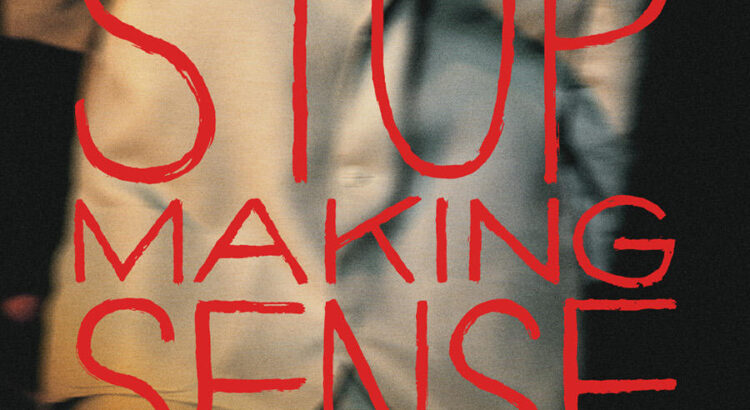
REVIEW: Stop Making Sense

Stop Making Sense is essentially a Talking Heads concert in movie form. Originally released in 1984, the movie was re-released and remastered in September of 2023. The movie starts with David Byrne playing “Psycho Killer”, arguably the band’s most famous song, on acoustic guitar with a boombox in the background. The second song in the lineup features Tina Weymouth (the band’s bassist), and gradually more and more members join alongside them. As the band plays, members of the crew assemble the set in real time. The band has multiple outfit changes but only wears neutral colors, allowing the focus to be almost entirely on the music and choreography.

What surprised me the most about the movie was how physical the performance was. Once each member of the band started playing they did not stop continuously moving one way or another. David Byrne even started running laps around the stage at an early point in the movie. The dancing that accompanied each song was very deliberate, and sometimes required every member of the band to move in unison. There was a particular emphasis on mirroring each other’s dance moves, making everything feel put together and sharp.

Light was another important aspect of the performance. The band at one point altered the lighting so they could disappear in and out of the darkness behind them. Byrne even dances with a lamp at one point, which is in direct contrast to the industrial lighting available to them on stage.  The performance also has a brief intermission by the band Tom Tom Club which was formed by Tina Weymouth and Chris Frantz, the band’s bassist and drummer. 

Going in as a casual listener of the band, I was a little hesitant to go see the movie for myself. All of my reservations were completely thrown out of the window as soon as the first song started. It was definitely a worthwhile, and incredibly unique experience. Stop Making Sense  is perfect for the big screen, and seeing it reignited my love for the Talking Heads music.       


Photo from Fandango.com