
REVIEW: Splendid Sounds of Taiwan: Soloists of the National Chinese Orchestra of Taiwan

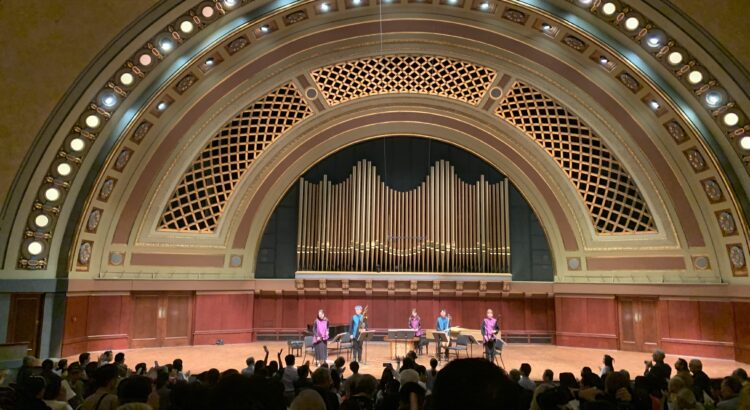
As part of the U-M Fall 2023 Festival of Asian Music, the National Chinese Orchestra of Taiwan came to Ann Arbor and hosted a variety of events from October 1st to 4th. On their last day, soloists of the ensemble performed at Hill Auditorium and showcased various traditional Eastern instruments including but not limited to the Yangqin (dulcimer) performed by Ming-Hui Lin; Dizi (flute) performed by Chen-Ling Liu; Sheng (reed organ) performed by Chi-Mi Chen; Erhu (two-string fiddle) performed by Yi-Fang Wu; and Gehu (four-string bass fiddle) performed by Ya-Tsing Hsu.

It’s difficult for me to describe each of the instruments, since it was my first time hearing them live. While the strings sounded muted, they were incredibly resonant and easily filled the large hall. The Dizi was sharp and piercing, whereas the Sheng blended beautifully in the background. My favorite was the Yangqin, which could produce a variety of clear and subtle textures. Though there was only one person playing each instrument, the music never felt lacking in dynamics and balance.

Their large selection of music shared a common theme of nature or dance. Each piece had a title that gave further insight into the intended imagery, sentiment, and context of the music. Furthermore, details of the historical background and origins of each piece were written in the concert programs. Reading the descriptions beforehand really added to my experience, because it gave me a visual aid to interpret as I listened.

For example, in the opening piece, Queen of Courtesans, each tempo change painted the different steps of a dance; the tremelo of The Butterfly Loves Flowers resembled a butterfly’s beating wings; and the grace notes decorating many of the other pieces acted as falling leaves and flowers.

The most impressive part of the program was the Skylark; the Skylark was a solo piece featuring an instrument called a koudi (similar to a picollo), which is so incredibly small I couldn’t even see it in the soloists hands. As implied by the title, it featured the melody of a skylark. The resemblance was simply uncanny to an actual bird.

Overall, it was a wonderful and unique experience to attend this concert. If given the opportunity, I highly recommend listening to music from other cultures.

REVIEW: Guys and Dolls

8:00pm • Saturday, Oct. 7, 2023 • Lydia Mendelssohn Theater

This Saturday’s performance of Guys and Dolls was one of the best musicals I have seen on campus. SMTD’s production staff, crew, and performers breathed life into the classic “Broadway fable” through their thoughtful and critical treatment of the 70-year-old subject matter, while remaining true to the musical’s original humor and optimism. 

First and foremost, the cast’s performance was exceptional. The actors embodied their characters with charisma and authenticity, making them relatable despite some of the more dated stereotypes. Their command over dialects transported us to the streets of New York, and their chemistry on stage gave the story’s romances real gravity that completely absorbed my attention. In particular, I was blown away by Alex Humphreys’ soprano (just like I was in last semester’s production of Rent!) in “I’ll Know” and literally all of her songs afterwards. 

I loved how the set and costume design expertly combined to craft a convincing world onstage, without visually overwhelming the talent of the actors. When the curtain rose at the beginning of the performance for “Runyonland,” the sparsity of the stage put the spotlight on the orchestra for a few well-deserved moments. An unexpected sense of excitement and anticipation overtook me as the curtain lifted a second time, revealing the blinking neon signs of Broadway and immersing me in the production’s vibrant atmosphere. 

Despite Guys and Dolls being a product of its time, based on the archetypes developed in Damon Runyon’s 1920s and ’30s stories about the New York underworld and Broadway, SMTD managed to navigate this delicate terrain with finesse. The show’s dramaturgs thoughtfully interpreted some of the more outdated themes in the show, making it relevant and engaging for a modern audience. I especially appreciated the incorporation of informational placards in the hallway, shedding light on the broader social context of the era. These additions offered audiences a deeper understanding of historical context like the LGBTQ+ scene in 1950s New York and the nascent Civil Rights Movement, adding layers of depth to the narrative we saw in the play.

In conclusion, SMTD’s Guys and Dolls was a resounding success on all fronts. The students’ dedication and talent elevated every aspect of the production, from the outstanding musical performances to the impeccable set and costume design. I was impressed by the production’s ability to breathe new life into a classic while addressing its historical context with sensitivity. 

If you haven’t yet seen Guys and Dolls, you still have the opportunity to buy tickets for this Thursday, Friday, or Saturday’s performances, and I urge you to do so! You might see me there as well!

REVIEW: Mesmerica

5:30pm • Saturday, Oct. 7, 2023 • Planetarium and Dome Theater

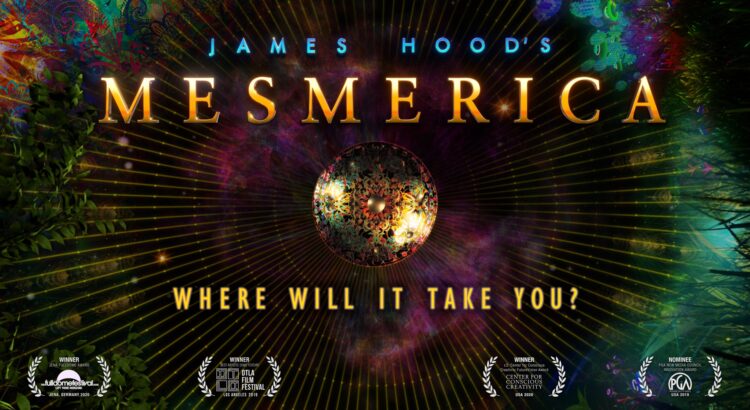
Settling into the Museum of Natural History’s Planetarium and Dome Theater to experience Mesmerica was like stepping through a portal. The show, imagined by James Hood, offered an immersive sensory experience that merged mesmerizing animations with Hood’s ethereal musical compositions. Mesmerica promised to transport viewers to a realm where we could let go of our worries and find a sense of joy in the present moment, and in many ways, it succeeded.

Designed for the unique physical allowances of a dome theater, Mesmerica enveloped the audience in a hallucinatory cocoon of visual and auditory art. The show was an hour-long journey filled with kaleidoscopic, abstract animations that danced across the dome overhead, perfectly synchronized with Hood’s ambient, new-agey music.

The visuals were a symphony of colors and shapes, constantly shifting and evolving, like a dreamscape brought to life. Each animation seemed to tell its own story, inviting viewers to lose themselves in its intricate details. In my favorite animation, a sprite-like blue star led viewers out of a dark nebula until we overlooked a great mandala wrought in bronze wires. We trailed behind as the star zoomed in and out of the wires, tracing lines of glittering dust that “activated” the mandala, which turned gold and pulsed with what looked like magic. It reminded me of attending fireworks shows with my cousins when we were little, where we imagined fairies being born out of every sparkling explosion. 

Mesmerica wasn’t without its quirks. In my personal opinion, there were some places where it took itself a tad too seriously. This feeling was particularly strong during Hood’s vocal interludes, which made the presentation feel like an overworked guided meditation. While the intention of promoting relaxation and mindfulness was clear, for me, it came across as a bit heavy-handed. 

Despite this minor caveat, Mesmerica definitely delivered on its promise of providing a brief vacation from the tedium of everyday life. The show served as an invigorating escape from my current, relentless world of midterms and deadlines.

In conclusion, Mesmerica was a uniquely immersive journey into the realms of art, music, and mindfulness. James Hood’s vision, combined with the collective creativity of artists from around the world, resulted in an imaginative and inspiring experience. While it may have risked taking the mindfulness concept to the level of tackiness at some points, the beauty of the animations and the soundscape created an enchanting atmosphere that was well worth the visit. 

REVIEW: Aurora’s Sunrise

3:00pm • Friday, Sept. 29, 2023 • State Theater

Content warning: genocide, violence against the Armenian community

Aurora’s Sunrise, directed by Inna Sahakyan (who was in attendance for a Q&A session at Friday’s screenings), tells the unlikely story of Aurora Mardiganian, a young woman who survived the Armenian genocide of 1915-1923. In 1918, Mardiganian escaped to America and through an unlikely series of events became a silent film star, playing herself in Ravished Armenia (Auction of Souls). The silent film was produced in 1919, purportedly to raise money for Near East Relief, a charitable organization working to protect refugees in the Ottoman Empire during WWI. Through its unique combination of animation, archival footage, and interviews, Aurora’s Sunrise provides a platform for the often-erased history of the Armenian genocide, while raising important questions about ethical storytelling.

For me, exploitation and revictimization were two of the documentary’s most striking motifs. Not only did we witness the horrors Mardiganian faced as a young girl in Armenia, which included watching the murders of her entire family and being repeatedly sold into slavery, but we also saw how she was forced to relive those traumas again and again for an American audience. Filming Auction of Souls was physically grueling, and when Mardiganian broke her ankle in a fall, she was forced to continue acting on it for weeks. Not only did Mardiganian re-enact her two years in exile for the film: At every screening, she shared the details of her story with private audiences of American women, enticing them to donate to Near East Relief. At a turning point in the film, Mardiganian fainted on stage at a speaking engagement. The director of Auction of Souls (who had taken legal guardianship of the young woman) told her she had ruined the event and abandoned her at a convent. Rather than providing a platform for Mardiganian’s own voice, we saw how powerful individuals in Old Hollywood co-opted her story and controlled her personal life.

Aurora’s Sunrise exposes how the Armenian community’s trauma was commodified and minimized for the sake of Hollywood spectacle, under the guise of humanitarian awareness-raising. Mardiganian’s work to spread her story and the realities of the Armenian genocide was highly impactful, raising over 30 million dollars for humanitarian efforts in the Ottoman Empire, but at what cost? The documentary raises essential questions about the ethics of representation: Can narratives of suffering be told without perpetuating harm and revictimization?

Despite the horror and injustice of her circumstances, Mardiganian’s strength and dedication to her community shine throughout the entire documentary. In her Q&A at the end of the film, director Inna Sahakyan prefaced the discussion with the fact that over 100 years after Mardiganian’s story took place, Armenians are facing renewed ethnic cleansing by Azerbaijan. I was struck by the parallels between the director and her subject, both of whom have chosen to convey deeply painful stories to removed audiences, out of a profound commitment to their people. Sahakyan urged moviegoers on Friday to share the film with friends and family, so I am using this opportunity to encourage readers to go watch Aurora’s Sunrise, and prevent this important story from being lost.

REVIEW: Renée Fleming, soprano, with Inon Barnatan, piano

7:30pm • Thursday, Sept. 28, 2023 • Hill Auditorium

Last night’s performance was a profoundly beautiful joining of nature and human artistry. In her musical program for this recital, Renée Fleming reminded us that our natural environment is humanity’s oldest muse, and it is in danger.

Fleming, a world-renowned soprano, is a five-time Grammy award-winner as well as a recipient of the National Medal of Arts. She was accompanied by Inon Barnatan, described as “One of the most admired pianists of his generation” by the New York Times, whose week-long residency at U-M includes two more performances on October 4th and 5th. The recital included the world premiere of “Voice of Nature,” a multimedia collaboration with National Geographic based on Fleming’s most recent work, “Voice of Nature: the Anthropocene.” “Voice of Nature” collected music from Fleming’s new album as well as from artists as varied as Björk and Howard Shore (The Lord of the Rings), all accompanied by a film created by National Geographic to represent the beauty of nature and the threat posed by global climate change.

“Voice of Nature” was a deeply poignant experience for me. In the 30-minute piece, imagery depicting the diversity and ingenuity of life on Earth was accompanied by poetic ruminations on life’s transience. The songs captured how nature has served as a backdrop for human love stories throughout time and reminded us that climate change threatened both. I was struck by the end of the piece in particular, where Fleming sang “Evening” by Kevin Puts, accompanied by images of shifting Aurora Borealis interspersed with gently spiraling views of the Milky Way. The solar winds buffeting the planet from millions of miles away, set within our solar system’s grand context, made me feel very small. The lyrics spoke to the space between hope and despair: “We know we are doomed, done for, damned, and still the light reaches us, falls on our shoulders even now, even here where the moon is hidden from us, even though the stars are so far away.”

The performance left me with much to reflect on. I was inspired by the power of music to evoke feelings of hope and commitment to life on Earth, which Fleming curated so thoughtfully in this program. For me, the call to action presented in Fleming’s work and in the accompanying film also exemplifies the spirit of arts as resistance, and I look forward to experiencing more work along this theme throughout this semester.

REVIEW: It Lives Inside

7:15pm • Tuesday, Sept. 26, 2023 • State Theater

In horror as a multi-disciplinary genre, the supernatural often serves as a metaphorical reflection of societal fears and anxieties. I don’t watch horror movies very often, but I found the trailer for It Lives Inside intriguing. From my outsider’s perspective, something I’ve noticed about horror is that it tends to be a very white- and male-dominated genre. In contrast, It Lives Inside centers on a community of Indian immigrants within white, small-town America, including teenage protagonist Samidha (Megan Suri, Never Have I Ever) and her family. I was drawn to the film’s exploration of racism, assimilation and community through the lens of horror. 

In It Lives Inside, Samidha is assimilating into (white) American society, distancing herself from her cultural traditions and from her family, community, and former best friend, Tamira (Mohana Krishnan). In contrast, Tamira is an outcast, living in perpetual fear of the thing trapped in a blackened mason jar she carries everywhere. When Samidha and Tamira fight, Samidha breaks the jar, releasing an evil spirit called the Pishach. The movie’s plot focuses on Samidha’s battle with the Pishach, a demon from Hindu mythology which feeds on human flesh. In this rendition, the Pishach feeds upon Samidha and Tamira’s anxieties and insecurities as second-generation immigrants until it can capture them and devour their souls.

One thing I love about It Lives Inside is how the movie emphasizes the necessity of community and solidarity in facing evil, real or supernatural. The Pishach alienates Tamira and Samidha from their families, friends, and supporters, preventing them from seeking help. However, it is when Samidha finally reaches out to her mother (Neeru Bajwa) and her teacher (Betty Gabriel, Get Out), she finds out that one cannot face the Pishach alone and survive–she needs help from her loved ones and community. It is only by reconnecting with her cultural traditions that Samidha can survive the evil forces threatening to consume her. 

Importantly, It Lives Inside manages to explore overarching issues of racism, assimilation, and community without making sweeping generalizations about an entire population. In an interview with writer-director Bishal Dutta, he describes how he hoped to “represent [his] culture in a loving kind of way without trying to make a statement about Indian Americans or the Indian population” (Fort Worth Report, 2023) which comes across beautifully in this film. Samidha and the other characters are portrayed as more than “types,” and while the film incorporates social realities like racism, it centers on the unique lives and relationships among its characters.

Overall, I enjoyed It Lives Inside both as entertainment and as a work fitting into a larger commentary on society. It wasn’t too scary for me, but it definitely kept me at the edge of my seat, and I would recommend it to anyone looking for a fresh movie to see in the coming weeks.