
REVIEW: Kelly Link Reading

We all filed into the Espresso Bar, lattes in hand. We found our seats and were not quite sure what kind of yarn Kelly Link was going to spin for us tonight. All we knew was that we were in the same room with Kelly Link, and that was good enough.

After an exuberant introduction by U-M lecturer Raymond McDaniel, Kelly Link took to the podium. She read a story entitled “I Can See Right Through You” (which you can read right here) from her newest story collection, “Get in Trouble.” The story involves ouija boards, mystery, jealousy, demon-lovers, and aged actors famous for playing a vampire a long while back. Although I can appreciate Link’s innovative narrative techniques, such as her disjointed timeline and her spelled-out ouija letterings, I couldn’t get invested in the story. Perhaps I wasn’t in the demon-lover kind of mood, or perhaps it was the way that Link read the story, her fast, monotone voice sliding by good punchlines and over key plot points. The story just moved by too fast and I couldn’t fully appreciate it.

What really got me excited about being there was the Q&A afterwards. Kelly’s anecdotes about her writing process or about little bits of Kelly Link Life Factoids had us all in stitches. For example, one audience member asked about the influence of art in Link’s work. Link told us a funny story about a time she was in Arizona (I think…don’t quote me!) at a tiny hole-in-the-wall art museum/shop. On the wall were these ugly paintings of a forest and naked people whose feet were so screwed up, a stream washed over them so the viewer couldn’t see the artist’s ineptitude (these are Kelly’s words. I couldn’t judge since I’m probably equally horrible at drawing feet!) And yet, the painting spoke to her and she had to have it. Now it hangs proudly on the wall in her writing space, which happens to be the dining room table. Every time they have guests over for dinner, Link realizes that the guests are forced to face this ugly painting. She laughed, and we laughed at the silliness of it all. The silliness that sometimes we are all drawn to something strange that speaks to us for some unknown reason. Life really can be unexplainable sometimes!

I really love any chance that I get to hear writers talk about their lives not as writers. It’s so easy to read this person’s name attached to books and awards, and we begin to think of them not so much as a person, but as just a name, a writing machine with no life but to produce literature and be successful. Putting a person on such a pedestal like that can be intimidating, for both upcoming writers and the successful writer herself! Kelly Link shed the layers at the Literati that night, and showed us that deep down, she is just like all of us. She loves the Vampire Diaries, she hates the fact that she HAS to write a novel (but still will anyway!), she gives in to buying obscene pictures for no particular reason, she has to write and write and revise and cut and edit, just like everyone else. Sometimes we all need a reminder that everyone is human, even the successful ones; a reminder that everyone needs to “get in trouble” once in a while.
REVIEW: Rotterdam Philharmonic Orchestra

What most interested me about seeing this performance was first of all the fact that this orchestra was from abroad, and that they would come all the way to Ann Arbor to perform. I have experienced orchestral and piano performances abroad as well and found that a lot of the charm of the event is in how it is presented and the social ritual attached to seeing a concert and how it varies in different parts of the world.

The first piece the Rotterdam Philharmonic performed was Maurice Ravel’s Suite from ‘Ma Mere l’Oye’ (Mother Goose). I had never encountered the piece previous to that night and I found myself surprised by the modernity of it. Maurice Ravel (1875-1937) was a French composer who was prominent during the early part of the twentieth century. Listening to this I was reminded of a time in elementary school when I was taught the different instruments and sections in the orchestra, and how each instrument was often used in plays or ballets to represent animals. I found this sentiment to be delightfully expressed in this piece by Ravel. He plays with the tempo and dynamic of the woodwinds such that they invoke images of fluttering birds or scurrying animals. This, in combination with the strings, brings a very full and vibrant environment to life and I think Ravel is very successful in this. As I have not seen this piece performed elsewhere, I find it hard to make comparisons or critiques of the Rotterdam Philharmonic Orchestra’s performance to others. I think that this piece was at least, in relation to the other pieces that the orchestra performed, the most successful and seemed like the most enjoyable to play.

Another aspect of this event that I enjoyed was the concert pianist, Hélène Grimaud. I studied the very basics of piano growing up, so watching her play and her fingers effortlessly and accurately play was quite enchanting for me personally. The way that the conductor and pianist take the center of the orchestra and both share in a leading role in directing the orchestra is an entrancing scene. The only point of critique for me was the way the pianist played was very humble and sometimes it felt like the orchestra overshadowed her presence in the some of the pieces played of Tchaikovsky. Besides that, I thoroughly enjoyed the performance and all of the new sensory experiences it brought to life.

The highlight of this evening was the Ravel pieces for me. Besides the Suite, the orchestra also performed a piano Concerto in G Major. It was easy to distinguish the story-like performance of the Suite from the concerto. I found the concerto to be excellent because of it’s experimentalist and innovate style. The tone was very reminiscent of jazz and that whole era and the culture of the time, it did not surprise me to discover afterwards that Ravel was heavily inspired by the rise of jazz during this time. I did find it surprising how the concerto was able to inspire that style while also maintaining some more classical orchestral moments in it as well. It thought it was a highly stylized piece with that always seemed to be dancing and changing and never losing interest with itself, and that was what I think kept me as well as much of the audience engrossed in the piece.

Overall, I found the experience to be a fall into a space of beauty and of listening. As a student, it was a welcome exclusion of words in favor of sounds. As an event to appreciate music, I found myself surprised and grateful to have experienced the sounds of an orchestra from so far away performing pieces of the not so distant past, but which do not occur as often as I think they should in the repertoire of contemporary music exposure.

PREVIEW: Basement Arts Presents Captive Babries

If you aren’t familiar with Basement Arts, they are a series of FREE student-run plays and performances that typically run in the evenings at the Walgreen Drama Center.

This weekend you have a chance to see the production Captive Barbies, the Hopwood Award-winning play by Levi Stroud and directed by Leia Squillace.

The summary:

Captive Barbies is a fast-paced black comedy that explores the story of the anti-hero, Lee, a criminal that lives in deluded realities, as he attempts to escape the law after committing a serious crime. Along the way to freedom, however, his journey clashes with a love triangle between a (kind of) married couple on the brink of collapse and a closeted cop. His quest for escape becomes impossible as their stories become increasingly entangled and emotions and motives develop. The piece is a meditation on notions of maleness, masculinity, and the conflict that erupts between the true self and the performance of self while facing the restrictions of normativity.

PERFORMANCES
Runs February 26-28
Thursday, Friday, and Saturday at 7pm
Thursday at 11pm

All performances take place in Studio One of the Walgreen Drama Center, North Campus.

Cost: PERFORMANCES ARE FREE!

www.basementarts.info

REVIEW: Rotterdam Philharmonic Orchestra

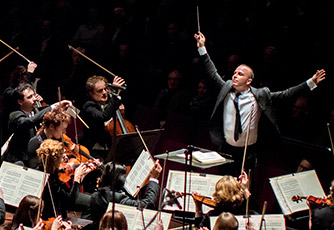
Looks like they’re all giving us magical spells! Courtesy of UMS

The first thing that I could say is “Wow.” I was so pleased with their playing that I did not want the concert to end. Each and every note was performed with so many different colors, with tones that we often cannot find in American-based orchestras. I was especially drawn by the extremely wide range of dynamics that the orchestra was able to produce, and the conductor Yannick Nézet-Séguin’s ability to convey all of his artistic visions with just his body language.

I was most inspired by their performance of Ravel’s Concerto for Piano in G Major (1931), with Hélène Grimaud on piano. Ms. Grimaud’s technique was beyond words — her fingers flew everywhere but knew exactly where to land, and produced the right kind of sounds for particular parts of the pieces. I absolutely love this concerto, and I was looking forward to hearing it live — soloist Hélène Grimaud and Rotterdam Philharmonic Orchestra with Maestro Yannick Nézet-Séguin all exceeded my expectations, and captured so many characters that this piece contains. They left me loving this concerto even more.

I also loved watching Maestro’s conducting style. A little bit of background story here: I am part of the conductor search for the orchestra I play in right now, and thus I’ve observed so many conductors in the past month. Through this search, I’ve realized that I really love it when conductors focus more on conveying the artistry rather than showing a steady tempo all the time. Mr. Nézet-Séguin’s conducting had just that — hand gestures that got the most out of the orchestra. How I wished he could conduct our ensemble! (Haha, right.) I had a lot to learn from the musicians in the orchestra as well, especially those in the woodwind section, who moved with the music to invite other players to play with them. It was beautifully done.

Rotterdam Philharmonic Orchestra was visiting Ann Arbor as a part of their U.S. tour, with the other stops at North Ridge, San Diego, Costa Mesa, Palm Desert, San Francisco, Chicago, and New York. They performed the same program — Ravel’s Ma Mere l’Oye and Piano Concerto in G Major as well as Tchaikovsky’s Symphony No. 5 — right before they left for the United States, in their hometown of Rotterdam, Netherlands. It is such an honor that an orchestra of this high caliber has visited Ann Arbor to share their art.

REVIEW: Stupid F###ing Bird

I’m not sure exactly what I was expecting, but it definitely wasn’t what I got Thursday night at the Mendelssohn Theatre. I’m familiar with Chekhov’s original, having seen it over three years ago, however I’m not so familiar that I remember every detail. So I found myself in a pretty good place coming in, seeing as Stupid F###ing Bird is a parody/adaptation of sorts.

What I wasn’t expecting was the tour-de-force production that the cast and crew of SMTD put on.

First things first, go see this show. Before I say anything else about it, just know that it is phenomenal and you need to see it. This play deserved a packed house last night, but unfortunately it was low on patrons – there were only a couple hundred people there at most. Tickets are free (yes, free) with a Passport, so please take advantage of it and go see it.

Now then, this play.

Being a writer and all, I have to first acknowledge what incredible writing this play contains. I’ve heard it said that good writing doesn’t need to use, ah, alternative language, but this play certainly uses it and abuses it and it works. But more than the profanity is the sheer truthfulness to the dialogue. Multiple times the actors talk over one another, fighting for dominance in the conversation, and then suddenly drift away, ums and ands included. While I can’t be sure all of this was written in the script and some of this should be attributed it to the actors, the script cannot be forgotten. At times I just marveled in how clear the play was. At one point, the actors line up, facing the audience, and rattle off what they want, to be loved, to be famous, to have a big bowl of ice cream (I feel ya, Dev). This kind of directness is rare to see in plays, and was a surprising but refreshing change from the usual.

However, it didn’t surprise me as much as the meta-textual elements that I found running rampant throughout the play. From the small, intimate looks the actors would give to the audience, to Con, our main character, calling for the house lights as he jumps off the stage and demands the audience tell him how to win his girlfriend Nina back. This was a particular high point for me, because it highlighted both the inevitability of life and of the play going on; there was a plant in the audience who prompted Con to rejoin the scene at hand. But it was more than that. As Sorn celebrates his 60th birthday, he demands to know if he’s the only one acting. Of course, the audience laughs, as yes, they are all acting on stage in the moment. But beneath those laughs is that very true question: do people put on an act even throughout their daily lives?

And that’s where this play’s writing shines. Most serio-comedies struggle with the balance between the two, instead making a drama with elements of comedy sprinkled throughout in order to keep the audience from leaving too depressed. Posner’s play does the exact opposite, relying heavily on drama to save the play from its own absurdness. Whenever things get too serious, true comedy, not a cheap joke, comes in to remind the audience that they came to see a comedy, and a comedy is what they’re getting.

As far as the actors go, they handled all of Posner’s randomness with the utmost perfection. The switches from life to scene could be jarring for some actors, and yet this cast does it with such ease, you’d think all plays include direct audience address and participation. I was also happily surprised that the majority of the cast also played instruments throughout. I knew there were musical elements in Stupid F###ing Bird, but I didn’t exactly know to what to expect. The actress portraying Mash, the gloomy yet always poignant sidekick, shined here, toting around a ukulele, always ready to show off her songwriting ability to either her friends or to the audience.

But the best acting really goes to junior Graham Techler for his superb portrayal of main character Conrad, or Con for short. While I had my doubts at the beginning of the play, he juiced Con’s character arc for all its worth. From his first appearance shouting START THE FUCKING PLAY at the audience, to his ultimate humiliation when firing his gun, demanding to know why he has to die and again, shouting at the audience to STOP THE FUCKING PLAY.

I could honestly go on about how amazing this production was, from all of the actors to the incredibly detailed and yet simple set designs, but I’ll spare you. All you need to know about Stupid F###ing Bird are these three things:

  1. This is a quality production

  2. This is quality writing, both the funny and the insightful

  3. You do not need to know anything about Chekhov to understand it

While the majority of the play functions as Posner using Con as his mouthpiece to berate Trigorin/Chekhov, this really isn’t the main point of the play. Asking the big questions, either to the audience or to the other characters, challenging current notions of what art can and cannot be, and being absolutely hilarious along the way – that’s what this play gives. It gives its heart, even if it amounts to nothing except a Stupid F###ing Bird.

REVIEW: Ruth Ozeki Reading

“Hi! My name is Nao, and I am a time being. Do you know what a time being is? Well, if you give me a moment, I will tell you.” ~ the first lines of Ruth Ozeki’s “A Tale for the Time Being.”

After listening to Ruth Ozeki last Wednesday night, I fully understand what it means to be a time being. You’re a time being. I’m a time being. We all are time beings and we share this wonderful life for the time being. But, first, let me give you some background.

Ruth Ozeki is the author of the novel which was chosen as the 2015 Ann Arbor/Ypsilanti Community Read. I had not read the book, but had heard spectacular reviews and knew that she was not only an author, but a Zen Buddhist priest. Since I’m currently writing a story myself about Buddhism, I was interested to hear if she would touch on that aspect of her life.

There on the stage of the Rackham Auditorium, Ozeki stepped out and spent five minutes, thanking so sincerely the committee members for choosing her book. She said that she couldn’t imagine being in their position, having to read so many incredible books and knowing that a choice must alternately be made. Her gratefulness was admirable and continued throughout the talk. She then talked about public libraries and their “magical spell,” which many of the audience members, including myself, had found themselves as little ones. Although the topic itself did not have relevance to her novel, she delved into her own past job as a library page, where she would keep a notepad on her trolley and write down story ideas as she combed the shelves. These personal stories humanized her and made her seem like a real person, because her stories were my stories. I think it is easy to put successful people on an untouchable pedestal, where we think, “No way can I ever get where they are.” But really, they came from where we are. And it’s stories like these that give us hope.

Next, Ozeki transformed into a philosophical physicist and began a lecture on time. She taught us one of her favorite Japanese words, “uji.” Uji can both be translated as ‘time being’ and ‘being time.’ She pointed out that this duality creates instability. Depending on the emphasis, you could say “time being” which connotes temporariness. But if you say, “time being,” it is like you are speaking of a being of time, such as an alien or a living entity. I fell in love with this image of “time beings.” For the rest of the talk, Ozeki called us, her audience, “time beings,” which was both lovely and made me think closer about what that actually means.

After explaining a bit about the main character Nao (a linguistic pun on the word “now”) and a humble confession that this final novel is the sixth version of her original draft, Ozeki recognized that novels themselves are time-beings. When one writes a draft, random factors of the time being influence the prose effortlessly. For example, she had written her novel in a pre-Fukashima Disaster time. She realized that the events and emotions of her novel were no longer relevant in a post-Fukashima time. As a writer who lives in Revisionland most of my days, it comforted me to hear that Ozeki had to wrestle with Time and redo her story to get back in step.

The last moments of her talk was actually silent. She led the audience on a meditation, a moment of self-awareness to put us all back in step with time. We too often feel like we are chasing time. We are quick to materialize time as an object. We’re always behind schedule, ahead of time, physically on time, spending it, keeping it, wasting it. This silent meditation let us just be in time with no worries about what to do with it, other than to exist. For me, time itself felt like it slowed down. Ozeki suggested that before sitting down to work, you should sit in silent peace for about ten minutes. Release any thoughts and be completely present.

Even though I hadn’t read the book (it’s on my list for Spring Break!), Ozeki made her talk accessible to everyone. She taught us to be more appreciative of life, of time, and to simply be the lovely time being who we are.