Fusion of Cultures is an event where many multi-ethnic groups on campus come together and showcase different aspects of their culture.
What kinds of things will be there? Dancing, Singing, Theater, and of course FREE FOOD from around the world.
Brought to you this year by:
The African Students Association(ASA), The Arab Students Association (ASA), The Persian Students Association (PSA), The Pakistani Students Association (PSA), Michigan Pakistanis (MPak) and The Michigan Latino Assembly (MLA)!!!!!
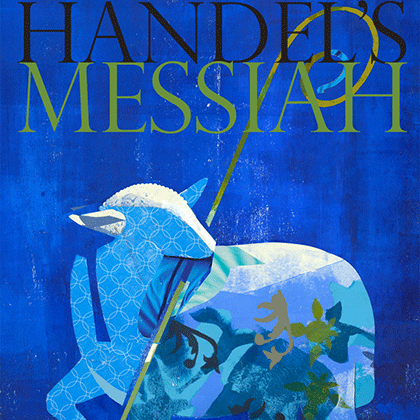
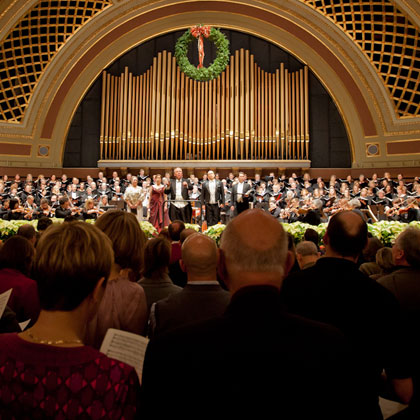
Now in its 135th season, the UMS Choral Union continues its tradition of performing the holiday classic, Handel’s Messiah, again with the Ann Arbor Symphony Orchestra and four amazing soloists. This oratorio is a good old friend for the Choral Union — some of the choir members have sung this for more than three decades with this ensemble! The most famous song from Messiah is the Hallelujah chorus, in which the audience will be welcomed to join in singing (if you dare!). This also marks the last time that Dr. Jerry Blackstone, who has conducted UMS Choral Union for many seasons, will be leading these Messiah performances with the Choral Union.
Also, if you have an ugly holiday sweater that you’re looking for an excuse to wear, join the UMS Student Committee’s Ugly Sweater Party on December 6 at 6pm, in Rackham Building! The admission fee for this event covers the ticket to that night’s performance of Handel’s Messiah as well. More details about this event can be found here.
Photo credits: Mark Gjukich Photography
When: Saturday, December 6 at 8pm -and- Sunday, December 7 at 2pm
Where: Hill Auditorium
Tickets: $10 and up for students; or use the Passport to the Arts to go for FREE!
Who: Dillon Francis with Trippy Turle and DJ Hoodboi
What: Money Sucks, Friends Rule Tour
When: December 3, doors open at 8 p.m.
Where: Royal Oak Music Theatre
Tickets: $29.50 plus service fees or $40 at the door
Dillon Francis is coming to Royal Oak to headline his Money Sucks, Friends Rule Tour and perform music off of his new album of the same name. One of his best albums to date, Dillon keeps you engaged throughout his wonderfully crafted electronic music tracks. You might have heard his collaboration with DJ Snake called “Get Low” that goes “get low when the whistle blow” and proceeds into a hypnotic beat. Get low with Dillon tomorrow night for this not-to-be-missed night out, and excellent mid-week break from studying for finals. Dance your stresses away.
For tickets, visit the AXS website here. Like Dillon on Facebook. Turn up for his Soundcloud. His YouTube channel is also quite the comedic feat and highly recommended on any day where you need a lift.
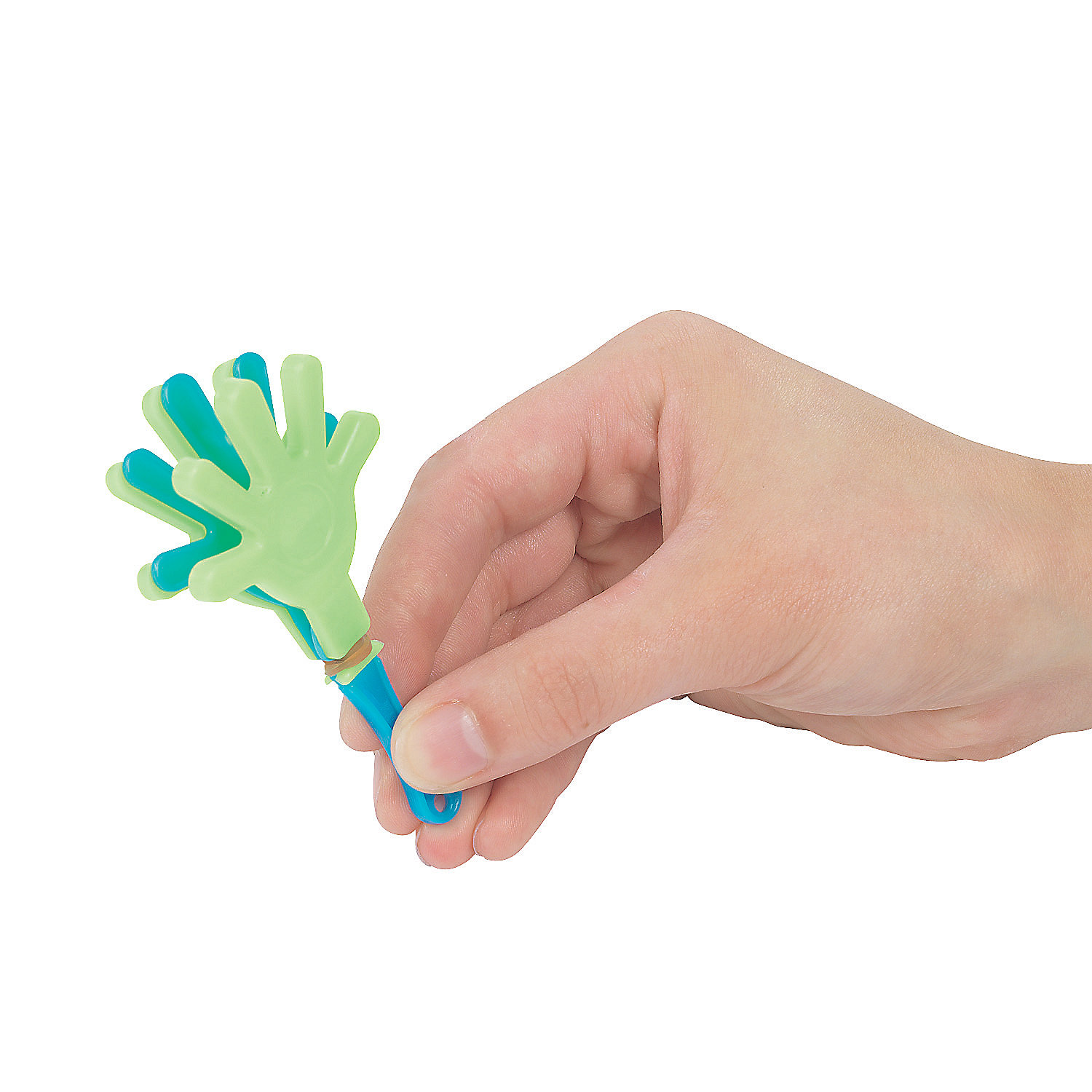
What does a tissue, a feather, a bottle of bubbles, a party popper, a plastic horse, a glow stick, and a hand clapper have in common? They could all be found in the goodie bag I received, as I entered the Michigan Theater last Friday night, ready to belt out the classic songs of Bing Crosby’s “White Christmas.”
Image Courtesy of WikipediaImage Courtesy of orientaltrading.comImage Courtesy of galleryhip.com
Donning the Santa Hat handed to me along with the goodie bag, I felt like an elf from the Polar Express. I followed the hordes into the theater, where the antique Barton organ was humming old classic favorites like ‘Frosty the Snowman’ and the ‘Chipmunk Song.’
The theater was packed with mostly families starting new traditions, and old friends remembering the past – a glorious mash-up of the new and classic, the young and old, coming together to celebrate the holidays. And if anyone could turn “White Christmas” into a “Rocky Horror” style experience, it is the Michigan Theater.
The red curtain lifted and the eponymous title song, “White Christmas” came on. In case you didn’t know the lyrics (????), the words were digitally projected onto the screen and looked just like the subtitles of those Disney Sing Along tapes we all watched so long ago. Throughout the movie, the subtitles prompted us to retrieve certain items from our goodie bag. Every time Emma the hotel clerk takes out her hankie, we shook our napkins (very lady-like, of course) at the screen and cried, ‘Boo-hoo.’
Image Courtesy of hookedonhouses.net
Grab your bubbles! It’s starting to snow!
The movie is centered around performances, and so, to imitate our role as an audience member for both the fictional performances as well as the movie itself, we were encouraged to flap our hand clappers when Bing Crosby and Danny Kaye finish their big dance number, or when Rosemary Clooney and Vera-Ellen take their final curtsy. But, basically, we could “hand clap” whenever we wanted (very much like in a poetry slam when you snap for anything that you find especially smooth). Among this particular audience, the hand-claps seemed to be synchronized with the kissing scenes. It was like we were all back in seventh grade when we had to say something at the sight of kissing. Except, instead of “eww,” we let out a collective, “ooh!!!”
At the final scene when the General (who owns the hotel which has been financially saved) blows out the candles on his cake, we were prompted to get out the poppers. We all waited, hands at the ready. Anticipation bubbled throughout the theater, as we waited for him to signal the celebration. It was as if we, the audience, were part of the movie! Suddenly, POP!!!! Streamers flew every which way throughout the theater and the smoky smell of gunpowder filled the air.
If you ever get the chance to take part in a communal sing along experience, do it! Even if you don’t like to sing. Because it isn’t all about the singing. The community of movie watchers and you become one. Together, you bond over the 5D experience of the movie. The smells, the sounds, the tangibility of the fictional movie become real with your help! You help bring it alive, which is an amazing thing to experience. The Michigan Theater is unique in that they put on events like this: events that you the audience member bring to life; events that will become an annual tradition time and time again. Someday, when I’m 89 years old, I hope to bring my friends, my kids, and grandkids back there to the ole’ Michigan Theater and sing along to “White Christmas” tunes, just like I did in 2014.
Françoise Mouly, current art director for the New Yorker, shares the story of how she became who she was today. In an effort to make this a divergence from the wikipedia page, I will try my best to add as much of her charm to this as possible.
Mouly began her presentation at the beginning — with baby pictures. First was a picture of herself in Catholic school next to a picture of her husband, Art Spiegelman, as a kid. Mouly was born in Paris and growing up decided to pursue a degree in architecture. But midway through her schooling she realized that a future in architecture did not appeal to her. Alumni would come to the school and talk about their experiences and how much they remembered fondly the days of school better than their days at work. She was not fond of this disconnect between the idealized structure put forth by the architect, who does not always have a direct hand in the realization of the work, and therefore who subject to change it was.
So for a change of pace, Françoise moved from Paris to New York. Making the move does not sound like it would be an easy task – with job, housing, etc to consider – but when Françoise talked about it, she made it sound like it was a fond memory in her past, whether or not it was a difficult one. It turned out to be a great turning point in her life, as she expected. She came in contact with many different artists and filmmakers, and most specifically a comic artist named Art Speigelman. Françoise would spend her time reading Art’s comics in MAD magazine to help learn English. She invested a lot of time in studying the way comics were made and even took classes in print-making and bought her own press for home. Along with developing a strong bond with Art, she also found a strong bond to the comics he made. She loved the means of reproduction involved in executing the final product that is the comic. She fond greater control in the process in that it bridged the gap between what you design and what gets built. It offered a lot more control over production than she felt architecture ever did.
One of her first jobs was working as a colorist for Marvel magazine, and also started her own business publishing maps and guides of SOHO and Tribeca. At the time she was living with Art and his parents were very keen on the two of them getting married. So, in order to appease their wishes, she and Art had a “taudry wedding,” according to Françoise, which was really only done to make good with the in-laws. Art and her decided to have another marriage ceremony in 1988, and that one was the real deal, she said.
In addition to meeting Art, she also started to take her printing press to another level. She and Art founded RAW comics, an underground comic magazine. Her and Art’s goal was to provide a striking comic magazine that would hopefully garner more attention for adults and aid in the reviving of the adult comic readership, which at the time was suffering. The magazine feature friends and contributors from America and Europe mostly, but from all over the world really. Because she wanted to put a handmade element in every piece, so in one issue she and Art placed hand designed gum wrappers from the gum factory Art worked at into each issue. In another issue, she inserted a small flexi disc into the back cover of a copy of one of Reagan’s speeches. This emphasis on doing things by hand makes it more thoughtful, Françoise believed.
The opportunity to work for the New Yorker came when Art was offered to do one of the covers himself. A cover he suggested was considered too bold for the running style of the New Yorker, which had grown in recent years to feature landscapes and non-abrasive images. The current editor reached out to Françoise, seeing the work she did with her comic magazine, and asked for her to assist in the cover design process. Françoise knew what she wanted from comics – powerful images that made it hard to remember what you thought before having seen the images. This is what the current New Yorker was lacking. So she went through older covers from the 1940s and 50s issues of the New Yorker and used those as example for what a cover for the magazine should look like. There was more story telling in those covers, and more of a human attitude in them, that was lacking in the current issues.
In 1993, Mouly became art director of the New Yorker and also publisher of her new project, Toon Books, which specialized in hard cover comic books for young readers. She lives a dream, and the way she talks about it is as if it were what happens to any other person in a lifetime. Her humility and charm make her an exceptional story-teller and person. In her final words, Françoise said the New Yorker magazine will not lose itself in the modern age because its’ images have no time. People take the images out of context of any time period and make them something accessible to many generations and future generations to come.
For someone who never meant to be an artist or a writer, Chris van Allsburg has fallen into one giant success story of a career. With over 20 children’s books, including Caldecott Medal Winners ‘Jumanji’ and ‘The Polar Express’, Chris has undoubtedly one of the most magical voices in the literature world.
Sitting in the newly debuted second floor of the Literati Bookstore, I waited, buzzing with excitement, along with other fans, both young and old. A clean-cut man, with just a smattering of white hair trimmed carefully around his head and square black glasses, appeared behind the podium. He looked just like someone you would want writing your child’s stories.
“Well, let’s begin,” he said. Somehow, his almost solemn, dry humor could still light up the room, like the headlights of the Polar Express itself. Chris, a U-M graduate, told us his story about how in the good ole days, if you wanted to go to a university, you simply had an interview, brought in your high school transcript, and by the end of the talk, you knew if you were in or not. The college-age kids, including myself, let out a collective envious groan. Chris went into his U-M interview with his choice of school unmarked. With only his fingerprinting, model-building skills from 12 years ago to keep him afloat at college, he pressed on and said that he wanted to pursue Art and Design.
What began as a career in Sculpting (which he still does privately today), Chris fell into the publishing world when his wife showed his personal sketches to a children’s publishing house. They loved his work, and wanted him to illustrate their story ideas. But Chris refused to illustrate “stories about Duck’s first day of school.” He prefers to draw his own original drawings.
He went on to explain his style of “cognitive dissonance,” and showed us slides of his early drawings. A chair floating in the middle of an ocean.
Photo Courtesy of hermionish.com
How did the chair get there? Did it fall off a ship? Is it close to shore? How long has it been there? Is it missing a leg? “Cognitive dissonance” can be defined as the uncomfortable tension that occurs when two conflicting images are unexpectedly juxtaposed. Chris is drawn to this psychological phenomenon, which explains why such strange things happen in his unconventional stories. Rhinos stampede through a perfectly plain house? Cognitive dissonance. A locomotive train hisses through a sleepy suburb street to transport a boy to the North Pole? Cognitive dissonance.
Chris van Allsburg is never afraid of the new. He’s expanded his oeuvre to include a children’s non-fiction biography, called “Queen of the Falls,” about Annie Edson Taylor, the 62-year-old woman who was the first person to survive riding down Niagara Falls in a barrel. He has also written a book called “Bad Day at Riverbend” which questions the feelings of coloring book characters. Do they disdain the fact that one day, their entire blank world will be covered with a waxy colorful goo? It’s questions like these that give children the opportunity to grow and think about the world in a different way.
Photo Courtesy of gatheringbooks.org.
The actual purpose of van Allsburg’s reading was to promote his newest book, “The Misadventures of Sweetie Pie,” which follows the almost fatal escape of a hamster back to his place in the wilderness. I found the book a little disappointing in comparison to his older tales. Perhaps it was the absence of cognitive dissonance that did it. In some ways, writing about a hamster who feels lonely in his cage at school seemed just like the “duck’s first day of school” plotline line that Chris had rejected in the past. But I suppose it was worth a try.
Nevertheless, I think that Chris van Allsburg is an inspiration to all aspiring artists and storytellers alike. In an age when every day, we students are forced to think about our future and our career, van Allsburg is proof that ‘doing what you love and what you’re good at’ will get you where you need to be. When in doubt, just listen for the jingle of a sleigh bell…and keep faith.