REVIEW: Nightcrawler

What they don’t tell you about this movie is that, when it is eventually shown on television during Halloween marathons, it can be paired perfectly with the Christian Bale-helmed American Psycho. Honestly, I will be shocked if we don’t see at least one academic paper comparing the two parables of lunacy, featuring two of our greatest actors giving exceptionally creepy performances. That being said, this is not that academic paper so I will not bring up American Psycho until the end.

Louis Bloom (Gyllenhaal) is quickly established as a man who will do anything necessary to make a living. The film follows his rise (or descent?) into the world of Los Angeles crime journalism via taping footage of crime scenes. He rises to the top of his league by increasingly malicious deeds and the stakes climb as we discover how much of a monster he truly is.

I like camera
I like camera

Being a film major myself, I know the struggles of filming night scenes. Anyone who has owned a camera or camcorder knows the pain of seeing grainy night footage cloud clear memories. That is one reason why the plethora of darkness throughout Nightcrawler is so gorgeous–the blackness is milky smooth and you find yourself truly immersed in the lunacy of our protagonist, Louis Bloom (Gyllenhaal). The majority of the film is shot in the dark, with only a handful of day shots as punctuation (that also have deeper meanings I am sure). However, the story is of a budding LA crime videographer and his questionable ethical decisions. This is not a film for the daylight.

At first I did not enjoy the cinematography. Throughout the film it is rough and unfinished, competent but not extraordinary. Then I realized: this is a film about a blossoming videographer. The genius of the cinematography is that it mirrors his own high-strung education in camera work and framing. Nightcrawler is quite a reflexive film, with not only images of cameras strewn everywhere and footage on videoscreens, but direct on-screen references to framing and camera jargon such as wide-screen lenses and megapixels.

In this way,  lovers of filmography and photography are given a chilling reminder of boundaries in capturing life through a lens. The cinematography hammers this point into our faces by trading shots between Lou’s camera and the “official” camera of the film.

So here's my number just call me maybe...
So here’s my number just call me maybe…

I enjoy James Newton Howard’s work, but the music felt inconsistent.

In this case, it seemed to be a reflection of the film’s own inconsistent message. Describing anything would give too much away, but the ending scene leaves the audience questioning its message more than anything. At some points the music is hopeful and cheery, reflecting Lou’s rise as a result of diligence and hard work. Other shots are adrenaline fueled and guitar driven. Then there were the pieces that matched the overall dark town of the film. Each would have worked in their own right, but spliced together they felt uncertain of which story they wanted to tell.

This brings me back to the comparison between American Psycho and Nightcrawler. At the end of American Psycho, we find that Bale’s character was only imagining his maniacal fantasies. He tries his hardest to confess his crimes, but no one seems to believe him or even bother paying attention to him for that matter. This is a dark commentary on the apathy of the corporate world and high-class society. What is the real lesson of Nightcrawler? The best I could think of is our failure as a society to address disturbed individuals when we have the chance.

Throughout the course of the film Lou interacts with many people. Several question his judgment, but none of them makes an effort to actively confront him or even help him. And this is not the kind of individual that suddenly develops a psychotic personality, this is a man who has been molded by the people around him.

Somewhere in this film there is a powerful moral lesson, but the film itself does not make that leap. Instead we are left with a morally questionable ending. We are left waiting for someone else to step in and fix the problem for us. Perhaps that is the film’s message, a commentary on our complacency and unwillingness to question what we see before our eyes.


PREVIEW: Madame Butterfly

Who: Michigan Opera Theatre

What: Puccini’s Madame Butterfly

Where: Detroit Opera House, 1526 Broadway St, Detroit, MI 48226

When: 11/15 at 7:30, 11/19 at 7:30, 11/21 at 7:30, 11/22 at 7:30 and 11/23 at 2:30

Madame Butterfly is an opera in three acts written by Puccini between 1903 and 1904. Set in Japan during the early 20th century, Madame Butterfly follows the marriage of Lieutenant B.F. Pinkerton of the U.S. Navy and a geisha wife named Cio-Cio-San. A young girl of 15, Cio-Cio-San became a geisha after her family lost their prominent position and has agreed to convert to Pinkerton’s religion of Christianity. Denounced by her family and later abandoned by Pinkerton, Cio-Cio-San faces a life a shame with her and Pinkerton’s child.

The Michigan Opera Theatre will be presenting Madame Butterfly at the Detroit Opera House from the 15th – 23rd of November.

REVIEW: Literati presents Short Flight/Long Drive Book tour

It’s Monday night and I’m walking towards Literati bookstore.  It’s been raining and the night is bizarrely warm and humid.  I’m reminded of the name of the book tour:  Marry, F*ck, Kill, (Cuddle) Tour.  The night feels like it is in the cuddling mood.
The basement of the Literati bookstore is small but filled.  Books surround rows and rows of people.  It feels like the ceiling is too low and the space too narrow to fit the excitement held for these authors.  Or perhaps it’s perfect and cozy this way.
There are four young published authors who will be reading tonight.  Each has been published by local press, Short Flight/Long Drive Books:
SHORT FLIGHT/LONG DRIVE BOOKS is an independent, non-profit small press specializing in the publication of fiction. A division of Hobart, Short Flight/Long Drive Book was founded in 2006 with Elizabeth Ellen as editor. SF/LD has published Chelsea Martin’s Even Though I Don’t Miss You (2013), Chloe Caldwell’s Women (2014) and working on Mira Gonzalez’s forthcoming untitled book w/ Tao Lin.
The first author to step up is Chelsea Martin.  She has written Even Though I Don’t Miss You (SF/LD 2013) and today she read a short story about meeting her father for the first time.  She detailed the pleasant experiences of a colonic and how a father’s seemingly good intentions at starting a relationship with his teenage daughter could cause unspoken stress and physical pain.  While the father lacked in communication with his daughter, the story did not lack in visceral detail.  Chelsea is also creative director of Universal Error art collective and has received a BFA in illustration and writing from California College of the Arts and currently lives in Oakland, California.  More about Chelsea can be found at her website.
The experience of the second author, Mira Gonzales, is noticeably different.  In her poem, dick pics first are announced first and foremost as extremely relevant for contemporary culture as large amounts of snickering and agreement is made by audience members during her reading.  She has a lot to say about the prevalence of dick pics in her life and it’s hard to come away with any other interpretation of the experience except to conclude that she was fed up with it.  Mira will be publishing a yet untitled book through SF/LD in March 2015.  She is from Los Angeles, California and her first collection, I will never be beautiful enough to make us beautiful together, was published by Spencer Madsen of Sorry House press in January 2013.  Mira’s blog.
The third author, Elizabeth Ellen, tells a story pertinent to the season.  She read two shorts on Halloween, haunting and filled with sexual tensions.  She has published a collection, Fast Machine (SF/LD Books).  She also won the Pushcart Prize for her story “Teen Culture”.  She is based in Ann Arbor and co-edits the web journal, Hobart.  Elizabeth’s website.
The fourth author was Chloe Caldwell, author of Women (SF/LD, 2014).  Her reading was by far the longest as she reads from her recently published novella, Women.  She tells the story of falling in love with an older woman, and begins by admitting to the destined failure of the relationship.  The reading is only an introduction to the book but already is an expression of raw feelings of love and the rotten things that can result.  Her excitement while reading her book complemented the no-nonsense style of her writing, the scenes of fucking and pining and resulting heartache.  It is one of those reads that makes you say ‘goodbye drama, I’ve had more than my fill. maybe next year.’  You can check out Chloe’s website here.
The four authors were all smiles and by the end of it, the audience was pushing to get to the front of the room to have a word with them.  Overall, it was a really great atmosphere and exchange of stories, and what I found most interesting was the camaraderie between the four authors.  They were all genuinely joking around, poking fun at each other, and game for karaoke afterwards.  I hope you check out these great ladies!
IMG_0473

REVIEW: Michigan Sahana’s “Rachana”

Image of the Final Piece provided by Esha Biswas

“Jugalbandi” : the most beautiful word you’ve never heard of. The term is used most commonly to describe the tradition in Carnatic and Hindustani styles of Classical music in which two musicians perform together. But, on Friday night, the talented students of Michigan Sahana took “jugalbandi” to the next level. They extended the metaphor to include dichotomies of music and dance, show and tell, performance and education, and Indian and American, to create a unique cultural experience.

In order to replicate the authentic experience of a true Classical Indian concert which last up to 4 hours, the performance followed a carefully chosen eight-piece repertoire that interweaved both music and dance pieces by Sahana members, and demonstrate a specific role of a true Classical Indian concert. First, a Varnam, a traditional raga, was performed in its ceremonial performance-initial position. Ragas are like the structured jazz of the Americas, in that they are the melodic framework for improvisation and composition. Sitting comfortably cross-legged on cubes, the four performers began the “alaap.”

This ‘alaap’ allows the musicians to warm-up their fingers, play with the notes and rhythms within the determined pitch, and introduces the central themes of the raga. I very much enjoyed this part, especially since I knew that it was so authentic to a real classical concert, but without structure or a full ensemble playing at the given time, I felt that the warm-up went on a bit too long, as it sometimes was longer than the raga itself!

The performers throughout the show took turns teaching the audience about their style of music, which was fantastic! They shared musical terms in the original Sanskrit, counted out tricky rhythms. It was almost like we had been invited to a guest lecture, taught to us by the students themselves! It was exciting to see them talk about something that they are so passsionate about. Also, I never realized how different Eastern music theory is from the Western theory that I’ve learned in my own violin lessons.

After an impressive second act of spinning and syncopated footwork by a dancing duo, the next act was a classical interpretive dance. Dressed in traditional saris, the three young women transformed into storytellers, regaling the audience with a spiritual story involving Ganesha and Nataraja, the Lord of Dancers. Thankfully, they told us the story before the dance. Each character had a specific action or pose associated with it (just like in one of those interactive stories you might have participated in as a child, where the king is identified by his crown and you clap your hands like a gallup when the horse is mentioned). There was so much to look at – so many details that the dancers had to control. Every eyebrow raise, eye dart, neck bob, finger undulation had a meaning, and added to the character development in the dance. They moved with a floating grace about the stage. I could imagine a story unfolding in front of me.

After an hour and a half (and a ten minute intermission), the second half kicked off with another alaap to another raga. The groups maintained variety to keep the audience interested. This time, two singers were accompanied by a tabla drum and a harmonium, a portable hand-pumped organ which sounds similar to an accordion. Give a listen here to The Best Harmonium Player on YouTube!

Followed by another storytelling dance, this time about the legend of Rama and Krishna. Almost balletic in feel, each dancer poured the emotion and devotion of the story out of every hand movement and neck oscillation.

The finale was by far worth waiting for in order to see so much color, so much energy and cultural pride on that stage. Both parts of Sahana, the music and dance portions, came together to accompany each other and create a complete picture of Classical India.

This unique educating type of performance got me thinking about what a musician needs from its audience. A performer really desires an audience full of people who either really understand the depth of the music and share the love and passion of the art form, and those who may have limited exposure, but come with support and a blooming curiosity. Michigan Sahana took a very bold move and used their concert as a tool to train their audience on how to enjoy the performance, and even went so far as to further the enjoyment factor by revealing the patterns and stories behind the music and dance pieces. How many times have you been to a Shakespeare play or a band concert, and wished that you had read the summary or knew the thematic layers that structured the Sousa Symphony?

By the end, I came away with a new understanding of Sanskrit, a better idea of various Indian instruments (other than the stereotypical tabla drum and flute), and a deep appreciation for the small details that the musicians and dancers pay attention to in order to convey their cultural stories. Also, I now realized that a true Classical Indian concert was a long event – up to 3 or 4 hours. I cheer Sahana’s authenticity, but I do believe that perhaps the concert could have been a bit shorter for this present day audience who is unaccustomed to long amounts of sitting. In the future, maybe they could include an optional “educational talk” before or after the show to discuss rhythms and Classical Indian terminology to those who are truly interested. Sometimes, after a long day, patrons just want to have a good listen, be entertained, and then, go on their merry way.


REVIEW: Twelfth Night

“What was the most foolish thing you’ve ever done for love?” read sticky notes that adorned the Arthur Miller Theatre ticket booth. Equally creative, humorous, and heartbreaking, answers included “Dressed as a gentleman and pretended to be a eunuch,” and “Fell in love with a girl who was pretending to be a man.” If this sounds like Shakespeare’s comedic drama “Twelfth Night” to you, then you’re correct!

“Twelfth Night,” a play appropriate for Halloween with its disguises and mistaken identities, actually refers to the festival that traditionally occurs at the end of the 12 days of Christmas. On this particular night, well-off citizens would become servants and enjoy the “low-class” revelry, such as cross-dressing, copious amounts of eating and drinking, and un-Christian merriment. Likewise, servants would act as masters for “just a little while.” Keeping this in mind, Shakespeare drops his audience plop down in a world where people don’t act as society says they should. Love can cause blindness, danger, and also, hilarious situations.

The play, performed this past weekend by the Ann Arbor Civic Theatre, begins when Viola (Carol Gray) finds herself on the coast of Illyria, having survived a shipwreck that she believes has killed her twin brother, Sebastian (Richard Graham). She disguises herself as a man and calls herself Cesario in order to acquire work serving Illyria’s Duke Orsino (Greg Kovas). But, she soon falls in love with Orsino, who has ordered her to court Countess Olivia (Kaela Parnicky) on his behalf. Olivia, is in mourning and has refused to see any suitors for seven years, until Cesario comes and awakes Olivia’s lustful appetite.

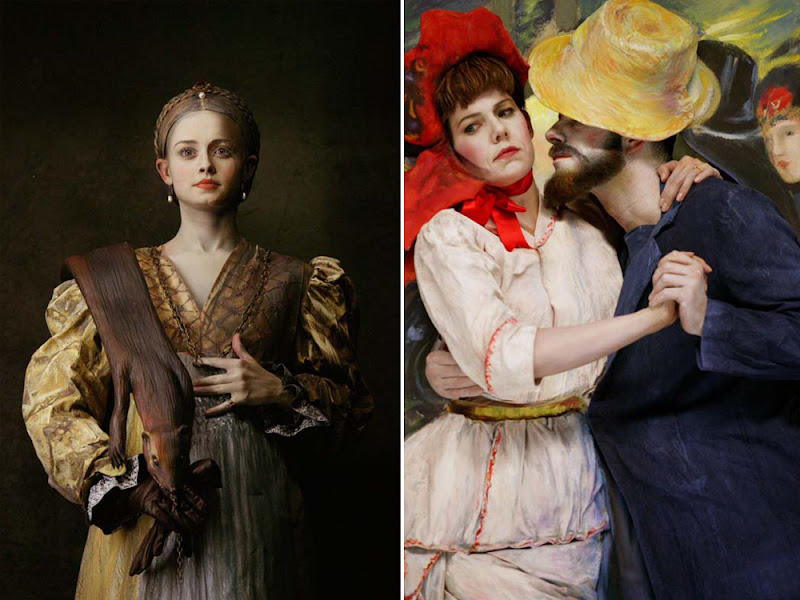
With such a complex web of many love triangles, you could easily find yourself drifting in and out as if you were lost at sea, waiting for a perfectly timed slapstick fall or jibe by the drunken Sir Toby Belch (Jeff Miller) or adorkable Andrew Aguecheek (Chris Grimm) to reel you back in to the plot. But director Kat Walsh and set designer Nathan Doud made the play visually accessible with the set design, especially with the use of tableaus. As the curtain raised up for the first time, we saw three large frames from which the actors exited or entered the stage. It looked as if we were watching a “living museum.” Think of the Museum of Living History from Gilmore Girls.

Image via kateofdiamonds.tumblr.com

The tableaus allowed the primary characters of the upcoming scene to be artfully displayed, as if in a painting, while others first spoke of them. It worked really well, especially given the play’s theme that there is always more than meets the eye.

Walsh made use of her actors’ musical talents: both Carol Gray (Viola) and Richard Graham (Sebastian) play violin, so they began the play with a harmonious duet. It must be a twin thing! Also, Dory Mead (Feste) sang with such power and sweet emotion that gave me goosebumps. Her songs were so beautiful and indeed almost characters themselves, despite their sometimes depressing and morbid themes.

The actors gave outstanding performances that dialed up feelings of pathos and joy, love and embarrassment; feelings that all humans have experienced and could relate to, as seen at the posting wall outside of the theatre, where audience members could write their own answers to the original question of “What was the most foolish thing you’ve ever done for love?” Walsh and her Ann Arbor Civic Theatre team have achieved the timelessness of Shakespeare. I can’t wait to see if they will try another Shakespeare in the future. If you’re interested in upcoming A2CT performances, check out their website: www.a2ct.org.

Review: Kiki’s Delivery Service

Kiki__s_Delivery_Service_by_KikisDeliveryService

Released in Japan in 1989, ‘Kiki’s Delivery Service’ was written, produced and directed by Hayao Miyazaki as an adaptation of the novel of the same name by Eiko Kadono. The film was brought to the US in 1997 by The Walt Disney Corporation.

The story follows Kiki, a young witch, who goes to town with her black cat, Jiji, to make a living on her mandatory year away from her family to train. Kiki makes friends with the villagers as she delivers packages around town. A young by named Tombo follows her around. He is an inventor of flying machines and admires her flying abilities.

Kiki has a crisis of identity as she momentarily loses an the ability to fly and has a harder time understanding her feline companion. Kiki regains self confidence after she saves Tombo and others from an airship accident. She remains in the town and resumes her delivery service in contentment.


The film is very much about coming of age, moving away from home and the familiar to grow from a child into a young adult.

There are noticeable differences in plot between the Japanese and American versions of this film. In the American version, Kiki reunites with Jiji which does not occur in the original Japanese. Cultural references are also changed to become more timeless and thus more relatable over time.


The next film in The State Theater Ghibli Series will show on Wednesday 5 November at 7pm, ‘Grave of the Fireflies.’