What: U of M Women’s Glee Club Fall Concert 2013: A Night of Premieres
When: Saturday, November 9 at 8:00PM
Where: Hill Auditorium
Why you should be there(!): The University of Michigan Women’s Glee Club is an organization composed of fantastically talented young women. The combination of beautiful voices and unique song choices always leads to musical performances that are definitely worth hearing. (This is apparent in their performance of “Frobisher Bay” in a 2012 concert, and no I am not biased just because I was in it.)
This concert will feature many songs written specifically for the Women’s Glee Club, as well as special performances from local youth choirs. Tickets for this event are $5 for students, or free when you use a Passport to the Arts! Check out the Facebook event page for even more details.
I walked down the cold, windy streets of Ann Arbor at 10 pm, unsure of what to expect at the Blind Pig. Although I enjoy listening to music and my library consists of thousands of songs, I would never consider myself a music aficionado. Unlike my roommate, I do not divide and subdivide my genres into obscure genres like spacesynth and chiptune; and if my library was lacking in any department, electronic was definitely one of them. Fortunately, the concert was not only a perfect opportunity to delve into electronic music, it was an example of the atmosphere and people that also listen to the atmospheric sounds of the genre.
Before going to a concert I like to “research” the headlining artist’s discography, but not the opening acts. Everything about them is completely new and unbiased. Man vs. Indian Man’s gig was only their second time playing a concert. When Jeremy announced this at the beginning of his act, I was shocked: what Man vs. Indian Man (MvIM) lacked in musical innovation and set list, they more than compensated with stage presence. Lead singer Clavius Crates molded his style along with the crowd, picking up maracas and other similar instruments as he pleased, dancing and gyrating to the beat, giving and taking energy to and from the ravers in the middle of the crowd. MvIM’s music began slow and deliberate, then gradually increased until it was impossible not to be swaying and bobbing to the beat. Overall I was pleasantly surprised by the first opening act.
After MvIM’s performance, Solar Year was a bit of a letdown. In retrospect, their cool tones and lumbering sound would have been good as a standalone opening act, but they did not work well as a bridged between MvIM and Chrome Sparks. At the same time, a video of the palace combined with the repetitive melodies and voice modulations were effective—it’s a shame they performed when the crowd was energized.
Chrome Sparks simply stood above the others. When Jeremy stepped on the stage and played the first two songs I noticed two things: a confident stage presence and a polished sound. In my mind, these are the things that help distinguish an established artist from amateurs or up and coming groups. Each song was lush, complete, and complemented by a series of videos on the backdrop. As a film enthusiast, I was especially touched by the editing and how it related to each track. Clips from old movies, historical footage, bizarre shapes, funky colors, everything. On top of that were the lights working their magic and the crowd of people dancing to the beat. This was how you experience music. My personal highlight was when Chrome Sparks played their hit song Marijuana. So much energy, people, and music.
Basement Arts, an awesome organization on campus, produced the play No Exit by Jean-Paul Sartre. The performances were on Thursday at 7 PM, on Friday at 7 and 11 PM and Saturday at 7 PM. All the performances were free and held in the Walgreen Drama Center. The performances were pretty well attended, as Basement Arts shows usually are. The Director was AJ Kolpach, Assistant Director, Alison Hacker, Stage Manager and Lighting, Jake Meyers, Set Designer, Daniel Estrella, and Sound Designer and composer, Samuel Johnson.
No Exit is an existential play, originally in French, in which two women, Inez and Estelle, and one man, Garcin, are escorted by a valet into a locked in a room where they remain together for all eternity as their hell. The most famous quote from the play, “Hell is other people” summarizes the entire plot. Plagued by the mistakes made when they were alive, and unable to find peace in the room due to their inherent flaws, the characters Garcin, Inez, and Estelle, reveal their biggest transgressions on Earth and, after an hour and a half, reach an impasse in their interactions with each other, revealing how they will remain stuck in an impossible dynamic with each other for all eternity.
Garcin was played by Aaquil Rowe, the Valet by Mingquan Ma, Inez by Nicole Gellman, and Estelle by Cayley Costello. Costello was by far the best actress. Her character was a social climber who had married an old, rich, man after her parents passed and was in hell for drowning the child she had with a lover. In the room, she is tormented by her need to feel desired by men. Costello did a great job of making her character vulnerable, high society, and really captured how worthless Estelle felt without validation. Aaquil Rowe was very passionate as Garcin, a pacifist who deserted the war, and abused his wife. Garcin was tormented by the idea that anyone would find him a coward, and is unable to physically love Estelle until Inez stops thinking of him as a coward. He was very expressive but flubbed his lines a few times. No Exit
Nicole Gellman did a good job of playing the sarcastic, cruel, lesbian, Inez, although the character seemed a little two dimensional, although that is not necessarily Gellman’s fault. Inez enters the room ready to admit to the murder she committed and fully realizes the point of the room and pits Garcin and Estelle against each other, which means, by the end of the play, the character has not really grown. The Valet, Mingquan Ma, was ok, although his diction was a little unclear.
The set on stage was a bit sparse, but still succeeding in creating the scene, with two couches, one chair, a door, a mantle, and a styrofoam bust. There was only one set issue which really brought the audience out of the moment. There is supposed the “unmovable” bronze bust on the mantle but it clearly moved and shifted around the mantle whenever anyone touched it. Original music was also created for this production by Samuel Johnson. Most of the background music was fine but there was one song sung by Inez which seemed out of place and did not have much to do with any of the characters.
Overall, Backstage Arts is a great organization on campus. This particular production was fine, anyone would have had difficulty with such an unusual play. Everyone seemed to have tried their best to make this existential play relatable and down to earth. I look forward to the next Backstage Arts production.
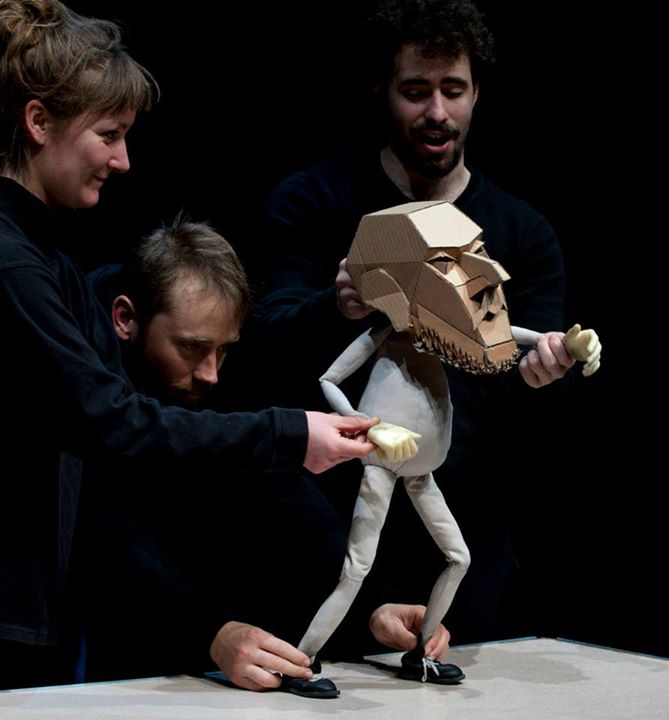
One politically incorrect British puppet, one sturdy American table and three improvising puppeteers. As our Bunraku puppet hero points out, no expenses were spared in the making of this evening.
It’s a show – about a puppet – on a table.
As the puppet keeps reiterating at the beginning, that’s really all that happens in the 70 minutes of this show. And what’s impressive is that it actually works.
So many productions nowadays on TV, film, or even theater emphasize the spectacle element with special effects overloading the senses of the viewers. Instead of aiding the storytelling process, the effects take front and center while the story is relegated to the back burner. The Table by the Blind Summit Theater is a welcome departure from this trend, exploring the basics of storytelling and what it means to be human using only the bare necessities.
The basic premise is that our protagonist puppet is undergoing an existential crisis because “all [he] gets asked to do are birthday parties and reenactments of some folktales set in Eastern Europe!” Our puppet wants people to know that he’s got dreams; he just doesn’t know what they are. So when a London-based Jewish organization tapped him to enact the life of Moses, our puppet was more than happy to comply. This is where the show gets its Bible inspiration—throughout the show, we return loosely to points of Moses’ life, but we never stay there for long.
What the show really turns out to be is an investigation of what it means to be alive. The puppet is quick to point out that “[he’s] not actually alive—it’s just a series of intricate movements!” In one of my favorite sequences of the show, the puppet and the puppeteers demonstrate what exactly these movements are, and how they can manipulate them. At one point, our puppet even demands his operators to lie him down (it’s okay, he’s a professional, he won’t die) and the puppeteers comply. We see that our puppet can still exist without a direct physical component—in fact, losing his ‘body’ is almost a liberation of sorts, freeing his existence from many physical restrictions. In a snap second he can change his size and do crazy contortions, which makes for a very interesting picture when the physical puppet is lying down on a side of the table yet his presence is still on the stage.
Of course, it’s the three puppeteers who make all of this happen. One takes his bum and right arm, another person takes his feet and the third puppeteer voices him and moves his head and left arm. It takes three puppeteers to bring one puppet to life, and it’s amazing how it’s all done in improv. At one point in the show, because one of the puppeteers are “busy in the bathroom,” the company asks one of the audience members to come down and replace him; even with this new element, the puppeteers make the illusion of life quite convincing. It shows how intricate their collaborative process is, involving acting upon and interacting with each other’s movements.
They’re not shy to reveal that they’re just following three basic rules—focus, breathing, and fixed point. Focus refers to what is being looked at on the stage; by the puppeteers keeping their eyes on the puppet throughout the show, the audience in turn is forced to focus on the puppet and makes him come alive. Breathe in—hold—breathe out; breathing serves as the basis of all movements, so all of their actions are based on the process of breathing. Fixed point is similar, but it refers to the organization of movement.
So there’s really not that much to recreating life on stage, which is what theater is supposed to do. Just three basic rules, that’s it. And life too—in one of my favorite moments of the show, our puppet pulls himself together in the midst of a breakdown by reminding himself to focus and to breathe in, hold, breathe out. Sometimes it’s so easy to get bogged down by the weight of your own existence or just life itself, but nothing’s really that complicated—just focus, breathe in, hold, breathe out. Huh. Even I didn’t realize that this show had such a semi-deep message; it just kept me laughing for 70 minutes. That’s the magic of this show—that it’s so approachable and at the same time, funny—and it certainly fulfills what Blind Summit sets out to do: “presenting new puppets in new places in new ways to new audiences, seeing puppetry as a radical part of the reinvention of theater in our time.”
Last Tuesday, October 29th, The Head and The Heart performed at the Royal Oak Music Theatre with opening bands Thao & the Get Down Stay Down and The Quiet Life. The Royal Oak Music Theatre only offers general seating, which is bad news for anyone arriving minutes before the main act. However, for those willing to stand packed tightly right in front, this venue is for you! Unfortunately, those opting for this option (as my friend and I ultimately did) would have had to listen to almost three hours of openers before The Head and The Heart graced the stage.
Though the first band, The Quiet Life, only started around 7:30 pm, they fed the crowd what we all wanted: some good lively music. With a sound that I can only describe as upbeat country, members of The Quiet Life played like they weren’t performing for another venue on the tour, but as if they were playing in some practice room for fun. In other words, they were up on stage just having an experience with each other.
The second opening act, Thao & the Get Down Stay Down, brought with them a completely different environment that definitely changed things up. What was most remarkable about this band was the ease at which they changed their vibe from song to song. With electric energy, leader singer Thao Nguyen danced about the stage singing passionately starting their performance off big…that is, until the mood drastically changed with the next song. Here, the melodies turned darker and the lyrics harsher. Instead of predictable, building tempos, Thao & the Get Down Stay Down would usually play consistently slow right up until the chorus. Here the music burst with palpable energy, lead singer whirling around the stage. Thao & the Get Down Stay Down had just one slow tempo song, but this one was my favorite because it didn’t have any harsh undertones and wasn’t startling. After the performance I looked up this band and it really seems to me that the quality of their music is significantly better off their album. I would definitely recommend buying their album off iTunes, but perhaps would not elect to see them live again.
By the time The Head and The Heart actually started to play, it was 10 pm. I’d gotten there on time, so it had been three hours at that point and I was tired, pretty thirsty, and getting impatient. However, what was truly impressive was that as soon as they got on stage, none of it mattered. They brought with them such an uplifting vibe that from the second they began playing, all pain from waiting was forgotten and the crowd was completely recharged.
What’s really great about this band is that unlike most other groups, the lead sound in each song comes from someone different, each as talented as the last. They switch singers from song to song, alternating between Josiah Johnson, Jonathan Russell, and the only female band member Charity Rose Thielen.
Pictured: Josiah Johnson, photo by Vik SantaprakashPictured: Jonathan Russell and Josiah Johnson, photo by Vik Santaprakash
They highlight different instruments in each song as well, often the guitar is most prominent, sometimes only the piano, and even the harmonica. The Head and The Heart had an amazing performance, cutting through the audience with their genuine spirit and utter joy. This band is the epitome of the kind of sound you want to hear in person, they are no less impressive than in their music videos or straight off their iTunes album. The only difference is, live, you get to feel their energy with them. To add to their playful stage presence, their between-song commentary was witty and entertaining. To be at this concert, to be a member of the audience, to see these characters in person…it was just fun.
Thought-provoking, inspiring, and very bizarre, Ballet Preljocaj’s performance of And Then, One Thousand Years of Peace was how I spent my outstanding Friday night. The performance had everything from enormous plastic sheets, 15-foot metal block-wall-things, frighteningly-athletic dancers, and two baby sheep. It was truly spectacular.
The subject of the dance was the apocalypse. As the dancers fought, made passionate love, crouched and swayed, the audience felt the earth crumble and collapse. They performed a few routines using flags of different countries of the world, soaking them in water and whipping them out to dry. As the full arc of the show came to a resolution, all the flags lay dampened on stage. Two baby sheep were released next on the stage, symbolizing a sort of rebirth of civilization, in my opinion. That part was a little much. I was so distracted by the sheep and nervous that they were going to run off stage that I kind of forgot I was watching a dance performance. There was an air pocket in one of the wet flags and one sheep was poking it until finally it daringly leapt over the bubble. With that final image, the dancers faded into the blackness and the curtain fell. It was weird, but awesome all at once. I left the performance breathless and awestruck.
This dance struck me as more complex than any other dance performance I’d ever seen. The dancers moved so fast for so long during the show; I felt breathless. They had a bunch of different props too! The metal block-wall-things, sheep, plaster sheets, silver trays, metal-helmet contraptions, books, and chairs. It was raw and sharp. One of the most memorable moments was when a series of metal chains fell from the ceiling. They would drop two, as one man danced below. And I don’t know if you’ve ever thought about this – I certainly hadn’t – but when chains fall, they fall in a straight line before crumbling to the ground with a sharp clang. It was super cool and added to the intensity of the performance.
As an intern at UMS, I got to ask people what they thought of the show and record their reactions after the performance. I talked to a few dance majors who were so astounded and inspired by the performance that they could hardly contain their enthusiasm. Others felt that the performance was strange, albeit beautifully done. I didn’t hear any overtly negative reviews. The harshest criticism I overheard was just: “What was that about?” (To see some of the video clips of reactions check out this page on the UMS Lobby website!) There’s something in letting go while watching these sorts of performances – you have to just sit back and let the show wash over you. I think this is why dance, especially modern dance, takes some viewing experience. I’ve found that the more modern dance I see, the more I am able to let go and just roll with the performance without overly analyzing what I’m seeing.
Thanks to UMS for bringing this immensely-talented dance company!
P.S. If you liked this (or think you would have), be sure to check out Compagnie Käfig when they come to UMS in February!