Review: Stamps Series Presents Joseph Keckler in “I, as an Opera”

The Michigan Theater hosts a Penny Stamps Lecture Series every Thursday at 5:10pm, open to the public. This past Thursday, the series replaced the lecture with a performance by Art and Design school alumni Joseph Keckler. Keckler performed segments of “I, as an Opera”, a multimedia opera performance. Keckler’s performance felt particularly personal, he began with a humorous conversational anecdote which served as seamless transition directly into the performance. What followed was a kaleidoscopic exploration into Keckler’s life, mind, and soul.

I admit I have no prior experience watching opera, but since Thursday I have scoured the internet for more information and feel safe to say Keckler’s presentation was quite original and innovative.

(A quick digression—I’ve never been interested in opera, nor did I ever expect to be, the fact that I have since googled opera speaks volumes about how creative and immersive this performance was.)

TL:DR, “I, as an Opera” is a humorous retelling of a really bad shrooms trip. I can not confirm or deny
On one hand, the tone of the piece was really funny, because the experiences Keckler sang about were so absurd, and hearing about a bad drug experience via opera singing is probably something I will never get to see again. At the same time, the story was quite disturbing—at one point Keckler tells about his drug-induced sensation of demonic possession.

I felt the inherently humorous concept of presenting a drug story through the conventions of opera is an incredibly bold idea, one that would probably never work in a traditional operatic performance. This is why Keckler’s unique spin on the opera worked so well. Rather than fill the stage with an elaborate set and a large cast, he used a projector to present a variety of visuals to the audience—a lightshow while talking about the positive aspects of the mushroom experience, a silent reel of his old singing teacher while recounting memories from the past induced by the psychedelics. This unique style both accentuated the personal nature of the narrative and successfully demonstrated the mind-warping nature of the story.

There was one other person on stage for about 5 minutes—a man dressed up as a minotaur near the end. Other than that, Keckler performed on stage alone. The one man show style created an intimate connection between lone performer and audience. Keckler also interacted directly with his projections. The audience saw the most important visual representations of the experience—absolutely no extraneous details. This performance, from start to finish, focused entirely on one man on a lot of drugs, and his disjointed journey through his own mind.

The visual details we did see gave us a greater insight into the psychedelic, introspective nature of the experience. Keckler projected images of strobing, colorful lights to illustrate his warped visions during the experience. Much of his performance also delved into memories of his teenage years, time spent learning singing. During this part of the performance, Keckler exhibited a silent film featuring a talking head of his singing teacher. She broke into a series of tangents about Keckler’s personality and habits. Whether this was her opinion or Keckler’s projection of his self-image is unclear. Regardless, this scene illustrated a psychedelic exploration of the self.

Keckler’s performance was a compelling introduction to opera. His performance focused on subject matter that is relevant and entertaining to today’s youth, but he told his story using an archaic style. This marriage between modern themes and classical storytelling made for a refreshing experience.

Watch Joseph Keckler‘s video short based on the opera here

REVIEW: In a World…

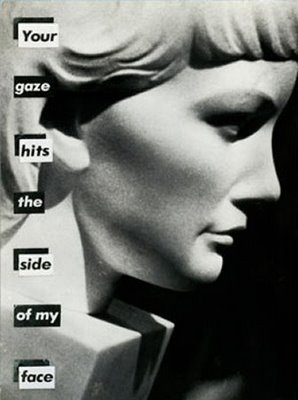
1982 Barbara Kruger
1982 Barbara Kruger

“Your gaze hits the side of my face,” in her 1982 piece, artist Barbara Kruger explores the male gaze through this iconic photograph. Throughout the last century, much has been said about the relationship between feminism and being seen; Kruger interprets the male gaze as an aggressive force that adds a layer of meaning to the classically beautiful form of the face seen on the piece.

We as a society often discuss the power relations regarding sight and the perception of women. Lake Bell’s directorial debut “In A World…” spins a slightly different take on the subject, dealing with the male voice in place of the male gaze. Think of all the movie trailers you’ve seen—“In a world…” rings a deep, bass, male voice. The protagonist Carol (played by Lake Bell)’s father (Sam Soto) is one of the most prominent voices in the industry, a guy who has his own autobiography, a lifetime achievement award and even a band of faithful groupies. And of course a misogynistic set of values and a complete bag of insecurities can’t be left out.

Carol is a vocal coach and aspiring voiceover artist hoping to break into the male-dominated field someday. Her father advises her to just concentrate on the accents that she does so well, because people just don’t want to hear female voices on trailers—“it’s not being sexist, it’s just the truth!” In an interesting turn of events, Carol catches a lucky break when Sam’s heir apparent Gustav Warner flakes out on a trailer due to a sore throat. After successfully stealing his gig, Carol starts getting attention from film producers, including one for the new epic movie ‘The Amazon Games’. The movie is gathering attention because it plans to bring the ‘In a world…’ trailer back; now the attention is on whose voice will utter those iconic words.

[Spoiler Alert: This paragraph will discuss the outcome of the epic trailer voiceover battle]

All is revealed at the awards ceremony at the end of the film, perhaps the most interesting scene in the movie from a dialogue perspective. Two conversations give the movie’s feminist take a deeper twist—the first is the bathroom conversation between Carol and the Amazon Games producer. Notice how it’s placed in the bathroom? These two female figures in a male-dominated world are talking in a male-prohibited space after hearing Carol’s voice emerges victorious in the epic voiceover battle. A shell-shocked Carol thanks the producer for picking her, but is quickly put down by the producer who says that she’s using Carol to further her feminist cause: “You were picked because I wanted to use you. Girls all over the world hearing your voice will be inspired…you weren’t picked because you were the best, because frankly you weren’t.”

The second conversation that changes the movie happens between Sam and his thirty-year-old new wife. All throughout the movie she’s depicted as an annoying groupie-type with a baby voice; in a scene where she deals with a hysterical Soto after he realizes that his daughter was picked over him, Soto’s wife transforms into an assertive female figure who tells her husband to suck it up and go thank his daughters after receiving his Lifetime Achievement Award. And it works.

Overall, Bell (who wrote, directed, starred in, and produced the film) utilizes dialogue and words very effectively. There are some interesting snippets utilizing the interplay between words and the visual—Gustav saying “culture was my education,” while doing clearly uncultured things, Louis having to resort to flailing his arms for Carol’s attention when Carol doesn’t stop talking. Another interesting element is the use of phone conversations to further various plot threads at once; simultaneous situations that sometimes parallel each other and at other times contrast with each other are woven together elegantly.

Growing up, I’ve always been one of those girls with a husky voice set in the lower registers; a voice that is not very ‘feminine,’ i.e., not the sexy baby voice (which apparently is greatly appreciated in the bedroom). I came to appreciate my voice when I started doing debate and public speaking, an arena where I found that a girl with a low voice appears apparently more logical arguer and less like a hysterical nagger. Before then, I hated my voice because it seemed to set me apart from other girls, made me less ‘girly’ in a way. I guess that’s why they call it finding your voice, the process of becoming more comfortable with who you are and learning how to accept yourself for who you are. And that’s what Carol (and Lake Bell) ultimately strives to do—Carol with her clinic for girls who aren’t taken seriously because of their sexy baby voices and Bell with her endearing film.

Watch the trailer here!

SPOTLIGHT: Sir Kenneth Branagh in Macbeth

National Theatre Live: Macbeth

There he is. Amidst a chorus of sword crashing against sword in a scene only hinted at by the Bard, there he is, the man we’ve come to see:  Sir Kenneth Branagh.

In the darkened Michigan Theater, my date and I squeal in excitement as this native of Northern Ireland dominates the screen with his rugged beard and flashing eyes. Yes, I do mean squeal, and yes, I am unabashedly a fanboy. I’m sure you can imagine my excitement at getting to watch him star as Macbeth in a live broadcast from the performance in Manchester that boasts of selling out in a mere nine minutes!

But perhaps you are wondering who this theatrical titan is, and I will endeavor to tell as best I can. If you watched the London 2012 Summer Olympics Opening Ceremony, then in addition to seeing the Queen become one of the newest Bond girls, you would have seen Branagh (in what might be confused for Abraham Lincoln-esque attire) delivering a speech from Shakespeare’s The Tempest. It is likely apparent by now, as it is by perusing his performance history, that Branagh and the Bard have quite the intimate relationship. In fact, Branagh’s role as Henry V in the movie he directed of the same name was what made me fall in love with him. Especially, though by no means limited to, his rendition of the well-known St. Crispin’s Day speech, which I memorized for a Speech class in high school after watching this video on repeat (half of the views are probably mine).

Branagh’s Henry V, for which he received Oscar nominations for best leading actor and best director, served as his first directing project for the Renaissance Theatre Company, which he formed with David Parfitt after leaving the Royal Shakespeare Company. He has gone on to direct seventeen films, including Shakespeare’s Much Ado About Nothing, Hamlet, Love’s Labour’s Lost, and As You Like It. NonShakespearean projects of Branagh’s that are recognizable include directing the first Marvel Thor movie, voice acting for Miguel in DreamWorks’s The Road to El Dorado, and making appearing as Professor Gilderoy Lockhart in Harry Potter and the Chamber of Secrets.

Recently Brannagh was being considered to replace Sir Nicholas Hynter as artistic director of the National Theatre in London, but the position will ultimately be going to Rufus Norris. While Branagh might not get to fulfill his “pathetic urge at some stage in [his] life to be able to pull out [his] wallet and pull out a little card on which it would say Kenneth Branagh, artistic director,” just yet, it’s comforting to me to know that he’ll still be free to keep making movies. Two of his current projects to look forward to include Jack Ryan, Shadow Recruit, which is in post-production, and Cinderella, which is still being filmed.

In describing working with Shakespearean material, Branagh says that: “it’s like going back to some great piece of music. It is dramatic poetry, so each time you hear it, it reacts on you in a different, usually a richer way. It’s like a wonderful dog that gives you much more than you’ll ever give it. There’s unconditional love in there; he never lets you down and he’s never sentimental; he’s always bracing because he’s so very, very realistic about families and love and all the normal human stuff.” This definitely came through in his performance last night as we witnessed Macbeth’s internal struggle with evil and ambition, paralleling his dramatic transformation from dutiful soldier to murderous usurper and ultimately to mad tyrant.

It remains my hope that Branagh continues to find inspiration in the Bard, and to bring these supremely human stories to life on both the stage and screen.

Sources

Read More

REVIEW: Halloween Concert

As the orchestra marched into Hill Auditorium while playing March of the Little Goblins, I found myself surrounded by zombies, Pokémon characters, the cast of Alice in Wonderland, Mario and his friends, and an entire viola section full of Despicable Me minions, not to mention all of the costumed audience members. After taking their seats, the orchestra proceeded to play without intermission, presenting a concert that showed off their excitement, skill, and playfulness.

The program consisted of seven classical pieces, all with a bit of Halloween flair, conducted by seven different conductors dressed to match their piece. The orchestra was a combination of undergraduate student musicians from the University Symphony Orchestra and the University Philharmonia Orchestra and the conductors were masters students in the conducting program. Although in full Halloween costume, the orchestra played with the precision and enthusiasm of a professional orchestra.

While all of the pieces were played exceedingly well, especially The Sorcerer’s Apprentice, and Overture to Orpheus in the Underworld, the highlight of the concert was when the costumed bear who had previously chased one of the conductors around the auditorium looking for food took the podium to conduct a piece. Soliciting laughs and supportive cheers from the audience, the bear danced his way to the podium and excitedly picked up the baton to conduct Queen Mab Scherzo from Romeo et Juliette.

After the final piece, the orchestra delighted the audience with an encore, playing the theme from Ghostbusters. As the seven conductors danced around in blue jumpsuits and lights flashed around the auditorium, the costumed orchestra danced in their seats, and the audience clapped and danced down the aisles.

Overall, this concert was fun and exciting, and the perfect way to get ready for Halloween. The orchestra didn’t disappoint with their creative costumes, skits, and wonderfully performed pieces. Since this is an annual event, be sure to check it out next year.

Preview: Toro y Moi

Who: Toro y Moi (and The Sea and Cake)
What: Anything in Return Tour 2013
Where: Magic Stick, The Majestic, Detroit
When: Monday, October 28, 8pm
Price: $20 advance/$24 at door
Check out Toro y Moi and The Sea and Cake tomorrow evening in Detroit! Toro y Moi is touring to promote recent album release  Anything in Return, and the show promises a hybrid of funky 90’s dance mix and pastel-colored electronica. Bring yo dancin shoes or, whatever, leave them at home! It’s really up to you… But please do wear something on your feet.
Get there early to see The Sea and Cake, jazz influenced indie-rock band that includes John McEntire from Tortoise and other greats!