40 Days of Teeth


On the last Friday of finals, a group of dance and music students collaborated in a grand finale performance of the semester. It wasn’t a final for school though. In fact, the production was entirely student created and student run without any requirements from the departments. The concept and the direction was organized by senior dance student Julia Smith-Eppsteiner. Hosted by Performance Ark, an artistic student group founded a year ago, 40 Days of Teeth was very bold, experimental, and unpredictable. It took place late at night in a warehouse on the way out of town toward the freeway. The venue was unlike any university locale. The floor was white; the walls were white. The scene was very hip and the people attending fit the bill. With musical performances by Ann Arbor bedroom glitch-pop groups such as Samn Johnson, Our Brother The Native, and Known Moons, that makes a lot of sense!
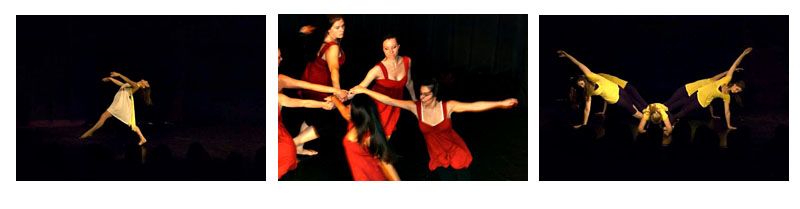
Though it appeared polished and well rehearsed, the entire evening was improvised. Structured, albeit improvised. The premise of the piece was based on Franz Kafka’s “Ein Hungürkuntsler” or, in English, “The Hunger Artist.” The dance began with the Hunger Artist”(above) crouching stoically while musician Samn Johnson read excerpts from the short story. Next, six dancers entered the floor and embodied characters from the tale such as the Impresario, the Panther, and several women, adults, and children. (The dancers included Julia Smith-Eppsteiner, Nola Smith, Ellen Holme, Hannah Schon, Alexandra Reehorst, Emma Fath, and Alexis Turner, shown in the rehearsal and performance photos above). The color palette of the costumes they wore was black, grey, and white which made think of an old film that would have been contemporaneous with Kafka’s artistry. The movement was fluid and graceful at times, while at others more fluttery, dramatic, and even pained. One of the more suspenseful and technically challenging moments was when the cast supported the Hunger Artist in their arms and floated her back and forth around the floor for an extended period of time. Throughout the piece, the lighting fluctuated with the quality of the movement, plunging into darkness and rising into a blue Christmas twinkle. Likewise, the electronic music roared and whispered accordingly. The sensory experience of the performance was captivating because the improvisation was so deftly cohesive.
Several days after the performance, I asked Nola Smith, the dancer who played the Hunger Artist, about her experience with the project:
I was so proud to be a part of 40 Days of Teeth… while there is definitely a way to go in terms of developing this kind of collaborative performance style at the University and in Ann Arbor, I am grateful to Julia, Samn, and the rest of the performers for opening up the possibility for future projects. The fast-paced nature of the process was exciting and kept the material feeling fresh… though on the flip side, the dance elements of the show might have benefited from the cast having a longer time to improvise together and really get on each others wavelengths, so to speak. One aspect of the show that was very enticing to me was having an all-female cast of dancers portraying the Kafka short story, which is pretty male-dominated– the hunger artist, the impresario, the doctor, even the panther are all male characters. In some of my own work I have been interested in exploring the ambiguity/fluidity of gender, so the chance to portray the Hunger Artist (clearly described as a man) was an exciting opportunity. The piece began with a six-minute section of Samn reading the beginning of his translation of Kafka’s story, and the Hunger Artist is constantly referred to as “he,” “him,” etc. I used this time (during which I sat completely still in the “cage”) as an opportunity to get into character, almost as if Samn’s voice was in my own head, narrating my thoughts and memories as the Artist. At the end of the story, the Hunger Artist reveals that he fasted because he could never find any food that he liked, a detail which I felt was important to keep in mind. Particularly as a cast of female dance majors, I felt that the story could easily be associated with body image/eating issues, which to me does not seem to be the point of Kafka’s story at all. Part of “getting into character” was trying to transcend these associations and convey the more “Kafka-esque” vibes of absurdism and existential malaise. 40 Days of Teeth was a wonderful experience and I hope to participate in or present more performances like it! Particularly with those three groups of musicians (Samn Johnson, Known Moons, Our Brother the Native)– those boys were makers of wild and beautiful sounds!
I also asked Julia, the director, about how “40 Days” came to be and what her process of creation was like:
I came up to Samn during Birthdays’ set at Komphaus on some weekday night in early October–and I told him that I wanted to produce a show with him. I also mentioned to his infectious grin that shadow puppets would probably be involved. We discussed in the quieter lulls of the set that that we wanted to create an evening where the people sitting around us left with a feeling of warmth and curiosity. The idea developed, shadow puppets were deferred for the time being, and we set out to create a world where Kafka’s tale of the hunger artist collides with the bare warehouse space, seven female dancers and three beloved musicians. My push to talk to Samn came from my having been to a lot of my musician friends’ shows that had an element of ‘jam’ to them. These shows were always later in the night than the dance shows I had been a part of … there weren’t on a stage and they consistently felt more spontaneous. This seemed to lead to fantastic performance experiences, but the dance-based productions that I had choreographed or danced in previously began to feel oddly formal. I love these formal natured beasts, there is a significant place for those productions, and I will absolutely go about it that same way in the future … but I wanted to see how this improvised performance formula might work with dance in the mix. And guess what? This foreign, fresh creature that wound up entitled 40 Days of Teeth truly was its own in a most imperfectly perfect way.
And about creating the music, composition student Samn Johnson said this:
The experience of 40 days of teeth snuck up on me without me realizing what I was getting into. Julia approached me at one of the shows I had booked at Comphouse with the idea of doing a more improvisitory show incorporating dance, shadow puppets, and several bands. When we met to discuss this idea a week or so later, we realized that without a central theme, such a performance could be really messy. We decided to rein everything in by basing the work of a short story, and I, being completely obsessed with Kafka, suggested a hunger artist Julia read the story and it really resonated with her, and 40 days of teeth was born. We asked Known Moons and Our Brother the Native to get on board since we thought their music would lend itself well to the emotional atmosphere of the story. We decided to used the story as a skeleton for the improvised dance, selecting songs from each artist that fit different events within the story, and then arraying these songs/event pairs in chronological order as a basic blueprint for the evening. We also realized that without some form of narration the audience wouldn’t get nearly as much out of the piece as we were putting in, which led to an aspect of the project which ended up being very immersive and emotional for me. I have spent the last year and a half learning German, a project almost entirely motivated by my desire to read Kafka in the original. When we started talking about doing a project after Kafka, I was eager to put my new German skills to use and personalize the narration by creating my own translation of the story. Working on this translation throughout the weeks leading up to the performance led me to be so much more involved in the universe of the story than I would have been otherwise. Thinking about each word and how to convert it to a suitable approximation in English almost made me feel like I was inside Kafka’s head. This feeling of oneness with the text really helped me get into a certain mental and emotional space while I was performing. Every event was so pointed and had such tangible significance. I felt so much a part of everything that was going on around me. One of the things that I thought was so beautiful about this show was that although the performance was really very very dark, everyone who I talked too afterwards seemed completely elated. We always try to bring words like catharsis and release into our analysis of art, but I felt like this show may have actually come close to accomplishing these things. It really felt that something significant had changed in the audience and performers during that hour or so, and that was absolutely the best reward imaginable and made all the work we put into this entirely worth it.
Attending “40 Days” was the best way I could kick off my vacation. It was so uplifting to witness such a skilled and well crafted student production. I walked away feeling that if they can do that I can do that! I think they call that feeling inspired. What most impressed me is the fact that the entire evening was improvised. That takes a leap of faith, a true sense of focus, a flexibility and a caprice, a willingness to be swept up in the moment on behalf of the performers. All acts of live art are unique and can never be repeated in exactly the same way. But an improv piece is even more ephemeral. You have to be there to really experience it.