
Review :: UM Symphony Band under the 100th year Banner

First. Symphony Band, Symphony Orchestra, Concert Band, University Philharmonic shows are 100% juice, 100% FREE @ Hill Auditorium.
Second. UMS and Music School event calendar here

Now, I truly do not mean to toot my own horn but I thought it may be neat to review the show as a member of the group. A kind of artistic mole, or “a reporter on the performance side of the curtain.” This is also the first time in that I’ve publicly reviewed a show I’ve been a part #livingadangerouslygeekylife. Here it goes.

Call was 7:30. The Band of some 70+ members arrived all suited up. The traditional black bow-tie and tuxedo. Stop. Hammer time. 1-second on tuxes. I think the tuxedo is out-dated for what we do. Sometimes I feel like I’m putting on my grandma’s moth balls and there’s hair in there and holy ja-hoopin-nanny how long has this smelled like mildew?? Sure, it’s the “highest” formality in terms of western attire but white under black on black on black is just done! We could afford to be much more sleek and modern and sexy. Like black on black on black on black – classic. Secretly, putting on a tux does make me feel like a million bucks and I love that but high school homecoming was much too long ago. Damn, just hit up GQ. Back to it..

Our musical squad walked on stage minutes before showtime for a last second warm up. As a percussionist, I was having a momentary FrEaKout, and frantically made sure my instruments and sticks we set, my music in place and my mind focused. I made sure that my set-up for the Chamber’s (of 2 congas, a djembe, 2 pirate ship bells, china cymbal, hi-hat, chimes, and LARGE tam-tam a.k.a Gong) was good to go just before the lights went up. All the members of the band stopped doodling and sat with a keen attentiveness. Michael Haithcock, our conductor, walked on stage, bowed to the applauding audience, swiveled round on his left heel in pin-dropping silence, raised the stick and off to the races we went.

El Salón México began the set. Behind the xylophone and temple blocks (hallow blocks of wood) from which I sparsely played, I had a clear vantage point to the rest of the percussionists and the brass. The Kettle Drums sang various solos and accents after rhythmic conversations with the snare drum, cymbal, bass drum, and the brass section. The crazy time signatures flew blew in exquisite feel and pacing. Next, Outcry and Turning. It’s a piece written about the morning anger in the aftermath of 911. Evan Chambers is a composer on faculty here and his shrieking of the horns and the woodwinds were backed by an arsenal of drums and gongs. The piece drove with a sporadic and shrill introduction. Unfortunately during the bongo ostinato, the group tempo quivered in parts it never had before and teetered on the edge of falling apart yet found balance. This show was only preparation for the recording session of the work the following night (6 hours in hill, cinnamon roll saved the night, whew!) The Bates was meant to represent “the phenomenon of dead animals decaying and drifting downward through the water” and the audience loved it…so they ate it up? Umm Yuck? However, the effects: knocks on top of the piano and a rhythmic typewriter played by the lovely Christina, made the work well worth it. The Band sounded tip-top together and played sparkly during the first movement, and dark during the second and third. I sat behind the timpani, and left with a sour taste in my mouth – not my personal best, could have played much better.

After the Bates, we have 15 minutes to transition between set-ups for the second half. This amounted to a militaristic drill, planned acutely before hand. “can I take this?”, “we don’t use those!”, “go, go, go!” Once the dust settled, myself, along with four of the six other percussionists remained back stage while Paul played solo on Ladder to the Moon – also written by a UM composer on faculty. The Granthum, through all it’s quirky dissonances and white-jazzy-swing sections, tagged the end of the show with a kick in the ass. Playing xylo, maracas, and spoons (hold two spoons by the ends so that the backs of the eating discs face each other, clap them together against your leg and bam, qualified musician. 10 points for execution) went as well as I could have hoped though it racked the ol nerves going inkto it. The Xylophone duet and feature locked and had flow – the bull’s eye we were aiming for. The spoon section, endearing and cheerful – all 6 of us clacking them together as we rose our spoons high and mighty to the air. The Band really came together. All around sound – superb.

The show ended, we were given a standing ovation, and off the stage. We un-dressed as the lights came down and as the rest of the symphony band left for home, the percussionists got as busy as the squirrels collecting fat for the winter – packing up all the gear needed for the show. “The Pack” went well, everything set in it’s right place in preparation for the following Halloween concerts and recording sessions early this week. A job well done. All walked home, tuxes and bowties in tow.

See more here.

Shameless Plug >>> BAND-O-RAMA THIS WEEKEND. Saturday night @ Hill Auditorium.

Wishing for SNOW SNOW SNOW. And Sandy, who invited you? Git out our subways and our beaches and boardwalks and such . Hunter Chee

PROGRAM
Aaron Copland – El Salón México
Evan Chambers – Outcry and Turning
Mason Bates, Sea-Blue Circuitry, Patricia Cornett, graduate conductor
Michael Daugherty – Ladder to the Moon, Yehonatan Berick, violin
Donald Grantham – J’ai été au bal (“I went to the ball”)

Updated . Nov 2.12 9:35am
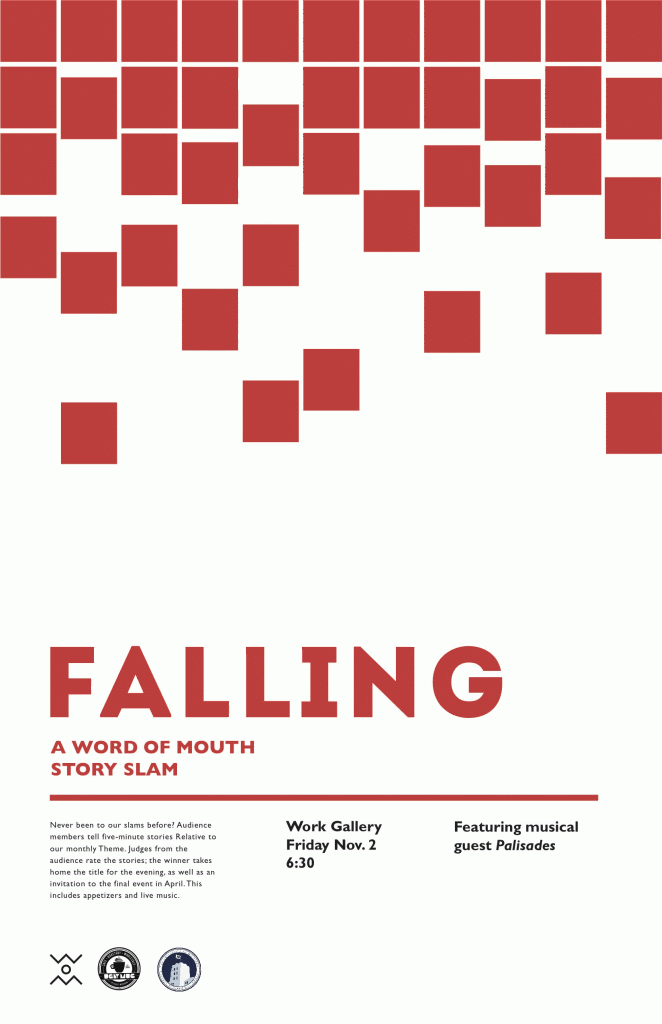
PREVIEW: Word of Mouth StorySLAM: FALLING

WORD OF MOUTH STORY SLAM: FALLING

Ever found yourself in free fall, fallen head over heels, or just down right tripped and fallen? Come tell us about it! Join Word of Mouth Stories for our next

Story SLAM event

Friday November 9, 2012

Work Gallery, 306 State Street

Doors at 6:30pm

Never been to our slams before? Audience members tell five-minute stories from their lives relative to a theme. Judges from the audience rate the stories; the winner takes home the title for the evening, as well as an invitation to the finale event in April. The friendly competition includes appetizers and live music.

This month’s performance will feature student band Palisades and coffee will be generously provided by The Ugly Mug. Sponsored by Dawn Treader and funded by Central Student Government. This month’s theme is FALLING. Whether it is about stumbling, bungee jumping, falling from grace or falling in love, come share your story at our SLAM.

Hope to see you there!

In the meantime, check us out online:

BLOG //FACEBOOK PAGE //SOUNDCLOUD

And take a listen to this months live performance by Palisades on Facebook or Band Camp

To get emails about more upcoming events and workshops or to join our planning crew, shoot us an email.


REVIEW: God of Carnage

“We are all civilized people, wich means that we are all savages at heart but observing a few amenities of civilized behavior.” -Tennessee Williams

Tonight in Studio 1, the liberal principles of two married couples were torn to shreds before my very eyes in 80 short minutes. Of course, this spectacle was in the guise of a play called God of Carnage by playwright Yasmina Reza, but does that make it any less real? Basement Arts (the source of tonight’s entertainment) is a long-standing student organization, but student organization it nonetheless remains. As such, this means that the quality of the shows they put on is hit-and-miss. “Hit-and-miss” is the nature of all theatre, professional, student, or amateur – but you would be mistaken if you were to suppose that the hits are irreproachable and that the misses are worthless. The directors, performers, and designers for Basement Arts are all students, and this means that, hit or miss, everyone in the room can learn from any kind of performance. In a sense, this is educational theatre – as educational for the actors as for the audience.

Let me first make myself plain: tonight was a success. I have been to nearly every Basement Arts production in the last year, and I must confess myself far more impressed than usual. The scenery was suggestive without being minimalist or reductionist, and I didn’t hesitate to suspend my disbelief. The props were especially clever (particularly the pillow – but I’m getting ahead of myself; we’ll come to that). The momentum of the play was airtight; kudos to director Austin M. Andres on that score. The small cast of four actors had a tough job – Reza’s work is difficult to execute effectively – but I think on the whole it was done right, and done right, the play is monstrously funny and appallingly delicious.

The setting of the play is the living room of Michael and Veronica Valone (Josh Aber and Zoe Kanters). They have invited Alan and Annette Reille (Nick Skardarasy and Emma Sohlberg) over to discuss an incident involving the couples’ sons, who were involved in a physical altercation at a public park. Rather, the Valones’ son was struck in the face by a branch wielded by the Reilles’ son, and the two couples attempt to make some kind of an understanding about it. For a minute or so, all seems civilized – if strained – but soon the pretense gives way to unbounded cruelty. It’s almost like Lord of the Flies, only the people are adults and the “island” is a living room.

Each actor tonight surprised me in various ways, but Skardarasy as the viciously intelligent Alan deserves mention as the stand-out performance of the night. Not once did I doubt the reality of his being. He embodied people I know, people I get along with famously, people I hate – all in the span of eighty minutes. His deadpan comic timing was right on – it was Alan’s deadly seriousness that made him funny, his dry and witty sense of humor that made him loathsome. Certainly God of Carnage was very well cast by a director who knew precisely what he wanted: clear archetypes. Emma Sohlberg was instantly recognizable as the almost Gothically prim wife of harried Alan, presumably a law advisor for a pharmaceutical company currently under scrutiny. His constant incoming phone calls were something of a joke throughout the play. Kanters as Veronica made a convincing self-righteous (and selfish) bleeding-heart liberal, while Josh Aber had a respectable run as her affable, simple, husband.

The genius of this kind of play (and its translator – let’s give credit here where it’s due – Christopher Hampton translated admirably this masterwork from the original French) is that, similarly to Chekhov’s best plays, no one character is the hero or heroine, yet no one is the villain. Still, this isn’t realism. Each character represents all of us, in a way – not entirely a victim, not entirely culpable; but at the end of the day, there is a mixture of pity and hatred for these characters. This is the only way that a play such as this can be successful.

A moment should now be taken to appreciate a part of the play that was so convincing it was almost alarming. Annette, after eating some of Veronica’s cooking, becomes ill, and yes, vomits onstage. Moments like this are so easy to glaze over, to half-ass, or to present apologetically because the director could not find a way to present it without looking foolish and phony. Not so in this case. I am told the vomit was very cleverly concealed inside a pillow that Annette held moments before she “puked.” It actually looked so real that it took a few minutes for me to decide fully that it had indeed been staged, since the characters were moving on with the play and not pausing to inform us that Ms. Sohlberg was truly ill. A very loud hand for this brilliantly conceived moment.

Of course, there were bits that annoyed me somewhat. A couple of times, I felt that the director was reaching for comedy by trying to force a laugh out of a moment that didn’t really warrant one – instead of playing the truth of the characters’ emotions and letting the audience decide when to laugh. This is certainly when the play was weakest. Happily, I can report that these moments were few and overall not corrosive to the rest of the play. Indeed, the truth of moments is what is memorable (Alan stonily quips, “Our son is a savage,” without a hint of bitterness or irony – it’s hilarious); the moments that tried to produce comedy rather than truth were forgettable. Cheaply manufactured “comic” moments rob themselves of humor and rarely make us laugh – one of the great paradoxes of the theatre.

All that aside, though, I enjoyed myself very thoroughly; something of that savage nature displayed in the four characters is awakened in the spectator, who gruesomely revels in the way the couples tear each other to shreds. It’s delightful. One of the greatest structural elements in the play is the way that the characters form and dissolve alliances with the speed of a bullet. Husband and wife wrestle with husband and wife; the next moment, it’s men versus women; at some times, it’s three-on-one. It is probably the most disconcerting and truthful element of the playwright’s storytelling: these are things that we all do. Consciously or not (probably not), we truly are savages competing under the laws of the “God of Carnage” invoked by Alan towards the end.

This is a play where each person starts out with noble intentions, and then for one reason or another, abandons them for the laws of the jungle. It’s important to note that all four people “lose” something important to them: Alan’s phone, his precarious link to his high-stakes job, is drowned in the flower pot by his own wife (she’s made bold by her drunkenness at this point); Veronica’s book is ruined by Annette’s vomit; Michael’s excellent rum is all drunk (again, mostly by Annette), and moreover, his secret phobia of rodents is made humiliatingly public; and by the end, Annette has lost her dignity, reduced to a sobbing wreck (“It’s the worst day of my life, as well”).

If tonight’s show is anything to reckon by, this will be a good year for Basement Arts. Let’s keep these hits coming.

Review :: New Music and the UM rendition

University of Michigan’s own Contemporary Directions Ensemble, otherwise known as CDE, is a group dedicated to playing contemporary music. What the hell is that? Steve Reich, a highly-praised, NYC based composer said, “…the essential difference between ‘classical music’ and ‘popular music.’ And that essential difference is: one is notated, and the other is not notated.”

Contemporary music a.k.a “New music” is a genre of notated music that appeals to a modern aesthetic. Similar to the way in which Beethoven was a revolutionary of his time, composers alive today like Steve Reich, Philip Glass, John Cage, Iannis Xenkis, David Lang, John Luther Adams, and a cast of others, are revolutionizing our ears and our minds. New concepts and definitions of sound and music are being realized almost daily. These composers have been classical trained but have moved so far past the archaic term, “classical” which no longer comes close to describing what they do.

Modern art – music meant for the art galleries and the coffee shops, the intimate venues and the outdoors, the art goers of today and the musicians of tomorrow. This is 21 century shit.

CDE >

Conducted by Christopher James Lees, and made up of graduate students, CDE is a small group – about 20 large. This past Thursday night, their show entitled Fathers and Sons let them all rip it. They played driving music like the Son of Chambers Symphony, paired with the sound explorations of John Cage, paired with the 20 minute long bassoon solo, paired with the in-house piece by Kuster, dedicated to her father now past. Incredible textures, wild combinations, and innovative sounds. A buffet for the ears

The gorgeous program ~

Here, Leaving by Kristin Kuster, premier by U-M composition faculty member

How we got here (4th edition) by Luciano Berio, bassoon solo complete with circular breathing

But what about the noise of crumpling
paper which he used to do in order to
paint the series of “Papiers froisses” or
tearing up paper to make “Papiers
dechires?” Arp was stimulated by water
(sea, lake, and flowing waters like rivers
forests)

by John Cage. Yes, all one piece. Simply Beautiful

Son of Chambers Symphony by David T. Little

I would describe everything in detail but as a friend told me once, “it’s like when someone tells you a joke is funny before you hear it decide for yourself.” In light of that, I would love to hear your thoughts. Listen to a couple of these, Catch a John Cage concert it’s his 100 birthday this year (if he was still alive) and I’m nutty about it. If you don’t hear of any, just get in touch.

Hunter Chee

REVIEW: Earth Without Ice

Earth Without Ice

On Thursday October 25, the Kerrytown Concert House hosted an ‘Out of the Box’ musical performance, arranged and enacted by professors from several departments: Henry Pollack of Geophysics, and Steve Rush and Michael Gould of the School of Music. As part of the Abacus and Rose: SciArt Live series, which pairs scientists with artists, the trio of scholars created a stylish, modern piece called ‘Earth Without Ice.’

The performance consisted of a series of noises that soundtracked a slideshow of images projecting from screens on stage that faced the audience. The ‘immersive sonic landscape’ was composed of ‘found sounds’ taken from the Huron River. The photos came from Dr. Pollack’s visual journal as part of his most recent transit of the Northwest Passage from Alaska through the Canadian archipelago to Greenland. They featured vast oceans, floating chunks of ice, inuit peoples catching and gutting fish, elders laughing together, youngsters playing, seals and polar bears splashing, open earthen landscapes, and lots and lots of factories. The contrast between the natural images and the industrial environment was striking. The music was appropriately mixed to match the effect of the scenery. The recorded, manipulated, and live noises created an unusual interplay of sound which caused a strong affect on the curious audience.

The inspiration for the content came from Dr. Pollack’s recent book ‘A World Without Ice.’ The style, however, seemed to be inspired by a  hybrid of John Cage’s Water Walk and Andy Goldsworthy’s nature photography. I liked the performance a lot.  It conveyed a strong message about expressing the danger of climate change through artwork. It was a very unusual performance, but equally entertaining and certainly out of the box.

PREVIEW: Bat Boy, the Musical

Yes, Bat Boy. The School of Music, Theatre, & Dance will be performing the musical at the Arthur Miller Theatre, Nov. 15-18. This American musical was written by Keythe Farley and Brian Flemming with music and lyrics by Laurence O’Keefe. The plot is based on a June 23, 1992 Weekly World News story about a half-boy, half-bat, dubbed “Bat Boy”, who grew up living in a cave. It has never made it to Broadway, but succeeded for several years Off Broadway, winning several awards such as the Elliot Norton Award, the Richard Rodgers Development Award, and the Richard Rodgers Production Award. I think it’s going to be good, and it’s by the Musical Theatre school so, needless to say, expectations should be high.

Bat Boy the Musical
Bat Boy the Musical

Get your tickets soon!!

citations:
http://en.wikipedia.org/wiki/Bat_Boy:_The_Musical
http://events.umich.edu/event/9696-1171537