REVIEW: An Evening of Dance

Dancelucent 2012 was held by the School of Music, Theatre, and Dance on February 3 and it was held at the Power Center for the Performing Arts. The evening began with a piece called “Been a Long Time” which was very rock and roll and it included music by artists like Led Zeppelin and Frank Zappa. The piece was choreographed by Bill DeYoung and it was an experimentation of interactions between all of the dancers. There was a plot to the piece that could be interpreted by the audience and the dancers featured were confident and able to create emotions individually as well as through interactions with other dancers.  The seven movements of “Been a Long Time” each had a purpose and led smoothly into the next and the different songs used were of similar style.

The second piece was called “Forest Through the Trees,” was a repetitious, but diverse dance that was narrated by a woman portraying Gertrude Stein. The Making of Americans by Gertrude Stein was read during the dance and the choreography followed the narration of the piece. There was an amazing video that accompanied the dancers by Peter Sparling and it made the perception of the piece altered in that there were so many different elements happening at once. The colors of the video were interesting and the dancers were featured in the video. Dancelucent gave the world premiere of this piece.

“Lightmotifs” also had its world premiere at Dancelucent. It was choreographed by Robin Wilson, who is an associate professor at the University of Michigan. This piece had a lighter feel to it and began with a very cute slumber party scene. At one point, there were some bicyclists riding around on stage! The final part of “Lightmotifs” had a gospel feeling to it and the costumes were vibrant and had great movement. The whole piece was very uplifting and was overall bright and cheery.

The final part of Dancelucent was Dance #1, which was based around a piece composed by Philip Glass. Lucinda Childs, who was involved in Einstein on the Beach with Philip Glass, choreographed Dance #1. As it was composed by Philip Glass, the dance featured elements of iteration. There were subtle changes with the music and it was fun to get lost in the piece but at the same time notice the changes every once in a while. Overall, the piece was interesting because it changed my perception of time and gave me an insight into the subtleties of Lucinda’s choreography.

Dancelucent was a diverse and beautiful event that displayed the great talent of the University of Michigan’s School of Dance through modern dance. The choreography was exceptional and it was great to see that our School of Dance does high quality work.

REVIEW: “Great Lakes, Fragile Seas”

Yesterday afternoon, I went to watch the National Geographic documentary screening my friend Emma was hosting, entitled “Great Lakes, Fragile Seas.” National Geographic is always good, so I wasn’t worried about being disappointed. Emma’s dad, Tom, was answering questions afterwards too, and that man’s knowledge knows no bounds when it comes to the Great Lakes (near Traverse City, MI, he manages and teaches at his environmental education program, Inland Seas Education Association).

The movie is actually about twenty years old, but the facts were, for the most part, up to speed with today’s environmental reality. It introduced us to a world of beauty and of horror: lengthy shores and shimmering water turned sour by the staggeringly large amounts of slimy, squirmy sea lampreys, invading the pristine Great Lakes. It also showed the effects of pollution, years after being allegedly taken care of, on birds and their poor, twisted beaks. It was really disturbing, to be honest. Even just looking at small organisms, a certain species of plankton, that’s relatively large, barbed tail apparently feels like swallowing a sword to the poor fish that attempt to consume it. The effects of pollution and of invasive species on the Great Lakes are really astonishing.

It also compared the methods of those native to the swampy marshes on the shores, like a tribe of Native Americans, to the over-industrialized approach of today’s harvesters. They harvest wild rice by whacking at the plant with these sticks, using enough force to let the rice fall into the bottom of the boat, but not so hard as to destroy the entire crop. This respectful method for collecting the rice has allowed the cycle of growth and harvest to continue for decades. I thought the film presented a beautiful way of how traditional methods, that have lasted for years and truly works, have proven, scientific benefits as well.

Another thing I loved about this film was its relation of the culture of those living way up north, surrounding the Great Lakes and how in their given environments, they’ve developed a unique way of living. For example, a small town made a racetrack out of the frozen lake in the winter. It was fantastic and I so want to try.

My thanks go to Tom Kelly, for answering questions pertaining to the current state, an ever-changing predicament, of the Great Lakes. It was an informative and not-too-boring documentary on a very intriguing, relevant issue of today.

For more information on Tom Kelly’s Inland Seas Education Association, see their website: http://www.schoolship.org/

PREVIEW: The 8th Annual Faculty Exhibition

For the past three week, the Slusser Gallery in the Art and Architecture building  has displayed an exhibit of faculty art work. A variety of mediums, from ceramic to painting, sculpture to photography, video installation to fibers, The 8th Annual Faculty Exhibition publicizes current creative endeavors of professors at the art school. In anticipation of the closing reception, which is this Friday, I made a trip to North Campus to explore the display. I was highly impressed by the pieces. These professors are true professionals and their craft is cutting edge. Several captivating portrayals of nudes caught my attention, as well as curious ceramic sculptures of over sized honey combs, and a self-portrait series of the artist in a body brace that alludes to Frida Kahlo’s famous work.

Only a few more days to get in on this art action. To celebrate the creativity, be sure to get to the closing reception:

Jean Paul Slusser Gallery

UM School of Art & Design, 1st Floor

2000 Bonisteel Blvd.

Hours

Monday through Friday: 9am – 5pm, Saturday: 12 – 7 pm

Closing Reception

Friday, February 3, 6-9 pm

PREVIEW: Great Lakes, Fragile Seas

Friday, the 3rd from 3-5 there will be a free screening of the National Geographic documentary “Great Lakes, Fragile Seas” in room 126 east quad. Can you hear the whooshing sounds even as you read this preview?? Should be a very educational film and beautifully done (hello, have you read National Geographic magazine?!).

On the facebook page, it says the film “describes the Great Lakes region as a melting pot of traditions. The waters that sustain the wildlife also shape the lives of people on the shores. The survival of their customs depends upon the preservation of the lakes.”

But wait – there’s more! Following the screening, director of the Inland Seas Education Association based outside Traverse City, MI and U-M alum Tom Kelly will be leading a group discussion. Having met Tom through his daughter Emma, I can assure you it’s going to be a very interesting conversation.

Come get informed! See you there 🙂

REVIEW: Maira Kalman and Daniel Handler in the Penny W. Stamps Lecture Series

I say it was confidence: the hidden gem of this university is the Penny W. Stamps Lecture Series.

Every Thursday at 5:10 pm at the Michigan Theater, the School of Art and Design hosts one of the most stimulating, well curated lecture series I’ve ever been to. Not that I am a wide connoisseur of lectures,  but this particular series is, in my opinion, free entertainment– one hundred percent. I may be preaching to the choir since it is a requisite for students of A&D. Even if you do not have a strong proclivity for the arts, the series also runs talks on all kinds of innovation: think cities, sustainability, film, fashion; anything and everything progressive, bright, and mindful.

Last week, Daniel Handler and Maira Kalman, a writer and illustrator respectively, spoke about their newest collaborated work, a nearly-graphic novel called Why We Broke Up. Before I continue, let me just say that you probably know at least one of these artists quite well. Well, your childhood book shelf does. If you were born of the nineties, you surely read A Series of Unfortunate Events, no? Well Daniel Handler is the man behind the madness, the renowned and yet oh so discrete Lemony Snicket.

With a name like Lemony Snicket, I imagined he would be haggled as Count Olaf, his villainous character. But not remotely. Tall and dressed in a suit, he stood beside his artistic counterpart Maira Kalman, an endearing-looking Californian, and worked the crowd from the start to finish. Professional comedy. The dynamic of the two mirrored that of an adorable old married couple (though they are not). They bickered, interrupted, and mocked each other’s habits, but ultimately, their humor exhibited a true sense of camaraderie in the presentation of the work.

Why We Broke Up is about first love. And, as the title reveals, first heart break. The story is told through the illustration of objects. Kalman paints figures that are simultaneously whimsical and stunning with realism. Min, the heart breakee, gives Ed, the heartbreaker, a box of keepsakes that represent their relationship. Each belonging turns a page and gives voice to the tale of their romance. The captions that correlate with each image are written by Handler (the two artists live on opposite coasts and created this work by mailing each other corresponding images and snippets until the book was complete).

This review I am writing makes the lecture sound as though it were morose and heart wrenching when, in fact, the crowd was in hysterics the entire time. At the end of the presentation, audience members filled out a quiz that scored their level of romanticism, responding to questions read aloud such as “Unicorns are special,” and “I like the hair you leave on your hair brush.”

You know, I’m just not getting the humor across in the same way that Handler and Kalman did. They are professionals. Read it from them at the Penny W. Stamps website. And click here to read about upcoming lectures, including this Thursday’s High Line: New York City’s Park in the Sky by Robert Hammond. It’s a talk about the future of urban infrastructure coming to life–should be interesting! My dad, an avid environmentalist, is driving into Ann Arbor to hear the lecture. Afterward, we are getting Earthen Jar. A great father-daughter date. I suggest you do the same with some body; Penny Stamps is a great way to start the weekend!

REVIEW: Ann Arbor Folk Festival Ryan Adams

Friday, January 27th was the first night of the 35th annual Ann Arbor Folk Festival. The Hill Auditorium was sold out, but many people didn’t arrive until about half-way through the night, as there were 7 performers total, not including Heywood Banks, the MC who entertained the crowd in-between bands with comical songs and cheesy jokes. My favorite was the “Toast” song, where he banged on a toaster like a drum and sang about how great toast it! Sometimes really silly humor is fun and refreshing.

The first performer to take the stage was Sunny War, a beautiful African American woman with incredible skills in her clawhammer, banjo playing style of playing the guitar. Her sound was delicate and airy, with a bluesy tone. Her voice was very girly and pretty, with an element of old-hollywood simplicity and elegance. Her songs were very calming, and I really enjoyed listening to her.

Second to perform was the band Elephant Revival, who reminded me a bit of the contemporary bluegrass group Nickel Creek. They had a very full-sounding band, and often sounded very rustic and traditional. I loved the strings, and that their songs often built in intensity over time. The vocals were beautiful and breathy, a nice contrast to the full-sounding band. They performed an a capella song as the last in their set, about a raven, that was absolutely beautiful and breath-taking.
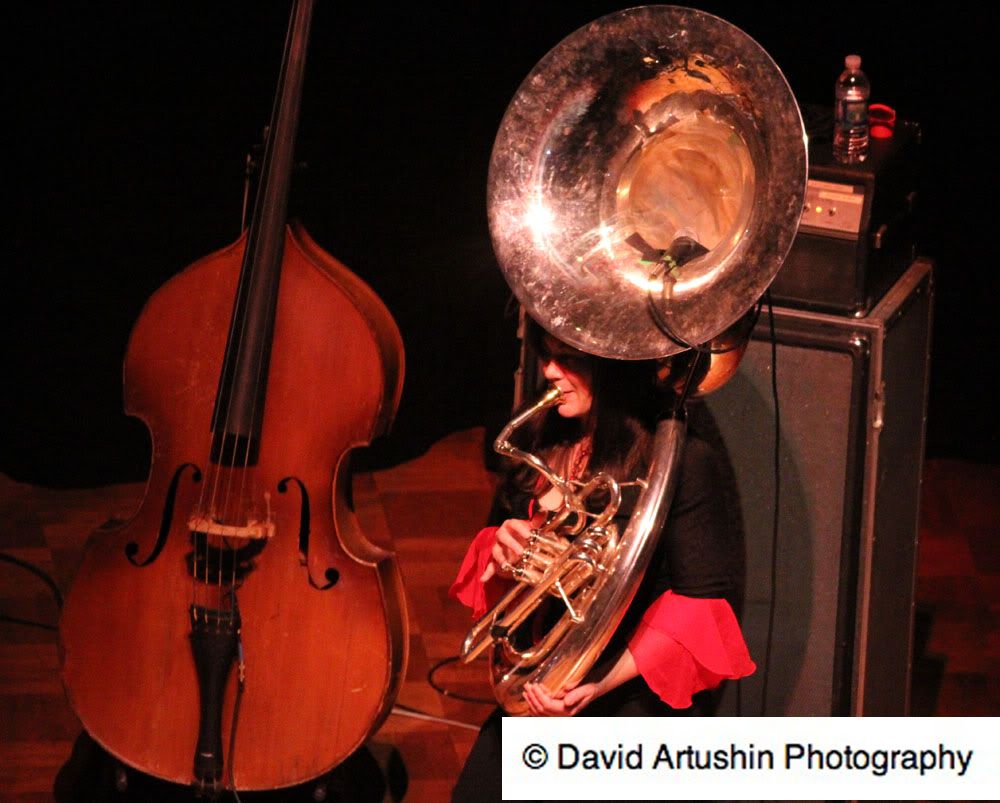
The David Wax Museum was next to perform. The band members wore much more modern dress than Elephant Revival, and had a much tinnier, less full sound. The band has a Mexican-folk sound, and they used a unique addition, a saxophone, in some of their songs, unusual in my conception of folk music. I felt that some of their songs were a bit too loud–not one of my favorite bands being showcased that night. But one of the great benefits of attending the folk festival is having the opportunity to be exposed to artists that you are unfamiliar with, so nonetheless I enjoyed experiencing their music for the first time.

Next to take the stage was a band called Carbon Leaf, a group of older men who reminded me a bit of a folk barbershop quartet, as they all stood in a tight circle throughout their performance, beginning their set with an a capella piece, in which their voices were beautifully in unison. Aside from the beautiful opening piece, however, I can’t say their music was my cup of tea.
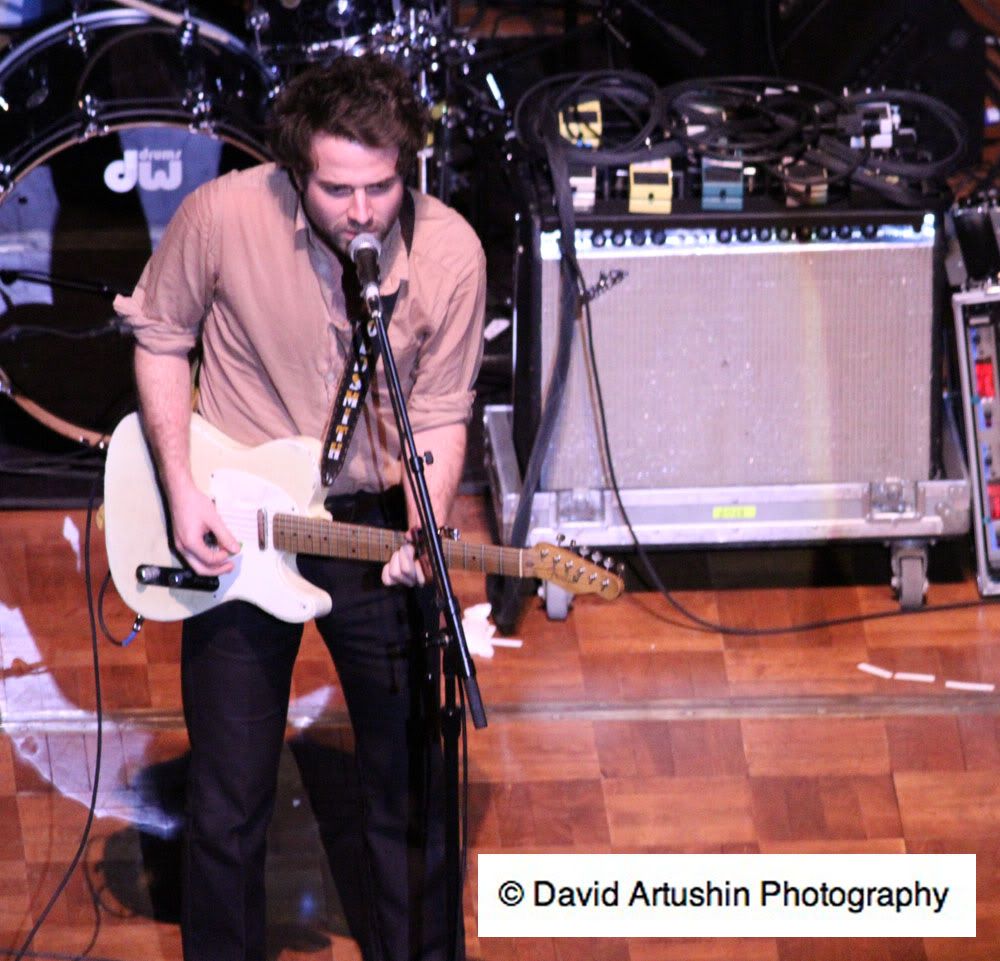
A band called Dawes was next to perform, the last band to perform before the intermission. They were a bit too rock n’ roll for the folk fest, in my opinion. They had a full band with electric guitars, drums, and a piano. Their songs were quite repetitive and the droning drum beat made me sleepy!

After the intermission, Devotchka took the stage, a Denver band with a Russian name. This band was very unique, with each song having a much different sound. At times it reminded me of Fiddler on the Roof, others I felt like I was being serenaded by a Mexican band–I also wrote down that their sound sometimes reminded me of a Jewish wedding, that song, The Devil Went Down to Georgia, and sometimes even of bands like The Boxer Rebellion or Coldplay. Despite the variety that caused a bit of confusion for me, their sound really began to grow on me and I found myself looking up their music online after the concert. The band did seem to play for a bit too long, however. The other bands that were not headlining only played for about 30 minutes each, while Devotchka played for over an hour, which seemed to be a bit unfair. By the time RyanAdams, the headliner for the evening, took the stage, I was pretty worn out.

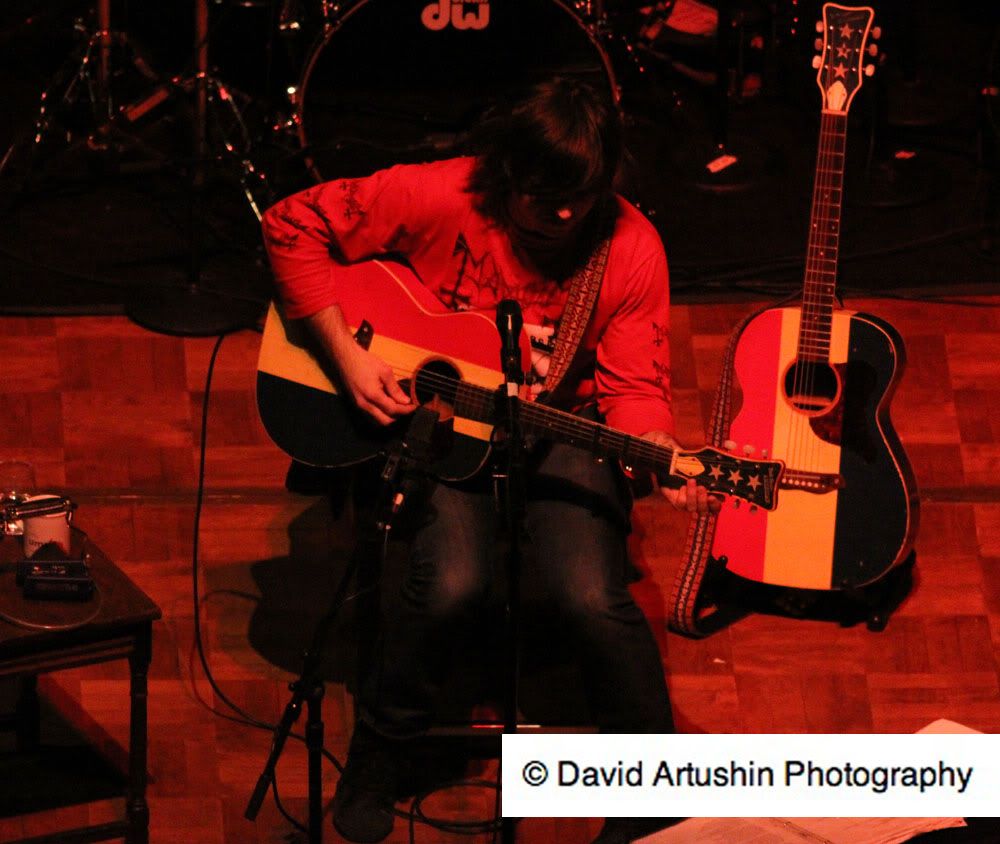
Finally, Ryan Adams ended the evening with an incredible acoustic performance. He was not what I expected–his songs are so beautiful and sensitive, but in person he dressed like a rocker with medium-length dark hair that falls in front of his face, hiding his face throughout the performance, and skinny jeans with Converse shoes… Not what I expected. His humor was also a bit different and weird at times–he joked about dinosaurs and smoking weed. But his music was beautiful! He played a lot of his hits, switching between acoustic guitar and piano on several occasions. He sounds just perfect live–I was very impressed. His performance was far too short–it seemed that most of the crowd was there to see him, but we all had to sit through four hours of other bands’ sets in anticipation. By the time Ryan Adams took the stage, unfortunately I felt quite restless and tired from sitting for so long.
This was my first folk festival experience, and I have to admit I’m not sure that I would go again… I would certainly recommend that you go and experience it once, because it really is a unique opportunity to see a lot of great bands in one night, and it is the biggest music event of the year here in Ann Arbor. But the Hill Auditorium was not the most conducive setting for something like a folk festival. I imagined the festival being a very laid-back event where you come and go as you please, and it’s loud, and exciting, and people get up and dance and enjoy the music, take pictures and sing along. But none of this happened. The Hill imposed a lot of rules on the event, like no getting up to come or go during a song, no photography, no standing in the aisles… We were forced to sit in our incredibly cramped seats for five hours. No one took pictures, (except quickly and secretly so no one notices!) no one sang along or got up to dance the entire time. And in the end, the audience clapped and cheered for an encore to no avail. Then we all went home. It really was much too quiet and boring, really stuffy for a music festival. I would love to see the folk festival move to a different location that is freer, possibly even outdoors during the summer. I think the atmosphere would have made a big difference in improving my overall experience of the festival.