PREVIEW: MOCHAS + MURALS: WALKING MURAL TOUR

There is nothing more Ann Arbor than sipping on a Zingerman’s mocha while staring at the city’s beautiful murals. Which is why I am excited to take part in the Mochas + Murals Walking Mural tour taking place this Friday (9/16) from 12:00 pm to 1:15 pm at the A2AC. If you want to sign up, spots are limited and may already be filled! However, there is another event offered on October 2nd. So if your interested check out the A2AC website at this link: https://www.annarborartcenter.org/beyond-the-pail/.

PREVIEW: RE:CLAIM : IMMERSION


Come visit the Washtenaw County Courthouse tonight (9/15) from 5:30 to 8:00 pm to experience the opening night of RE:CLAIM. RE:CLAIM is a project seeking to honor the complexity and diversity of the community impact of the criminal legal system as it affects youth, adults, and families.

Tonight will be filled with song, dance, poetry, and visual arts. It will surely be an experience to remember with over 30 dancers, poets, and musicians performing. The night will also include poems featuring artworks from the Embracing our Difference Exhibition that took over Gallup Park, Leslie Science and Nature Center, and River Side Park.

REVIEW: These Precious Days by Ann Patchett

Ann Patchett’s recent collection of essays, These Precious Days, is a tour de force that traverses a wide range of themes and the author’s life experiences. There is, however, a weighty thread running through the book, which reads more as a personal memoir than an essay collection – mortality, particularly in connection to the pandemic and the last several years.

In the book’s introduction, entitled “Essays Don’t Die,” Ms. Patchett, a prolific novelist, explains that when she is working on a novel, “were [she] to die, [she’d] be taking the entire world of [her] novel with [her]”, and “the thought of losing all the souls inside [her] was unbearable.” On the other hand, essays offer a way out: “death,” she notes, “has no interest in essays.” Hence, These Precious Days is a collection borne out of 2020, the COVID-19 pandemic, and the resulting inability to avoid our own mortality. “Death always thinks of us eventually,” she writes, adding that “the trick is to find the joy in the interim, and make good use of the days we have.” Ms. Patchett’s essay collection is a tabulation of that joy.

The essays themselves are vivid without being florid, and poignant, but certainly not saccharine. They are humorous at times, and melancholy at others. They offer a small window into Ms. Patchett’s childhood, education, writing process, and personal life, touching on her family, relationships, bookstore, and even her knitting. One of my favorite essays, titled “Reading Kate DiCamillo” is a reflection on children’s literature from an adult reader’s perspective. (Ms. Patchett writes: “These books had given me the means to look backwards. I marveled at the resilience of children who were strong enough to read such sad and beautiful novels full of prisons and dungeons and hunger and sorrow and knives.”)

“These Precious Days,” the book’s title essay, is simultaneously the unlikely story of how Ms. Patchett and her husband spent quarantine with Sooki Raphael, who happened to be Tom Hank’s assistant, and a meditation on life, death, and the human experience. Though the essay could gleam with the star power of the celebrity names included in it, it instead ends up being a real and tender story of regular people. Ms. Patchett notes in the introduction that this “essay was so important to me that I wanted to build a solid shelter for it” (These Precious Days, the book, being the result). It is the longest essay in the book, pithy and raw in a way that stings, and I stayed up reading it into the early hours of the morning because I could not stop in the middle.

Though death is a current present throughout These Precious Days, “the river that ran underground, always,” the essay collection is ultimately about life, and the people and moments to be cherished. It is a beautifully-crafted literary reminder in trying times that, even when death and shadows lurk, there is still life, and there is still joy.

REVIEW: That Brown Show

That Brown Show, presented by Michigan Sahana, is an annual event that showcases South Asian performance groups at the University of Michigan. The show allows for members of the South Asian community and others to enjoy a night of traditional and not so traditional performances. The night started off with a performance by Michigan Sahana Music, who performed Indian classical music as students showed their skill with various instruments as well as their voices. Also performing a musical number was Maize Mirchi, a South Asian a cappella group that presented a Hindi-English fusion song mix. I really enjoyed watching their performance and loved how they were able to combine songs of different cultures into a cohesive production.

The various dance performances were also very entertaining to watch. Michigan Sahana Dance and Michigan Mayuri both performed Indian classical dances that were traditional in style. Both groups were very skillful and expressive, able to communicate an entire story through dance. Michigan WolveRAAS also performed, mixing traditional regional dance styles with some contemporary elements. Their performance was extremely energetic and very entertaining to watch. South Asian fusion teams Michigan Taal and Michigan Manzaat also danced, mixing Bollywood and South Asian music and dance styles to create incredible and unique programs. The night ended with a series of thank you’s as  WolveRAAS won the judge’s choice award and Manzaat took home the audience choice award. I truly appreciated the sheer variety of performance groups, each of which offered something new to the audience while still highlighting South Asian culture.

REVIEW: GROW(ING): The 2022 Senior Exhibition

As a Stamps student eagerly stepping into my second year, I find that any glimpse I can get into the work of upperclassmen at Stamps is a treasure. The talent of Stamps students, refined by years of practice, discipline, and creative freedom, is manifested into varieties of works scattered throughout Stamps hallways. Although I enjoy the intricate jewelry and fiber sculptures put on display, many display cases remain empty; I often feel a disconnect from my fellow art students, constantly craving a more in-depth look at how Stamps allows ambition to blossom. The Grow(ing) exhibition was the first deep dive into Stamps work that I have experienced, and it was transformative.

Grow(ing) is a senior exhibition, showcasing the work of BA, BFA, and Interarts students at Stamps. The exhibition is arranged as a maze of large cubicles, each containing the work of one artist, accompanied by a plaque. Art across all mediums is included, from time-based art to wearable sculpture to projections on a floor. The variety is what immediately struck me the most— each artist was able to convey their personal message in truly whatever format they wanted, and this allowed them to communicate effectively, each work standing out from the rest. Three-dimensional art forms dominated two-dimensional, noninteractive art forms in this exhibition, which was shocking to me. I feel as if most Stamps students enter the curriculum with a focus on traditional two-dimensional forms— drawing, painting, et cetera— but Grow(ing) emphasizes the students’ capacity to expand their comfort zones. Stamps’ encouragement to explore creative possibilities paid off in the form of plant-adorned mirrors and enigmatic ceramic furniture sets. Even with limited time on my hands, I couldn’t help but stop at each and every cubicle to absorb the individuality of each space and how the artist’s energy dominates it.

Many artists combined mediums to create deeply layered works. One of my favorites at the exhibition was Silencio by Lissette Quintanilla, a collection of beadwork wearable sculptures that were both displayed on the wall and photographed. Lissette explores her heritage, upbringing, and the intersections of her identity through these delicate sculptures, portraying symbols of identity in a three-dimensional format. Although the sculptures are small, the obvious dedication behind them gave them an air of sophistication that demands your attention. I found that many smaller works throughout the exhibition were outstanding in the same way— although small, they are mighty, carrying a powerful message in a compact and detailed vessel.

Many of the exhibitions were larger sets, complete with instructions on how to interact with the work, lighting elements to boost the atmosphere, or sound elements. Each cubicle represented a fragment of an enigmatic world, a brief glimpse into the colorful mind of a creator. For non-art students and art students alike, the Stamps Senior Exhibition— and any Stamps exhibition at that— is a gift. Student exhibitions are a source of inspiration that naturally renews, encouraging its viewers to create more art, which will build future exhibitions, which will be viewed by more creatives searching for inspiration, and the cycle continues. Art is a beautiful thing, and fleeting moments to stop and appreciate it should be grasped. I look forward to future Stamps exhibitions and you should too!

REVIEW: Home

# Warning! Spoilers!

Welcome to the review of a performance that I think I will remember for the longest time. Was it the best play ever? I liked it, but I have yet many to come that I haven’t seen yet, so it’s hard to say – so how can I say that I will remember it the most? Because I’m pretty sure that there won’t be many plays where I’m invited to the stage!

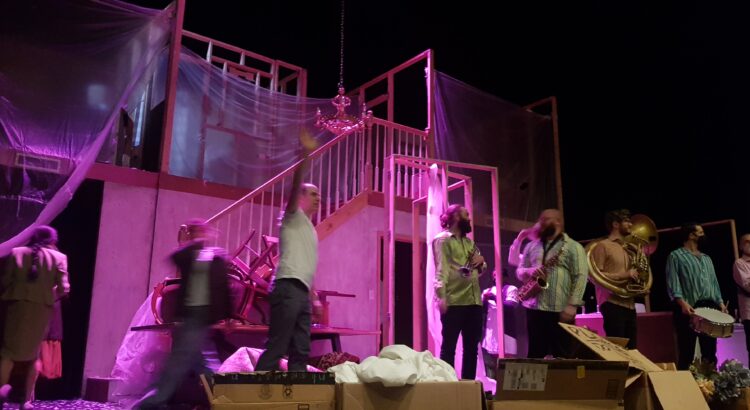
The play started with the mimes of the actors where the construction workers were actually building a house. First, it was a steel frame that looked like more of an art exhibition than a house. Then, they started adding walls, doors, and other appliances and wow, it worked! Personally, I was impressed that they managed to make a working tab on stage – where would the water supply have come from? After the house was physically constructed, the actors started to make it a ‘home’ by acting out daily life situations on stage – showering, sleeping, and displaying different emotions. The actors had diverse ethnicity and age, and they acted out different family/friends relationships among them. After the house was mostly constructed, they moved in and out of view through all sorts of places, including the refrigerator and the closet in the wall! The stage design was so interesting to design the route of actors in such a way. There were also light and sound effects to make the construction really seem like home – my favorite was the one where they created night and day by moving a bright light source from the bottom to the top of the stage, hidden away from the audience’s view, to mimic sunlight. The light was a warm yellow-orange color just like the morning sun and it draw long shadows against the structure of the house. That shadow made the scene look so cozy and peaceful, representing the warmth of a home.

The play got more interesting when a young boy actor put on a mask and came down the stage to invite an audience to the stage. He suddenly became the host of the house and greeted every actor as they showed up with gifts to a party hosted in the house. I was wondering if he was an actor secretly in disguise as the audience because everything was so smooth, but my curiosity was solved soon after as I was invited to the stage as well! The boy showed up with a wine and asked me whether I like a party. I said yes and boom! I was wearing a Santa costume and dancing around the stage. The secret was that the actors were giving instructions to the audience on stage. More than 30 people came upstage throughout the show. I’ve never seen anything like it-it was really an innovative performance.

In all, I think the play nailed its proposal to show what a home is consisted of – physical structure, coziness, old personal items, people living and interacting in it with diverse emotions, stories, and memories. Each was explored without breaking up the flow of the performance and delivered vividly. They were emphasized in the last scene where they were gone and only a fan and ripped plastic cloths were flailing in the wind – the emptiness showed that they were what’s making a house a home. Even without the audience coming up stage, this performance was highly delightful to watch and wonder, yet coming up stage made the event more special. Don’t miss your chance if it hits Ann Arbor again. I HIGHLY recommend this performance.

P.S. This will be my last post writing as a Student Art reviewer for this blog. It was great to deliver the news and reviews about local art and performances around here. Keep your love for arts and go check out the local art scenes as much as possible! Go Blue!