Review: Octavia E. Butler’s Parable of the Sower at the Power Center

This past Saturday, I and some friends saw the Octavia E. Butler’s Parable of the Sower, a new opera developed by Toshi Reagon and Bernice Johnson Reagon from Butler’s masterwork written in 1993 and set in 2024. This musical adaption utilizes the styles of folk, blues, and gospel to tell the story of Lauren Oya Olamina, a young prophet of a post-apocalyptic America. A true parable, this musical provides a sketch of an incredibly rich story created by Butler. Through beautifully layered choral performances and compelling narration, Reagon and the performers offer us the greatest lessons of Earthseed, Lauren’s religion created around the ethos that “God is Change” and that people have a responsibility to shape God, to adapt and learn from the Earth and become its collaborator.

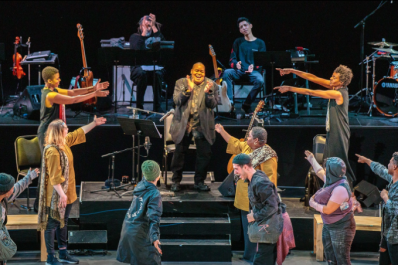
Lauren confronts her community at church.
Colorful compositions reflect the action

She comes of age in a community walled off from the outside world. Her father is a professor and Baptist minister and he along with the other able-bodied adults of the community enforce their security from the outside world. Lauren knows that this can’t last forever and at first her ideas are met with fierce disapproval from those around her. Soon enough, she is proved right in the worst of ways when her community is razed to the ground and she is forced to flee along with a couple of her peers. A lot of the strength of this musical is not so much what happens, but how it’s shown through music, color, and lighting. In one of the show’s greatest moments of pathos, the entire theater goes dark except for single light on Marie Tattiana Aqeel’s face while she, performing as Lauren, beseechingly sings to the crowd “Has anybody seen my father?” During moments of tension, a triptych showing explosive and swirling textures of paint is lighted in various colors.

Toshi introduces herself to the audience

Unlike dystopian works of more recent acclaim like the Hunger Games or the Giver, the world Octavia Butler has created is remarkably familiar but no less terrifying. A lot of the inventions of her future setting have parallels or precedents in reality. (Such as addictive sensory VR technology or new prescription drugs with performance enhancing side effects). As some who has read the source material, I was aware of a lot of the worldbuilding that was left on the cutting room floor. A lot of these details are left out of the musical, but there is one number included which deviates from the main plot line to warn us, the audience, of Olivar. This is Toshi, our narrator’s, solo. Toshi tells us about the “company town” of Olivar, in which people become indentured servants in exchange for housing and stable employment but are really no better than slaves. (This hitting home for anybody?) Toshi interrupts Lauren’s story to remind the world not to sell our freedom for security. Toshi explains the role of the folk singer, to be critical of corruption in society and government, even if it means foregoing conventional life and societal expectations. Toshi, like Lauren, remind us of the consequences of our apathy and complacency.

Refugees wait in line to buy water.

I think Butler’s masterworks should be on the must read list of anyone serious about surviving a changing world or just looking for an incredible and unique piece of literature. Likewise, this musical performance is an emerging landmark work in a new school of Afrofuturist thought. Music lovers will  not be disappointed by Reagon’s opera. The powerful voices of the performers brought many to tears and at various points the audience clapped or sang along. This is a work of “pleasure activism”, something to be enjoyed while shifting the consciousness and asking important questions about our unsustainable economic system. I have no doubt that we will be seeing and hearing more of Earthseed in the years to come.

REVIEW: Cece June, Big Chemical, and Jacob Sigman

Last Friday at the Blind Pig, I had the pleasure of attending Cece June’s set, situated between performances by Big Chemical and Jacob Sigman. It was a cold trek out to the west side of downtown, but as I find with many shows I’ve attended at the Blind Pig, it was definitely worth it. Cece June’s presence in the University of Michigan music scene has grown immensely over this past year, and this set shows exactly why.


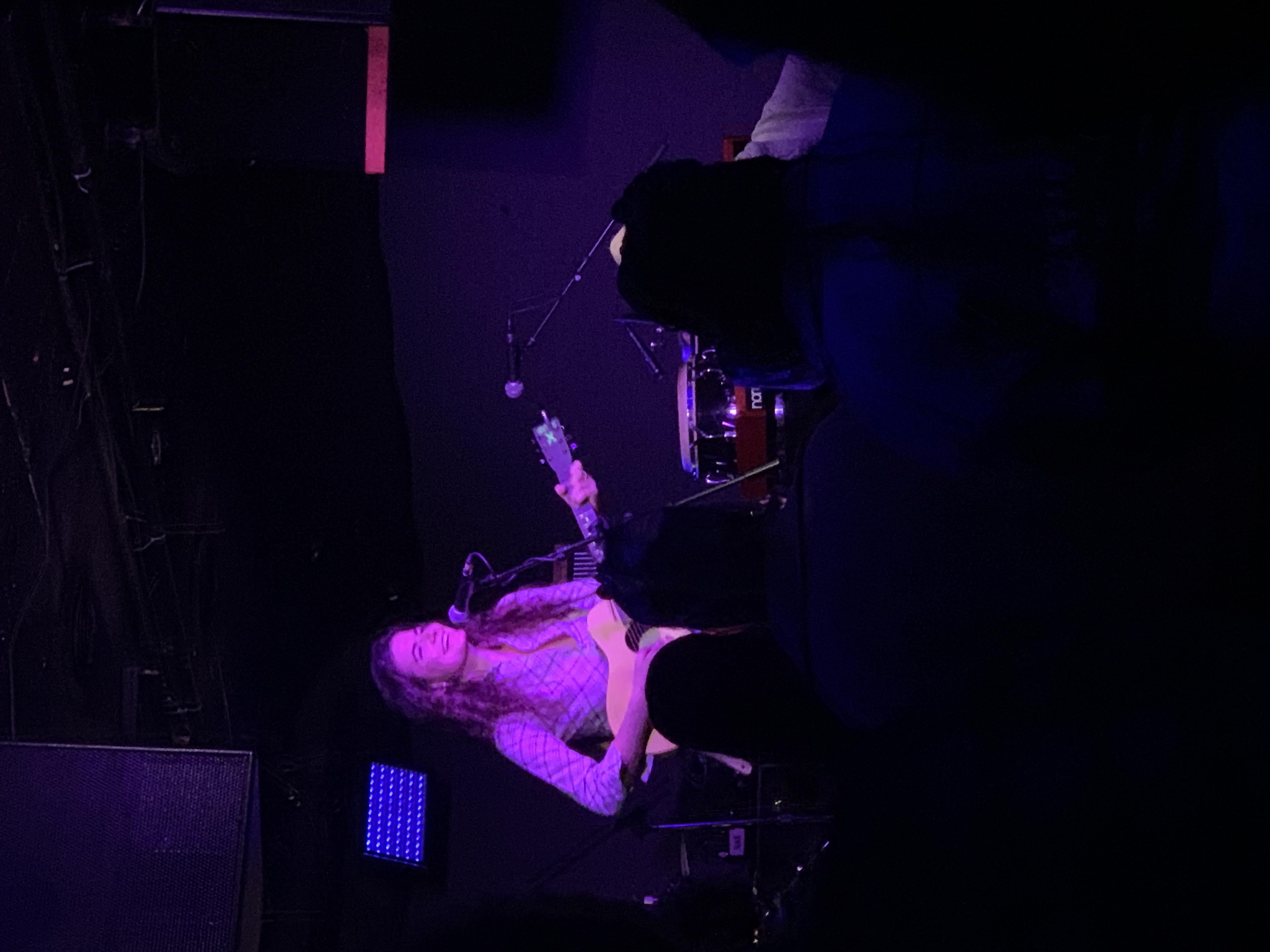
A mix of covers and originals, Cece Durán commanded the room as a solo act with her powerful voice and clear proficiency on both acoustic and electric guitar. She offered a fair amount of music from her excellent EP, and we were able to hear soon-to-be released material from her forthcoming LP. She also had a distinct grip on the mood of the room, offering both thoughtful, soulful moments and energetic, uplifting points throughout her set. Her ability to oscillate between the two and carry the room with her was a joy to witness.


Now a part of a group as well, Cece and the Crawlers, her ability to adapt between solo and collaborative performance shined through that evening. Speaking to this point, during her set she invited fellow act Jacob Sigman onstage and performed a touching duet of an unreleased song of his. Their voices complemented each other perfectly as the power and passion in their musical expression matched so well.


Another highlight included her cover of a song by Nothing But Thieves. This performance showed the way Durán was capable of filling the room with her voice, the ballad providing a certain emotional dimensionality to her set. In addition to her voice, Durán’s capabilities on the guitar were stellar, punctuating and accentuating her act in a highly effective way. The song she performed in her native language, Spanish, was also captivating and showed off yet another facet of her musical oeuvre.


Durán had natural stage presence, interacting with the crowd and encouraging participation in a way that didn’t feel forced or one-sided. It was easy to find oneself singing along, feeling the music just as much as others in the crowd.

REVIEW: Jujutsu Kaisen 0: Jujutsu High

Jujutsu Kaisen 0: Jujutsu High follows  Yuta Okkotsu, a dangerous and powerfully unstable curse user who is unaware of the world of Jujutu sorcerers until he is taken under the wing of another powerful curse user: Satoru Gojo. Yuta, along with the rest of his class at Jujutsu High (a school for Jujutsu sorcerers), learn and grow together, forming bonds of trust and friendship that are put to the test by evil curses and curse users that strive to gain the power Yuta holds.

As underwhelming as the title may be, Jujutsu Kaisen 0: Jujutsu High was a welcome addition to the world of curse fighting, power wielding sorcerers that is Jujutsu Kaisen.  The movie itself takes place a year before the Jujutsu Kaisen anime begins. This allows audiences that haven’t watched the anime to still be able to enjoy and understand the film. And those who are familiar with the anime are gifted with brief appearances of beloved characters from the anime such as Nanami, to give an example.


I personally loved seeing another side of Jujutsu Kaisen brought to life on screen. A personal favorite character of mine from the series is Inumaki Toge, and because he is Yuta’s classmate I was able to see him shine on screen! Something Jujutsu Kaisen does spectacularly well is create depth within every character we are introduced to. The audience is able to learn so much about characters in an entertaining way rather than through tedious expositions.

Another aspect that makes Jujutsu Kaisen so enjoyable on the whole is the humor. Because it is a darker anime filled with blood, gore, and heartache, Jujutsu Kaisen balances itself hilarious character personalities as well as spontaneous moments that cause frequent moments of laughter for the audience. 

I personally am not the biggest fan of darker anime, but Jujutsu Kaisen balances itself so well that I couldn’t help but fall in love.

I would recommend Jujutsu Kaisen 0:Jujutsu High to anyone who would like to dip their toes into a darker anime. If you haven’t seen the anime or watched the manga, Jujutsu Kaisen 0 is a time effective way to see whether you’d be interested in delving deeper. For those of you who have watched the anime and read the manga, it’s nice to see Yuta brough to life on screen!


REVIEW: Who Put Bella in the Wych Elm?

Last night at 11pm, the doors to the Newman Studio opened, letting an excited crowd in to an intimate studio stage decorated in the style of an outdoors campsite: a tent, logs around a fire pit, and the centerpiece, a tree with a mysterious hole in its trunk.

Who Put Bella in the Wych Elm? is a 90-minute one-act horror play, set in the Michigan upper peninsula woods near Lake Superior in the year 2042. Three queer college-age students make a visit to the campsite that Harper, an AFAB nonbinary person, and their childhood friend Olive used to visit each summer. Olive’s recent girlfriend Gray tags along, putting a strain on the childhood best friends’ relationship as they settle into the campsite. The ongoing climate crisis and its consequences are worried about as they come to the site, which is growing increasingly more run-down and abandoned as the world tumbles into desolation. The play takes place over the course of a single night. Written by Emerson Mae Smith and directed by Mirit Skeen, the play was gripping and intense from beginning to end. The talented three-person cast, consisting of Alex Christian, Claire Vogel, and Edie Crowley, stunningly carried forward the plot of the play, revealing mysteries, secrets, and horrors at various twists and turns. 

I was amazed by this play and how it ensnared the attention. In such an intimate setting, it was nearly impossible to remove oneself from the interactions that were going on in the middle of the studio. I find myself, the next day, still grappling with elements of the story and striking moments that stuck with me. The director’s note called the show “an opportunity to explore transness and horror,” and the author’s note emphasizes the importance of queer and trans representation in media: “When trans people are allowed to be full human beings in fiction, with all the complications that brings, we will be allowed to be full human beings within the world.”

I cannot congratulate the writer, cast, and crew enough for this fantastic performance. I will be thinking and talking about this one for a long time.

REVIEW: 60th Ann Arbor Film Festival

The 60th Ann Arbor Film Festival is a goldmine of ingenuity. Although I only experienced roughly two hours of the weeklong event, I left with a newfound sense of what film could be; film could be a series of ambient noises and fractal images, or a stop-motion documentary comprised completely of graphite drawings. It can be a scene of boredom, commonly overlooked but injected with life as soon as a filmmaker touches it. Held at the Michigan Theatre, which I’ve luckily been able to visit a few times for other movie screenings, the Ann Arbor Film Festival’s diverse crowd complimented the extravagance of the theatre’s gilded ceilings, the environment glowing with quiet excitement. Special screenings at the Michigan Theatre always bring a niche crowd of enthusiasts, but this mingling group of filmmakers and film-goers added another dimension of community.

Although I’d planned on seeing A Lantern Through Your Labyrinth: Out Histories of the Ann Arbor Film Festival, schedule changes led me to see the screening just afterward, Films in Competition 6. I entered the theatre with no expectations except to embrace the bizarre. The Films in Competition 6 didn’t seem to have any common theme or genre tying them together, and the variety was electrifying. About a dozen short films were screened one after the other, ranging from two to twenty minutes. They were tales of heartbreak, death, connection, and experimentation. Some were animated, others filmed in bizarre ways with extended shots and unconventional angles. I found that some of them were tediously drawn-out, while others were deeply moving and opened my eyes to new methods of storytelling.

My favorite short film of the night was Life is a Particle Time is a Wave by Daniel Zvereff. The stop-motion film is illustrated with what looks to be charcoal or graphite on white paper, dense lines telling the tale of a widowed old man floating through the rest of his repetitive and lonesome days. The clever sound design is entrancingly ambient, a steady ticking conveying a complicated relationship with time and the slow march toward death. The motif of time is symbolized in the minimal but effective illustrations— of the man repeatedly fixing his watch, of the ominous clock above him, and of his worn-down face. His brush with death sends the film into a fresh segment that is much more experimental. The screen explodes into surreal designs that flow into each other, smudging and warping to evoke the in-between feeling of a chaotic purgatory. The experience is heartwarming, saddening, and utterly human, masterfully speaking to fundamental human experiences in the span of a few minutes.

After the screenings, a few of the filmmakers took to the stage for a Q&A, allowing the community to connect on a personal level with passionate creators. The “festival” part of “film festival” revealed itself more through this degree of interactivity; it was a group celebration, each person a part of the joyous experience, whether they create or just observe. It is a wholly equal appreciation for art in every form.

Life is a Particle Time is a Wave is just one of the hundreds of mind-bending films in the competition. Knowing I can’t possibly see all of them is a bit saddening, but good news: the best of the best will be shown on Sunday! Award-winning films will be chosen by the jurors and screened to the Ann Arbor public, so grab an $8 student ticket and check it out!

PREVIEW: Octavia E. Butler’s Parable of the Sower

Parable of the Sower hits the Power center from March 25th to 27th.

This performance is an opera consisting of 30 original anthems which originate from 200 years history of African-American music. The storyline is from the novels Parable of the Sower’ and ‘Parable of the Talents’ by the late Afro-futurist and science fiction author Octavia E. Butler. These novels are Post-Apocalyptic novels-the story will follow young Lauren Olamina’s spiritual awakening in a dystopian America destroyed by greed and systemic injustice. I’m excited to check out how Opera could be set in a Post-Apocalyptic setting and can be combined with activism, ethnic and humane messages as the background of the numbers suggests. March 25th performance will also feature a brief Q&A with artists hosted by Dr. Toni Pressley-Sanon, the Eastern Michigan University’s Associate Professor of Africology and African American Studies. Tickets could be purchased at UMS website.