REVIEW: The Philadelphia Orchestra

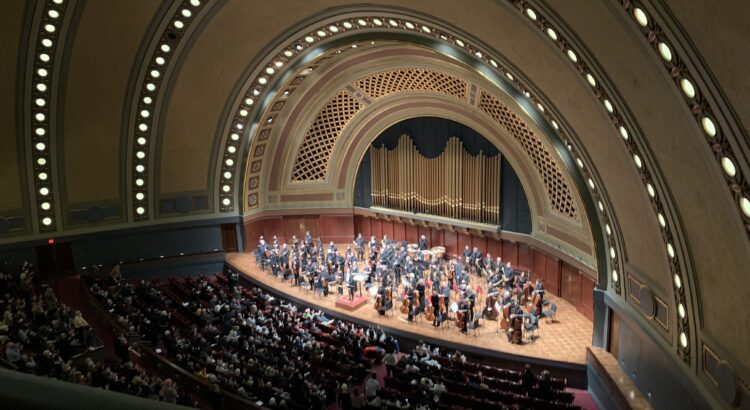
Call me biased, but one of the best parts of being a violinist has to be the concertos. They’re iconic, flashy, and for the musician playing, career-defining. The Bruch Violin Concerto No. 1, in particular, has a special place in my heart, so I was delighted to hear that concertmaster David Kim would be performing it alongside the Philadelphia Orchestra at the Hill Auditorium in concert last Saturday evening. A quintessential staple of violin repertoire, the piece truly comes alive with the many different interpretations by its players.

Opening the concert, however, was a more avant-garde piece by contemporary composer Missy Mazzoli. The Sinfonia (for Orbiting Spheres) sneaks in with a distinctly soft, grainy texture provided by violin and harmonica before expanding to bellowing slides in the lower strings. A mixture of serene and ominous, the composition gives off the impression of irregular, interfering sound waves to convey the vastness of space. Due to its unique instrumentation, they had to take some time to switch out quite a few instruments before the following concerto!

If I were to give one word to describe each movement of the Bruch, I would say intense, longing, and triumphant. However, what makes the concerto so compelling is the complexity of emotion that lies within each category. The violin enters the first movement with a subtle, unassuming G, before erupting into crisp double stops and finger gymnastics. The orchestral passages here, a textbook example of tension-building, are somehow just as attractive as the solo. David Kim’s version had an unmistakably sweet quality, which particularly shined when he got to the slower second movement. From the balcony, I had a great view of his precise bow control which allowed for both a timid, “held back” sound and an unhindered singing voice above the orchestra. In contrast, Kim’s third movement was light, clean, and playful despite the heaviness of all the chords. It was a pleasure to be able to hear in person.

Concluding the concert was Schubert’s Symphony No. 9 in C Major. I had never heard it before, but a particular amusing comment written by Doyle Armbrust of the Spektral Quartet in the program guided my listening: “Franz Schubert wanted to be an opera composer with all the desperation of a hollow-eyed film school grad shopping a script from his garden-level studio in Burbank. My take on him is that he would have been a lot like that one friend — you know, the one who appears to have taken up permanent residence on your couch, but is somehow redeemed by his charisma in conversation?”

The symphony interestingly begins with just horns. A lighthearted melody gets passed around the orchestra like a breath of fresh air—this is later bolstered by bass drum and big, operatic tuttis. Nathalie Stutzmann conducts with an infectious swagger, which I enjoyed watching here. My favorite movement was probably the second one, opening with a plucky oboe solo over a quirky, mysterious, tiptoeing base of strings and interrupted with sudden outbursts of emotion.

Overall, the concert program brought forth a lovely combination of familiar and unfamiliar sounds. As expected, the Philadelphia Orchestra did justice to these works!
REVIEW: Perspectives: An Exhibition of AAPI Expression

I came to the exhibition severely underdressed. Upon entering the gallery, I was greeted with warm lighting, a spaced out selection of art – giving most pieces their own living space to breathe – and a room full of artists and patrons of the arts. Most are dressed well, not to the nines, but in knee-length black dresses or cardigans, getting semi-formal down to a tee. That label was always a bit confusing for me– what constitutes semi, and how much is too formal? Either way, it didn’t matter. What everyone really came here to see was the art.

Placed in each corner of the room, projectors loop videos, rerunning the media art. For the photography, there are display boards that MA:E and the photographers hammered in themselves. Most of the paintings and fine art span the walls, a couple placed in the center of the room.

After the opening remarks and an acknowledgement about the term AAPI and how it generalizes an incredibly diverse community, especially for Pasifika communities, the gallery tour begins. We roam like sheep, tranced by each new work. Everyone cranes their necks to get a better look, arching around one another to see fit. As much as I enjoy how art is in the eye of the beholder, I like hearing directly from each artist. They explain their intentions specific to each piece and the personal meaning behind their art. The distinctness of each artist’s style and voice, and the unique experiences that shape them, are especially apparent.

Some of the pieces that stood out to me:

Riya Aggarwal’s highly-detailed, depthy paintings immediately caught my attention. Each piece flaunts a deliberate to-the-brim intricacy, yet deftly skirts around appearing too busy. I liked how the content of Riya’s paintings were neither black nor white: she specifically explores the cultural tension between “following in the footsteps of my ancestors and creating my own path.” I admired how her artwork elicits feelings of both pride, celebration, and conflict. In True to My Roots, the dark background, body language, and facial expression of the subject evoke a gripping emotionality. 

True to My Roots (2020)

Keri Yang’s paintings pop off the page. I like how even the non-3D elements push the limits of their dimension and create visual allusion. Soulmates plays with border, as the subject encroaches outside of its backdrop.

Soulmates (2021)

Perched high up on the wall, taller than the artist herself, is Michelle Ha’s The Girl with the Iron Fist. With her art, Michelle hopes to “represent Asian American experiences by focusing on representing true narratives rather than focusing on the suffering that prejudices bring.” The lighting in the bathroom of the painting is synonymous to the ballroom’s dim ivory brilliance. “With oil paintings historically being about possession and male pleasure in the western context, I bathed my subject in the light of reclaiming that gaze.” I like how the subject looks half taken off-guard, half-bored yet unwavering. Through peering at the audience, this subject, performing the mundane task of brushing her teeth, confronts “the biases the audience has about East Asian American Women. On another layer, by showing the subject doing an activity anyone may do, I make the experience of being an East Asian American woman more accessible to those that find it hard to find empathy with those different than themselves.”


The Girl with the Iron Fist (2021)

Dorothy’s Masked is striking, from both afar and up close. From across the room, at first I thought the aquamarine on the girl’s face looked like tears. The painting emphasizes the importance of masks, and Dorothy chose her subject, her friend Angela, “because of the increase in racism against Asians at the time since the AAPIA community was being blamed for the virus.”

Masked (2020)

Angeline Tran’s Missing Eye, “an experimental top made of denim, selvage, and buttons sewn together both by machine and hand,” was my personal favorite. The material is sewn “to overlap itself and create the illusion of an eye socket and the buttons are placed in the middle, depicting the pupil.” With one eye lying on the breast, and the other at the belly, the garment represents heart and gut instinct. I loved this piece because of its visual attractiveness, message, and frankly, because it’s just so cool. It was also one of the only 3D, sculptural works in the gallery. I am just starting to take a STAMPS sewing mini-course, and hope to take a garment construction class in the future. As someone who expresses creativity largely through writing, exploring visual mediums has been a therapeutic, refreshing process. Angeline’s inventiveness and utilization of scrap material and selvage inspires me to create with intention and take risks with garment sculpture!

Missing Eye (2021)

Event Program: https://www.yumpu.com/en/document/read/66499721/perspectives-gallery-digital-program

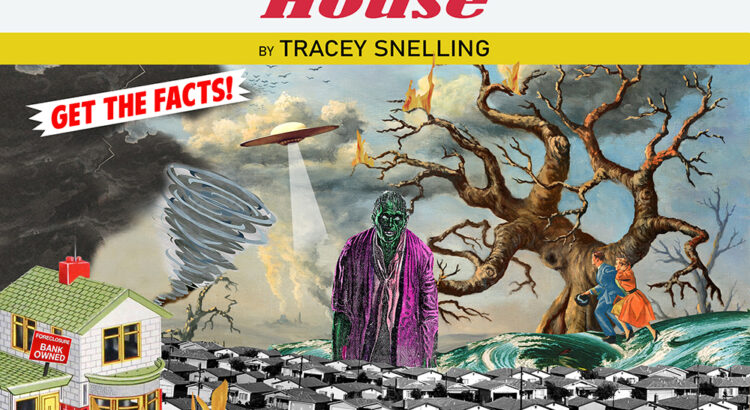
PREVIEW: How to Build a Disaster Proof House

The Institute for the Humanities’ latest exhibition will be on view this week, beginning March 16th. How to Build a Disaster Proof House consists of the work by the current Roman Witt Artist in Residence, Tracey Snelling. Snelling previously exhibited here and has come back again with sculptural conceptions of various worlds, looking to themes of escapism and environment while also integrating eye-grabbing pop aesthetics.


The show is free and certainly not one to miss, as there’s a slew of accompanying programming in conjunction with the works. It’s truly a community effort, as talks and workshops intersect with corresponding exhibitions and installations coming from institutions like the Ann Arbor Film Festival and the Ann Arbor Art Center.


The Institute for the Humanities is right across from the MLB, situated right in central campus– be sure to stop by!

Review: Dance Mix 22′


Dance mix is hard to describe in a few words. If I had to choose it would be energetic. The show was phenomenal. All the participants performed extremely well and it was incredible. I could see their hard work in their moves and it was just amazing.

The dance mix was a show that featured performances by 11 different dance orgs on campus. It also had a percussion group performing. The performances ranged from hip-hop to modern ballet, to a yo-yo performance. I could see what university students had been up to and see the diversity present even in dance organizations. 

I loved the show and it was clear to see the audience loved it too. The auditorium was the fullest I’ve ever seen. It was a busy, busy night! 

There was a lot of audience engagement and the crowd was definitely loud (in a good way). The performers had a lot of engagement and none of their unique moves went unnoticed. It was obvious that the audience was really thrilled. 

The dance mix theme was the roaring 20s which wasn’t followed by a lot of the organizations but it did not take away from the show at all. While reading the program for the event I saw the description of each group and I was pleasantly surprised by how special all the organizations were. Their purpose for performing ranged from advocating their culture to just dancing around and having fun with friends. 

To give a brief overview of the performances- there were tap-dancing performances by RhythM (a group that started in fall 2000!). There were performances by the ballroom dance team, a storytelling performance tied with memes and dance by Funktion, a huge dance ensemble by K-Gayo-3 (a collab of 3 k-pop dance groups), a unique twist on ballet and contemporary dance by Salto to name just a few. 

If you think this description sounds fun and diverse then the actual event was only more so. All and all dance mix was an amazing experience. The performers, the audience-it was all a big vibe. 

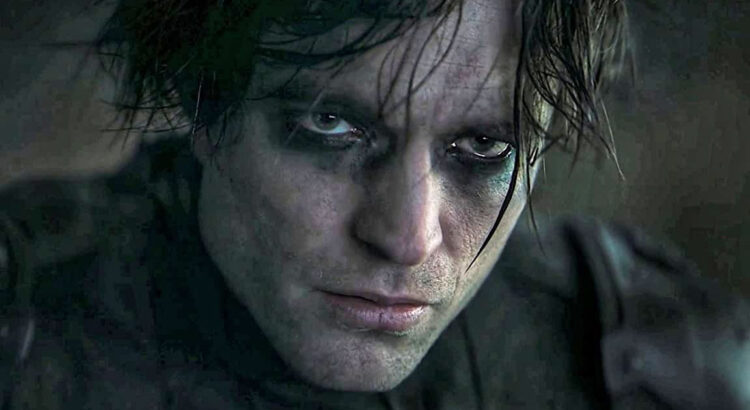
REVIEW: THE BATMAN

The Batman, 2022 / Spoiler Alert!


If we look at the evolution of superhero movies decades later, I think it will be a pretty interesting anthropology resource. All superheroes symbolize justice but the social norm of justice changes over time. This happened in the new batman as well.

New society, new villains. The villains in this movie do not work on personal, fictional motivation like pride or psycopathy. Instead, in this movie, they are the ones who were harmed systematically. The villain is not lone genius anymore – they are people who urge others to turn to violence with them to break down the society, and the most vicious crisis was aroused when they worked as a group. This resembles the spread of hatred on the internet and violent crimes happening in consequence of those messages. The metaphor to the modern society was quite clear – the riddled even blatantly talked like a  youtube or user of another Social Media platform, thanking the viewers for their support. I was almost expecting a ‘please like and subscribe…’.

The classic hero changed with the society to address the new messages aginst the evil as well. Bruce Wayne, if I remember correctly from prior films, was torn between his identity as a billionaire and the mysterious superhero and the dilemma of the personal judgment of justice was his main worry. For this new Batman, however, whether it’s known who’s under the bat-mask is not such an existential problem. This batman seems to be more careless about it (he got almost unmasked by a curious policeman after he was unconscious due to a bomb explosion) and the Riddler even says that who’s under the mask “does not matter”. If the former batman hides deeper inside himself to solve his doubts, this one comes out. The scene where batman leads the civilian out of the water with the red light and help carry wounded citizens clearly showed that this batman demonstrates a new notion of peace-not one that is magically achieved by a lone superhero, but one that is led by a superhero symbol but that can be achieved together. This batmans stands with the people, and that reminded me of the appeal in the society to unite together to fight the wrong. Batman with the mysteriousness reduced, interacting with the people was a new change. Almost like a friendly neighborhood… No, that’s another guy.

This movie is dark-literally. It had a lot of rain in the scenes and ones that minimal light is used. This led to many visually highly satisfying scenes-my favorite was the one where the screen was all dark and the movement of the characters was illuminated only with the fire from the end of the gun. Also, I saw the rain as more than the weather- with the final crisis being the flood, water could mean the danger to the city, and the rain could represent that the city was in danger. In all, highly recommend this movie. Go check it out!

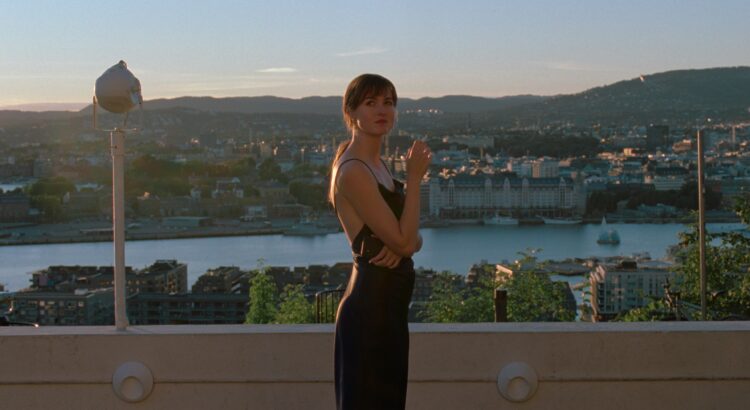
REVIEW: The Worst Person in the World

The Worst Person in the World is an anthology of sorts, chronicling a young woman’s struggles with making meaningful connections, navigating her career, and establishing her general place in the world. This sounds extremely cliché on paper, and I hate to say it but it somewhat held true in the film as well. 


I will firstly recognize that there’s a very strong chance I simply didn’t connect with this film. Sometimes that just doesn’t happen. There was still a sense of quality to the production and the performances did feel genuine, so maybe the fact that I walked away feeling very little is moreso a matter of a personal misalignment.


That said, I think there are a few other factors that caused me to feel so neutral. The style of the film felt a little inconsistent and choppy, this owing greatly to a scene involving psychedelics. All the established conventions of the drama that had been unfolding thus far were eschewed in favor of overblown effects, animation, and surreal sequences. I understand that there’s a lot of fun, playful techniques that can be used to convey an experience like that and there are moments of quick, pastiche editing earlier in the film, but in this case it just felt out of place and a little indulgent. Another particular instance of a chapter that didn’t fit quite right was a short one that used constructed media clips that we watch the protagonist watch. This isn’t inherently bad but it just felt disjointed in terms of style.


Another manifestation of this choppiness was the excessive structuring of the narrative. There was a prologue, an epilogue, and twelve individually named chapters between. For an ultimately chronological story, these separations felt unnecessary and moreso a chance for foreshadowing puns and dramatic titling. I do think it was an interesting mode of pacing for viewers, but making sections more discrete didn’t serve the narrative’s development and the emotional shifts of the film. 


Lastly, the paths of the characters all intersected far too neatly. This could be a style choice akin to the surreal moments in the film, but the way people floated in and out of the protagonist’s life felt a bit too convenient. The first few instances made sense, but there’s a specific reveal at the end of the movie that just made me roll my eyes. 


Any of these thoughts could certainly change on a second watch, but the fact of the matter is that I left the State thinking about other works that make the same points as this film, but better (see: Shiva Baby, Fleabag, etc). I still encourage a watch as I think this film is doing some interesting things with cinematography and has some thought-provoking points, but it’s definitely not going to be my film of the year.