REVIEW: 14+14 at WSG Gallery

Located in Kerrytown about a fifteen minute walk from the Diag (and only steps away from two other local galleries), WSG Gallery is an artist-owned gallery that displays and sells work by its 14 members. Among their number is Stamps School of Art & Design Professor Nora Venturelli, who teaches many of Stamps’ figure drawing and painting classes. While WSG’s work is priced well above a typical student budget, it can be visited and admired for free, and new shows are installed almost monthly.

For their annual “14+14” show in January, each member of WSG invites one additional artist to join them for a large group exhibition. This year’s invited artists included Stamps professor Lee Marchalonis, who teaches printmaking and artist books classes, and Stamps student Denali Gere. (Disclosure: I’ve worked with three of the artists in this exhibition in the past—with Venturelli and Marchalonis as professors, and with Barbara Brown during a visiting artist workshop.)

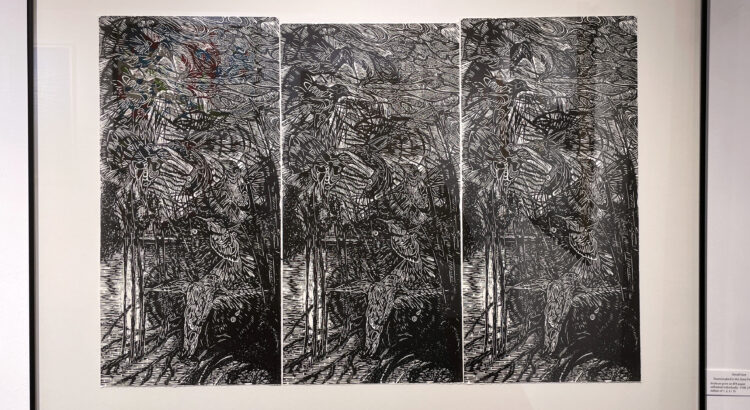
Denali Gere, “Hummingbird in the Great Fire – triptych.” Linoleum print on BFK paper.

With a total of 28 participating artists, the exhibition was packed with colorful artwork. The walls of the main gallery space were covered with artworks that spilled over into a small back room and downstairs into the basement. They covered practically every medium, including painting, drawing, photography, printmaking, fiber arts, and mixed media. Shelves and pedestals also held three-dimensional work like artist books (Barbara Brown) and ceramic sculpture (Monica Rickhoff Wilson, Marcia Pollenberg). One striking fiber installation by Boisali Biswas hung from the ceiling in the center of the room.

Cathryn Amidei, “Canopy.” Handwoven Jacquard, cotton, linen, synthetic.

It was exciting to see the work of members of the Stamps community on display in a professional, off-campus gallery setting. Nora Venturelli had several expressive, layered figure paintings and drawings on display. Lee Marchalonis’s work included a series of monoprints that depicted the soft glow of candlelight with hazy blue ink. And Denali Gere showed off her talent with astonishingly intricate linocut prints.

It’s difficult to choose standout pieces from an exhibition with so many strong works. There was much to admire in the broad array of media and styles, but I found myself particularly drawn to the fiber works, such as “Canopy” by Cathryn Amidei. Amidei uses a computerized jacquard loom to hand-weave detailed images with a mix of fibers. “Canopy” is filled with beautiful variations in texture that mimic the feeling of looking up through the branches of a forest overhead, with light streaming through the leaves. It was an image that felt immediately familiar and calming to me, captured perfectly in textile. Other works by Amidei in the exhibition depicted human figures, with the same skilled eye for light and form.

Boisali Biswas, “Echos of a Left Behind Place.” Fibers.

Another captivating fiber work was Boisali Biswas’s “Echos of a Left Behind Place,” composed of several textile elements hung in layers to create a domestic scene of a balcony with laundry hung out to dry. The subtleties of color and texture in Biswas’s weaving welcomed me in, but the gauzy fabrics made the scene feel delicate, tinging it with a feeling of nostalgia and memory.

As with any wide-ranging group exhibition, not every piece spoke to me. But the abundance of excellent work made the exhibition as a whole feel like it was bursting with creativity. The 14+14 show left me excited to return to WSG Gallery for future shows. For students looking to expand their horizons, I would absolutely recommend taking a trip off campus to see what the Ann Arbor artistic community has to offer.
 

REVIEW: Hot Coffee, Cool Jazz

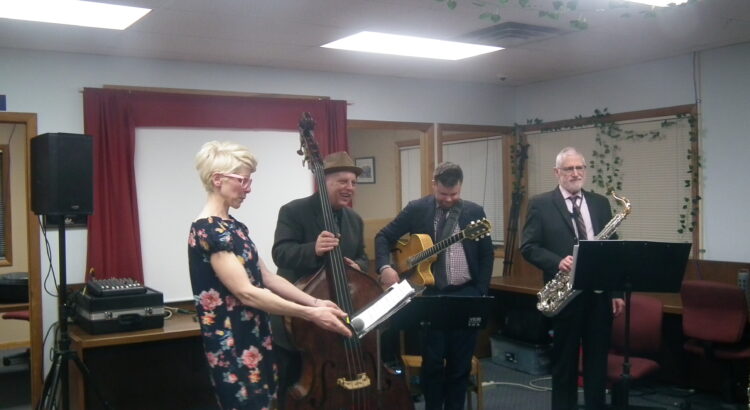
Your early afternoon cup of Joe may be best served to a near burning temperature, but jazz on the other hand may best be served cold. A Flint resident looking for live jazz groups may find themselves to be surprised when they happen to come across the highly acclaimed Paul Keller Quartet in humble Holly Michigan. The Paul Keller Quartet has been shattering the Detroit jazz scene since 2011. One may often find the group in a bustling jazz lounge or restaurant throughout Ann Arbor and the greater Detroit area, but for this past Tuesday, Holly residents were welcomed to a more personal and intimate experience right in the towns’ cozy library.

Alongside coffee and decadent bite size pastries sat a quartet with genuine love for the craft.

“Yeah man, give it to me!” exclaimed an engaged Sarah D’Angelo while entranced in her collaborator’s spontaneous creative auditorial flow.


It’s something you like to hear, the engagement, the mid-song applause and praise, being feet from performers, one can close their eyes, and interrupt their surroundings as a communicative gathering for personalized expression. Don’t close your eyes for too long, for when looking at the performance you can see the passion put forth in the faces of the artists’ subtle (and maybe not so subtle) gestures communicate their truths through facial expression. It seemed while one player took a solo, the others happen to be singing or scatting the melodies they had just produced.

Every artist brought a unique color to the performance provided a clean and collective combo array of sound. The blend of clarinet and tenor saxophone especially crafted a dark inflection of the lows that complemented the upper clarion register of the clarinet. As both a clarinet and tenor saxophonist myself I find myself amazed at how these two instrument colors merge, I feel inspired to write harmonically for these two horns in my own original material.

Paul Keller wrote many arrangements of the works played that evening proving his myriad of utility as performer, artist, and creative writer. I found it quite  compelling how for one of the tunes the saxophone was written over the clarinet for the melody. The upper range of the saxophone combined with the low register of the clarinet displayed a low smokey undertone not many works utilize. A creative choice of breaking the rules of typical western harmony one may say.


Two original songs draped the small library that evening. Two tales of the passing and coming seasons, winter and spring. The work titled “winter song” featured the jazz singing of Sarah D’angelo along with a the tenor saxophone in the upper register, giving a cold whisper presence. The song personified both the season and the weather, this was followed be delightful solos in a “cool” jazz type of style. “Frosty winds say hello…”

The song focusing on spring was unique as it was written the day before the event, making this work a welcomed premier. Paul Keller spoke on how when he wrote the song, the title was the start of the creative process. Following the title, the chords, melody, and words came to him quickly. “Spring is just around the corner” also used personification when talking about the changing weather. Steve Wood turned to the flute which reminded me of the Grieg song, “Summer Mood.” Flute is synonymous to me with warm weather and early mornings, which may be what the artist was going for. Following the chorus the song sped up which made me reflect on the speed of time and the changing weather. Ralph Tope on the guitar provided a strong harmonic groove with a relaxed but consistent feel. The colors of the strings blended great with the horns, allowing all voices to balance.

Cool Jazz is a subgenre of jazz that was popularized by the jazz trumpetist Miles Davis. This style of jazz focuses on a walking but relaxed tempo and a prioritization of memorable and tasteful melodies when improvising. The quartet made everyone feel welcome and I found myself enjoying every moment. I am excited to see more of what these artists have to offer for future events.

Following the performance I was able to speak with the group. Prioritising small local concerts allows audience members to greet artists directly, something many people wish for when wishing to talk to their artistic influences.

I was able to talk to Steve Wood and get his take on what artists influenced him the most. Steve Wood is influenced by artists such as Yusef Lateef, Dexter Gordon, Ben Webster and Sonny Rollins


These great jazz giants defined and captured styles of the genre. Steve wood noted he transcribed several Dexter Gordon solos, and I can hear it in his sound. The dark subtone inflection is strong in his sound. The jazz language spoken by Steve wood was one that captures elements of all his inspirations. Jazz is a melting pot of what is picked up by the listener. You are what you eat? You are what you listen to!


When a celebrity is asked for a backstage interview what is the most common question the interviewee asks? What can you say to those looking to follow in your footsteps of course! I ask this question not only as a reporter but also as an artist with an increasing drive for jazz. Sarah’s answer was one that was simple but non the more true and possibly the most important. Play. Play often. Get out and find those with similar interests. I found that there is no substitution for experience. I can tell from

Sarah D’angelo giving her all

this show that Sarah D’Angelo has played countless gigs and presented herself as a courageous and wonderfully charasmatic jazz singer and clarinetist that was a true pleasure to listen to. Sarah recommends newer jazz musicians to head out to Arethas Cafe, a jazz sit-in that focuses on education and learning, hosted by Scott Gwinnell every Sunday. I am hopeful the culture of jazz continues to grow. Going out and playing is a great outlet for individuals to express themselves.


This concert was made possible by the wonderful staff and directors of the Holly Township library. Notable efforts such as Tina Russette, the adult services manager, and Greg Hayes the library director allow concerts and events like this to be a regular occurance. The Holly Township library has several upcoming events that Flint campus locals can look forward towards. A belly full of piping hot coffee and jelly filled pastries held down the audience as they whisked into a warming but still winter night as cool and relaxed melodies packed the listeners ear in delightful hums.

REVIEW: Mary Poppins

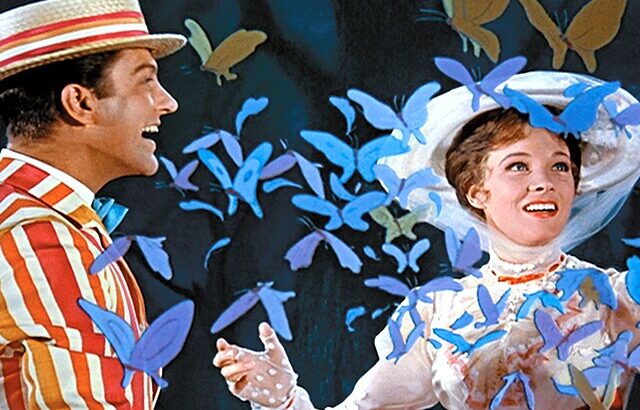
I had fond feelings but not much memory of Mary Poppins (1964), so when the Michigan Theatre showed this iconic, classic film, I was excited to re-explore the magical wonders and musical adventures the movie took me on in elementary school. At first, I feared the story would be too childish to enjoy, but I had a rather pleasant experience even as an adult.

The story takes place in early 20th-century London and around Jane and Michael Banks, the troublesome and ill-mannered children of George and Winifred Banks. Though wealthy and of respectable status, George and Winifred are emotionally distant parents. After Jane and Michael keep chasing away the nannies Winifred hires, George decides to take matters into his own hands and find the strictest nanny possible. Against his expectations, Mary Poppins arrives and immediately captures the innocent hearts of Jane and Michael with her rosy cheeks, magic items, and mysterious background. With Bert, a cheerful and kind street musician who works multiple odd jobs, Mary Poppins brings the children on unimaginable journeys while instilling discipline and moral principles through fun songs. Though written for children, the musical quality and melody of the songs in Mary Poppins, such as “A Spoonful of Sugar,” “Feed the Birds,” and the legendary “Supercalifragilisticexpialidocious,” captivate audiences of all ages.

I was most surprised by Mary Poppins’ stoic, strict, and prideful personality because I imagined a nanny to possess a more soft-spoken and gentle quality. However, actress Julie Andrews’ portrayal of confidence and quiet kindness brought to life the perfect nanny for Jane and Michael, who did not have a consistent adult figure in their lives. In contrast to Mary’s authoritative demeanor, Dick Van Dyke’s character, Bert, is goofy and nurturing in his own way. His Cockney accent and regular fourth-wall-breaking antics bring a lighthearted energy and make each scene more immersive.

I can see why this movie made such a deep impression on me as a kid. For younger audiences, Mary Poppins is a film that fosters imagination in the mundane scenes of daily life, inspires hope for a more exciting future career, and helps children identify the simpler joys in even doing chores. On the other hand, for adult viewers, this movie serves as an example of good parenthood and an exploration of family dynamics, specifically highlighting how misunderstandings and emotional neglect can influence children. This thematic element encourages adult viewers to evaluate the method and significance of nurturing emotional bonds within their own families.

Although the storytelling starts strong while setting the scene and introducing the main characters, the plot grows frustratingly slow without much character development or world-building, which is when I had to remind myself that children are the target audience. Even though this movie does not demand a re-watch, Mary Poppins deserves its name as a beloved classic and enjoyed best as a leisurely, nostalgic experience.

REVIEW: The Government Inspector

Notice of Content: This article references moments of death by suicide and instances of fatphobia in a theatrical performance. Read with care.


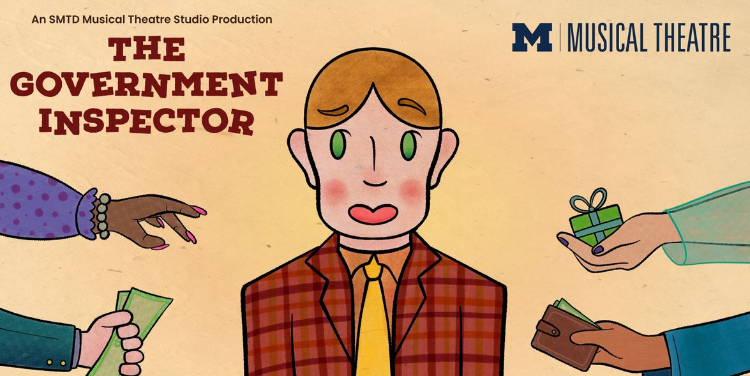
Every piece of art should resonate with the urgency of a question: “Why now?” Yet, after watching the University of Michigan Musical Theatre Department’s studio production of The Government Inspector, I’m left scratching my head, struggling to understand the artistic vision.

This comedy of errors originally written in mid-19th-century Russia by Nikolai Gogol follows the story of a small town frightened by the news of an inspector, spying and evaluating the organization of their community. As mistaken identities and drunken behaviors abound, the townsfolk turn to bribery, flirtations, and trusty ol’ vodka to impress their supposed inspector. In Jeffrey Hatcher’s adaptation, what’s supposed to be a poignant satirization of greed, political corruption, and stupidity falls flat in comparison to the glaring offenses performed onstage. 

Malcolm Tulip, the director, greatly oversteps when inviting the audience into the world of remote, provincial Russia. Tulip forces audience members to participate in some of the most gruesome moments of the show: this includes an actor gagging onto an audience member’s lap from alcohol consumption, and having a patron hold a mirror for a performer to look into as they perform a staged death by suicide. Irresponsible is the only word that comes to mind. Audience members can’t consent in the dark, and to thrust unsuspecting patrons into distressing scenes without their prior agreement isn’t what they paid for; it’s highly unethical and dangerous.

The offense that takes the cake, however, is the interpretation of the Judge. Not only does the actor don a fat suit, but they use it to its full extent, making a mockery of fat people in a caricature-like fashion. The actor waddles onstage with hands cradling their belly, as if parodying pregnancy. As a plus-size person, I couldn’t help but roll my eyes and think, “We’re fat, not pregnant.” Then, they top it off by taking a fall and flailing around like a pig in mud. This portrayal not only insults the audience with its blatant fatphobia, but also exacerbates its harm with tones of ableism. Such portrayals are far removed from entertainment, serving only to reinforce harmful stereotypes and degrade those of us who are simply living in our bodies.

What do we have to learn from old or outdated stories? Maybe, this is the wrong question. Instead, let’s ask who should we trust to direct these new interpretations? I would be remiss to place any blame for these offenses or missteps on any students involved. It’s not their fault. Faculty who hold a clear power dynamic over student artists are responsible to lead and uphold an ethical, safe, and responsible production. It’s obvious, in the case of The Government Inspector, that there was a failure to provide such leadership. The themes of corruption and folly in The Government Inspector might have contemporary resonance, but the execution here is tone-deaf.

However, to give credit where credit is due, Nicola Troschinetz and Stephanie Reuning-Scherer were hilarious and bubbly in their twin roles as Dobchinsky and Bobchinsky, Ellie Van Engen successfully cements the proposed idea of satire through her costume design, and the ensemble, while lacking relevance and stage time, sure can sing a tune. While the production manages to deliver moments that are both shocking and undeniably funny, these are often overshadowed by its more problematic elements.

You’ll definitely find yourself laughing during The Government Inspector, but at what cost? $16 for students? $25 regular price? Or at the expense of others?

REVIEW: Winter Blues Cabaret by Olivia Van Goor

January 16 | 9pm | North Star Lounge


Got the winter blues? I sure do. But Olivia Van Goor has a remedy—sing about it.

The North Star Lounge welcomes the fourth installment of Olivia Van Goor’s vocal jazz cabaret, where she hosts an evening of vocalists based in Southeast Michigan backed by a jazz trio. I caught the second show at 9 pm, (first set sold out) where the neon green walls of North Star were crowded with full tables and assorted cocktails. Four singers each performed three tunes, with hostess Olivia Van Goor bringing the set home.

The band included Rowan Tucker-Meyer on piano, Trevor Lamb on the bass, and Phillip Buchman on drums. This tight trio was swingin’. Sensitive, but not too careful. Tucker-Meyer’s solos were particularly impressive—he’s playful and concise with sprinkles of Oscar Peterson licks.

First to the bandstand was seasoned vocalist Ellie Martin—a jazz scholar who teaches at The University of Toledo. She has a deep and thorough jazz education, which shines through in performance. Her set included “Blossom’s Blues”, “Snowbound” and LHR’s “Blue (I think it’s called..?)”. She was an engaging and hip improviser; full of ideas and vocal freedom.

Hadley Rasnick mentioned she is firstly a pianist, and has been picking up singing in recent months. Second to the bandstand was a young vocalist with a humble, but charming presence. She offered a bit of a variety: Gershwin’s “Not For Me”, The Queen of Soul’s “Ain’t No Way” and “Ain’t No Sunshine” by Bill Withers. I could sense an ethereal attachment to the piano, but her performance was nonetheless endearing. She shined on the Franklin—perhaps most comfortable in R&B.

The multi-faceted Pia Broden Williams was third on the bandstand, a classically trained coloratura, educator, pianist, and tonight, a star jazz vocalist. You can hear the breadth of her vocals the moment she began singing. She brought out the classic “Blue Bossa”, “Afro Blue” and “I Was Born To Be Blue”—tunes with contrasting energy and spunk. Three of my favorite tunes were performed by the penultimate vocalist Anna George: “I’ve Got My Love To Keep Me Warm”, “Mood Indigo” and “I Let A Song Go Out Of My Heart”. Ms. Van Goor even popped up to hit a few “Mood Indigo” harmonies.

Ms. Van Goor closed the gig with the Antônio Carlos Jobim tune “No More Blues”, a killer latin staple. Right when we thought the gig was done, she passed out papers to the bar with lyrics on them…the words to “Centerpiece”. Perhaps the first time 25 people at North Star chant a blues together. Ms. Van Goor, she’s a stellar vocalist—lively, dedicated, and committed to tradition. So PSA: a doctors prescription for vocal jazz in the dead of January works swimmingly.


Images thanks to The North Star Lounge. 

REVIEW: Laura-Simone Martin at The Blue Llama

Jan 25 | 10:30pm | Blue Llama Jazz Club


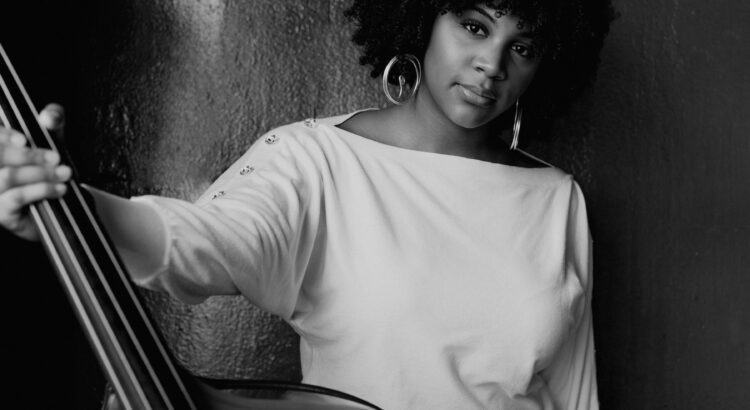
It’s clear Laura-Simone Martin brings the swing. Her debut show at The Blue Llama was filled to the brim with vitality, love, and a whole hour of masterful music-making.

At just 19 years old, Ms. Martin already has a host of accolades as a young bassist. She’s performed at acclaimed venues throughout the world like the BBC Proms, Carnegie Hall, Blue Note at Sea, the Kennedy Center, and the Monterey Jazz Festival. She was a member of Marcus Miller’s five-person bass ensemble, alongside Meshell Ndegeocello (a 12-time Grammy nominee), Aston Barrett Jr., and Mamadou Kouyaté, for Steve McQueen’s art exhibit Bass—the director of 12 Years a Slave. She’s currently studying bass at Michigan State University with renowned bassist Rodney Whitaker.

She took the stage under soft pink and blue lighting with her trio: drummer Caleb Robinson (a quirky and dynamic player) and pianist Redwood (a deftly captivating performer). Alto saxophonist Kevin Brewster joined for a few tunes as well, another fearlessly creative player on the bandstand. The trio’s feel remained immaculate the whole set through many different grooves.

Seven songs filled the set, many of them beginning with Ms. Martin’s radiant bass solos. Starting out was Horace Silver’s “Sister Sadie” and the beautiful “Mona Lisa”, a Jay Livingston and Ray Evans tune made popular by Nat King Cole. Ms. Martin revealed her charming and sensitive voice singing “Mona Lisa” while simultaneously playing bass. To start this tune with solo bass and voice was absolutely thrilling. Though quiet (perhaps from the distant microphone), you can hear the sincerity behind every lyric she sings. She finds conviction in intimate tunes contrasting with the bright verve in Silver’s.

Ms. Martin included one of her originals in the set “Kamora’s Bounce”, offering some insight into her compositional tendencies. The tune was fun and featured some of Redwood’s killer improvisational skills—thorough and precise, but never careful. Redwood played both on the grand piano and the electric keyboard next to it, swiftly changing the sound’s texture a few times in the set. Later on in the night was Ann Ronell’s “Willow Weep For Me” (a beautifully bluesy standard). With another solo bass intro (and melody!), I loved the space in this tune, and the choice to feature the lowest voice.

I regrettably did not catch the name of her final tune—but what I do remember is the joy and gratitude that suddenly overwhelmed the room. Ms. Martin penultimately left the audience with some words referencing her gratitude for the art form, and an intention to bring love into the world through her music. Her artistry runs deep into her soul, and when you hear a player perform as such, you can’t forget it.  The world always needs more love (and more jazz). Thanks for the reminder, Ms. Martin.


Images thanks to The Blue Llama Jazz Club.