REVIEW: Jader & Hilary Hahn with the Detroit Symphony Orchestra

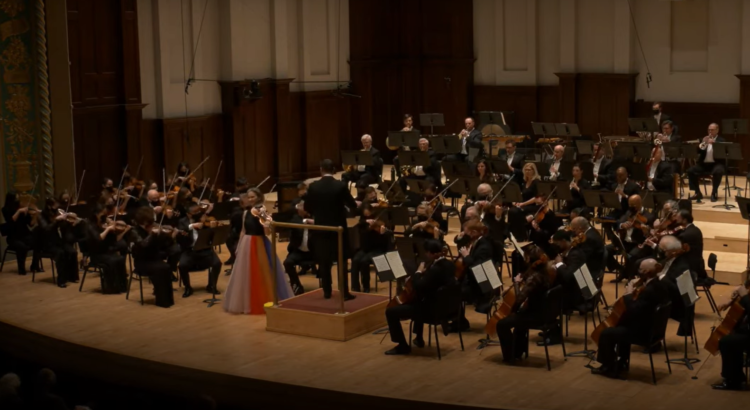
Home to the fourth oldest orchestra in the United States, Orchestra Hall is truly a magnificent venue. December turned out to be the perfect time to visit, as the holiday-themed pine garlands and twinkling string lights in the lobbies paired beautifully with the red carpets and warm lighting to evoke the Christmas spirit. As a testament to Hilary Hahn’s influence and outreach work, I noticed that the audience had a notably larger proportion of younger attendees than what one would typically find at a symphony concert—including me and my four friends, of course. I found it funny when one friendly usher asked which one of us was “the violin player of the group,” and we all raised our hands. 

The DSO opened the concert with Bedrich Smetana’s Overture to The Bartered Bride, a bright, vivacious piece full of moving notes and striking dynamic changes. Still groggy from the trip from Ann Arbor, I found the piece was a great opener to sit back, build excitement, and appreciate the crisp acoustics of the hall.

Next, Hilary Hahn took to the stage to perform the Dvorak Violin Concerto in A minor. Distinctly contrasting with the previous piece, the concerto featured a dramatic introduction that showcased Hahn’s virtuosity—namely some pitch-perfect runs climbing up the fingerboard and ending with her insanely powerful fourth finger vibrato. I was amazed by how clearly her sound projected over the orchestra to our seats in the balcony. The second movement took on a more somber tone, with a dark-yet-sweet melody echoed by the flutes. Meanwhile, the final movement was clean and bright, playing with a delicate, bell-like motif introduced by the soloist at its beginning. Cue the standing ovation. 

Going off the program, Hahn took some time to say a few heartfelt words about the recent tragedy at Oxford High School and dedicated a solo piece she often plays alone when thinking through things. In this new context, the unaccompanied Bach Sonata for Violin Solo No. 2 in A minor, Andante adopted a whole new depth of emotion. In that hushed room packed with hundreds of people, the longing, sustained melodic line sung over an underlying current of pulses, like a heartbeat. 

After intermission, the DSO performed what is probably Smetana’s well-known piece, The Moldau No. 2 from Má vlast. The piece took the audience on a journey along a great river of the same name running through Czechoslovakia, featuring flowing lines to illustrate the intermingling of hot and cold water over the natural landscape. 

To conclude the concert, the orchestra played Symphony No. 3 in C minor composed by Florence Price, the first African-American woman to be recognized as a symphonic composer. Jader Bignamini, the conductor, noted the importance of playing such underrepresented works that deserve to stand amongst iconic orchestral repertoire. An exhilarating mixture of warm melodies, jazzy-ragtime rhythms, and big brassy sections, the piece was truly refreshing to listen to.  

As expected, Hilary Hahn and the DSO delivered an excellent performance. I look forward to future visits to Orchestra Hall while I’m at UMich!
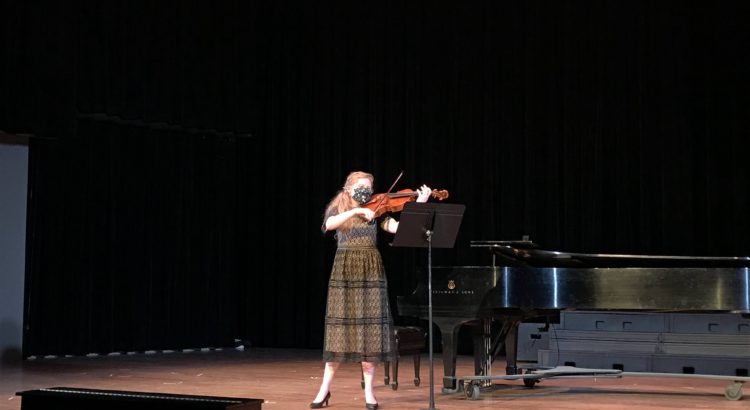
REVIEW: Viola Senior Recital by Kirsten Riggs with Pianist Naki Kripfgans

Before we dive in, a disclaimer: I played the cello in an orchestra in high school and therefore am hopelessly biased toward the superiority of that instrument.

HOWEVER! I am here today to begin to build an appreciation for the thousands of other instruments out there, starting with….the viola.

The viola gets made fun of a lot. Often mistaken for a violin, it’s actually slightly larger with a deeper sound and often plays the “inner voices” in a symphony. They’re crucial for harmonies in music composition but their voices are harder for the ear to pick out when playing in a symphony in between the deeper voices of the cello and bass and the melody voice of the violin. Over six year of playing in an orchestra, I can remember playing exactly one piece where the violas had either a melody or a solo part. They were very under-appreciated by music composers until the 20th century when more viola soloists came to prominence and people realized they should really write better music for this beautiful instrument!

PROGRAM
Suite No. 4 – Johann Sebastian Bach: https://youtu.be/70hcPBdzD1c

Sonata for Piano and Viola in E flat major op. 5 no. 3 – Johann Nepomuk Hummel: https://youtu.be/cFZyCna2vQA

Sonata for Viola and Piano op. 11/4 – Paul Hindemith: https://youtu.be/NxN2vrDeFjk

The performance venue was the McIntosh Theatre in the Earl V. Moore music building. The recital hall had a lot of seating and was acoustically resonant. Kirsten Riggs, the violist, had a great stage presence and seemed completely absorbed by the music. A stand with sheet music was set up in front of her but she hardly seemed to need it and often closed her eyes while playing. Something I noticed was that she would sometimes breathe in the pauses between phrases or at the very beginning of a piece before she played the next note. I thought it was interesting because it’s the same thing I was taught to do as a cellist when I played in an ensemble to help with keeping rhythm and synchronizing with the other players.

My favorite was the very last piece by Hindemith. It was so INTERESTING and dark and twisty, with a mood and tone that seemed to gain new dimensions every minute. Give the part from 10:25 to 11:30 in the video linked above to see what I mean. The piano part played by Naki Kripfgans paired gorgeously with the viola, and both musicians coaxed such a variety of moods out of their instruments. I loved their interpretation of the emotions.

I’ll be honest and say I don’t understand some of the stage mannerisms for classical music performances. For example, between each piece the performers would walk off the stage to a side room. Then a different person would walk out, remove the sheet music from the stand, and walk back. Then after a minute the performers would walk back on stage, set up their new sheet music, and resume their positions to start the next piece. It seemed like a lot of unnecessary walking to me! If there’s some important history behind this ritual and I have offended every classical soloist on Earth, please educate me so that I too can be in on the secret.

Tune in next time for when Himaja appreciates even more non-cello instruments! Up next….harp? tuba? kazoo? You decide!

PREVIEW: Blue Bop Jazz Orchestra Winter Jazz Concert

Are you looking forward to the holidays? Are piles of homework and final exams damping your holiday spirit? Wish your shoebox apartment had a roaring fireplace so you could pretend you live in a cozy cabin in the middle of the forest? (that last one is just me I think)

You probably won’t find a fireplace but you WILL find the ambiance and coziness of one at the Blue Bop Jazz Orchestra’s Winter Concert tomorrow.

The Blue Bop Jazz Orchestra is a swing band run by students at UM! They recently joined a host of other orgs that are part of the University Activities Center (UAC) including the Amazin’ Blue a capella group, MUSKET musical theater org, and Photonix glowsticking group.

Jazz is a music genre that originated from the African American communities of none other than New Orleans, Louisiana (NOLa!). Jazz music is unique in that it uses complex harmonies and blue notes, syncopated rhythms, and heavily emphasizes improv! Today there are many different styles of jazz, from bebop to blues to big band swing. Blue Bop seems to focus on swing – a very danceable style of jazz from the 30s that was named for its emphasis on the off-beats.

Check out a little sample of their playing here: https://www.facebook.com/watch/?v=411437709416552

Come unwind at the end of the day with their jazz and holiday tunes tomorrow December 7th at 8:30 PM in the Michigan League Hussey Room!

REVIEW: PandemoniUM presented by Amazin’ Blue

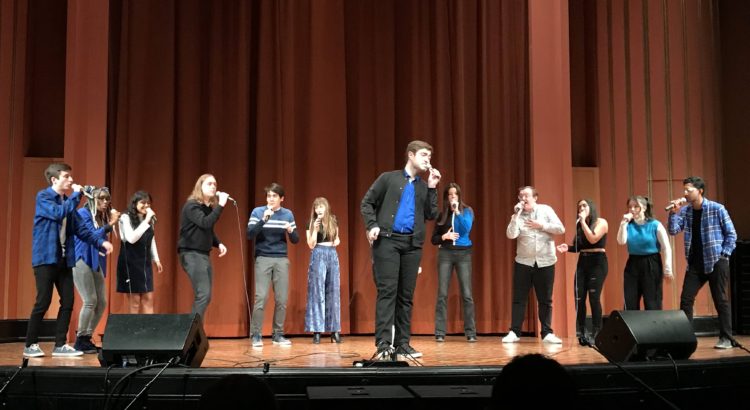
Going to see Amazin’ Blue and State of Fifths rock the (very orange!) Rackham Auditorium was the perfect way to spend a Saturday Night.

If you don’t believe me about the orange part, just take a look:


It’s gorgeous. I wish the world had more monochromatic auditoriums.

ANYWAY, Amazin’ Blue is an award-winning a capella group at UM founded in ’87, and it is the only university-sponsored a capella group on campus. They try to create innovative music!

State of Fifths is an award-winning a capella group at MSU founded in ’08. They arrange all of their own pieces and perform a wide variety of music!

All of the singers and soloists from both groups were phenomenal and had me wishing I could sing because they made it look so easy! And best of all, every single one of them looked like they were having the time of their lives up there. They were grooving and bopping on stage the whole time looking like there was nowhere else they’d rather be. It made it impossible to not have fun down in the audience too.

Every so often in between songs someone from Amazin’ Blue would take the mic to introduce one of the “newbies” who had joined the a capella group recently! They read out fun, teasing bios for each newb and then asked them to mimic a certain sound on the spot. Some of the interesting ones were the sound of a vending machine, ripping off a piece of tape, and a plane taking off. All in all I loved their camaraderie on stage and how they made it clear they really think of Amazin’ Blue as a found family.

At the end they sang their alumni song and invited any Amazin’ Blue alums from the audience to come up and sing it with them. An alum jogged up to the stage and took over the percussion and absolutely DOMINATED it. It’s never too late in life for me to learn how to beatbox right? If I do I’m going to add it to my resume.

Something I didn’t know is that both Amazin’ Blue and State of Fifths release studio albums! You can check them out on Spotify here and here. Support your friendly neighborhood a capella groups!


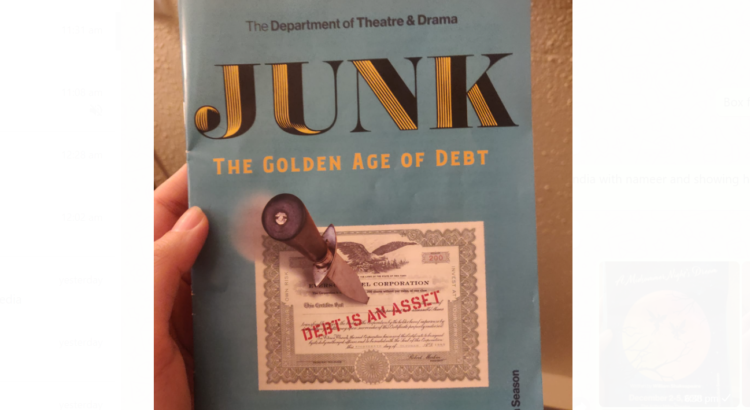
REVIEW: Junk: The Golden Age of Debt

I don’t know where to begin. Junk was a phenomenal show and the team behind it really put effort into every. single. detail.

Let’s begin with the actors. It is hard to think who acted the best because all of them were so good. The plot of this play was quite corporate and the actors carried the theme of the play well.
They spoke dialogues in a believable tone such that I could see real CEOs speaking like that. Their strong delivery also made it stage-worthy. They combined the best of both worlds to up the stakes of the story.

Another star of the show was the set design. I have rarely seen such a well-integrated setup. The set was designed perfectly. It wasn’t meant to be beautiful but to go complement the plot. And complement the plot it did. They had lightboxes that synced up fast-paced music and blinked. It reminded me of stockbroking and the 80s architectural design. The audience also got to see the set being dismantled when a company lost its financing. To see that happen at the very end was just amazing. It reminded me of how important people working behind the scenes of a show are.

The techniques used in the play for phone conversations were nice and brought out the interconnectedness of the characters in the play. The costumes were well designed and fit the 1980s period (the play is set in 1985). Despite the play being set in the 80s, it had a topic as relevant as could be. Its similarities to the 2008 financial crisis and the chaos of the Gamestop situation reminded the audience of the stakes involved when people play around with stocks.

I really liked the ending of the play (I won’t spoil it for you). It highlighted how much money rules everybody. Some accept the cards they’ve been dealt with, some try to hack the system, and so on. The protagonist tries to hack the system and we see how he too gets trapped by it and it’s all a game of numbers. The system speaks in another language and only some can understand it and those who do try to get to the top. Others might have different interpretations of the ending but I think it was about the irrationality of who gets the most money.

The show got a standing ovation from the audience so you know everyone loved it. It showed a lot about the financial world and the power of money without being too dramatic or obvious. It was a great show!

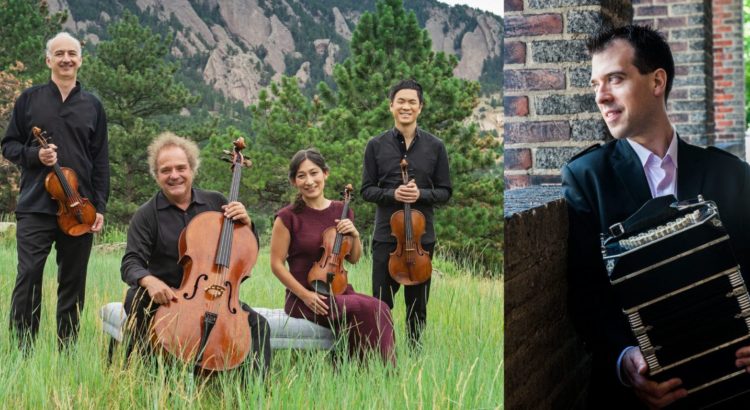
REVIEW: Takács Quartet with Julien Labro

Coming to this performance has reminded me of how remarkably similar listening to new music is to meeting new people. If you come into the interaction without any background knowledge—their origin, their influences, their motive—you might spend the whole time confused, struggling to construct their story from whatever you see at face value, or simply uninterested. It’s the reason why program notes exist, and why I typically like to search for the pieces on Youtube before I hear the performance. Yet, with its mixture of world-premieres, uncommon instrumental combinations, and reimagined pieces, this program definitely challenged typical means of music consumption. 

I was immediately struck by how compact the bandoneon was and how it could achieve such crisp articulation and human-like phrasing. When Labro played, it felt like he was pumping his own breath and soul into the instrument. While the bandoneon is typically associated with tango, Labro also notified us that it was originally intended to play church music in small parishes in Germany. I didn’t quite believe him after he had performed Saluzzi’s Minguito, a groovy, pulsing Argentinian folk music-jazz hybrid incorporating percussive finger tapping against the sides of the instrument. However, his arrangement of Bach’s Wachet auf, ruft uns die Stimme, BMV 645 introduced an entirely new color and tone. In contrast to the previous push and pull of these tangled music lines, Labro’s Bach had a rich, organ-like sustain that put each voice in the four-part harmony on equal footing. 

I was also surprised by how naturally the bandoneon fit in with the quartet. In the first co-commission by UMS and Music Accord, Bryce Dessner’s Circles, the bandoneon set the stage with an oscillating rhythm for the strings to weave between. At some point, the pulsating melodies aligned and transitioned into an icy, polyphonic whistle-like section. Meanwhile, in Labro’s Meditation No. 1, the bandoneon reinforced the ensemble’s warm, syrupy chords and shined in a rich, cadenza-esque solo. In Clarice Assad’s Clash, the second UMS-Music Accord co-commission and concert finale, the bandoneon delivered punching dissonant chords and almost upsetting slides as the strings incorporated various frictional textures and sound effects.

The Takács Quartet was able to show off their refined musicianship in the hauntingly beautiful Ravel String Quartet in F Major. Melding elements of tension and dissonance, the piece had a shiny quality that fit really nicely with the rest of the program while still bringing a whole new flavor of sound. The complex layered plucking of the second movement was truly a marvel—the audience felt compelled to applaud afterward even though it was still between movements.

One of the most experimental pieces was Labro’s Astoración, performed as a solo with a pre-recorded backing track. Described as “an imagined duet and conversation with Nuevo Tango master Astor Piazzolla,” the piece tugged at single notes before expanding into big dissonant chords. Meanwhile, the backing track echoed spoken narrative phrases and introduced a second bandoneon that Labro riffed with. At some point, he also pulled out an accordina—a small, hand-held wind instrument with similar sound qualities to a harmonica— for an added layer on top of the rhythmical background.

All in all, I feel that I had witnessed something remarkable last Friday. My roommate who accompanied me enjoyed it as well, although she admitted that some parts were “a lot”. Such is contemporary music!