REVIEW: Triptych

Upon entering the realm of Peeping Tom’s Triptych, one quickly learns to abandon all preconceived notions of a linear narrative. This Belgian dance theatre company crafts an experience that is just weird, yet so irresistibly fantastic that it leaves you ensnared in its labyrinthine grip. Composed of three haunting acts united by the intricate theme of “memory as labyrinth,” the production ventures into territories both unsettling and sublime, drawing you into a journey that defies traditional storytelling.

Where Triptych excels is in its audacity to explore the intangible nature of memory—not a straightforward journey, but a dance through corridors flooded with both familiar and fantastical whispers of the past. Each act draws you deeper into the maze, where paths are both discovered and created anew with each performance.

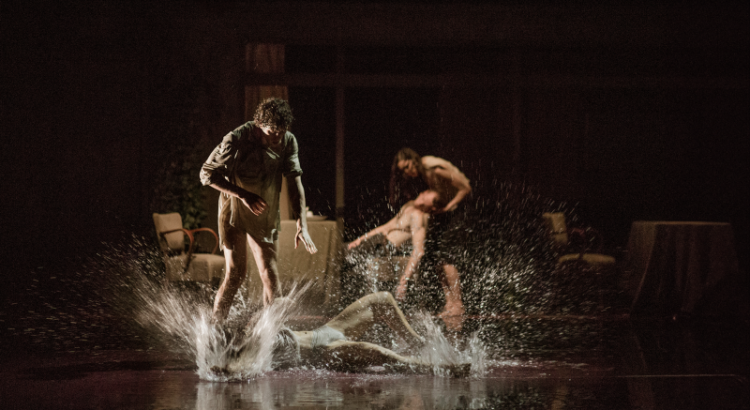
Triptych is a masterclass in marrying choreography with set design, where each act unveils a new visual marvel. From the immaculate hotel room, where doors seem to have minds of their own, to a restaurant submerged in a foot-deep pool of water, each setting serves as a dynamic backdrop to the dancers’ wildly impressive physical feats. It’s a wonder no one emerged injured from such daring aquatic performances.

In between acts, be prepared for a unique intermission experience. The entire company, with remarkable synchronization, deconstructs and reconstructs the set, transforming it into the next fantastical landscape. Witnessing this metamorphosis is a testament to the powerful collaboration between performer and designer, a reminder that storytelling transcends words. My advice? Take your bathroom break before the show if you don’t want to miss this spectacle.

What’s particularly astonishing about Triptych is its ability to weave compelling narratives without a single line of dialogue. The movements speak volumes, their language universal. The choreography, a mesmerizing fusion of styles and techniques, crafts stories so vivid and gut-wrenching that audiences are left to decipher them through their own lenses. You might walk away with a narrative entirely different from the creator’s intention, yet equally profound and personal.

Even if dance isn’t your forte, Triptych is a masterpiece that stands out for its technical magic on stage and behind the scenes. With its ability to harness unorthodox elements and turn them into visual and emotional storytelling, the production redefines what it means to experience theatre.Peeping Tom’s Triptych defies convention and challenges its audience to lose themselves in its dance of memories. A compelling kaleidoscope of movement, design, and the murky depths of the mind, this is one performance that will linger long after the final bow has been taken.
REVIEW: Michigan Youth Mariachi Festival 2025

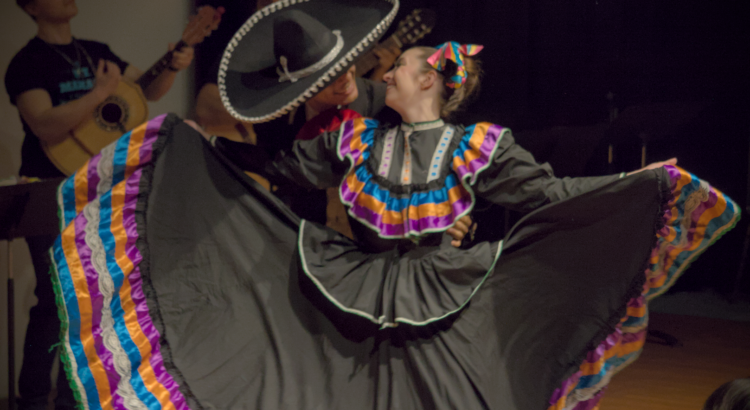
“Viva Mexico!” Sombreros raise high in the cool stage air as a large community of passionate individuals come together to celebrate the history and culture of Mexico through the art of music and dance.

Not many people are familiar with the art of Mariachi and Folklórico dance, so it was an inviting experience to have such talented youth in our college community of UM-Flint. Mariachi is a style of music and dance deeply embedded in Mexican culture. Traditional Mariachi includes instruments many are familiar with, such as the guitar, violin, and trumpet. Also included are native lesser known instruments such as the Guitarron (a six string acoustic bass with a deep body) as well as the vihuela (a small five string guitar). Mariachi also heavily uses the voice both for singing as well as a certain vocal technique known as  El Grito. El Grito is a traditional combination of a cry and a laugh that passionately represents the Independence of Mexico and past civic celebrations. The singing style felt very rustic and crafted with love. It gave a sense of uplift in me, a sense of pride for what I had and what to celebrate. This cultural showcase concert was organized and led by El Ballet Folklórico Estudiantil, a leading music program based in Flint, Michigan.

The early afternoon concert was filled with students of many backgrounds coming together to celebrate Mexican tradition. What I really enjoyed about this concert was the vast inclusion of levels of experience. The concert opened with the instructors of the program, followed by student ensembles such as the Mariachi Knights, Mariachi los Tigres, Mariachi Alebrijes, and the Beginning Mariachi. Not only as a concert attendee but also as an assistant volunteer, I was shocked and amazed to know that the last few songs of the program were learned over only two days. This goes to show how strong the education program is, and as well it shows the dedication and strength of the musicians to come together and work as one over something completely new. Groups from Flint to Detroit displayed to me wonderful tunes that had me clapping along in my seat.

Mariachi music is often based on melodies from folk songs from other regions in Mexico. As an audience member I can recount several melodic lines that I had previously come across in early piano study course books, many of which also take from universal folk songs. One of the songs on the program featured a classical vocal work, Por Ti, Volaré by Andrea Bocelli.  The Mariachi sound mixed with a new context of a classical vocals, created a beautiful rendition of the work. The ensemble of trumpet, violin, and voice led by Brandon Sexton, produced a performance that elicited resounding applause from the audience.

One of the lead Instructors, Gino Rivera, guided the group from the morning rehearsal right up to the concert’s opening note. What Gino Rivera loves about teaching mariachi to young students is seeing the progress, growth, and confidence in people. He noted that many people of Mexican background my feel alone or even ashamed of their ancestry, but being in Mariachi allows them to find their identity outside of the house and truly thrive. Exposing culture to a more public eye strengthens the beliefs and passions of those looking to grow. Music transverses all cultures, and is a great way to express the history of many.

Sue Quintanilla, Founder and Director of El Ballet Folklórico Estudiantil hopes to grow and strengthen the community. Anyone Interesting in joining the program can visit the website, ebfedance.org for more information. I hope to see more from the group in the future and I am so glad I was able to indulge in this beautiful cultural experience.

(Photography credited to Nathan Cross, ncrossmusic@gmail.com)

REVIEW: Echoes: A Music Journey to the East

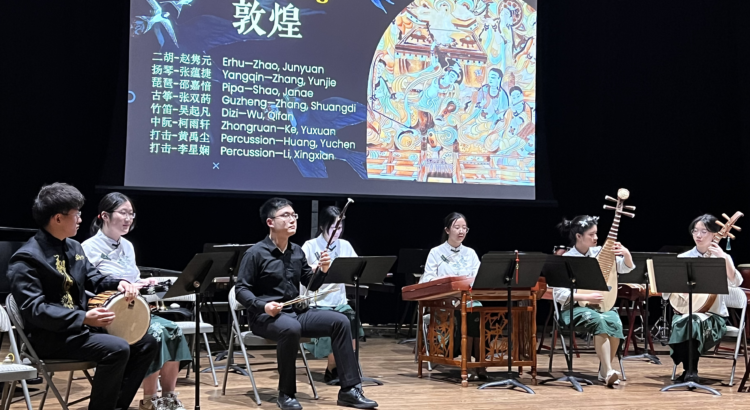
In the fall of 2019, Qingyun Chinese Ensemble was founded, emerging as the University of Michigan’s first and only Chinese music ensemble and carrying a mission to bring traditional Chinese music to Michigan audiences. Their recent performance at the McIntosh Theater, Echoes: A Music Journey to the East, operates as an extension of their ambitions, focusing on bridging the gap between ancient melodies and contemporary interpretations. With extensive experience in their respective instruments, the members not only displayed technical skills but also a deep pride in representing their culture and heritage. 

Echoes: A Music Journey to the East was divided into three chapters–Journey to the West, Diversity in Harmony, and Life as a Bundle of Spirits– each showcasing a diverse selection of short pieces. Soloists and full ensembles constantly fluttered on and off the stage with their instruments as two announcers enthusiastically introduced each piece’s context and featured instruments. The announcers noted specifics of certain instruments, for example, how the sound of a solo instrument accentuated the intended emotion of the piece, as well as some of the song’s history. Whether or not audience members arrived with prior knowledge of Chinese traditional music, Qingyun ensured they left with a newfound understanding of the genre. 

My knowledge of Chinese traditional music is limited, and perhaps as a result, I found the evening marked by diverting surprises. I was taken at how the performers utilized the entirety of their instruments– for example, tapping on the base of the erhu (Chinese fiddle) or running a stick beater along the ridged encirclement of a dagu (Chinese bass drum)– and at the variety of songs being played. The repertoire ranged from Chinese folk music to more contemporary pieces, to adaptations of music from the video game Black Myth: Wukong, alongside a Japanese song and Mozart’s iconic Turkish March. The distinct sounds each instrument produced were strikingly beautiful, and when the full ensemble came together in the final chapter, their rich harmony was accentuated by individual tones adding layers of texture. I especially loved when the sounds of the dizi (Chinese transverse flute) poked through with its deep, melodic tones. Additionally, many of the traditional songs performed were deeply rooted in nature, a sensation that resonated in the music itself—the dizi evoked birdsong, the muyu (woodblock) mimicked the rhythm of galloping horses, and the guzheng (Chinese plucked zither) gently flowed like water streaming down a mountainside. 

Performance of Erhu Concerto “War Horses Galloping” (1976)

The compact McIntosh theater seated no more than 100 viewers, fostering an easy exchange between the performer on stage and the audience. The ability to see each musician’s fingers move deftly across their instrument, catch subtle expressions, and witness the silent nods exchanged before beginning a piece added a sense of intimacy to the experience. The final surprise song was one of exuberant energy as the behind-the-scenes crew was brought onto the stage and the audience was invited to heartily clap along to the rhythm. After the performance, there was also a ‘Meet the Instrument’ segment where the audience was invited to come up on stage and play the exhibited instruments.

The Qingyun Chinese Music Ensemble continues to provide a space for students to refine their craft while introducing new audiences to the often-overlooked beauty of Chinese traditional music. Their performance was both welcoming and educational, offering an experience that was not only immersive but also deeply personal, reflecting the performers’ passion for their art. 

More information on the ensemble as well as the pieces and instruments performed in Echoes: A Music Journey to the East can be found here: https://qr-codes.io/pkFUwE


REVIEW: The Stampede

When I picture an art gallery, my mind conjures a quiet, sterile space lined with ancient sculptures or framed paintings, each accompanied by a neatly printed placard. Even trendier collections, like those at the Museum of Modern Art, tend to follow a certain formula: curated, polished, and sometimes intimidating.

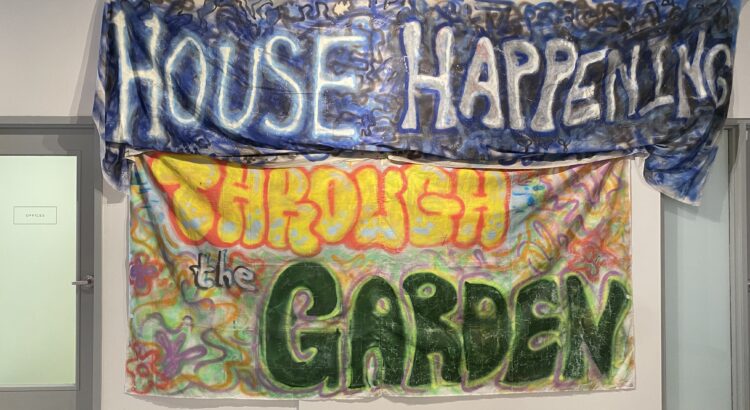
But The Stampede installation at the Stamps Gallery is something different — fresh, young, and alive. This exhibition is the first gallery showcase for The Stampede, a student organization founded in 2023 with a mission to create spaces for students to present new and unconventional artwork. With a rallying cry to “RUN WITH US!” it presents some of their work while showcasing the energy of this student-driven art movement.

Gallery-style art collection at The Stampede exhibit.

The exhibit serves as a retrospective of everything The Stampede has accomplished in its short existence. In just a year, the group has hosted pop-ups, parties, art markets, concerts, and gallery exhibitions, establishing itself as a vibrant hub for artists, writers, and musicians. This exhibition isn’t just a collection of their work — it’s a living testament to their rapid growth and creative impact.

The first thing you encounter upon rounding the corner into the one-room exhibit is a simulated merchandise table. While it was used for actual sales during the opening night, afterward, the items weren’t available for purchase. Instead, they mimic the kind of setup you’d find at a Stampede event, reinforcing the immersive, DIY ethos of the organization. It’s a clever way to blur the line between exhibition and experience, making visitors feel like they’ve stepped into a real Stampede gathering.

Artwork at The Stampede exhibit.

One wall is dedicated to a constantly running short film, projected in a loop, capturing the raw energy of Stampede parties, behind-the-scenes glimpses of artwork in progress, and the collective excitement that fuels the group. Another wall displays the spray-painted banners seen in the video, along with an archive of promotional posters from past Stampede events. The third wall is packed floor to ceiling in a salon-style arrangement, a practical necessity at their pop-up galleries where wall space is often scarce. This layout mirrors the spontaneous and organic nature of their events, where art spills over every available surface.

The variety of mediums on display is striking: zines, collages, paintings, sketches, and even papier-mâché sculptures. Each piece stands on its own, yet together they form a cohesive narrative of experimentation and self-expression. The installation feels less like a traditional gallery and more like an active, ongoing conversation between artists and their audience.

Perhaps the most playful (and fitting) element of the exhibit is the shrine to the “Blood of the Bull,” The Stampede’s signature sangria. A simple spray-paint can and red Solo cups serve as a cheeky nod to the community-building aspect of their events. It’s an artifact not just of their gatherings, but of the youthful, unfiltered spirit that defines The Stampede.

“Blood of the Bull,” an ode to sangria at The Stampede.

More than just an organization or an exhibit, The Stampede is a community. Every part of this installation pulses with the energy of the college experience: messy, exciting, and full of possibility. Rather than adhering to the conventions of traditional galleries, The Stampede invites us to break free, run wild, and make space for something new.

REVIEW: Sasha Velour in the Big Reveal Live Show

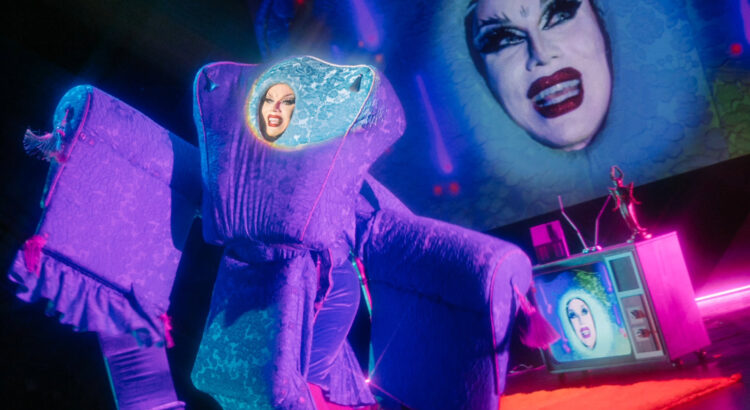
The historic stage of the Michigan Theater sits sparse, except for a comfortable cyan lounge chair, a cozy floor lamp, a vintage two-knob TV, and a dainty desk with Sasha Velour’s The Big Reveal: An Illustrated Manifesto of Drag neatly atop it.

On screen behind them, a prerecorded Sasha Velour dangles a disco ball from an elegant, silver finger. As Jennifer Lopez’s Waiting for Tonight begins to play, Sasha caresses the disco ball with her other hand, and as a spotlight appears on the cyan lounge chair, the audience waits with bated breath.

In an instant, the chair blanket is yanked back to reveal…

Sasha Velour…inside the chair…and I was gagged by possibly one of the best live reveals I’ve ever seen.

Her ruby lips gleamed unobstructed through a face-sized hole, as she began to lip sync sections of Kylie Minogue’s futuristic In My Arms, Dionne Warwick’s forever cherished A House is Not a Home, and Brandy’s *perfect* rendition of In My Own Little Corner.

As the chorus of Britney Spears’ Stronger begins, Sasha sheds the chair from which she came, only to become…

Sasha Velour…the chair, again…I was gagged again.

She struts in a brocade gown of the same cyan fabric, cream tassels on her shoulders and hips, and chair arms accentuating her tightly-corseted waist…a hybridized perfection of camp, glamour, and humor on full display to close act one.

As the energy in the room quells, Sasha reflects on her grandmother Dina, who came to America from China as a Jewish immigrant during World War II and, “would always encourage me [Velour] to channel my inner diva.” Showing videos of herself as a child, Sasha cherishes these moments aloud on stage, gushing about how Dina’s love and enthusiasm shaped her as a child, and now as a performer.

In one of a series of hilarious video skits, Velour switches between various personas, who comment on drag’s significance across communities: a medium of history, of fun, of revolution. Velour asserts that drag can be anything, for anyone, and this fundamental freedom affords drag infinite power.

But what happens when this freedom is at stake? Unafraid of asking the difficult questions, Velour challenges the audience to both revel in the privilege of being able to attend her show and share in her sense of growing urgency towards collectively understanding what these next few years will bring, not just for the queer community, but for everyone the Trump administration seeks to erase.

Drag is not dangerous for children, and helps to embolden those who need creative outlets of expression… “I have always been Sasha Velour…drag has a spiritual mission to give each other the biggest gift in life — to be seen and documented as we really are…to write our own stories”. The Big Reveal is everything a drag performance should be: It acknowledges what drag has been, what it is now, and everything it can be, while somehow completely exceeding the expectations of any audience member or Sasha Velour fan in the audience.

Even if you didn’t have a chance to see Sasha Velour, supporting your local drag scene helps to contribute to the parts of her show that still sit within me as I write this — drag is more than just a performance, it is the establishment of ones’ identity in relation to themselves and their community. It is a way of surviving, thriving, and ultimately, existing in the world in a profoundly beautiful way. A way of life that has always existed, and will continue to thrive in spite of those who seek to refute it.

REVIEW: Berliner Philharmoniker with Benjamin Beilman, Violin

Photos are provided by Peter Smith Photography

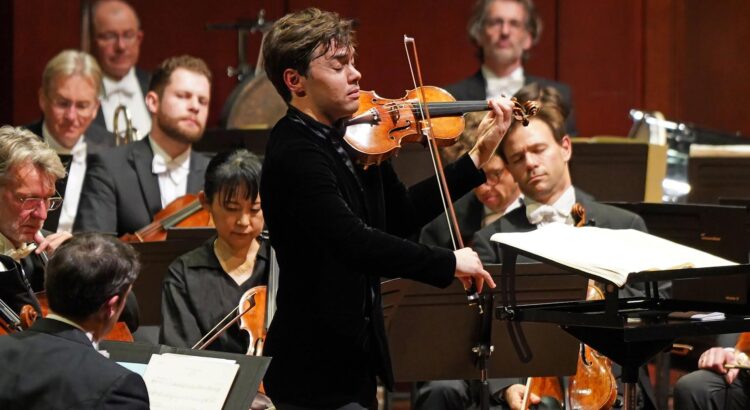
On November 23, Hill Auditorium was brimming with excited classical music lovers, and even President Santa Ono was in the audience. It was finally the night of the much-anticipated concert that had sold out months in advance. Under the baton of Kirill Petrenko, the Berlin Philharmoniker, alongside soloist Benjamin Beilman, delivered a masterful performance of Rachmaninoff’s The Isle of the Dead, Korngold’s Violin Concerto in D Major, and Dvořák’s Seventh Symphony.

Rachmaninoff’s The Isle of the Dead is a symphonic poem inspired by Arnold Böcklin’s painting Die Toteninsel. Böcklin intended his painting to evoke dreams, a quality that Rachmaninoff’s composition certainly achieved. The orchestra’s interpretation captured the audience’s attention with its heavy emotion and power. The dynamics ringing throughout the auditorium felt like crashing waves, while the layered harmonies added a sense of delicate chaos. However, when I looked up the painting, I found that the energetic, determined melodies of The Isle of the Dead largely clashed with the somber mood and muted colors of Böcklin’s work. Later, I discovered that Rachmaninoff had been inspired by a black-and-white reproduction of the painting, which allowed him greater creative freedom.

Next was Korngold’s Violin Concerto in D Major, my favorite—and I dare to assume, many people’s favorite—part of the night. Fascinatingly, Benjamin Beilman grew up in Ann Arbor and attended Community High School. He won first place at the Montreal International Music Competition in 2010, received the Avery Fisher Career Grant in 2012, has played with many major orchestras worldwide, and is one of the youngest artists ever appointed to the faculty of the Curtis Institute of Music. 

When I attend concerts, I often find myself amazed by a soloist’s technique, but this time I was in awe of how much fun Beilman made playing the violin look. Rather than feeling like a performance on stage, it felt like watching a film with headphones on—which makes sense, considering Korngold was an extremely successful opera composer who also played a major role in shaping early movie scores. At times, the softer passages in the music painted serene fields of flowers; at others, Beilman’s tone felt tangible, as if I were sipping rich, melted chocolate. 


The second movement, “Romanze,” was particularly moving. The opening, with its gentle and tender chords from the winds in the background complemented by the dreamy violin melody, perfectly captured the sound of falling in love—exciting and mesmerizing. Meanwhile, the closing melody, built from odd intervals, reflected the more complex side of love—confusing yet irresistibly tantalizing. 

The final piece, Dvořák’s Symphony No. 7, brought me back to Earth with its tumultuous and unexpected notes. The themes in this symphony didn’t paint vivid landscapes like those in The Isle of the Dead, but each phrase unfolded as if it were a page in a storybook. It was a piece that required a commanding and charismatic conductor to maintain its passionate energy—keeping it controlled yet never subdued—and to harness its power to blend the unexpected turns in the music into lyrical phrases. The third movement, “Scherzo,” was vivacious, its rhythm inspired by the Czech folk dance furiant.

By the end of the night, the Berliner Philharmoniker had established itself as my favorite orchestra. After delivering an enchanting, surreal, and healing performance that would convert even the worst classical music skeptic, the audience went wild—I can’t remember the last time I heard more wholehearted applause. Not to be overdramatic, but Benjamin Beilman’s performance of the Korngold Violin Concerto reminded me of how important classical music is to humanity. Combined with the Berliner Philharmoniker’s mastery, It was a night I will never forget, and I felt extremely lucky to have that experience.