
The Kingdom of Tokavsk, Session 5: The Golden Hawk, Part II

The chief returned to his people and told them they were to go west, as he had received a vision1

The people understood he was leading them to a better future and followed him without complaint.  They gathered what few things they had and set out west through the forest that day and set off just before the sun dipped behind the trees.  For many days they traveled, guided only by the direction of the sun and the silhouette of a hawk that always flew just on the edge of their sightline.  Some said it was gold, others bronze; one said the hawk was as black as night.  The only certainty of the hawk was that it was present no matter the hour.


One night after a long day of travel, the chief had a dream.  In it, a golden hawk emerged from a liquid moon framed by a sky sark and silent as waves.  He saw tongues of smoke rise from the hawk’s plumage and heard a muted roil as though he was underwater.  He looked at the bird again and realized it was the same Hawk who had given him his mission.  Upon making this discovery, the Hawk spoke to the chief inside his mind:  “Remember you must die in order to save your people.”  Then the Hawk vanished, and the chief woke up.


The chief continued on his journey without fearing the Hawk’s warning.  He felt invigorated by his purpose and was eager to share his newfound hope with his people.  But by and by, the chief noticed his body was growing weaker.  It was gradual at first, feeling tired earlier in the day and moving more slowly than he had before, but then his weakness grew.  He became thin and pale and had to be supported lest he get left behind.  He rapidly developed a cough that nothing could remedy.  The people feared for his life and their own futures, as the chief was young and had no heir.  The chief told them not to be afraid, for his fate was to be different than theirs, but there would be a paradise for them all in the end.


The people came to a place where the trees thinned and a cold stream cut through the land like a liquid knife.  Low hills sloped from the banks, and snow drifted from the trees in showers of light.  By now, the chief was so weak that he was bedridden and only opened his eyes to say all would be alright.  When the people approached the river, he stirred, a smile upon his bloodless lips.  “We are here,” he rasped, and breathed his last.  They buried him below a pine, and as they were digging someone pointed to something across the river.  There, nestled amidst the newly disturbed snow and the immortal firs, was an old building atop which perched a golden hawk.


  1. The meaning of this word is unclear; it is an archaic term that appears to have meant “dream,” “vision,” and “sight” depending on the context. It refers to both literal and figurative seeing, which makes its translation rather difficult.
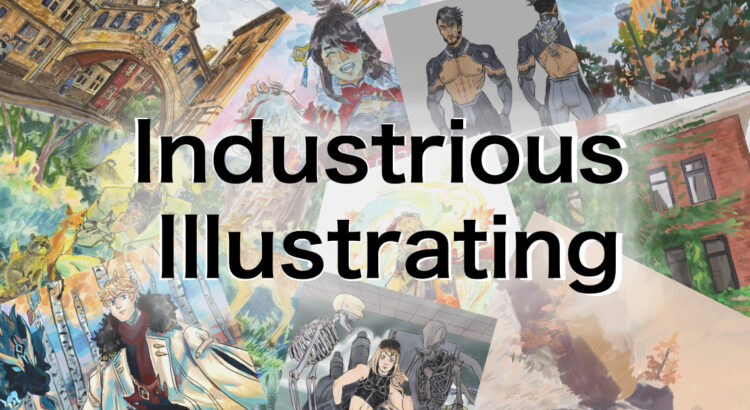
Industrious Illustrating #17 – Youmacon

Welcome back to another week of Industrious Illustrating! This week is another week where I don’t have much new art or sketches to share because most of my time has been eaten up by logistics and preparation for the biggest convention I’ll have ever sold my art at — Youmacon in Detroit at the Renaissance Center and Huntington Place. For those who don’t know, Youmacon is an annual 3-day pop culture and anime-focused convention with a dedicated Artist Alley and Vendor Hall for independent artists and businesses to sell their wares. While there

I’m splitting a table with Ria, another STAMPS Art & Design student, and we will be located at table number PA3 between the Vendor Hall and Artist Alley. We will be there for the entire weekend, so be sure to come by, say hi, and maybe peruse our offerings of art prints, acrylic charms, stickers, and more!

Here’s a picture of our actual booth that we put on social media:

Next week, I may be briefly recapping how my weekend of selling at Youma went, and hopefully soon I’ll have some non-business-related posts to share with all of you!

Fable Friday: Benzaiten

Benzaiten, also known as Benten in a simplified form, is the Japanese buddhist goddess associated with many things. She is the goddess of the arts, speech, learning, wealth, and feminine beauty, often pictured with a Japanese version of a lyre, or other musical instruments. She is also considered a goddess of the sea. She reminds me of Aphrodite, the Greek goddess of love and beauty, who also has an association with the sea. This leads me to wonder why these two things have been combined together in worship of female deities and if there are others across the world that fit this mold?

S2 Scribble #5: Lied vom Scheitern

“Du bist immer dann am besten wenns dir eigentlich egal ist.” (“You’re always your best when you don’t really care.”)

Believe it or not, I’ve yet to write a Song Scribbles blog based on one of my favorite bands – but German band Die Ärzte (“the doctors”) finally makes an appearance on today’s blog! I’ve been listening to their song “Lied vom Scheitern” (“Song of Failure”) on repeat these past few weeks, and even though I don’t know much German, I’ve read the translated lyrics countless times and always see myself in them.

“Du bist immer dann am besten wenn du einfach ganz normal bist.” (“You’re always your best when you’re just normal.”)

Being surrounded by so many impressive, busy, talented people at college is so inspiring. Sometimes, though, especially on busy weeks like these, it can also be exhausting. Last week’s blog focused on my feelings of doing “enough.” I can confidently say that I am overwhelmed with the amount of things I am doing, and I know I have a lot on my plate. Why do I sometimes feel guilty about being overwhelmed? Why am I comparing myself to what I see others doing without knowing their story? What is “enough” anyway?

“Du bist immer dann am besten, du musst das nicht austesten nicht noch mal.” (You’re always your best, you don’t have to test it again.”)

I am always my best when I’m doing what I love. I’m always my best when I’m trying my hardest. Even when my best on a given day isn’t my best of all time, I’m still the best I can be in that given scenario, and I’m learning to accept that striving for perfection is simply setting myself up for disappointment. Whether I’m doing “enough” or “my best” doesn’t depend on what I see or hear others doing. What is “my best” is up to me to decide, and I am deciding to show myself compassion and love and understanding, working toward a better me every day. I am doing enough, and I am enough, and I don’t have to test it again. 

“Dein Spiegelbild ist anderen egal.” (“Your reflection in the mirror doesn’t matter to others.”)

Listen to Lied vom Scheitern by Die Ärzte here: https://www.youtube.com/watch?v=ZQDI-8YfzWQ

Sagas Among the Arcana: The Plague Doctor, Part IV

If you’ve been reading since the start of the arc, thanks for sticking around! This will be the final part.


It continues in a commanding murmur. “So what do you expect of me?”

The blank black eyes bore into him. He wants to walk back further — run, anywhere away from here. But he remains in his spot, locked by invisible chains. 

“I expect you to help my mother.”

“And that is what I will do.”


The Ten of Cups is drawn — family, similarities, peace


When the doctor first came, Robert had noticed dark skies blanketed with grey clouds. The grounds were already damp from a previous downfall and he worried that they’d soon become so wet that he’d drown if he dared to step out.

Now, it has yet to flood, and Robert wishes it would so he could drown. 

Has he done something wrong in letting this strange “doctor” in? He can’t bear to look at what it’s doing to his mother — he doesn’t want to know. And he may never know because everything is silent. Is that creature doing anything at all?

“How much do you want her to live?”

The crow-creature’s voice startles him.

“What do you mean?”

“How much do you care about her?”

Robert shifts his weight between his feet.

“She’s my mom.”

“I know — but how much do you care?”

He immediately turns around. Its hands are pressing around his mother’s face and upper body. 

“Why do you need to know that? What are you going to do to her?”

He steps forward. The creature’s hand is on her chest —

Her un-breathing chest.

. . .

Shit.

This is not what she wanted to happen. Her movement across the woman’s chest becomes frantic. Amina didn’t do anything to the woman. Sure, she never intended to cure her, but she never meant to harm her either — how is she already dead?

“What did you do to her?!”

. . .

The guy — her “client” — screeches frantically, embarrassingly. She would have laughed if she didn’t realize how deep of shit she was in. Luckily, he doesn’t notice her hyperventilating through her ridiculous mask. 

“What did you do.”

This time his tone is low. Something crawls up Amina’s spine.

He whips his head around to face her and she feels the tables turning. His eyes have darkened and his eyebrows have scrunched in pure hatred. No longer does he look like the pathetic, skittish boy that she found at the front door. No longer does he appear gullible to her tricks — and that’s a dangerous thing.

Finally, Amina begins to feel dangerous herself. 

. . . 

The Ten of Cups

“I’ve given her peace.”

Robert stares hard at the expressionless mask. He hates it so much, with all its lies about the plague and helping his mother. For the first time, Robert begins to wonder about the ugly creature that lies beneath the mask. 


So he lunges — 

— and then he’s lunged at, and then they’re both tumbling through the sharp glass and out into the open world where the clouds begin to clear —

— and onto the damp ground, they make wet with their blood.


. . . 

End