REVIEW: she was here, once

Monday night the Institute for Research on Women and Gender welcomed Nastassja Swift and her exhibit she was here, once as part of their Narrating Black Girls’ Lives Conference series. Over three days they hosted speakers and other events, including a wool art workshop, focusing on the stories of Black women’s lives. The opening of the she was here, once exhibit took place in the Lane Hall entrance, utilizing the space as an unconventional gallery. The exhibit was not large, it featured a half dozen photos down two hallways, short films looping on two screens, and three large masks hanging above our heads. The exhibit opening was small; everyone who was there knew someone there and was clearly comfortable in the space.
This art exhibit is based on a performance art piece. The performance was a journey of three and a half miles for eight African women in Richmond, Virginia. These women traveled from the port on the James river, past the old auction blocks, and finally into a majority Black neighborhood. Throughout their journey, the women, ranging in age from teen-aged to mid-40s, stopped along the way to dance and sing. Swift was inspired to create this piece after learning about the historical significance of the city she had spent so much time in.
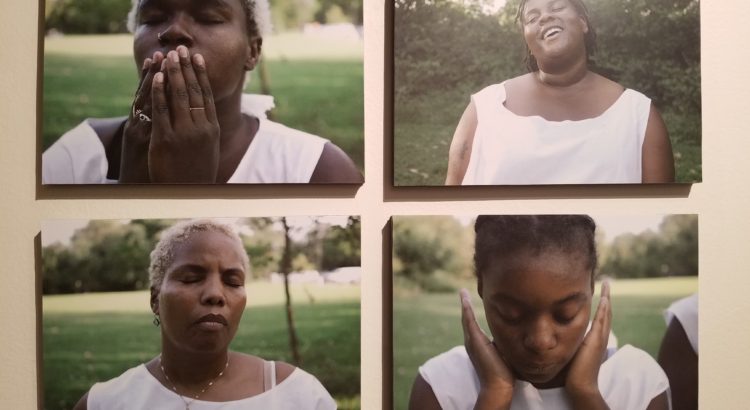
I looked at the photographs first. I was struck by the last four photos I looked at (below) featuring some of the performers without their masks on, one of the few chances to see their faces. The photographs featured such raw, beautiful emotion and their placement in a quadrant of four panels made it even more striking. Next, I took in the masks. The performers wore larger-than-life, white, wool masks for the majority of their journey. Three of these masks were featured in the exhibit hanging above us as almost caricatures of stereotypical African features. Finally, I watched the two short films documenting the performance art piece and the creative process. As I moved throughout the space the sound of the women singing in the videos was omnipresent, creating an ambiance in the space and a moving experience.

REVIEW: Third Place Concert Series presents: Zelasko // LaBonte // Rosen

As the icy wind blew snow along the pavement like sand through a frozen desert, I walked into Bløm Meadworks. It was just after hours, but the promise of good music had drawn a modest crowd of around 30 people. After beer and wine was distributed and the audience settled into their seats, they killed the lights, and we were suddenly thrust into a warmth and calmness that rivaled even the most roaring of hearth fires. The red and blue glow of smaller lights along the wall and the low hum of the brewing vats beside us made the blizzard outside feel a million miles away.

The concert featured three vocalists: Rebecca HH Rosen, Jocelyn Zelasko, and Hillary LaBonte. Rosen is a singer-songwriter who tours all over the U.S. with various groups; a musical vagabond since 2014. Zelasko and LaBonte are contemporary classical singers, taking part in various operas. All three have immensely strong voices with tones and ranges that are quite unique from each other.

The music from Rebecca HH Rosen and the cellists made me feel such conflicting things at once I became stuck in a tight space, held by the sound, feeling secure and claustrophobic both. Though the songs made me automatically picture peaceful summer images of the sun and breeze and soft, long grasses, I cried through the entire 30-minute set. And it wasn’t as if I began to listen and take in the words, gradually tearing up at the beautiful intersection of voice and my favorite string instruments. No more than five seconds passed from the moment Rosen began singing and I felt tears hitting my cheeks. There was nothing sad about the experience; all at once I felt all that is good and beautiful in the world, every sunny day. The sound of the cellos, guitar, and voice was simultaneously impossibly smooth and strong and sweet. I regret that I could not pay much attention to the lyrics, most of which were written by Rosen herself.

The next singers, Jocelyn Zelasko and Hillary LaBonte, performed together in what proved to be the most wildly conflicting, experimental version of chamber music I have heard yet. Though maintaining a classicality that stretched into opera at times, much of their performance was illogical, though it provoked critical thinking. A few songs had no words at all, but were piercing and emotional enough to stay in my memory for days afterwards. This may have been the effect of the room’s odd lighting, but I swear I lost my sense of sight for a time, LaBonte’s hair and face melting together with her neck and shoulders. I do not have a clear idea of what this fleeting semi-blindness means. The last part of their set used audio description as a medium–they literally put headphones on and described the sounds their phones were playing. It sounds ridiculous and confusing, but it felt like something more. When combined with the wordless songs and the often irrational ramblings of ones with lyrics, I had a sense of reliance on the singers for information, on the stories they were piecing together for us. It was reminiscent of ancient oral storytelling traditions; I was grateful to gather and understand the details they were passing down.

This concert was just one in Bløm Meadworks’ Third Place Concert Series. The series features a wide variety of artists in a wonderfully-curated monthly event. Check their Facebook page (https://www.facebook.com/TheThirdPlaceConcertSeries/) to look for future events.


PREVIEW: Special Talk with Yo-Yo Ma: Culture, Understanding, and Survival

On February 26 at 7 pm in Hill Auditorium, legendary cellist Yo-Yo Ma will present a talk entitled “Culture, Understanding, and Survival” that will “explore the role culture can play in helping us to imagine and build a better future, drawing on examples from his own life as a musician and citizen.”

Don’t be turned away by the fact that this event is a talk and not a performance (though the rumor is that Mr. Ma will have his cello on him to provide musical illustration)! Though he has achieved pop-culture status as one of the greatest musicians of our time, he is also extremely intentional and human. I once listened to a podcast in which he compared mistakes onstage to Julia Child dropping a chicken on the floor, picking it up, and putting it back in the pan, which in addition to being hilariously funny, proves his down-to-earth and relatable perspectives. I am extremely excited to listen and learn from what Mr. Ma has to say.

Tickets may be purchased online or at the Michigan League Ticket Office. As always is the case for UMS events, student tickets are $12-20, depending on seat location.

On February 27, Mr. Ma will also host a Day of Action in Flint, Michigan, which will culminate with a celebration of Flint in a community cultural showcase at the historic Berston Field House.


“All the things I love about life outside music have to do with people, and playing the cello allows me to fulfill all those interests through music.”

– Yo-Yo Ma


REVIEW: The Exonerated

The American criminal justice system is not perfect. Far from it. In fact, you can even say that the American criminal justice system is not just. The Exonerated tells the story of six wrongfully convicted people on death row using first-hand accounts, as well as court transcripts, letters, and interviews.

We meet Kerry Max Cook, Gary Gauger, Robert Earl Hayes, Sunny Jacobs, David Keaton, and Delbert Tibbs. They start by telling us about their lives, about how things were before their lives changed forever. They take turns sitting in the spotlight and introducing themselves and the nature of the crimes they were accused of, with occasional and brief flashbacks acted out. They narrate what led up to it, about how they weren’t even close to the scene of the crime, yet they were accused and arrested and berated by police officers. They were all convenient victims as suspects for these crimes, tricked into confessing and easily disposable.

Their harrowing experiences in prison, waiting for death row, was painful to hear. Listening to Cook’s account about how his imprisonment affected his older brother particularly stung, reminding us that these people, who aren’t even criminals, are still people, with families and feelings and a life outside of the prison walls even if we forget that. Sunny Jacobs’s gentle and innocent personality especially reminds us of their humanity, something that the justice system robbed them of but they managed to keep, even after the injustices they suffered. Eventually, they tell us how they were exonerated, but only after they paid the price with many years lost and many losses suffered.

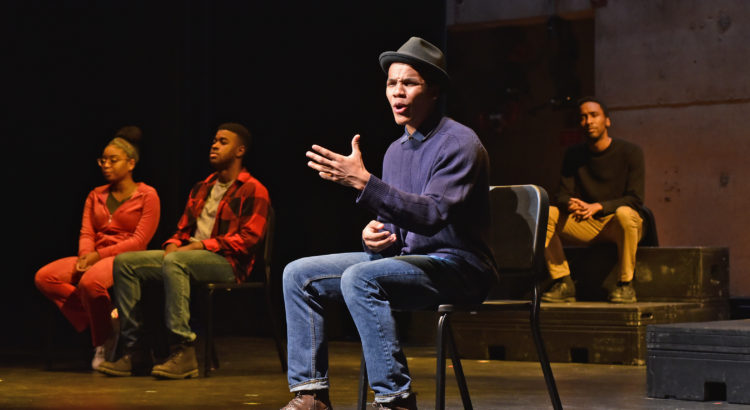
Andrew Cekala’s portrayal as Kerry, the fast-talking Texan, was very amicable and easygoing, just as Maddie Eaton gave Sunny a bright and sunny personality. Similarly, Jacob Smith as Gary, Chris Washington as David, and Lee Alexander as Robert all made their characters warm and distinct. Delbert Tibbs, portrayed by Mason Reeves, acted as a powerful narrator and common thread among all the stories, listening to Sunny’s account of her strength at the very end. The entire cast delivered a moving performance through all the nuances of their characters and their situations.

All the characters remained onstage the entire play, sitting in their chairs on the side while listening intensely to the person in the spotlight whose story is being told. The simplicity of the set, with nothing more than a couple boxes and plenty of chairs, let us focus on the stories they were telling. The movement was also simple, the characters moving their chairs and shifting positions throughout the play, sometimes accompanied by the cast’s quiet yet powerful humming. The sound of the gentle rain and the shifting colors of the background gave a sense of growing uneasiness and eerie calmness at the same time.

The stories of these wrongful convictions shows how the justice system fails its people, and it touches on race and the death penalty and how we need to rethink such things. This play is extremely thought-provoking and important to watch and even more important to remember. SMTD’s production of this documentary play reminds us how relevant and timeless this work is. Though the sentences in the play took place during the 20th century, there are plenty of people still waiting to be exonerated today, and we walk away from this play with those people in mind.

REVIEW: Happy Death Day 2U

I watched Happy Death Day and Happy Death Day 2U in somewhat close conjunction with one another, which made for a somewhat bizarre and disorienting (or weirdly orienting?) viewing experience. A large part of this is due to the eerie, albeit absolutely deliberate, similarities between the structures of the two movies. At their very heart, the central problem is almost the same: Theresa “Tree” Gelbman (Jessica Rothe, La La Land) is stuck reliving the same day.

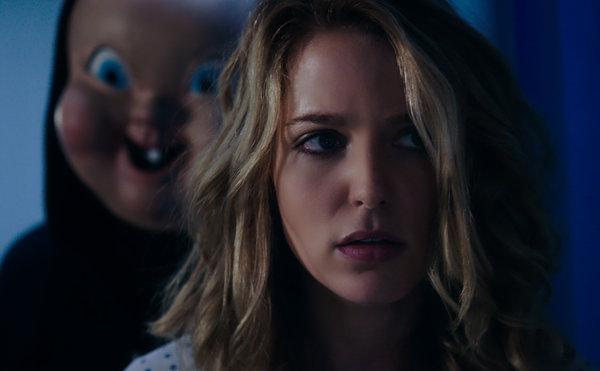
Anyone who has seen Happy Death Day (2017) is familiar with this conceit and with the problems it spells for Tree, a college student. There are the typical Groundhog’s Day-style frustrations of retaining her memories of previous days — falling in love, for instance — while everyone around her forgets. And then there’s the somewhat more distressing problem of the killer in a baby mask, who stalks Tree and murders her every time on the night of her birthday.

The sequel, Happy Death Day 2U, directed by Christopher Landon and released recently through Blumhouse Productions, presents a new complication. Not only is Tree stuck reliving the same day—it’s now the wrong day. In the completely wrong universe.
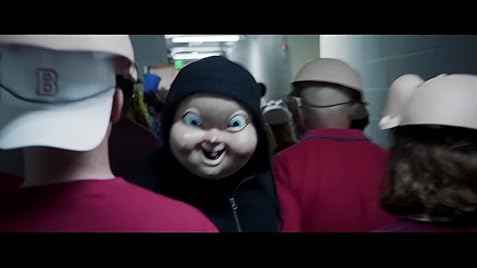
Image result for happy death day 2u stills

The film sets itself up in an interesting way, holding a close focus on Ryan Phan (Phi Vu), who had a marginal role in the first movie as the roommate of Tree’s love interest, Carter Davis (Israel Broussard, To All the Boys I’ve Loved Before). It seems at the beginning like the focus of this movie is going to be on Ryan, but this remains the case just long enough to explain to the viewers that Ryan and his science friends are responsible for the strange time-looping that Tree has experienced. After a strange altercation involving multiple Ryan’s and the panicked pressing of Ryan’s student-made quantum reactor, Tree wakes up back at the beginning of the previous day. Only this time, she’s been thrown into another dimension, and things are a little different: The original Babyface culprit, Tree’s roommate Lori Spengler (Ruby Modine, Shameless), is no longer the killer, and Carter is now dating Tree’s sorority nemesis, Danielle Bouseman (Rachel Matthews). Perhaps most significantly, while Tree’s mother (Missy Yager) was dead in her original timeline, she is now alive and well.

Tree’s transplantation into this new world kicks off a wild journey, as she is confronted by the simultaneous problems of learning how to navigate the changes to her life in this new world and the implications of those changes, figuring out how to get back to her home dimension (and indeed, whether she even wants to), and solving the Babyface killer mystery all over again. Although interestingly, the latter of these winds up taking something of a backseat. While the original Happy Death Day was a black comedy slasher film, working largely within the sphere of horror, its sequel ditches the horror almost entirely in favor of comedy, emotional drama, and adventurous science fiction. The segues into hallway-creeping and killer-unmasking don’t feel out of place at all, but they also don’t feel particularly haunting or scary, especially not in comparison to some of the emotional scares that Tree must deal with instead.

Image result for happy death day 2u stills

On the whole, Happy Death Day 2U is a success not because it delivers scares, but because it recognizes and builds on the elements that worked so well in its predecessor: comedy, irony, and a real sense of heart that carries emotional resonance. A great deal of this is concentrated in Tree’s character, actualized by Rothe’s wonderful acting; we spend almost the entire movie in Tree’s head, and we’re along for the ride as she finds herself forced to tackle conflict after conflict, eventually having to choose between a life that’s not hers that would mean reuniting with her mother (albeit under somewhat false pretenses) and the world she knows, where her real friends and loved ones are back waiting for her, but her mother is not. The implication that her choice is as simple as her mother versus her boyfriend is a bit of a red herring, and the film tries to stay attentive to this, stressing how the memories everyone else has of Tree in this new dimension don’t align at all with her own. Ultimately, Happy Death Day 2U is an adventurous and captivating success, demonstrating how the continuation of Tree’s story can again have more profound and intriguing implications — not only for her, but, in the end, for the people around her as well.

REVIEW: The How and the Why

Was it worth it?

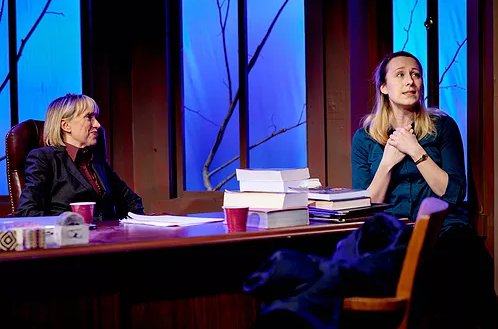
Zelda, an award-winning evolutionary biologist for her work on the ‘grandmother hypothesis’ (which suggests that grandmothers improve their grandchildren’s initial chances of survival, hence giving a reason for grandmothers’ survival past menopause), meets her daughter Rachel, a PhD student in the same field with a new hypothesis on the reason for female menstruation (as a defense against the toxicity of sperm), for the first time in The How and the Why. As they discuss their ideas, as they share with each other their past experiences, this question of worth, in a variety of ways, becomes a focal point.

Is love worth it? Zelda, direct as ever, says it’s just stress. What does it feel like? she asks Rachel at one point. As a scientist in and out, this question is one I think about often. But despite the question, it becomes clear Zelda loves deeply, and, I think, understands the sentiment more fully than Rachel, who believes that when you love someone you always put them first but hasn’t quite figured out yet how to do that while maintaining one’s own self-worth.

This juxtaposition of Zelda and Rachel is an interesting one, of maturity and youth, levelheadedness and emotional volatility, professionally experienced and just beginning a career. I think that the overall result of this is that everyone can relate to one of the two women; the downside is that because of the play’s context, Rachel was usually the one learning, not providing the answers. Zelda, as mentioned, provides answers and advice that Rachel, with the hotheadedness of youth, freely disregards. I enjoyed Zelda’s character very much, partly because it mirrored my own: scientific and logical, she encourages Rachel to pursue her hypothesis even though it ostensibly contradicts Zelda’s own.

It was impressive that this play was so accurate with its scientific details – Is it worth it? comes up again as Zelda and Rachel discuss whether the benefits in their theories (cleaning out the uterus, for example) outweigh the risks (expending energy on creating a new uterine lining every month). Yet somehow the play still had so much time to delve into its characters’ personal issues. It is a rare breed of artwork that manages to give equal weight to both science and people, and Sarah Treem, the playwright, managed this extraordinarily well.

I thought a lot during the play about how resilient women are. Towards the end, Zelda has just revealed some very personal details and is, naturally, somewhat shaken up as a result. However, Rachel then begins to get anxious about something, so Zelda composes herself and puts her armor back to help Rachel. I see this tendency in real life, in the women around me and in myself, to make ourselves available for those we love even when we are facing our own difficulties. Similarly, we don’t let our difficulties break us; we always find a way to bend with them and then move forward. Whether it’s a less-than-perfect presentation or that messy thing called love, Rachel and Zelda do the same, emerging as stronger scientists and more complex people as a result.

Was it worth it? Some days yes; some days no.