REVIEW: Yoni Ki Baat

It is unique to have a space centered around women of color and only women of color. It is a space to be vulnerable, powerful, and truthful.

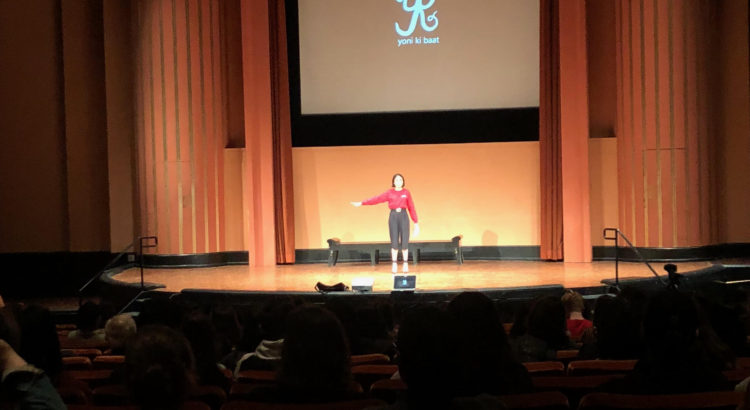
Yoni Ki Baat– which loosely translates from Hindi as “Talks of the Vagina”– is a show that centers around these women, whose voices are often stifled. 

Inspired by The Vagina Monologues, YKB started off for South Asian women. At the University of Michigan branch, the organization expanded to a larger array of diverse performers.

Before the monologues kicked off, there was an art gallery for audiences to observe. Artists were able to talk about their work and explain what inspired them, which added another layer to the gallery. The artwork was presented through a slideshow in Rackham auditorium, but I found it much more effective to view it in person and actually seen the work up close.

The monologues themselves ranged from deeply heart-wrenching to thought-provoking to humorous. The topics varied: stories about first love, war, objectification of women— all specifically tailored to how it affected their lives as well as perceptions of women of color. The performers of Yoni Ki Baat approached their stories with a nuance that is demanded of the space and the topic at hand.

In return, Yoni Ki Baat demands you to be empathetic, kind, thoughtful, comfortable, uncomfortable, and reflective. I was struck by the emotion that came from the performers and the hours of love and work that clearly went into the presentation. Yoni Ki Baat is a crucial organization that fulfill a vital role on this campus and you should absolutely head out to their next production!

Two people dancing the yonna

REVIEW: Birds of Passage

The beginning of Ciro Guerra and Cristina Gallego’s Birds of Passage opens with a symbolism-laden new beginning: a young girl’s transition into adulthood. The Wayuu people at the center of the film celebrate this occasion with a festival of family, friends and dancing. But it is the dancing that provides the clearest window into the future of this sprawling clan. The daughter on the brink of womanhood, Zaida, is dancing the Yonna, a fast-paced give-and-take between her and another man. She is dressed in a flowing red garment, racing back and forth to the beat of a drum, the camera closely following their faces and imparting the dramatic feeling that you too are being chased in the circle, racing around and around in the ambiguous fear of what might happen if you stop. Her first partner, a young boy named Leonidas, eventually trips and falls to the ground. The dance stops, but not for long, as an outsider to the clan named Rapayet steps up and enters the fray, outlasting the drum, and making his first mark on the clan he will eventually join.

The clan is led by a powerful matriarch, Úrsula, who makes clear from the start that her power lies in her willingness to do anything to protect her family. Rapayet, a suitor intent on marrying Zaida, strikes Úrsula as a danger, but possibly even she does not realize the depth to which he will uproot her family and her culture. The Wayuu of northern Colombia had persevered through the rise of the modern nation by their adherence to their traditional practices that Úrsula is determined to protect. As Rapayet ventures into the marijuana trade to finance his dowry for Zaida, he finds himself sucked into a whirlpool of greed and desperation despite his best efforts to preserve the culture of honor. It is only a matter of time before the consequences manifest themselves.

Rapayet, Zaida, and their two children eventually move into a grand stucco villa in the middle of the barren desert, a visual metaphor for the isolation their wealth has granted them. The film is a deliberate exploration of the fine line between providing for your family and sacrificing them in pursuit of these provisions. It showcases the delicate tension between the traditional ways and the allure of 20thcentury wealth and luxury, and the mythic power of the dollar, propelling business and violence across the Colombian desert in an ancient blue Jeep.

Now showing at the State Theatre. In Wayuu, Spanish, and Wiwa with English subtitles.

PREVIEW: Mystic Nights at Zal Gaz Grotto Club

Image result for magic clipart

The world is full of unknowable things, things that exist underneath reality: the supernatural, the magical, the mystic. Some are gifted with the ability to see into this plane of being, but most of us are offered mere glimpses, if any sight at all. Occupied by the ordinary world, we fail to see the extraordinary that lies just beyond our unseeing gaze.

But this Wednesday, March 27 the magician Misha Tuesday will be lifting back the curtain. He will be performing miracles in the form of hypnosis, mind reading, and magic to provide guests with a soul-changing evening. Your very understanding of reality will be tested and torn by the hands of this great illusionist. Perhaps you will be given the sight yourself. Anything can happen when mystery rules the night.

Doors are at 8:00 PM, and the show begins at 8:30, but the kitchen and bar are open beforehand. The experience will be priceless, but tickets are $10 at the door or at http://mishatuesday.wellattended.com.


PREVIEW: That Brown Show

I’m excited to go to That Brown Show again this year; it’ll be my fourth time, I think. Every year the Indian student performance groups come up with something totally new, which means you never quite know what you’ll see. But they are always consistent in the high quality of work they present, and their dedication to their art. And every year what the show does best is highlight India’s bright colors, vibrancy, and our deep love for our culture.


That Brown Show will be held in Hill Auditorium on March 30, 2019. The performance runs from 7-9pm; doors open at 6. Tickets can be found here.

REVIEW: Value the Voice

Hosted by the Comprehensive Studies Program (CSP) and the Department of African American Studies (DAAS), Value the Voice is a storytelling speaker series. This month, the series concluded with its fourth installment of this academic year, being its eighth installment overall since its beginning. The theme of this installment was “The Shoulders of Giants.” Hosted in the UMMA Auditorium, the vibe for the night already felt intimate and welcoming. Before introducing the speakers, there were a few ground rules that the audience was encouraged to recite after the MC: Love, Support, Encouragement. I really appreciated this introduction for the speakers given that for some of them, this is their first time sharing their personal story and for most, this was their first time sharing their story on stage in front of an audience. Each speaker spoke for approximately 10 minutes each, with there being five speakers in total.


The first speaker, Kristin, was a freshman (!) whose “giant” was her mother. Kristin told such a beautiful story of her relationship with her mother, while also alluding to some frustrations, confusion, and anger along the way. What I liked most about Kristin’s story is that it was so thoughtful, mature, and accommodating. Kristin’s story was an exemplary reflection on living life with loved ones who are suffering from mental illness(es). Throughout her story, she was honest in the pain that she must have felt but ultimately, she was so considerate of her mother and her hardships. What I gathered from this story was that it takes a lot of patience and understanding in these situations but most importantly, it’s not always about you. The reality behind having loved ones suffering from mental illness is that no matter how bad you think it affects you and your relationship, often times, it’s hardest on the carrier.


The second speaker, Elizabeth, was a senior whose “giant” was her grandfather. Elizabeth began her story explaining what it’s like to be from a family of immigrants and a 2nd generation American. Elizabeth’s story was especially insightful and gives me the impression that she has a keen attention to details. She told a story about a simple routine of making coffee for her grandfather every day after school and transformed it into a life lesson that she continues to carry with her. The moral of her story was about not losing your focus. As a fellow college student, this really resonated with me. This environment can easily become overwhelming and not just with academics but with your social and personal life as you’re constantly being pulled in so many different directions.


The next speaker, Vivian, is a graduating senior. She spoke about the importance of finding your own niche here on campus. Eventually, she shared that two of her family members had passed within one year of each other. I really enjoyed Vivian’s story because her energy was so genuine and calm. I shared the sentiment of praising God under all circumstances in your life. Vivian concluded her story by ensuring the audience with “Keep going y’all. It gets better eventually.”


Following Vivian was Phancie, who is also a senior. Phancie’s story was a tearjerker, to say the least. She began by introducing four different individuals in her life who she considered to be her “giants.” For each person, she assigned the following words to describe them, respectively: Personality, Generosity, Determination, and Love. My takeaway from her story was that “Love is a choice.”


The last speaker was Ms. James, who is a Program Associate for DAAS. Her story was about a faculty member who looked over her during her time at the University and presumably was her mentor. She shared with us three key points of advice: 1) Treat others the way you want to be treated, 2) Life is easier when you use humor, and 3) Live your life with integrity. However, one of the more impressionable statements was from her mentor who told her “You did not come to this University to win an Olympic Gold Medal. So why are you running around?” That really stuck with me because many times, I have to remind myself to slow down, take my time, and trust that everything will get done someway/somehow without having to exhaust myself at the benefit of others.


Value the Voice is an intimate safe space for students to share their stories and be heard. As an audience member and a fellow CSP Scholar, I felt at home in their welcoming presence. I was able to feel my emotions as I listened and reflected on the stories being told.

PREVIEW: Ballet Preljocaj

Tomorrow night I will be going to see my first modern ballet performance, and I’m pretty excited. I’ve always loved dance, particularly ballet and the way it combines strength and grace into a single verb. However, I haven’t had much exposure to ballet. Every year we have a lovely production of The Nutcracker in my hometown, but I’ve never seen it. Seeing Ballet Preljocaj perform La Fresque is part of me deciding to expose myself to the beauty of ballet. Ballet Preljocaj was founded by Angelin Preljocaj, a French dancer and artist. The company operates out of France and performs pieces choreographed by Preljocaj who draws influence from his training in classical ballet and modern dance. For the performances Tuesday and Wednesday evening, Ballet Preljocaj will be dancing La Fresque, a dance inspired by a Chinese tale about a painting coming to life and the fantastical dimension that lies beyond. I can’t wait to see what dimension these dancers will lead me into.

Image courtesy of UMS.