REVIEW: Captain Marvel

We hurried to the darkness of the theater even as the sunshine beckoned. We hurried, compulsively, because the newest Marvel movie, Captain Marvel, had finally been released for our eager consumption. We hurried without much contemplation for this was just the latest piece in an expanding narrative. I wonder when I will stop hurrying to MCU movies. I have watched them with my sister, my friends, even dragged my parents along to some. It used to be that such communal experiences would thrill me. Each movie spawned a conversation, one of the few that encompassed my entire community. Yet, I find myself balking now, twenty-one movies later.

This is, of course, not entirely due to Captain Marvel, itself. It is a perfectly serviceable movie that has a perfectly acceptable mixture of action scenes, inspirational montages, and banter. But Captain Marvel was never going to be judged entirely on its own merit. No Marvel movie can separate itself from the overwhelming pressure of living up to greater expectations. Each must reach outside of its own story to connect to its predecessors as well as serve as infrastructure for future entries into the pantheon. Perhaps it is here, where Captain Marvel stumbles the most. Set in the 90s, the movie is situated in an era far before the one most Marvel films take place in. Due to the difference in time period, it is often tasked with being a prequel to the rest of the cinematic universe. This is most evident in the excessive incorporation of Nick Fury (Samuel Jackson) into a movie that is ostensibly about Carol Danvers (Brie Larson). Instead of being an origin story for one character, it is the origin story for Nick Fury, and for the MCU in general.

With much to accomplish, it is Carol’s story that gets shortchanged. It takes half of the runtime even for her true name to even be revealed. She is instead introduced as Vers, a warrior for the Kree race in their war against the shape-shifting Skrulls. Vers is a dedicated soldier whose quips are as sharp as her blows. But beyond the occasional sarcastic turn-of-phrase, not much of her character is revealed. Brie Larson plays this initial version of Carol with a discomfort that doesn’t quite fit with the character’s brash confidence. It is, indeed, difficult to see her as a cocky, but selfless hero. It is a strange combination that the movie fails to justify with further backstory. Instead, the movie substitutes character development for easy montages and deus ex machinas. It allows Carol to fly before we even see her learn to run. It is a movie out of sync, which is ironic, for one that seems so concerned about continuity.

It is those that are invested in the Marvel Universe that will benefit most from this movie. We will be the ones that ‘get’ the references, the ones that understand the significance of Captain Marvel in a greater narrative. But as a movie unto itself, it does not understand the characters at its heart.
REVIEW: Six Senses of Buddhism

Like all special exhibits in UMMA, this exhibit is a very small exhibit, only taking up part of a hallway and consisting of a few art pieces. It is an interesting exhibit because it is about how Buddhist art and objects invoke our senses; smell, sight, feel (there are lots of things to touch in this exhibit), and most importantly mind (thought), our sixth sense. In fact, I have always thought of Meditation as a release from all six of our senses, we close our eyes, sit still, ideally only smelling one fragrant of incense, hearing only silence, and letting our mind relax, detached from any thought.

The main piece of this exhibit is a painting of a Buddha heaven. This painting is from Pure Land Buddhists, one of the biggest sects of Buddhism in China, and is of someone, probably a monk, being welcomed into heaven. I like that the heaven is on the clouds, it makes me think that heaven is always watching over us. In this painting figures with halos represent Bodhisattvas. Tea is an integral part of Buddhism, and so there were two tea bowls, one from China and one from Japan. The Chinese bowl is a lot older, but it looks more modern because it is symmetrical and completely smooth. The Japanese bowl, on the other hand, seems much more hand crafted,maybe even by an amateur, because it is rugged and asymmetrical. However, in Japanese art this is intentional because Japanese ceramic art considers asymmetry more beautiful and more impressionable.

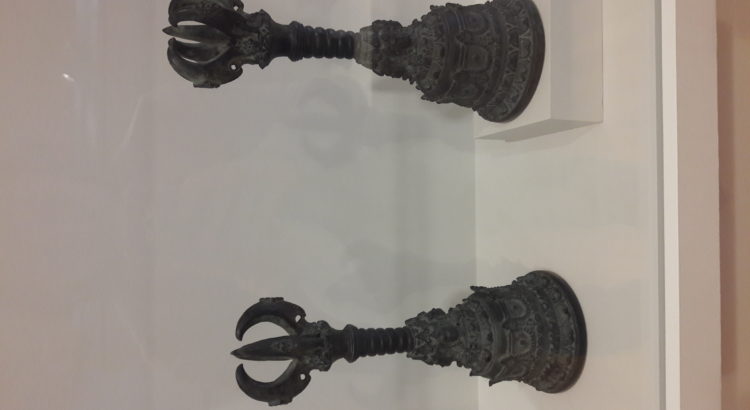
The featured photo is of Bells and Vajra. This bell is very ornate, and was probably used to call monks to the meditation hall. You can touch a 3D printing of the bells at the exhibit. There are beautiful incense holders. Next to them are cards you can take that smell like clove incense. Incense is often used to keep track of time while meditating. When the incense burns out, you are done. No sporadically looking at a clock is necessary. The last piece in this exhibit is a Rakusu, which is the garment monks wear outside their robes. This Rakusu was pretty ornate and had designs, so it was probably of a monk that had a higher status. Monks like to make their own clothes, because it is a tradition from monks who were too poor to afford clothes and would patch together old rags.

The exhibit is small, but there is actually a lot of Buddhist artwork in the Asian Art gallery. If you can’t get enough from the exhibit you can see more paintings, actual scrolls, and shrines that were in temples in the gallery.

REVIEW: Avengers: Endgame

Mild spoilers alluded to in this review.

It took me a very long time to figure out how to approach this review. I was practically raised on this series— an eleven-year-old baby when the first Marvel installment, Iron Man, came out.

It is a pretty long-running joke/phrase/cultural feeling that people are tired of superhero movies. Some people bone-deep hate them— and that these pictures are difficult to ignore with how huge they are in pop culture. And I empathize. But I am, tragically, overwhelmed with a deep love for these films that it drives out my naturally cynical side. I love these movies.

It is a frustrating genre, absolutely. I don’t completely have rose-tinted glasses but it is still something I kept to my heart. Because I love legacy and expansive lore. I love adaptations. I love an idealistic base and people trying to be the best they can be— and that is what Endgame ultimately encompasses.

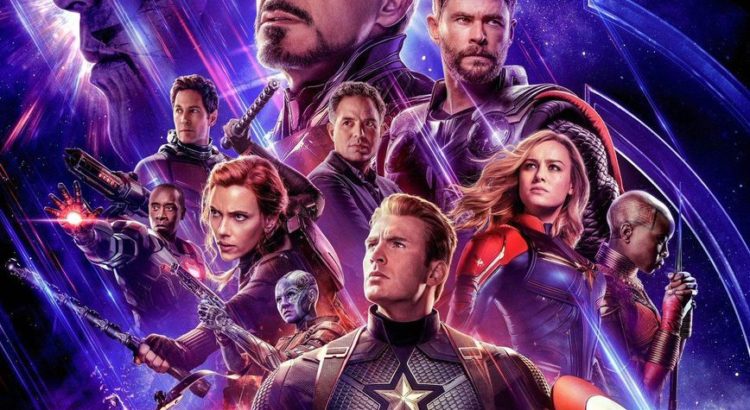
Avengers: Endgame is a loving dedication to the superhero world Marvel has created, capping the first arc and juggling a surprising amount of character development for each of its original six heroes. It wanted to make you smile, a big tonal departure from from Infinity War and a necessary one. I don’t mean to say that the nuance of grief is unneeded in a large production— it absolutely is. But Endgame falls back on a Golden-Age feeling, a more classic superhero feel as it says goodbye to the first, long stretch of the series. Most of all, Endgame wanted to remind you where this whole journey started, when things were a little brighter. 

After the alien-induced rapture at the end of Infinity War, our original Avengers are left on a desolate Earth that is dealing with an unbearable loss. Departed friends, children, and loved-ones has left a surprising amount mystery around the central goal of the film. There wasn’t a moment where you would doubt that T’Challa or Peter wouldn’t be back— it was the how they would be back that drives the film, with a fast-paced and snappy momentum.  

Basically, one of these solutions is a time-heist and without getting too much into what that entails, it allows the movie to go back and revisit the Cinematic Universe’s high points (or middle points). With our heroes’ backs to the wall, a desperation turns into craftiness as they debate and bicker over magical science, falling into a cast chemistry that has been the heart of these movies. And it is a surprisingly niche mission for their final hurrah.

Robert Downey Jr.’s Tony Stark has been as natural to the actor as breathing and his love poured into the playboy billionaire with a heart holds the plan together this round. Tony finds a calm that hasn’t been granted to him in over a decade, putting him at surprising odds against the others. His growth, redemption, and new family makes Tony suddenly the most stable Avenger. 

On the flip side, Chris Evans’s Captain America continues to suffer loss and falls back into the muted depression that has been a defining, if often overlooked, characteristic of the hero since the end of his first movie. Scarlett Johansson’s Natasha Romanoff strives to find a type of redemption that puts her at rest. Mark Ruffalo’s Hulk finds an equilibrium, Chris Hemsworth’s Thor falls into despair after the complete bloodshed of his people, Jeremy Renner’s gets bloodthirsty and an interesting haircut.  

There were definitely parts that falter— a lot of the arcs for the characters were shifted to make things lighter or quickly pushed aside to move on to the next thing. Because of the overstuff of content, content, content, the movie forgets to sit down and cry over the shocking thing we just saw. The first half of the film tries to remedy this old Marvel habit but drops it at the latter half for some important scenes. 

Not everyone gets their goodbye— which hurts. As a fan, I need to remember who would reasonably could get their share of screen time. But even then, a line or two more dedicated to beloved relationships would have been just fine. And I definitely have some Thoughts on the send-off for one of the flagship characters.

But I was still smiling through a lot of Endgame. 

Because I saw this movie on Thursday at 12 A.M. Three hours long and running purely on coffee, I let shocked yelps and gasps that was shared across the theater. The final battle was chock-full of these character who only ever thought would stay on the glossy pages of a four dollar single issue. While I believe it is vital that we all view industries with a critical lens, it genuinely is wild that this franchise was able to happen and sustain for for so long. Endgame was built to be the series finale and it did just that.  

Avengers: Endgame is in theaters now— head to State Theater for the closest showing.

REVIEW: A/PIA Closing Ceremony

This April, the Asian-American Pacific Islander community held a closing ceremony gala— fancy dress and all— for the first time in many years. Taking place on the ground floor of the UMMA, it was an absolutely gorgeous way to end Heritage Month’s dedicated annual work.

Faculty, staff, and students gathered around tables with a fairy light centerpiece as they honored leaders in the A/PIA community. Multiple awards were given— from lifetime achievements to who had the best Instagram aesthetic— all voted on by students.

The group performances were also lovely. rXn was one of these groups– it is a Chinese Student Association multicultural dance group that performs both hip-hop and traditional Chinese dances. With grace and enthusiasm, they were a fantastic display to see during this celebration of cultural organizations.

Seoul Juice was also present. They are a cover band that mixes pop music with acoustic instruments in a mashup of Korean and American styles. “With this, Seoul Juice strives to celebrate Korean culture and have a good time united with other musicians,” their webpage states. They are affiliated with Michigan’s Korean Student Association.

My favorite performance was their cover of “Lost in Japan”, a newer Shawn Mendes song. The singers and musicians made the piece their own— a song already filled with enough finality and longing to make the seniors in the room a little teary-eyed. (My emotional impulses were already kind of high— I’m graduating, leave me alone.)

The entire evening reminded me of the hard work that organizations on campus put into their craft and their love for community building. I cannot wait to see this tradition continue in the future and I hope that everyone in the area can find a way to support student artists.

REVIEW: Ann Arbor Symphony – Beethoven 9

Saturday’s performance by the Ann Arbor Symphony Orchestra was celebration of the number nine: The program included Dmitri Shostakovich’s Symphony No. 9 in E-flat major, Op. 70, as well as Ludwig van Beethoven’s Symphony No. 9 in D minor, Op. 125. Appropriately, this concert was the conclusion of a season that marked the Ann Arbor Symphony’s 9th decade (90th anniversary!).

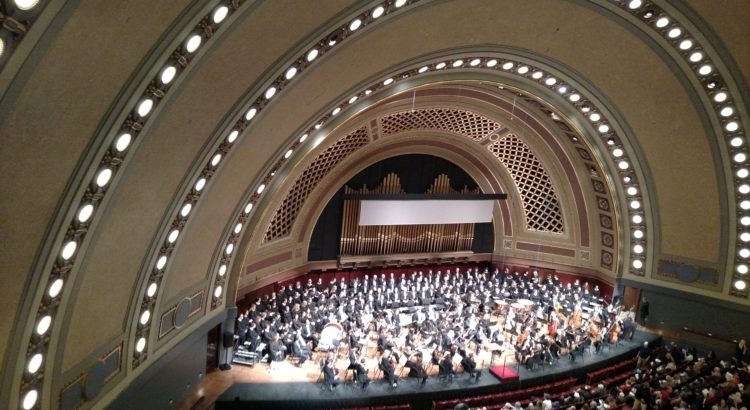
However, although both pieces were their respective composer’s 9th symphony, the difference between them is clear. Shostakovich 9, composed just after the end of World War II in 1945, is a whimsical piece, but with, in my opinion, very little melodic material. The composer himself noted that “It is a merry little piece – musicians will love to play it and critics will love to bash it.” I certainly did not leave Hill Auditorium humming motives from Shostakovich’s 9th symphony, but the piece gave me the feeling that it was depicting something electric and fleeting, like fireflies in the dark of night. I also did enjoy the plaintive clarinet solo in the opening of the 2nd movement, “Moderato.”  However, it seemed to me as if the piece lacked the energy that I, as a listener, wanted it to have, and I am not entirely sure whether it was the actual score of the music, or the performance of it, that caused me to feel this way.

In contrast, Beethoven’s Symphony No. 9 contains what is probably one of the most recognizable melodies in all of music. Even if you don’t know it as coming from Beethoven 9, you most likely know “Ode to Joy.” Related to this, although I knew that “Ode to Joy” was from this work, and although I have heard recordings of the symphony, it was interesting to hear the famous melody in its original context. It is almost as if “Ode to Joy” has, in popular culture, lifted itself out of the confines of Symphony No. 9 to become its own entity.

After the mildly disappointing Shostakovich, Beethoven’s famous work drew me and held my attention. It was awe-inspiring to fully process that Beethoven wrote his 9th symphony after he had gone entirely deaf. At the work’s May 1824 premiere in Vienna, he was unable to hear a single note. And yet, listening to the work, I realize that it is abundantly clear that the music was still very much alive in his mind’s ear. The beauty of the music cannot be captured in words on paper – it must be heard. In fact, Ludwig van Beethoven’s Symphony No. 9 in D minor has become one of the most widely performed works in classical music, and it established itself as an impossibly high standard by which other composers’ 9th symphonies would be evaluated.

PREVIEW: The World to Come: Art in the Age of the Anthropocene

Source: https://www.merriam-webster.com/dictionary/Anthropocene

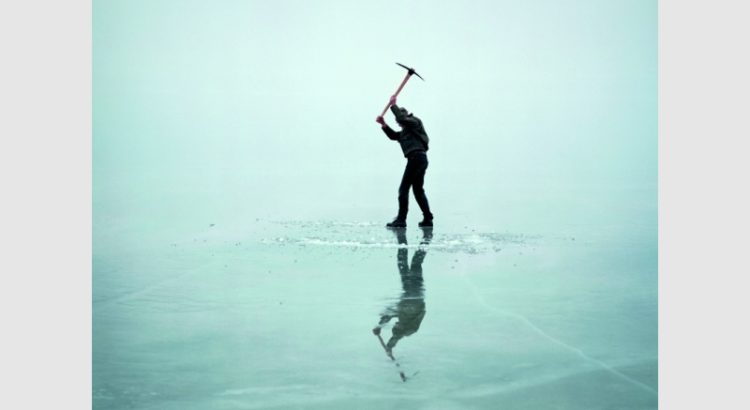
The new exhibition The World to Come: Art in the Age of the Anthropocene at the University of Michigan Museum of Art is an ecological-issue-focused exploration of “subjects and themes related to raw materials, disasters, consumption, loss, and justice.” Over 45 international artists, using a variety of mediums, are featured. In the new reality where humans shape the environment, what will be art’s role?

I am particularly interested in this exhibition because it is a blend of two of my strongest interests, art and environmentalism.

The World to Come is on display from April 27 through July 28, 2019.