REVIEW: Beth Nielsen Chapman and David Wilcox

After a tough week I was looking forward to a relaxing concert. The ark does quiet-comfortable concerts perfectly. The dark small intimate atmosphere fits slow music very well. The performer’s mics weren’t working for the first 20 minutes or so, which allowed us to hear multiple songs unplugged. This was actually my favorite part of the concert. I could hear everything perfectly without the mics, because the ark is small enough to support unplugged music. I think soft singing and acoustic guitars sound better this way. There was a stillness in the air that disappeared as soon as the mics started working.

David and Beth’s music styles were a lot more similar than I was expecting or hoping for, but the content of their songs, the lyrics, metaphors, themes, and meaning, were drastically different. David was like a philosopher. His songs all had deep, often transformative meanings. He sang songs about the political state of our country and related it to a winter storm. He sang a song about emptying our minds, which made me think of the Buddhism class I am taking. He even quoted Abraham Lincoln in one of his songs. My favorite song of his was a song about how we are only responsible for the things in this world we can change, and that we shouldn’t feel responsible from all the bad news happening around us. He used water and the ocean as a recurring theme throughout this song.

Beth sang songs about love. All her songs seemed to relate to the happiness or sadness or mysteriousness of love. Beth has had a very impactful and emotional love life. She has lost two loved ones to brain cancer. It was remarkable how easily she was able to speak about her past love history. My favorite quote of Beths was when she said that Grief is like a boulder in our path that we can’t go around, under, or over. We just have to wait for the rain to wear it down into sand. The only way through grief is time. Beth had a beautiful voice which I actually thought fit the piano more than the guitar. All my favorite songs of her’s were songs played on the piano.

David and Beth would switch off playing songs, which made me wonder why they were even performing together. They only played two songs together the whole, and these were the best songs. I don’t see the point in them performing together if all they are going to do is take turns performing songs. They should learn eachothers so they can perform them together. Even songs that they wrote together, they would split in half instead of playing it together.

REVIEW: Ballet Preljocaj

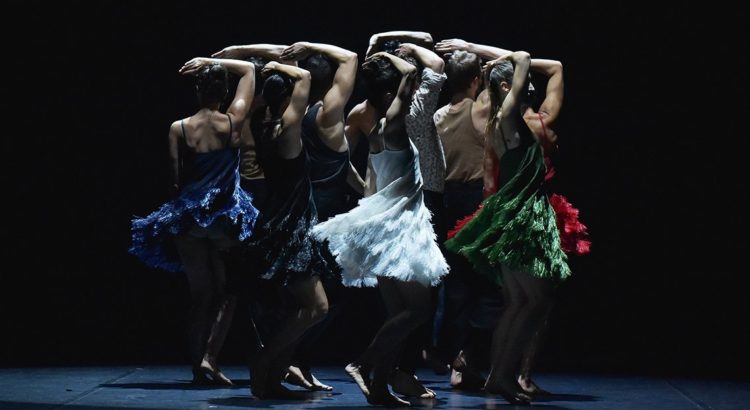
Ballet Preljocaj’s performance of “La Fresque” was a wild experience. At first I wasn’t really sure if I liked it. The first few dances were set to music which I would describe as a mix between ambient and electronic while the dance itself was very abstract (at one point I recognized a series of moves as yoga positions I did during my fitness kick last winter). I found myself feeling like I was watching a caricature of what people would imagine a modern ballet to look and sound like. However, I slowly became more immersed in the performance and really started to enjoy myself.
The ballet did a very good job of presenting the story it was trying to tell of a man in love with a painting come to life and his journey into the painting, through alternate dimensions. The use of curtains and set to create the impression of the painting in its frame was particularly successful. The ballet was supposed to explore juxtaposition and it definitely accomplished this, but it was to a fault. Each dance featured vastly different dance styles and music, going from hard rock to soft ambient music, flowing ballet to frenetic jumping, leaving me with whiplash sometimes. I often felt confused by the abruptness of the changes in tone and felt like it was being extreme for the sake of being extreme. While my overall impression of the ballet was positive, I often felt like the creator was just trying too hard to be edgy. It certainly stretched my idea of what is considered ballet.
A theme developed early in the ballet which was present throughout in various iterations and that was hair. There was so much hair. All the ballerinas had long, beautiful hair. Was that a requirement for auditions? “Ballet Preljocaj seeking female dancers with hair at least two feet long.” And their hair was so shiny and healthy. Are they sponsored by Pantene? I could almost imagine some of the dances being featured in one of those ridiculous shampoo commercials. The focus on hair almost started to feel inappropriate, like we were getting a glimpse of Angelin Preljocaj’s obsession. The first dance performed by the female ballerinas made this theme apparent as they would cover their faces with hair then slowly pull it back or toward the end of the dance when they started furiously flipping their hair to a degree that felt comical. They also used hair to distinguish between the prima ballerina and the crew as she kept her hair down and flowing for much of the performance while the other women tied their hair back in ponytails. Then there were the hair suits. Most of the crew came out in masks and black bodysuits with what looked like long braids of hair attached to them to perform a dance which felt very much like an amalgam of African and South American traditional dances. The hair continued to be included in wilder ways. The dance that really took the cake was toward the end and featured the female dancers with long bungee cords attacked to their buns, meant to look like their hair, attached to the ceiling. The female and male dancers danced in pairs on and around the cords. At first it seemed ridiculous. However, after they started dancing it became beautiful. The women wrapped the cords around their hands, arms, or torsos to support their own weight or the weight of their partners as they suspended each other from the ground and spun in circles. It was truly magnificent. My favorite of the “hair dances” featured the female dancers to a beautiful piece of string music in an intimate and emotional dance. The four dancers each held a portion of the prima ballerina’s hair and danced around her, eventually wrapping her hair into a bun like a human maypole and taking turns to secure the bun with pins. It was a little silly in concept, like the rest of the hair dances, but it felt more sincere than much of the rest of the ballet. The final nod to hair was in the final scene, after the couple fell asleep and the man was taken out of the painting dimension, the roses he had given her were placed in her bun in the painting showing him that their adventure was real.

Image courtesy of the UMS Twitter account.

REVIEW: Mystic Nights at Zal Gaz Grotto Club

Certain situations seem to arise from mostly nothing, creating a sensation of mystery from mere sights and feelings and sounds. In the event room of the Zal Gaz Grotto Club, there was a heavy, though not unpleasant, smell of red wine; dimmed overhead lights, with strings of Christmas lights bordering the room; a quiet playlist of music going, ranging from the Doctor Who theme to classics from The Beatles; and a thickness to the warm air coming from the heaters.

I sat at table 8 before the show began, reading a science fiction novel. Though distracted by the book, I was aware of my surroundings. However, at some point Misha Tuesday just seemed to appear in front of the velvet curtain, gazing at the audience. I dog-eared the page, and the show began.

It was curious that the mystic’s performance was not based in the showy ways of magicians or mediums; there was no claim of celestial powers beyond that which anyone can obtain through study. He stood before us, a slightly short, unimposing man, and argued he was neither a mind-reader nor a psychic, but a well-read investigator of a world hidden by our need for simple order and logic. I had not been expecting a Ted talk, but it was a good speech.

He went through a whole lineup of what he called “experiments,” exercises where we were meant to allow our latent intuition and sight to come through. There were some card tricks, displays of mind reading, of predicting the future. Nothing quite made sense; he seemed to be able to see with people as they visualized names and places, stepping into their thoughts as one could step into a room. Everything should have had some explanation, but it laid a little ways beyond my reach.

I was called up towards the beginning, and though I had wished to be chosen, when it became reality I was nervous to stand before the audience. I was shown a paper with a list of objects for less than a second. One of the objects was inside of a closed box I held in my hands. With the blank side of the paper facing toward me, he moved a pair of scissors up and down, asking me to tell him where to cut so that he cut through the word of the object in the box. I stopped at a random point (or so I thought). He asked whether I wanted to move a word up, and, the spotlight seeming to beat down on me like an August sun, I said no. The word was uttered quietly; it seemed to slip out of my lips without meaning to. He asked if I wanted to move one down, and I said yes, again unsure why I was feeling so certain and yet maybe not in control, not quite.

The word he cut through was “keys,” and in box was a ring of them. Unsure of what had passed, and unsure of its importance, I walked back to table 8 as the audience applauded my participation.

Was it all the effect of exquisite slight of hand? The power of persuasion? Some passing of unspoken signals between the volunteer and the mystic that allowed Misha Tuesday to command thoughts? I have no idea.

But that was the point of his performance, and of any performance that deals in mystic themes. To know the reasons for everything is to have failed at living meaningfully. Instead, as Tuesday preaches, we must ask questions, but not ask for their answers. There is a certain amount of mystery in the world, and it should be considered, but not attempted to be arranged into the static patterns that dominate society. Wonder is precious in the way it takes us away from the oppressive structure of the rest of our lives, and allows us to imagine, if just for a second, that the things we hold as fact may have many forms.

PREVIEW: Roulette

This a Basement Arts Show, which means it is completely directed, performed, and ran by Students. It also means that this show is FREE!!!! What is even more special about this basement arts show is that it was written by Michigan Students, Kyle Prue and Kathleen Taylor. So it is a special opportunity to see this play, at the place it was created, before it becomes famous.

This show is at the Newman Studio in Walgreen Drama Center. Watch it Friday (March 29) at 7pm and 11pm or on Saturday (March 30) at 7pm.

This is the description from BA facebook:   Preston returns home one night to Emma. The conversation they have opens up the floodgates of every problem between them; all of the secrets they’ve kept from one another, everything they are too afraid to say. Preston suggests a solution—a drinking game. The rules of the game dictate that they pour six shots and ask each other honest, essential questions about the nature of their relationship. At any time, if someone wants to kill a topic or doesn’t want to answer the question, they take a shot. If they finish all six shots, it means their relationship is beyond saving and they have to break up. Roulette asks us to consider whether human relationships are built on mutual effort or some uncontrollable, cosmic force.

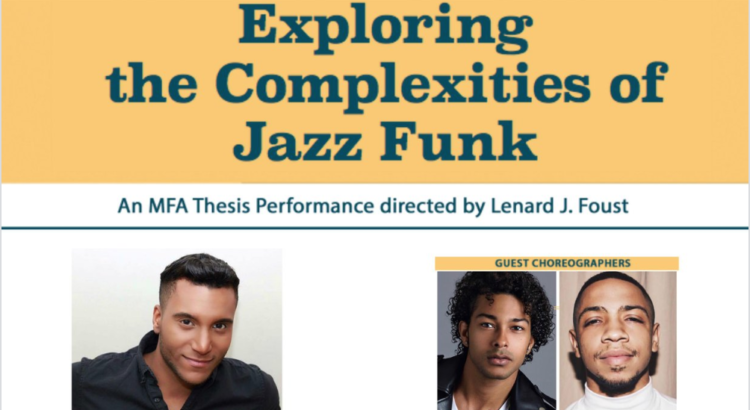
PREVIEW: Exploring the Complexities of Jazz Funk

It’s that time of year again when thesis performances are in abundance. Tomorrow and Friday, Lenard J. Foust (Master of Fine Arts in Dance candidate), will present Exploring the Complexities of Jazz Funk.

What is Jazz Funk? It’s more than sharp movements and syncopated musicality. It blends traditional concepts of “masculine” and “feminine” movement. A jazz funk dancer isn’t just someone who embodies the movement, but also one who understands the historical and cultural contexts that led to the birth of jazz funk as a genre.

The thesis performance features twenty dancers, interactive projections, and choreography by Foust, Lando Coffy and Jose Tena (who are international jazz funk dance professionals). Audience members will experience behind-the-scenes production of a commercial dance video.

A panel discussion will follow each 8:30pm performance.


Price: Free

Show Times:

March 28th, 7pm and 8:30pm

March 29th, 7pm and 8:30pm

Location: Duderstadt Center Video Studio (Suite 3360), 2281 Bonisteel Blvd, Ann Arbor, MI 48109

More info: smtd.umich.edu/dance/#events & https://www.facebook.com/events/217873582492656/

Dancers

PREVIEW: That Brown Show

I’m excited to go to That Brown Show again this year; it’ll be my fourth time, I think. Every year the Indian student performance groups come up with something totally new, which means you never quite know what you’ll see. But they are always consistent in the high quality of work they present, and their dedication to their art. And every year what the show does best is highlight India’s bright colors, vibrancy, and our deep love for our culture.


That Brown Show will be held in Hill Auditorium on March 30, 2019. The performance runs from 7-9pm; doors open at 6. Tickets can be found here.