PREVIEW: Zell Visiting Writers Series: Esmé Wang & Danielle Lazarin

Esme Wang and Danielle Lazarin

Kicking off the first installment of the Zell Visiting Writer’s Series for fall 2018 is  novelist and essayist Esme Wang and short-story writer Danielle Lazarin. The Zell Visiting Writers Series invites one or two distinguished writers for a reading of their literary work. These authors have critically acclaimed reception for their fiction, and engaging in their work and this event is a great way to be involved in the literary scene on campus and beyond.

Born in the Midwest to Taiwanese parents, Esme Wang is the author of the Border of Paradise, which is her debut novel. It is set in a post-war America and centers around the secrets and the haunting mental illness of family members affecting generations to come. A graduate of the University of Michigan’s MFA program, Danielle Lazarin has recently published her debut collection of short stories which has been called a brilliant look into the inner lives of middle-class women. Both these writers have much to say about womanhood, complex mental lives, and the truth of being human. Attend the reading Thursday September 20th, 2018 from 5:30-6:30 at UMMA’s Helmut Stern auditorium.

PREVIEW: Staging Unrest: Performance in times of crisis

Staging impactful and politically provocative theatre in times of social unease is the focus of this brilliantly crafted and much-needed presentation hosted by The School of Music, Theatre, and Dance. “Staging Unrest” is a panel, presentation, and discussion centered around the topic of how to stage and interpret art in a politically decisive climate, as well as the role of art in such a climate. The panel includes directors Malcolm Tulip and Dominika Knapik, designers Vince Mountain and Wolfgang Macher, and some of the members from the American and Polish cast. With a robust panel of many perspectives on performance on the stage including academic experts on theatre, this event is sure to be both moving and extremely important.

“Staging Unrest” will take place in the Walgreen Drama Center in the Newman Studio from 5-6:30 pm on Wednesday, September 19th 2018. The event is free; no ticket required.

PREVIEW: The Wanted 18: Contemporary Cinema from the Islamic World

If you’re interested in the intersection between art and politics, this film screening is just right for you. With tasteful and clever genius, the creators of “Wanted 18” tell the true story of a group of Palestinian civilians that subtly resist Israeli forces who label Palestinian farms “a threat to the national security of the state of Israel.” The Palestinian farmers privately buy 18 cows and produce their own milk; in little time, the cows become local celebrities and a symbol of resistance. This film combines stop motion animation and in-person interview for an intriguing artistic documentary film about the power of grassroots activism. “Wanted 18” premiered in 2014 at the Toronto International Film Festival. You can watch the screening on Tuesday, September 18th at 7 p.m. in East Quadrangle’s Benzinger Library. Entrance is free and the viewing is open to all students!

This screening is also part of a series of movies on contemporary Islamic films: 

REVIEW: Lecture: Race, War, and Refugees with Viet Thanh Nguyen

Viet Thanh Nguyen received critical acclaim for his book The Sympathizer, earning a Pulitzer Prize in 2016 and a string of other awards and recognitions. It was to the utmost excitement of the University to host him with the collaboration of over a dozen student organizations and departments on campus. The reading and lecture was introduced by the well-loved and exuberant Emily Lawsin, Professor of Women’s Studies and American Culture, who declared his novel as a major work of representation for Vietnamese Americans, and the Vietnamese Student Association; both welcomed Nguyen to the stage with raucous applause. There is much to be said about both the reading and lecture, though I will focus on the reading in this review.

Nguyen’s reading was moving in an unexpected, visceral kind of way. Framed by the lecture’s air of social justice and interwoven with his own personal accounts of being a refugee in America after the Vietnam war, the reading was elevated in its state of importance in the packed theatre. The book follows the circumstances of a nameless narrator moving from the final days of Vietnam to his shift to Southern California. The narrator is a double-agent, spying on Southern Vietnamese forces until he is forced to the US.

Nguyen’s writing is witty, funny, takes the often mundane or silly and complexifies it into something rich and important. There was a passage that he read on the stench of Vietnamese fish sauce, which could not have been more eloquent and hilarious: “This pungent liquid condiment of the darkest sepia hue was much denigrated by foreigners for its supposedly horrendous reek, lending new meaning to the phrase ‘there’s something fishy around here,’ for we were the fishy ones.” He tackles Vietnamese identity with the depth of someone who is acutely aware of all facets of his American experience– from the microaggressive comments from white people to the guilt of being a half-refugee, half-American and having to choose one to the strange, wacky clashes in culture and tradition.

One of the students asked a question about how one can make their story readable and engaging, especially if it focuses on issues that its audience won’t know much about. Nguyen explained that the whole point of writing a story is to elucidate experiences that its audience doesn’t know about. He knows that Vietnamese fish sauce may be an experience limited to a few, but it simply has to be included if one is to tell an honest story– how it’s included is the question. And how Nguyen does it is brilliant: with rich language, an exuberant narrator; unafraid to grapple with unsettling topics; sensitive yet risky; bold enough to say, in the end, this: “We used fish sauce the way Transylvanian villagers were cloves of garlic to ward off vampires, in our case to establish a perimeter with those Westerners who could never understand that was truly fishy was the nauseating stench of cheese. What was fermented fish compared to curdled milk?”

More than anything, what moved me about this event is how important it was. It was a space for the APIA community to be represented and heard. Nguyen made a point that stays with me still: he said that he was disappointed that a New York Times review of The Sympathizer described Nguyen as “giving a voice to the voiceless”. His objection: “We already have a voice. Do you know how loud Vietnamese people are? We have a voice, but the problem is, we’re not heard.”

Most critically acclaimed stories on the Vietnam War are often from the American perspective, like The Things They Carried or Matterhorn. They all focus on how the war affected America and wounded its soldiers– it’s the same sentiment of how Americans start wars and then make a movie thirty years later on its damaging consequences on its poor citizens. And I don’t mean to diminish the trauma of the war on Americans– it’s just that when you think about it from a bigger perspective, it’s a bit selfish to see only that. We’d left a country with hundreds of thousands of orphaned children, over a million refugees, and a simmering hatred between North and South Vietnam that still lasts today. At least our stories must reflect both sides. At least our stories, if anything, must do the invisible job of reconstructing our wars so we remember them through a lens of truth, justice, and of honesty that couldn’t be served before those stories were made. The Sympathizer ranks among those stories, and Viet Thanh Nguyen among its brilliant tellers.

REVIEW: Isle of Dogs.

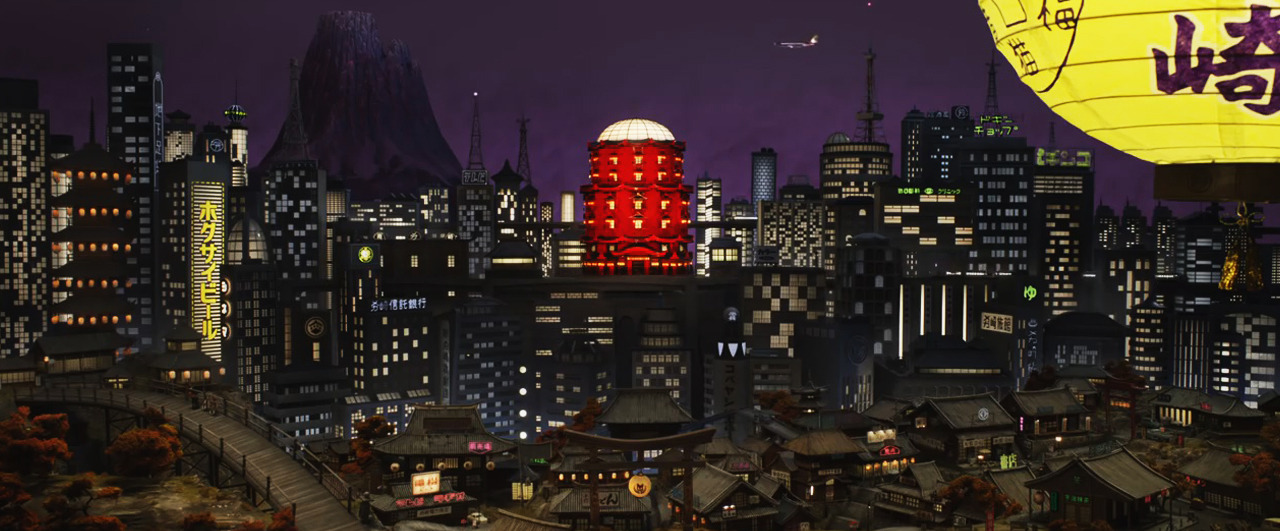
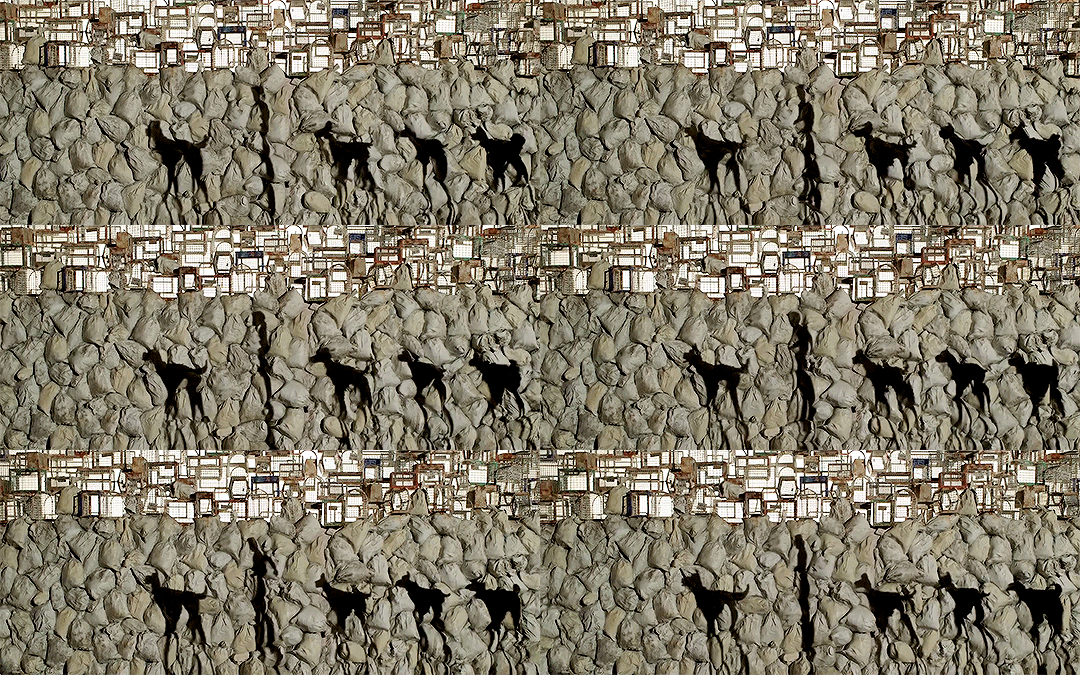
Momotarō is a peach boy in Japanese folk lore – a hero who had been born from fruit. In the story, he travels to Onigashima, the isle of demons, and defeats monsters with his newly acquired animal friends, obtaining treasure for his family. These parallels are seen in Inugashima, or Isle of Dogs, where Wes Anderson crafts his newest endeavor around a Japanese setting. When a dog flu sweeps through Megasaki City, the mayor Kobayashi exiles all dogs to Trash Island, exercising his authoritarian political precision with sinister intent. But Atari, his nephew, is determined on finding his bodyguard dog Spots.

For many reasons, Isle of Dogs is spectacular and clever. It bangs into its self-assured display like a firework – having the same amount of subtlety and persuasion as a firecracker, but similarly lacking as it dissolves too quickly and leaves a measurably less remarkable post-impression. It is undeniably fantastic, but there is something missing from all the razzle-dazzle.

The production is beautiful, one-of-a-kind. And even without the slick graphics of computer CGI, there’s a exactness in the stop-motion animation, detailed in scenes where a sushi chef prepares a lunch, or when Tracy recites the facts on the actors of her conspiracy theory, shining a flashlight on an elaborate tangle of clippings and string. At a technical standpoint, the film is incredible, made with 240 sets and hundreds of models, scenes constructed with a visionary lens to turn plastic sheets and cotton wool into interesting landscapes. From untranslated easter eggs printed on the overhead trolley to numerous references to Kurosawa, the visuals are refined. The colour schemes are beautiful. Not a strand of fur is out of place.

On the other hand, the film sometimes borders on using Japan like a mood board, as purely an aesthetic, swinging back and forth between succeeding and failing its original intention of being a cultural homage. It’s an interesting choice to have no subtitles for any of the dialogue given in Japanese, dialogue that is given by well-known stars such as Ken Watanabe and Yojiro Noda. It gives us the dogs’ perspectives and uses mistranslations as a plot device, but this can be hairy in certain aspects, especially when a character like Tracy emerges from this kind of language choice.

Nevertheless it’s an idiosyncratic plot, emerging from the surfeit of adaptions and remakes to tell us a story centered on man’s best friend with a weird but irresistible kind of charm in the folds of the writing. Isle of Dogs is ambitious in many ways, and in others, it’s all bark but no bite. It’s crafty in its humour, often deadpan and sometimes near ridiculous. The dialogue is well-timed and funny. And for a film about cute dogs, there’s a grittiness to it, never shying away from graphic themes or its political undertones.

But while there’s certainly a lot of good bois in Isle of Dogs, it’s difficult to form a relationship between the viewer and the number of characters the film introduces. We learn a lot about Atari, Spots, and Chief, but it doesn’t leave much room for the growth of all the other characters, including our main band of dogs. With such a hefty, vibrant plot, the screen time of under two hours ends up becoming a limiting reagent, not allowing the story to glow to its full potential.

In the end, Isle of Dogs is fantastic and it is fun to watch, but it lacks a certain depth – a certain howl – to its puppy snap.

Currently playing at State Theatre and elsewhere! Student tickets are $8.

REVIEW: Reverence by Salto Dance Company

It’s not too often that you see dancers en pointe, wearing Hawaiian shirts with sunglasses and holding up a beach towel.

But that’s exactly what Salto Dance Company did in their winter show, Reverence. And though unexpected, it was a move that cemented Salto’s identity as one of the most unique, innovative dance groups on campus.

Reverence is a French word meaning “a feeling of great respect.” At the end of performances, dancers perform a gesture called a reverence to show respect to the audience, and the audience applauds to return that respect to the dancers. After Salto’s opening number, the club presidents came onstage to teach the audience how to perform a reverence. Then they continued the show and put the crowd under their spell.

Salto is known for its blend of many different styles of dance; they are the only student dance group on campus that performs en pointe, but they also perform contemporary and lyrical pieces. Many of their dances transcend genre entirely. And indeed, Reverence provided a perfect blend of tempo, genre and mood.

Say My Name was the first piece that really stuck out to me.  A contemporary piece, the choreography pulled me in from the beginning and the leaps and turn sequences were technically impressive.

Several dances evoked nature with their movement. Revolution, a contemporary pointe piece, flowed like water, and San Francisco, the second act finale, made me envision birds. The technique and choreography were beautiful and captivating.

The solos — mostly classical variations — also impressed. The audience oohed and ahed over the difficulty and quality of movement. However, where Salto really shined was when it went outside its comfort zone.

Sunshine was the first example. Set to the song by Kyle and Miguel, it featured dancers en pointe wearing beach clothes. In the middle of the number, they held up a towel with the words “Salto brings the sunshine.” The dance was full of personality and evoked an almost Broadway feel. It was unexpected from a ballet and contemporary company, but it worked.

And when Salto came on for the second act, their opening number was entitled simply Broadway. Set to a medley of songs from Chicago and A Chorus Line, the musical theatre number was different from anything else in the show. It showcased a completely different side of the dancers and brought out a performance quality that was sometimes lacking in other pieces, especially in the first act.

Another unique piece was Focus, which featured three dancers using contemporary technique and three dancers en pointe. The choreography blended the two styles seamlessly and highlighted the strengths of each individual dancer.

When the show ended and the dancers came out for a curtain call, they did their reverence. And while the gesture was meant to show respect to us to thank us for coming, all I could feel was respect for them for blending so many styles, for displaying a full range of emotion, for pulling me in and never looking back.