REVIEW: New Red Order – Crimes Against Reality

What does it mean to commit a crime against reality? How is this realness defined through actions to capture and liberate it through additive transformations? What can experimental approaches to using technology do to construct alternative realities advocating for Indigenous futures? New Red Order (NRO) explores these issues in their first solo exhibition, Crimes Against Reality, at the Museum of Contemporary Art Detroit (MOCAD), which runs from October 1, 2020 until January 10, 2021. Amidst increasingly publicized conversations about race, nationhood, and equity worldwide, and particularly in the United States, New Red Order’s exhibition is showcased to the public during a time of long overdue reflection and gradual unlearning among the most privileged.

Crimes Against Reality exhibition view at MOCAD

The “public secret society,” a spinoff of the Improved Order of Red Men, an all white fraternal organization established in 1834 in response to desires to “play native,” was created in 2016 by core members Zach and Adam Khalil, of the Ojibwe tribe in Sault Ste. Marie, and Jackson Polys, of the Tlingit tribe in Alaska. By identifying as such, it classification exists in relation to anthropologist Michael Taussig’s concept of a “public secret,” developed in his book Defacement (1999), and described in depth in Kenneth Surin’s article, “The Sovereign Individual and Michael Taussig’s Politics of Defacement” as “among other things the creation of social subjects who ‘know what not to know,’ thereby instituting a pervasive ‘epistemic murk’ whose core is an ‘uncanny’ dialectic of concealment and revelation, though the secret revealed in this case is, qua public secret, not really a secret (49)” (206, 2001). NRO works to “confront” and “rechannel,” two words used by Jackson Polys, long standing and overlooked desires for indigeneity that lie at the core of our national identity as a way of clearing the murk.


New Red Order is future oriented and committed to expanding Indigenous agency, as stated within their “who are we” portion of their website, https://www.newredorder.org.  Approaching the 3 Cs – contract, concealment, and capture – as a methodology to create successful informants, another reference to anthropology, among non-Indigenous allies, this society fosters growth of decolonial perspectives, in physical and virtual realities. The films, Culture Capture: Terminal Addition (2019) and Never Settle (2020), their dark humor filled recruitment video, illuminate the process of building a virtual repository of monuments and museum artifacts, or the stolen collectibles framed as such. These rendered models, generated from differently angled captured photographs, are then mutated via a glitch, or series of phase changes, that transforms them. This glitch, or interruption of normalcy, calls for a reevaluation of hegemonic relations that we refer to as reality. Applying computer technology in investigational ways,  New Red Order succeeds in conducting “a small speculative step toward rectifying the violence committed by museum archives and the settler colonial icons that guard them.” (Never Settle, 2020) “The society of statues is mortal. One day their faces of stone crumble and fall to earth. This botany of death is what we call culture. And this is how we capture it.” (Culture Capture: Terminal Addition, 2019) 


New Red Order, Culture Capture: Terminal Addition, HD video, 2019, Photo: Courtesy of the artists

This day is among us. Now how do we, as settler colonial Americans, foster important discussions about overshadowed cultural issues, or culture as it was defined above, to devise a better and ultimately decolonial society? New Red Order: Crimes Against Reality is on display alongside two additional Detroit-based artists’ solo exhibitions, Conrad Egyir: Terra Nullius and Peter Williams: Black Universe. All three exhibitions close on January 10, 2021 so make sure you visit MOCAD, now open Thursday through Sunday, this weekend or late next week! 


You can find more information about the exhibition here: https://mocadetroit.org/event/the-new-red-order-crimes-against-reality/


Supplemental work of New Red Order can be found here: https://vimeo.com/adamkhalil
 

REVIEW: Soul

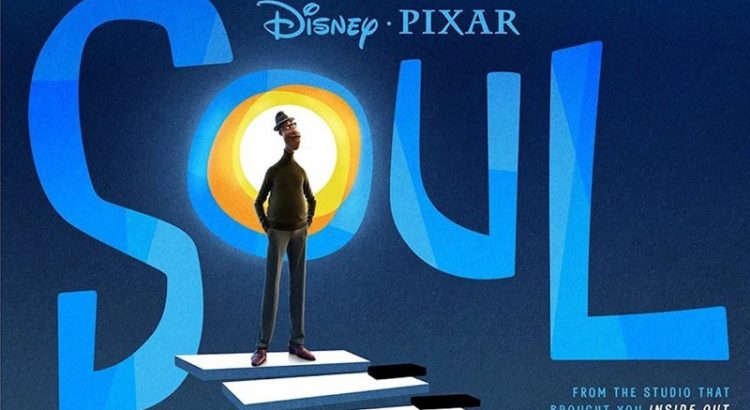
Soul, released on December 25th, is the newest movie by Disney-Pixar, available exclusively on the Disney Plus platform. Unfortunately, I do not think it lived up to the Pixar standard, and was much more sub-par than most Pixar films.

While I didn’t think it was that superb of a movie, Soul definitely had its shining moments. I loved the interesting and clever representation of the Great Beyond (and Great Before), and I thought the all-powerful “beings” that controlled the after/before life that were so cute and well-designed. In fact, I think one of the movie’s strongest elements was its animation design. The characters were so richly different, when black cartoon characters are often overlooked or stereotypical. I loved all the different face shapes, hair, bodies, and voices, and I loved that basically the entire human cast was black, and the movie was not centered around their blackness in any way. That is not something you often get from a movie-making monopoly like Disney. Also, the design of the afterworld and the afterworld beings were awesome, especially the “god” figures, who were made up of abstract lines, and could travel along the lines of other things, which was so clever. And the unborn souls were basically little blobs that bounced around everywhere, so the element of adorable that is a key part of any Disney movie was kept intact.

In Disney and Pixar’s “Soul,” Joe Gardner (voice of Jamie Foxx), a middle-school band teacher in New York City, makes one small misstep and ends up in The Great Before, a fantastical place where new souls get their personalities, quirks and interests before they go to Earth. There, he meets Terry (voice of Rachel House), who is charged with the singular duty of keeping track of the entrants to The Great Beyond. Determined to return to his life, Joe teams up with a precocious soul, 22 (voice of Tina Fey) to show her what’s great about living. Directed by Academy Award® winner Pete Docter, co-directed by Kemp Powers and produced by Academy Award® nominee Dana Murray, p.g.a., “Soul” will debut exclusively on Disney+ (where Disney+ is available) on December 25, 2020. ©2020 Disney/Pixar. All rights reserved.

However, I definitely think the movie had several flaws. For one, I was left with quite a bit of confusion and questions about the theme of the movie when it was over. The movie’s climax is when the main character differentiates between his “spark” and his “purpose”, which is never really elaborated on enough to be clear to viewers. They sort of make this differentiation at the end of the movie, but it is very much glossed over. I feel like if I had trouble understanding the main theme and point of the movie, then it is going to go right over the heads of the intended audience, mainly young children. While the movie was definitely adorable, I did not find that it had much meaning when it boiled down to the storyline and overall message. I know it was a Disney movie, but I feel like they usually have a bit more substance and meaning than this one did. I also thought the movie had such a good opportunity to display some fantastic jazz, and while they did have some, I thought it was a mediocre amount and quality. The movie could have had a ton more music, and they could have used recognizable tunes to make it more broadly relatable as well.

In conclusion, I thought the movie was cute and clever, but the plot line and theme were a little weak. I would recommend if you really enjoy Disney movies and were probably going to watch it anyway, but I would definitely not place this up there with some of the much better Pixar movies that have been released in the past.

PREVIEW: Soul

Soul is the newest movie from Disney-Pixar, and came out on December 25th on Disney Plus. The cast is stacked, including Daveed Diggs, Jamie Foxx, and Tina Fey. The movie stars a middle-school band teacher who is still searching for his purpose concerning jazz music, which is his true passion and talent. But when he travels to another realm to help someone else with their passion, he finds himself along the way. Probably. This is a Disney movie after all.

If there is no singing in this movie by Daveed Diggs I think you all know what my review will look like, because that would be a waste of his talent. Otherwise, I am very excited to see how this much-anticipated movie turns out!

Watch it on Disney Plus here: https://movies.disney.com/soul

REVIEW: Big Mouth Season 4

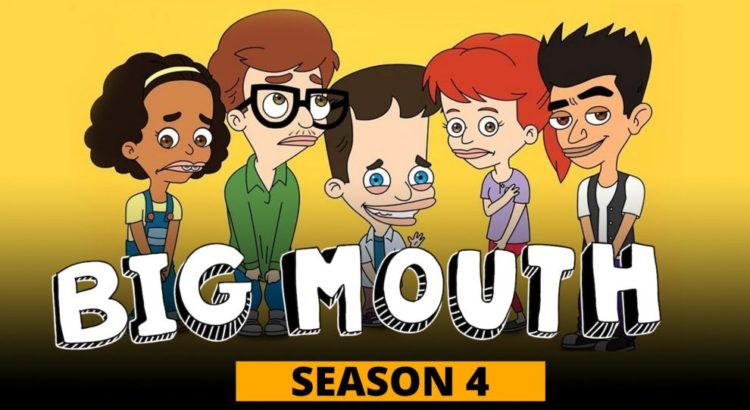
From the beginning of the show, I feel as though Big Mouth has had an important balance of comedy and real-ness. I think they have done a great job tackling some important topics that apply to kids in middle school, but also beyond middle school, especially in this new season.

This new season integrates a few more monsters like the anxiety mosquito, the recurrence of the depression kitty, and the gratitude toad. I loved this transition to more monsters and consequently more emotional difficulties, as the show becomes more complex. The writers did a great job of portraying the different monsters accurately as well, which I very much appreciated. The anxiety mosquito was horribly accurate, and I really related to each character as they were overtaken by its thoughts. I thought it was so clever that they had the depression kitty and anxiety mosquito work together too, as it is so true that depression and anxiety go hand in hand. But my favorite new monster was definitely the grati-toad, who helped several of the main characters, especially Jessie, to see what they were grateful for in their lives. I was  so excited to see a more positive “monster”, especially one that could possibly provide insight to viewers as well.

I also enjoyed the students being in different locations other than school this season. I think a lot of new interesting characters were introduced when the core cast went to sleep away camp, and through that medium were able to cover such important topics like transgender issues, more interesting problems with friends, and getting a period for the first time. Missy also had a huge transformation, and learned to embrace her blackness, which was an issue that I really didn’t know more about and loved watching.

I did, however, notice much less of the parents in this season, which I thought was disappointing as they were all very fun characters. I also wish there was more of Coach Steve. Well, I always want there to be more of Coach Steve. Another thing that I did not love was that there was more singing, and it wasn’t particularly funny or good. It was almost like they were trying too hard to make them sound like real songs, so that people would enjoy them, but by doing so actually made them less interesting, even if they were more “real” sounding. But I would say that was really the only thing that got worse in this season. I didn’t even like the inclusion of songs in the first place, so that was a bit disappointing, but the fact that everything else was great made the songs more bearable.

Overall, I think the new season did very well at building upon the show and continuing to be fresh, raunchy, and poignant. I cannot wait to see what other misadventures the Big Mouth crew has in the next season, and I think I’ve been inspired to watch the whole show over again!

PREVIEW: Big Mouth Season 4

Big Mouth Season 4 follows our classic cast as they experience summer camp, the first few weeks of school, and several new kinds of “monsters” that come along with being a teen. The season contains 10 episodes, about 20 minutes each, and they are all available now on Netflix. If you are a fan of Big Mouth, be sure to catch this new season!

I am excited to watch this season because I love this show so much. I think it does a great job representing lots of different experiences that people went through around middle school times, and also has hilarious and completely inappropriate jokes. What could be better? I can’t wait to enjoy this newest season!

Watch it on Netflix: https://www.netflix.com/title/80117038

REVIEW: Proving Up

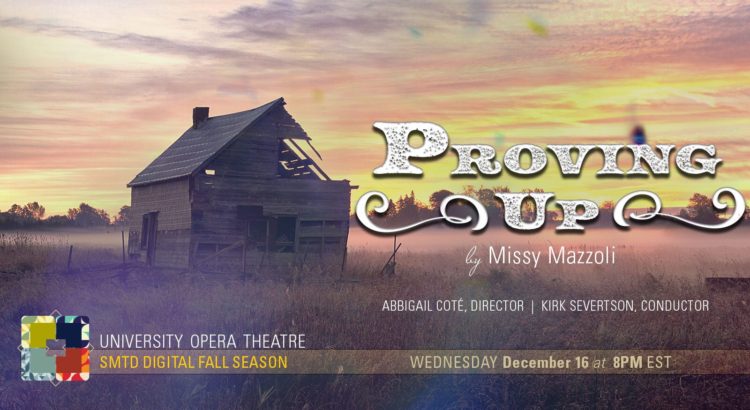
Piercing vocals and eerie lighting fill the Power Center arena. Performers pace the stage, desperately chanting a seemingly impossible list of requirements for obtaining the deed to their land. Though physically distanced, each character’s life is hopelessly entangled with every other person on the stage. A show that had once started in warm yellow light devolves to a harsh inky blue, leaving audience members with a kind of uneasiness that can’t be shaken. This is emotional opera theatre in the age of a global pandemic. This is the University Opera Theatre & University Symphony Orchestra production, Proving Up.

Premiering just last night on December 16th, audiences across the region were given the chance to watch Proving Up, an opera included in SMTD’s winter digital series. Taking places in the early 1870s at the dawn of the Homestead Act, the opera follows a family of Nebraskan homesteaders in their quest to obtain the deed to their farmland– to “prove up”.

The chamber opera begins in a way that seems mostly normal to audiences. The orangey-yellow set feels warm and welcoming, inviting viewers into the family’s world and their quest for the American Dream. Almost obsessively, the family repeats the four requirements that need to be met in order to get their land deed: a house of sod, acres of grain, a five year history on the land, and a window of glass. The last requirement is the most elusive, as it is the very thing that leads to the family’s eventual demise. With every line, the atmosphere on stage grows colder– a mother makes a haunting confession, a father commits a desperate crime, and a ghostly set of sisters weave back in forth between reality and the beyond. Nothing about the world on stage is truly normal, and it is almost impossible while viewing to ignore the sense that the family is being controlled by events just outside of their sight. Though set in what may be a familiar period in American history, Proving Up is anything but expected.

As the opera continues, it becomes apparent that every creative decision made by performers and production team members alike was made with the audience’s discomfort in mind. Scenic Designer, Henry Pederson, has created a set that just slightly exposes the industrial innerworkings of the Power Center itself. Lighting Designer, Harrison Hoffert, lights the performers in a way that pointedly foreshadows their demise. Remaining in line with COVID-19 safety guidelines, the closest performers stand an achingly far 12 feet away from one another, even in times of immense emotional distress. Though subtle details exist throughout the show, it isn’t until the last two acts that audience members find such details coming together to reveal just how warped this world is. Left in an initial hazy confusion, an understanding of events doesn’t dawn on viewers until the true tragedy is centerstage.

Proving Up is a morbidly beautiful opera. The talented performers and members of the creative team work have worked harmoniously to create a cohesive yet grating environment for the heart of the show to live in. With every scene, viewers pick up on yet another detail in a complicated series of events, eventually resulting in an emotionally-charged finale that will leave some unsettled even hours after the curtain falls. This modern age opera expertly combines some of the best things that art has to offer: emotion, drama, and story-telling. Those looking for an evocative show must look no further: Proving Up draws on an intangible kind of fear that audience members will find nowhere else.