PREVIEW: No Safety Net Student Kick-Off Party

This party is a preview of the semester’s theme for UMS: No Safety Net, the three-week festival featuring four provocative theater productions that foster timely conversations around topical social themes.

This particular evening is free, at Canterbury House. The night surrounds 4 performances: Midnight Book Club (improv comedy), a.n.g.e.l.i. (hip-hop/rap), Aldo Leopoldo Pando Girard (spoken word/poetry), and Virago (free improv/new music). The doors open at 7 pm, and the performances begin at 7:30.

If you’re not yet convinced, the event also provides free food…

Come this Thursday (1/16) for an engaging and unique group of performances!

PREVIEW: Fantastic Fungi

Michigan Theater is still showing “Fantastic Fungi,” one more showing! Tomorrow, Wednesday, January 15 at 9:55 pm. They have been showing it since before winter break, and I think I understand that people liked it so much that Michigan Theater brought it back to run a little longer than expected! It’s a documentary film about fungi, their roles on forest floors and potential to heal people. Check it out.

PREVIEW: Weathering With You

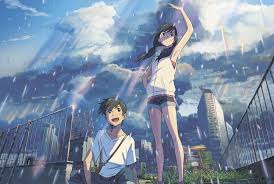
If you are fan of the famous film director Makoto Shinkai and his much beloved and critically acclaimed anime film, Your Name, I”m sure you’ve already heard of his new project, Weathering With You.

Weathering With You focuses on two young individuals: Hodaka, a boy who has run away to Tokyo to start a new life, and Hina, a mysterious, magical girl who is able to control the weather. Hodaka’s life quickly becomes bright and full of wonder due to Hina and her ability to chase away the rain and the two quickly fall in love. However, they must fight to stay together.

Michigan Theater is providing a fan preview screening of the film this Thursday, January 16th, at 8pm.

If you do not yet have tickets, now’s your chance!

There will even be an exclusive interview with the Makoto Shinkai along with the film.

I am very excited to experience Weathering With You. Makoto  Shinkai has such a unique imagination and an impressive ability to merge the mundane day to day of human life with magic in such a way that you could almost believe the events actually happened.


PREVIEW: Little Women


I don’t think I can describe the visceral sear of excitement I felt when I heard that Greta Gerwig was directing a Little Women remake. I do feel sorry for anyone who was in my immediate vicinity. There are noises that no human should bear witness to. My squawk-squeal was one of those. And that was before I found out that Saoirse Ronan (who starred in Greta’s previous film, Lady Bird) would be playing Jo March, one of my favorite characters in all of literature. Of course, she will be joined by other three March sisters: Meg (played by Emma Watson), Beth (Eliza Scanlen), and Amy (Florence Pugh). But mainly, Jo and her writing and her cool hats! Though, this will be the seventh film adaptation of the classic 1868 novel, I have no doubt that this star-studded cast along with their talented director will be able to create something altogether new and interesting. Little Women is currently showing at the Michigan Theatre. Tickets can be bought online or at the box office ($8.50 with a student ID).

REVIEW: Marriage Story

The beginning of marriages tends to be well documented. Professions of ever-lasting love on Facebook. Engagement photos on Instagram. Videographers and photographers at the meticulously planned wedding. No detail is too small to be forgotten. Everything must be remembered. The end of marriage, on the other hand, is swept carefully away, only referred to in a past tense long after it has occurred. No one live tweets their divorce. In many ways, then, divorce becomes more personal and less public than even marriage. An intensely shared experience between two people alone. Yet, Marriage Story brings this private process to the big screen without sacrificing any of the awkward, all-too touching intimacy.

Image result for marriage story

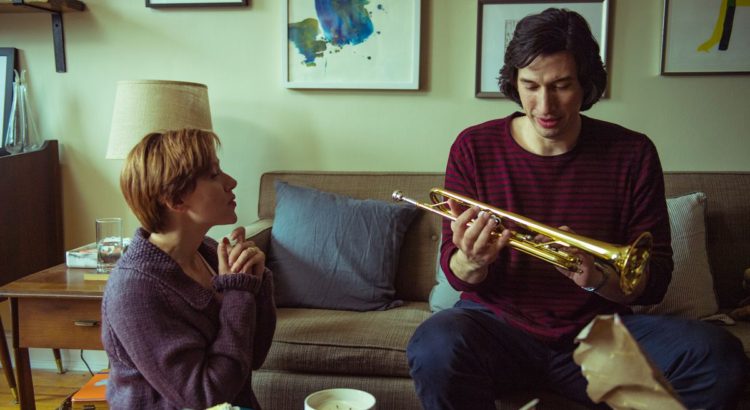
When you marry someone, you know more than enough to love them. When you divorce someone, you know just enough to hurt them. Nicole (Scarlett Johansson) and Charlie (Adam Driver) obviously know a lot about each other. Years of accumulated knowledge spill out over the opening few minutes as each describes the other, noting many of the little quirks and characteristics that make up their partner. Each detail is the result of loving and being loved. Yet, all this knowledge is not enough to stay in love. For all of the things that Charlie and Nicole do notice about each other, there are other characteristics that they failed to acknowledge. Oversight breeds resentment and grievances overwhelm. Gradually, affection is paired with an equal amount of bitterness. What director Noah Baumbach does so well is portray both the lingering tenderness as well as the animosity. By avoiding depicting a truly hateful divorce, he achieves sympathy for both Nicole and Charlie. Neither want to hurt each other. Yet, the process of separation makes hurt inevitable. For, divorce means an entire disentangling of lives. It means taking separating all the things you once shared together. It means becoming selfish and a little bit petty despite your best intentions. Marriage Story doesn’t avoid depicting the inevitable clumsiness of the process, often in ways that aren’t typically acknowledged by separation stories. A particularly funny and insightful scene, for example, involves Nicole informing her mother and her sister that they can no longer be Charlie’s friends during the divorce. Even families must be disentangled. The process of divorce becomes imagining separate lives when you once could only see them together.
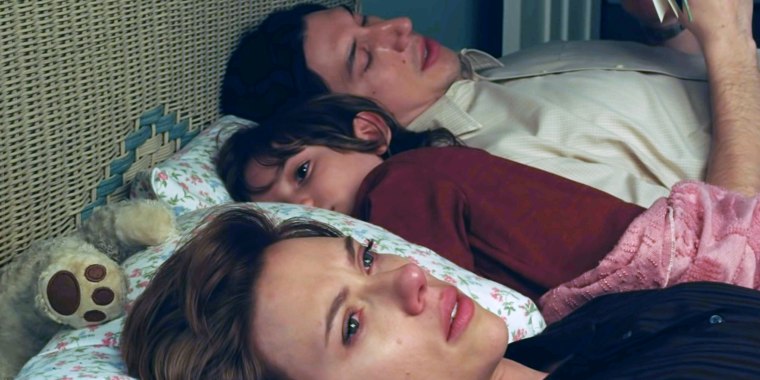
Image result for marriage story

To their credit, it is even more impossible to imagine the film without the collective brilliance of Johansson and Driver. Each, when given the moment to shine, take the light and reflect it a hundredfold. Johansson is particularly good at modulating her voice, going from a place of resignation and softness to fierce independence. Her face, too, expresses a thousand different feelings in the span of a monologue. It is a revelation after seeing Johansson stiffly emoting in so many Marvel movies. Driver, on the other hand, is most effective with his body. He uses every inch of his tall frame, his physicality always more humorous because of how large he is. Somehow, he depicts Charlie’s lack of self-awareness through slouches and hand gestures alone. The characters are brought to life both by these extraordinary performances and the thoughtful attentions of Baumbach, who wrote the screenplay as well. It is almost uncanny how natural the dialogue is, as if all were improvised or stolen directly from real life. Johansson and Driver deliver his words without a hint of performance, transforming memorized lines into something more honest. Thus, when Charlie and Nicole speak, we pay attention, unable to tear our eyes or ears away from the screen.

Marriage Story is all the moments that you typically cannot glimpse. It is about the messy moments that you don’t show others, for fear of exposing too much. But it is also about how those moments are ultimately necessary. There can be no omelet without first breaking a couple of eggs.


REVIEW: Pain and Glory

We spend most of our life forgetting. We forget the countless minutes and hours that sandwich those few occasions of great importance. Out of those bits of time that are deemed memorable, a whole narrative of life is constructed. All the rest discarded as unimportant. That exhilarating summer afternoon, that moody day spent surfing YouTube, all is reduced to the same monotone muffling. It is a time that we know existed but can no longer prove. Left with only remnants, we can only stitch together a partial picture of what our lives were. Making such a fractured image cohesive is the particular talent of the filmmaker. In two hours or less, they must assemble enough of these pieces to create a character whose life can move believably. Intuitively knowing which piece is most important, knowing which space can be left intriguingly open is why some people are directors and I am relegated to mere critic. I have learned to appreciate the picture all the more, though, especially when it is as beautifully constructed as in Pain and Glory (Dolor y Gloria is the original title). In his latest film, Pedro Almodóvar assembles critical moments from both his character’s and his own life to create one vivid whole.

Image result for pain and glory

That feeling of artistic fulfillment has been missing from Salvador Mallo’s life for many years now. Mallo (Antonio Banderas) was formerly a critically successful film director. But time has left him with raging migraines, excruciating back pains, and a throat that will close up without warning. At least he still has a glorious shock of grey hair. Each encounter with bodily agony leaves Mallo bent over, literally breathless. Even in the moments where he is temporarily free, pain casts its dusky shadow over his life. It makes all of his movements careful and slow. Getting into a cab is a cautious unwinding of the body, each breath devoted to avoiding further aggravation. Natural movement is repressed out of fear. This physical repression has led to an artistic bridling as well. He cannot direct while being unable to move with his films. It is not only Mallo that instinctively relates his art to his physical state. Art has always been a bodily act as much as a mental one. Physical suffering from art. Michelangelo was afflicted by severe backaches after standing for hours painting the Sistine Chapel. Art from suffering. Frida Kahlo painted herself laying in a hospital hemorrhaging blood. The title of the film, then, refers to both of the binary aspects of art. We create glorious beauty even in the moments of greatest agony.

Related image

Almodóvar, thus, chooses to depict Mallo’s pain unconventionally. Instead of painful, tearing strokes, we see Mallo’s pain in a colorful swirl of animated color. The rest of the film is similarly bright even as it depicts the various indignities of aging. Almodóvar never lets his film get bogged down by the seeming darkness of the present, allowing for a constant light to shine through, especially when Mallo reflects upon his childhood. Loved and guarded by his mother (a brilliant Penelope Cruz), young Salvador discovers much of the inspiration that will fuel his artistic endeavors in the future. The problem becomes combining that young, beautiful idealism with the harsher realities of getting older. It is like drawing a cohesive picture using both crayons and oil paints. This is the problem that Mallo must truly confront, not simply pain, but the fracturing of self that the pain causes. His suffering proves that he is no longer that invincible young man. So, who is he now? Perhaps this film is Almodóvar’s answer to this question. He says it quite beautifully.