PREVIEW: Rocky Horror Picture Show

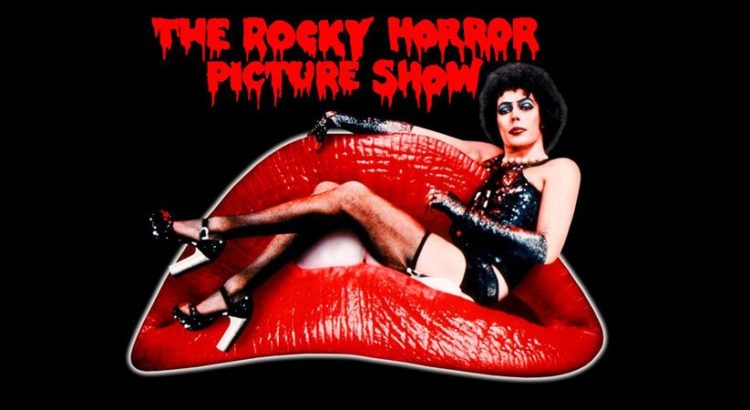
This Saturday at 10 pm catch a one-night only showing of Rocky Horror Picture Show featuring a shadowcast performance by the Leather Medusas! This cult classic will not disappoint as the audience shouts, dances, and throws things all over the theater. To give a summary or a sneak peak into what to expect of the movie would be a grand disservice to those uninitiated, so grab an $8.50 student ticket and let’s do the time warp again!


It’s highly encouraged to dress up, if not as a character then as taboo as possible. Follow the cues of the crowd and PLEASE don’t be the Rocky Virgin that comes with the call out script memorized. Just come and let it happen (and don’t forget red lipstick).


If it’s any indication of the kind of fun that will be going on Saturday, here’s a list of banned props for the evening:

Rice/confetti
Water guns
Candles/lighters (flashlights are fine)
Whole rolls of toilet paper
Hot dogs/prunes


PREVIEW: Nosferatu

I hope everyone is enjoying the Halloween season (though truly every season is Halloween) by immersing yourselves in as much spooky media as possible. Decorations, candy corn, and research into ancient gruesome myths are all important parts of a healthy Halloween diet, but we must not forget to honor the great movies that never fail to get us into the spirit.

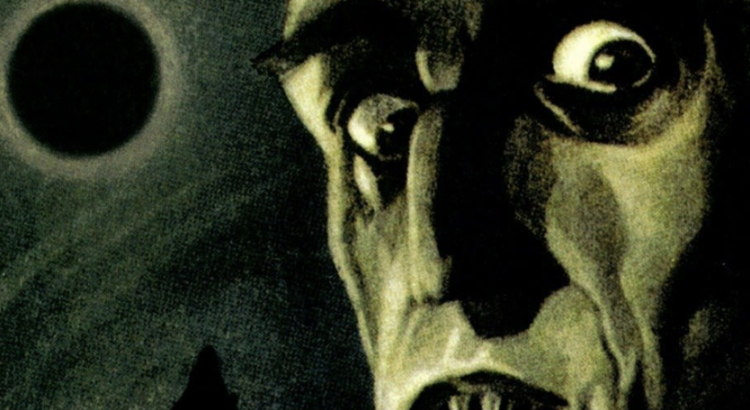
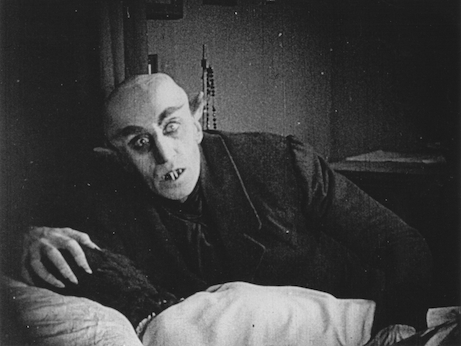
While the genre of horror has become something wildly artful and haunting over the decades, we must look to the classics that provided inspiration for the present. That is why I will be attending the 7:30 pm showing of Nosferatu at the Michigan Theater on Wednesday, October 16. The night will feature live accompaniment by our resident organist Andrew Rogers! The 1922 silent film follows the life of one of the original vampires ever to be depicted on screen, modeled after Bram Stroker’s Dracula of a few decades prior.

Until then, I will be busy learning how to apply a bald cap, because (of course) I will be showing up in full costume. I invite you to come sit with me (I’ll be quite visible), and encourage you to wear your own frightful fashion.

Tickets can be found at michigantheater.org.

Image result for nosferatu


REVIEW: El Camino: A Breaking Bad Movie

The original Breaking Bad TV series had a certain appeal to it. I think it was a combination of a lot of things that made me fall in love with two crazy meth cooks some 6 years ago: The amazing plot, the pacing and tension, the perfect cinematography, the powerful acting, the list goes on. As for El Camino, I think that Vince Gilligan and Netflix hit the nail on the head.

There was no driving event to the plot, no crazy twist that happens at the beginning of the movie to motivate Jesse’s next actions. This is perfect because one wasn’t necessary. The end of Breaking Bad was poetic, and tied up all of it’s loose ends- except Jesse. Anything that needed to motivate him- to fuel some intense plot- had already occurred in the past. Which is why at the beginning of the movie, he is driving away from a meth lab in a stolen El Camino, ducking to avoid the cops who are on their way to find Jesse’s partner, along with several others, dead. It is also why, at the end of the movie, he is a new man- Mr. Driscoll- ready to start life again in Alaska.

The movie, for being two plus hours (as most movies are these days), certainly went by quickly. This is good, because it meant I was captivated by the story, but of course bad because I never really wanted it to end. The way events in the present were often preceded by flashbacks from the past really added an intensity to each moment, while also paying homage to the original series. While there was no big climactic event, each separate scene had its own climax- each one built up to perfectly. Most notable is the wild-west-style duel in the warehouse. That moment was so beautifully set up, and I was shaking in my seat waiting to see what was going to happen.

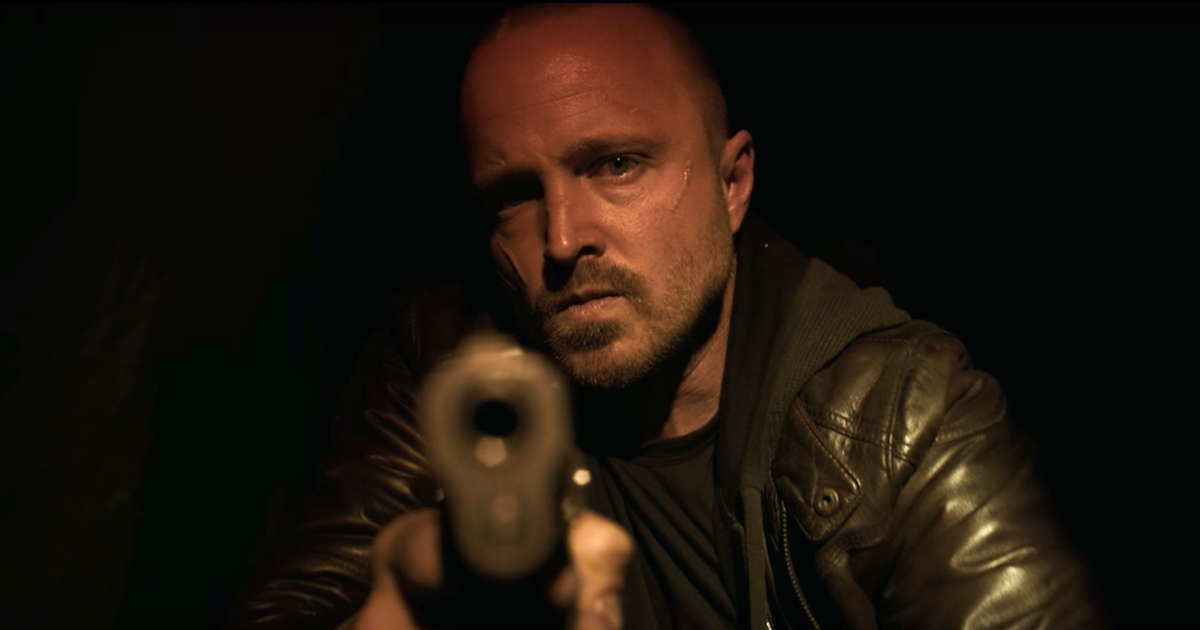
The cinematography in Breaking Bad has always been masterful. Hell, one episode was told almost exclusively from the perspective of a fly (one of my favorite episodes, really). El Camino was just as good with it’s visuals. So many scenes were really amplified by the use of camera focus and angle. Image result for el camino scenesFresh on my mind is the shot of the card at the very end, where the camera focuses in to confirm what we all suspected: that letter was for his parents. Another great example is when he is hiding behind the mattresses in his previous captor’s home, hiding from who he thinks are cops. The way the camera zooms in through the dark to focus on Jesse there with his gun (right) amplifies the intensity of the scene.

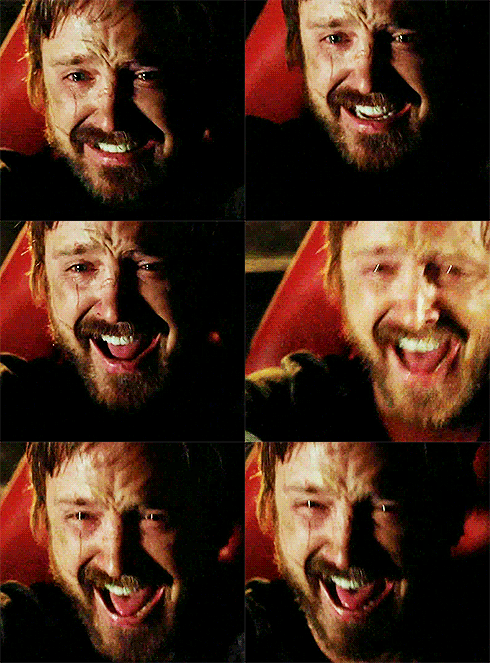
Acting was something I was confident this movie would do well, since many characters had been in the original series. Even with that being said, I feel Aaron Paul’s performance deserves special attention. He always played Jesse so well, but it was different in this movie. More like a traumatized version of Jesse that he had to pull off; a test rat just let out of its cage. I think he portrayed it perfectly. More than reading the emotions on his face, I could feel them inside of me, somewhere deep in my gut.

Certainly a success for El Camino; everything I wanted it to be and more. A worthy sequel to the amazing work that is Breaking Bad. If you missed it this weekend, don’t worry! El Camino is also on Netflix for anyone to watch!

Related image


REVIEW: The Goldfinch

I fell in love with The Goldfinch by Donna Tartt this summer. I’ve said this many times after reading her first and cult favorite novel, The Secret History: that I am convinced Donna Tartt is the best novelist of our time, if not only my favorite. The intricacy of her genius is mind-blowing. The Goldfinch has every Fareah-esque theme a book could possibly have: large, sprawling, ambitious plots, a character we see grow and mature and break, glittering prose, an attention to the everyday, philosophical underpinnings, an incredible (!) best friend figure, unrequited love (not essential, but definitely a perk). I love The Goldfinch so much. I’ve reread some of the passages religiously. 

The story follows Theo, a bright and thoughtful young boy who loses his mother to an attack in an art museum in New York City. In his fervor, he takes a painting with him: Fabritius’ The Goldfinch. We follow him throughout his life, the secret possession of this painting threading its way through every milestone. The story is about a lot of things: love for objects, for art, for people; a search for meaning and value, and sometimes the crushing absence of meaning and value. It is a stirring and riveting story.

The narrative of the book is inexplicably tied with words, with prose, with life given form by language. It’s essentially part of the logic of the story, the central thrumming aesthetic question. Without the craft of language, the narrative seems lacking. I used to be a book purist– someone who believed that books were always better than their movie counterparts. I don’t believe this anymore, because I think that movies and books are two essentially different modes of storytelling, and so a movie adaption must be judged differently than the book. This being said, however, my heart still flinches at the injustice inflicted upon many a good book by horrific and painfully bad movie adaptations. The fact that The Goldfinch relied on language as an essential part of the structure of the narrative and in the history of Hollywood movies with bestsellers, I was incredibly weary of the film adaption. This, I believed, was one of the kinds of stories that movies could not capture. 

I went to the film with my friend who had not read the book. It was a nearly three-hour movie, dense and rich with images and motivations, trying too hard to encapsulate the plot of intricately woven nearly thousand-page novel. It is almost adorably endearing to me that any filmmaker would even attempt to grapple with the magnitude of this novel. It’s uncontainable! I wonder how Donna Tartt does it herself! Three hours is not enough! The psychologies of the characters are too complex, the relationship too deep, the philosophical underpinnings too expansive to capture in the form of film. Perhaps it is unfair of me to say this, and perhaps I am being unfair to the form itself, but they were much too ambitious. I think the film would have worked much better if they had focused on a particular aspect of Theo’s life and developed that carefully rather than trying to explain his relationship with Pippa, and Boris, and Hobie, and Mrs. Barbour, and Kitsey, and drugs, and artwork, and depression, etc etc. Choose one! You don’t have enough time!

Thus, in my opinion, the movie feels like a dilution of plot points, racing to the end. I cannot imagine the movie being successful as a standalone; without the book, it withers. Moreover, the images feel artificial to me, too constructed, and obviously symbolic– all in the varnish of a blockbuster-type style with oversaturated gray skies and all-brown and gray tones. I’m not entirely sure how to explain this, probably because I don’t have the proper film vocabulary, but it felt to me like the images were trying too hard to mean something. I would have liked it to all be scaled back, broken down into the elements of its true nature; not glamorized and made larger-than-life. I felt like I was watching a fantasy, like Harry Potter– and this was, intuitively, the wrong feeling for the story. 

My friend, who had not read the book, loved the movie very much, so perhaps this review is irrevocably restrained by my opinion. However, I did love that the movie reminded me more of my love for the book; when I got home, I sat down on the floor of my apartment with our dim lights while my roommates slept and re-read my favorite passages. If it could do that– spark joy and love, and remind me of what I loved– I am still grateful.

REVIEW: Tigers Are Not Afraid

It’s hard to describe this movie. It feels like it was made a while before its 2017 release, reminiscent of ancient fairy tales and old westerns. Fantasy blends with the supernatural with cowboy kids and unspecific wars that rage eternally.

The whole film had a strange feeling to it, a dark beauty made all the more sinister by the twisting of youth into a violent survival. Sandwiched between scenes of children killing to live–pistol large and awkward held in their small hands–we witness a lavish mansion, a beautiful koi pond, the sun laying warm orange hands upon the earth.

In various scenes I drew a similarity to the 2010 adaptation of Alice In Wonderland, whose creators favored the duller, harsher, rotting side of marvelousness. The blueprint to this wonderland is reflective of that, its color scheme made up of romantically bleak sandy expanses and pastel paints faded by time under the watchful eye of the sun. Dust covers all in a show of a strangling embrace, clouding the landscape in an attempt to dilute its horrors.


What was unclear was the lack of explanation of the adverse effects of making wishes. This seemed an uneven piece of the plot, as Estrella’s mother and the other victims of the gang are seeking justice for the violence through which they’ve suffered. Perhaps they recognize some need for balance, granting wishes being too disruptive an act unless it was accounted for by some random tragedy. But this concept is not corroborated by any other behavior by the dead; they seem motivated only by the rage from the injustices committed against them, and in this basically solely self-interested. Adhering to a lawful cosmic order does would not seem to be an overly pressing concern for them.


But beyond this confusion, there is at least some dark beautiful justice to mingle with tragedy. All the conflicting directions involved in the film makes it difficult to process, but truly this is what film should do: confuse, make us process at once all it’s trying to communicate. There is no movie of any quality that does not frustrate.

I don’t know exactly that any romance should be juxtaposed with real, current violence. I have some creeping sensation that its beauty, however clearly dark it may be, is dangerously placed. Perhaps this movie is only this way as it’s shown through the eyes of children. Though hardened by their circumstances, they still possess the imagination of the young, and need to cope somehow with their orphaning. They seek shelter in each other, yes, but must see something else in the world that can distract them from what they’ve lost.


PREVIEW: El Camino: A Breaking Bad Movie


Spanning from 2008 to 2013, Breaking Bad was an immensely popular television series. It won countless awards, including a Golden Globe award in 2014 for best drama television series, and a People’s Choice Award, also in 2014, for “Series We Miss Most.” Fortunately for Breaking Bad fans all over, we no longer have to miss it.

Now, in 2019, the show makes a comeback in the form of a Netflix original movie, El Camino. This movie takes place following the climactic events of the television series’ finale, and tells the story of Jesse Pinkman, played by the original actor, Aaron Paul,  as he copes with his past and tries to move forward with his life. Staying true to the television series, the movie rendition is directed by Vince Gilligan, the creator of Breaking Bad. In addition, some characters from the TV series make a comeback for this long awaited thriller. Most notable is fan favorite Mike Ehrmantraut (Jonathan Banks), a private investigator with a peculiar set of talents.

If you’re a fan of Breaking Bad and this isn’t on your radar yet, clear your calendar! El Camino is showing at the State Theater this Friday and Sunday (10-11 and 10-13) only! I know I’ll be spending these next few days re-watching the end of Breaking Bad so that I am ready for this weekend. Hopefully I’ll see lots of you there!