
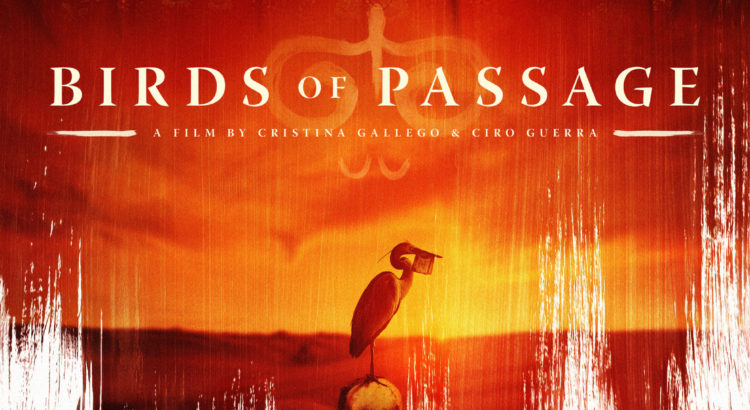
Birds of Passage (Spanish title: Pajaros de Verano) is screening at the State Theatre this week (beginning Friday, March 22). An epic crime film that received the Colombian nomination for best foreign language film for the 91stAcademy awards and was selected for the December shortlist. The drama centers on a Wayúu indigenous family during the illegal drug trade of the 1960s and 70s, illustrating the moral costs of the all-encompassing pursuit of power and wealth. The film will be screened daily at the State Theatre, with audio in Spanish, Wayuu, and Wiwa, with English subtitles.
Category: Film
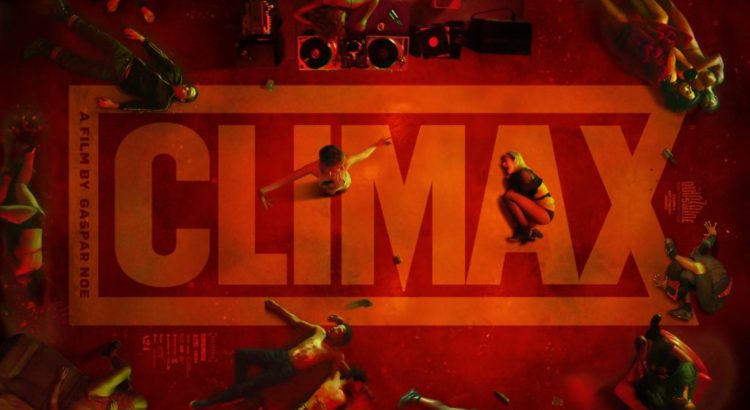
REVIEW: Climax.
With films like Black Swan, Suspiria, and now Climax, dance is a staple in horror, both sublime and dangerous. Some kind of magnetism exists to the art, an incredible fascination with the primal power behind the lofty, elegant institutions of dance. Climax is already a bit stripped down in this sense – there is no renowned ballet school, no classical compositions to be centered around. Instead, the film is focused on a diverse dance troupe, and the pace is set from the first major dance sequence to be erotic, sensual, and chaotic.

Climax feels like an amalgamation of limbs and sound, as if it were a strange animal pulsating with bass and red lights, with a feral energy that doesn’t stop until the party’s over. There isn’t really a script, and it was noted by the director Gaspard Noé that most of the scenes were improvised, shot linearly, over the course of only a few days. It feels organic and crude, surreal in some ways and too real in others.
The cinematography is unusual, with brutally long takes, and the camera primarily focused on the mesmerizing choreography and disorientating scenes that almost seem to amount to nothing. If there is supposed to be a story line, a significance behind everything that unfolds over the course of the movie – then it’s lost to a special echelon of hell that spills across the screen.

At first, the film starts off like any other onscreen party: a bit hedonistic, a bit messy, full of drama and gossip and dancing. The audience is exposed to the private problems and personal relationships between the members of the troupes through cuts towards the different characters at different points during the party.
Things are amplified when the group realizes that their sangria had been spiked with LSD, and all pleasures and desires reach unthinkable magnitudes before turning dangerous. Dance is melded with violence and paranoia, and the scenes turn into an unending, bizarre, sensory surge. While this feeling is nearly normalized by the end of the movie, a few scenes we see through the eyes of some of the only coherent characters are the realizations of the nightmarish reality.
Climax is a polarizing film, strange in composition and delivery, but undoubtedly powerful. It’s a movie that is difficult to make sense of with the traditional parameters of good film-making, and is probably most aptly described as a bad trip – perfectly filmed as such, and unforgiving in how far it takes the viewer down a path of indistinguishable pleasures and pains. The ending reveal almost feels insignificant in comparison to the trauma of the rest of the movie.
While beautifully shot and unmistakably special, Climax is difficult to watch and reads more like an abstract exploration of the moraless, raw side of the human condition than an actual plot. It’s interesting, it’s an experience, and it’s probably a masterpiece in its own genre, but it is definitely not for everyone – maybe not even for most people.

PREVIEW: Secret Love in Peach Blossom Land Film Screening
The CHOP Film series presented by the U-M China Ongoing Perspectives programs is presenting a viewing of Secret Love in Peach Blossom Land (暗戀桃花源) with special guest, direct and writer Stan Lai. The warmly received movie was an adaption from Lai’s self-penned play of the same name, and was the Taiwanese Oscar submission in 1992. The comedy features a unique mix of tones and themes as it features on a single theater that is housing two different plays, both a modern romantic tragedy (Secret Love) and a historical comedy (The Peach Blossom Land.)
Following the film will be a Q&A session with Stan Lai, who is one of the most prominent and acclaimed playwrights in Asia. He was the first to receive the highest degree of Art Award in Taiwan, the National Arts Award, two times in 1988 and 2001 respectively.
The event will be hosted at the State Theater, Tuesday, March 16th at 7:00 PM. It’s completely free and open to the public, so if you’re interested you have nothing to lose!
As a note- the event is titled “Secret Love in Peach Blossom Land,” However the movie is also sometimes translated as “Secret Love for the Peach Blossom Spring.”
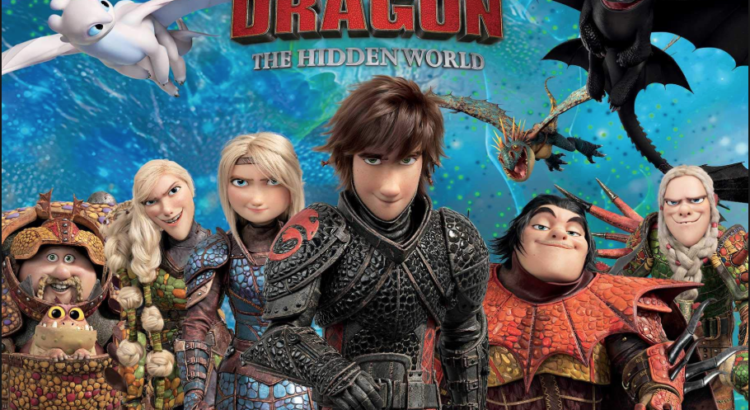
REVIEW: How to Train Your Dragon 3: The Hidden World
I had mixed feelings about the third movie in the trilogy. On the one hand, there were many elements that I enjoyed. For one, I loved the soundtrack. Two, the animation was amazing. The Hidden World was creatively imagined, and I really enjoyed seeing new species of dragons that hadn’t appeared in the previous two movies.

I could also tell that the animators did research on birds and other biological organisms in order to display a diversity of dragon species and behaviors. Toothless’s mating dance was clearly based on mating dances of birds of paradise. Lastly, I thought the themes explored were substantive and intriguing. Hiccup’s coming of age story was heartfelt; he eventually found his sense of self and established self-confidence, even without Toothless. Flashbacks to Hiccup’s childhood were emotional and vulnerable. Toothless and Hiccup’s relationship also demonstrated the important lesson of how love and loss comes hand in hand.

The weaknesses in the film, I thought, were generally in the plot. At times, it was rushed and sloppy: there were unanswered questions in the narrative, levels of threat posed in the story were either exaggerated or understated, illogical choices were made by Hiccup as a leader, and the main villain was unconvincing.
Loose threads/unanswered questions: What happened to the warlords (secondary antagonists) in the story? After Grimmel (primary antagonist) was defeated, the warlords just dropped out of the narrative, which was odd given their massive army, resources, and ambition to conquer the world. The narrative could have been stronger, arguably, if they were taken out of the story completely.
Plot points that don’t make sense: Why would the Vikings of Berk abandon their home without a concrete plan? Yes, Hiccup’s thinking and style of leadership is unconventional, but their village has hundreds(?) of people from an older generation accustomed to combat and warfare. It would make more sense for them to hunker down and fight Grimmel, meanwhile sending out people in search of the Hidden World so they can move there later (once they’re sure the place even exists).

Exaggerated and understated levels of threat: (1)Grimmel had six Deathgrippers, versus the hundreds/thousands of dragons on the island of Berk. Hiccup’s forces significantly outnumbered Grimmel’s forces. Why would the people of Berk feel threatened enough to flee their island they’ve populated for seven generations? (2)Near the end of the movie, Hiccup’s crew attacked a massive fleet of ships in order to save Toothless and the Light Fury. They were outnumbered—possibly 1000:1. However, only two or three ships attacked them and were then easily defeated. There were no cannons fired, no arrows shot, no naval tactics were employed. What??? If only ten or fifteen ships were present in the scene, I would have been less confused and unsatisfied by the enigmatic ease with which Hiccup’s crew defeated the antagonists.

Regarding the antagonist: I thought Grimmel was an unconvincing villain because he didn’t possess strong intrinsic motivations. Why did he target Night Furies? Why didn’t he want to train Toothless into being his servant instead of killing him? Why didn’t he kill Toothless, given the many chances that he had, if that was his ultimate goal? The movie briefly tried to answer some of these questions during Grimmel’s few monologues and encounters with Hiccup, but I just wasn’t convinced. Perhaps if the movie included a couple of flashbacks from Grimmel’s past, it would have shed more light on his hate of dragons and ambition to hunt Night Furies specifically.

An Aside: Strangely, Astrid felt like a different character in the third movie. I’m not able to pinpoint why, but I think it may be because she had a more masculine role in the first movie (engaging in combat, being jealous of Hiccup, picking a fight with him, being rash(?)), and in the third, she took on a more feminine role (pacifying Hiccup, being the voice of reason, etc). Just the way she talked felt different for me.

Agree or disagree—what are your thoughts on the film?

REVIEW: Captain Marvel
This article alludes to minor spoilers.
In a beautifully shot debut, Captain Marvel cultivates a mythological (and exciting and godly) character, rightfully cementing her as one of the most anticipated heroes in the Marvel Cinematic Universe.
Best known for her Oscar-winning role in Room, Brie Larson plays a Kree warrior referred to as Veers (the reason why is nicely revealed later on). Kree warriors has a single mission to uplift the universe: defeat an alien race called Skrulls who are hellbent on infiltrating and destroying civilizations through shapeshifting. She is often encouraged to suppress her curiosity regarding her lost memories in order to embrace their mission for the better of the Kree army. However, after a failed assignment, she is knocked down into Earth— where she finds out that she might once have had a life on this planet.
Veers — also known as Carol Danvers — has a particularly unordinary origin story. She’s a little difficult to adapt to the big screen, considering she is unknown to the greater public and has a less consistent comic book history. But the movie packs her distinct story in the runtime, establishing the world and moving dynamics within it.
The loss of memory is a major theme— and point of confusion for Veers. However, it never seems to be her main goal to find out who she is, as pointed out by this piece in The Atlantic.
However, I interpreted this as the Kree’s obsession of suppressing emotion and embracing a militaristic way of life— something Veers was (fruitlessly) trying to adopt. I will say, the movie could have expanded the Kree way of living and its operatives a bit more (and more subtly). To delve into the world that adopted her and how they effectively shaped her into being their warrior would have allowed us to understand our amnesic hero more.
But the movie is a lot easier to handle once you realize that Veers is approaching her time on Earth as a single-minded soldier. She is not impressed with what she sees on our planet at all. But there is a break once she realizes that Earth is a lot more personal than she had thought. Larson was given a very confused person to portray, but her cadence and gait throughout carried the character. The movie approached the “obligatory origin story movie” by working backwards, which I believe is ultimately more beneficial to Carol and the audience.
I thought it was rather effective to leave her emotional Earth connections to past friend Maria Rambeau (Lashana Lynch, Still Star-Crossed) and her daughter Monica Rambeau (Akira Akbar), rather than her clearly unhappy upbringing. Veers seems to be cemented in the connections she chooses to make, rather than ones forced upon her. There is something poetic to leave much of her past in flashes, mysterious glimpses, as it allows as to see Veers as the person she currently is— a Carol Danvers who has changed, who has experienced a world bigger than hers. I hope dearly we can see the Rambeau family again, as they were darling in every way.
I am especially glad Maria was on board for the climax as well— her relationship to Carol was especially complex, full of distinct grief and care. Lynch gave a performance that balanced the quick-pace of a fun Marvel movie with the underlying yearning of the character.
The most expected comment of the film will be that Carol is too powerful— and logically, I can see that. But I had a smile on my face throughout the climatic sequence. It’s not subtle, but it’s not distracting. It’s not bad. The movie is just fun, alleviating and paced in ways that a viewer needs.
Samuel L. Jackson’s Nick Fury was an absolute delight as the deuteragonist. Jackson’s character has been flitting in and out of the franchise for a while now, so seeing him as an unabashedly enthusiastic fan of Veers and her world gave a lot of endearing insight as to why he would create The Avengers in the first place.
It was wonderful to see Fury as wide-eyed, less brittle man who is open to trust people. It explains a lot about Fury in the present timeline— why he isn’t as wary of these powerful superheroes as one would think he would be. It’s because he can sense the good in them— he’s seen it before in Carol. Jackson was consistently uplifting in every scene he was and continues to be a highlight in the Marvel universe. I also hope we can see their dynamic (and the cat) again.
One of my biggest disappointments definitely stems from the larger problem that the MCU tends to adopt: they hire really fantastic actors, hide them under voice changers and armor, and have them appear essentially as background characters. Gemma Chan (Crazy Rich Asians) and Lee Pace (Pushing Daisies, Guardians of the Galaxy) were just a few examples in Captain Marvel— both dynamic and beloved actors but barely used.
Annette Bening (20th Century Woman, one of my favorite movies) played a larger role and even then, I felt like she could have been allowed to chew up the scenery a bit more. However, she was deeply engaging on the screen— a relaxed, cool presence and the key to the story’s mystery.
And if I can take a moment to say— I deeply enjoyed the look of the female characters in this movie. I wouldn’t say I have an eye for fashion sense/aesthetics, but they were all framed in the way that felt deeply different. Maybe it was the absence of a male gaze. Maybe it was the grunge look.
Captain Marvel’s arc wraps up in a satisfactory way, concluding a piece of the larger intergalactic Marvel story. It pumped me up for Infinity War and what our new player can bring as a superhero and as a reassured Carol Danvers.

REVIEW: CatVideoFest 2019
Cats are, without a doubt, amusing to watch – and even more amusing to observe in a partially filled theater of 75% octogenarians, 20% wholesome families, and 5% college-student-not-yet-killed-by-curiosity. The 2019 reel for the annual CatVideoFest encapsulated this entertainment quality unique to cats quite accurately – as lofty as they are, their antics warm the heart and soul.
Cats have always had a mysterious pull on the internet and its users; from live stars like Grumpy Cat to cartoon favorites Pusheen and Nyan Cat, our feline friends have been subject to relentless meme-ing, viral videography, and all-around internet-ing. Yet a psychological reason for our obsession with these whiskery creatures as internet sensations remains unclear; some hypothesize that cats exquisitely mirror human behavior and tap into deeper perceptions of human emotion, while others think it as a result of our inclination to procrastinate with feel-good activities. Regardless of the true science behind cats’ internet popularity, the curators of the 2019 CatVidFest reel effectively harnessed all of the distinct qualities of addictive cat GIFs, videos, and animations.
Going into the experience with more than my fair share of paw-slapping cat videos, I had a general expectation of what was to ensue on screen. What I did not expect was the audience’s high responsiveness to anything and everything the cats, both large and domestic, did on screen – with every twitch of the ear and shake of the tail, my fellow cat-lovers roared in hilarity, cooed with empathy, or buzzed with anticipation of the next clip. Needless to say, the majority of viewers were silver-haired, yet a surprisingly substantial number of young families attended. Every 6 minutes or so a tiny chorus of manmade meows would erupt from different sections of the theater, which I interpreted as proof of the bewitching hold that cat videos have on the average citizen.
My favorite clip had to be the little gem strategically shown within the first five minutes of the reel; it hooked me in and set the bar for the later lighthearted, comical videos. The brilliant 41 second nugget portrayed a fluffy-cheeked, domesticated orange tabby in its true form: a predatory bounty hunter. I watched in quiet suspense as the great orange 13 pound beast stared down the slinkily approaching young black bear, as if daring the young contender to intrude further onto the tabby’s turf. Its orange and cream tail swished dangerously for four counts, back arched and prickly, ready to pounce. The naive little Ursus americanus failed to get the memo; as the outraged Felis catus shot forward in one elegant leap, its cowardly prey hightailed it up the nearest tree in an almost feline manner, only daring to slowly inch back down to its natural elevation and habitat once Felis catus was well out of sight.
Though the tabby’s bravado elicited a hearty wave of laughter, it was accompanied by a plethora of other heartwarming and inspiring videos about cats and how they function as healers in our everyday lives. Oskar the Blind Cat is a prime example of this – though his recent death was a tragedy for the community, he will forever be known to inspire the blind with his iconic and energetic will to live life to its fullest. Another video followed the story of an abandoned kitten who finds its way into a computer guy’s car engine, and later, his heart. CatVideoFest is far more than a celebration of the ingenuity of various cat videos on the internet – like the organizations that it benefits, it interweaves stories of how cats have strengthened our very own interpersonal connections, bringing harmony as well as endless joy to communities who cherish them.
