REVIEW: If Beale Street Could Talk

If Beale Street Could Talk is a paradox. It is a beautiful movie about ugly realities. It is light enough to take flight and simultaneously weighed down. It should be an ordinary love story of two young people, but it also can’t be because those two people are black. And it is a movie of extraordinary substance, but only sometimes. So, I loved it, but only sometimes.

One of the most significant paradoxes, is how the film can feel incredibly focused and far too broad with its characterization. This is especially true for Tish (KiKi Layne) and Fonny (Stephan Lane), the couple around which the film (and occasionally the camera) revolves. Tish is newly pregnant. Fonny is newly imprisoned. It is a story that feels sadly inevitable. So even as Tish holds out hope for her beloved’s return, we watch with a sense of doom. They are beautiful outlines, walking down the street, hand in hand. Brightly blue and yellow clothing against the concrete sidewalk, you want to follow their silhouettes forever. But that’s all they are. Outlines. They never feel shaded in because so many things, their personalities, their histories, feel like afterthoughts in the narrative. Instead, they are constantly overshadowed by racist, societal forces that refuse to see them as people. And ironically, neither can we.

Though, Barry Jenkins certainly tries. His humanist style is apparent in every shot. When his camera focuses, really focuses, on Tish’s and Fonny’s faces, the lack of explanatory detail is utterly insignificant. Their eyes seem to contain a depth that is voiceless, a meaning that is inexplicable. When the score starts thrumming and the camera sweeps across a brick New York street, the feeling grows until it encompasses everything. Those overwhelming moments don’t by themselves, make the film incredible, but it certainly impresses upon you the importance of every moment. Time slows down, each passing moment agonized over, a memory in movement. For Tish and Fonny, after all, time is of the essence. Separation by prison glass makes every second precious. Seconds before Fonny is led away to a place where even Tish’s love cannot reach. Seconds before their time together is a distant memory.

The film’s greatest accomplishment, though, is forming characters around the Tish and Fonny so their relationship never becomes claustrophobic. In that way, the movie emphasizes familial love as much as romantic much to its advantage. Unlike Tish, her parents have long seen the world as it is. So, their happiness at the imminent birth is both incredibly joyous and a cautious projection. Regina King as Tish’s mom stands unwaveringly in her role, her eyes swimming with hidden vulnerabilities. And as Tish’s father, Coleman Douglas is a pillar of strength, going so far as to sell stolen merchandise to support the increasingly heavy fees for the lawyer. Every moment that the world crumbles, there is a willing hand, reaching out to take on another burden.

A love story above all, If Beale Street Could Talk wanders in a world of color without ever hesitating to explore the dark corners. It is, after all, in the hidden spaces where love blossoms best. In a cramped apartment room where Tish and Fonny finally connect. In a family home, where the celebration for a new member begins with a toast. In these places, there can be no police interference or shady justice systems. In these places, love triumphs.
REVIEW: 2019 Oscar Nominated Shorts: Animation

The 2019 Oscar Nominated Shorts in the Animation category explore similar themes of family and time, evoking certain emotions over and over again.

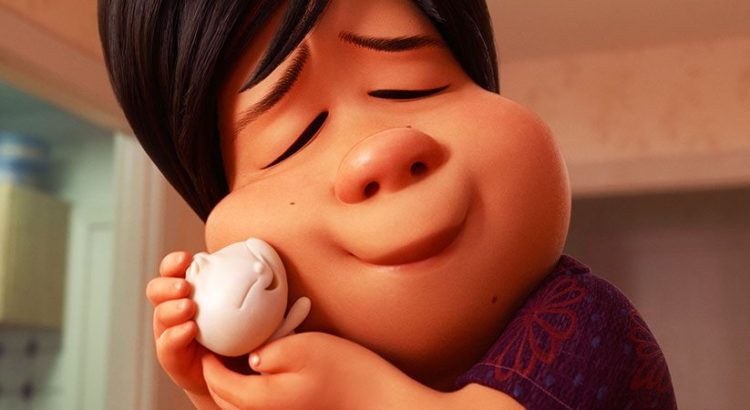
Many of the shorts, including Bao and Weekends, were autobiographical. Bao, Disney Pixar’s short released with Incredibles 2 and applauded for its cultural representation, tells the story of a lonely Chinese mother and one of her dumplings when it comes to life as a little dumpling boy. This narrative with animations characteristic of Pixar plays with the idea of parental possessiveness and the need for familial love and attention, taking a harrowing turn at the end that leaves one to wonder the costs of overprotection. Also featuring an Asian-American family is One Small Step, the cleanly-drawn animation about big dreams and realistic achievements. Through the passage of time, Luna must grapple with her dreams of being an astronaut and the obstacles in her way, supported by her single father the entire time. The crisp 3D animation was certainly appealing, turning this “dream-chasing-believe-in-yourself” storyline into something fresh and emotional.

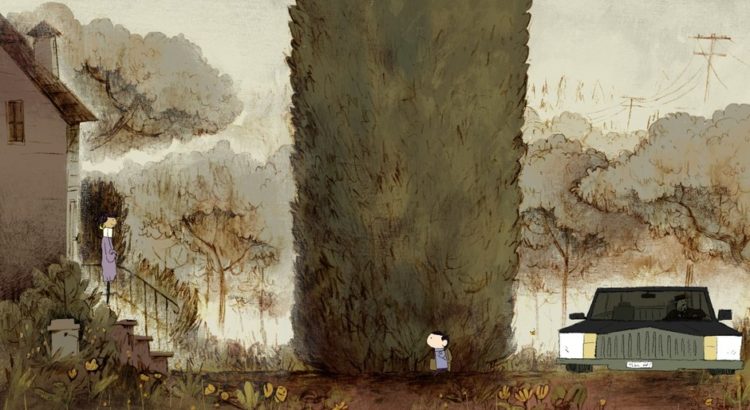
Another short that deals with family is Weekends, a hand-drawn melancholic tale of childhood after a recent divorce. The absence of dialogue brings all the focus onto the universal mood of this film, as a child bounces between homes and lives and relationships evolve as a result, offering a compelling story of a fractured family with purely the art of animation. Late Afternoon looks at the painful issue of memory loss, as Emily, an elderly woman, goes through old memories in order to make sense of the present. Through the use of color, Emily was able to weave through all the different memories, and the flow through time between the present, the subconscious, and the memories. The emotions associated with memory loss was heightened with the use of water throughout the film, washing over her as she searches for clarity.

The last nominee shown, Animal Behaviour, features anthropomorphized animals in a group therapy session. As the most comedic short in the featured films, it is filled with crude animal jokes based on their natural traits until an ape gets going and sets off the dog therapist. The lineup also included two additional selected shorts, Wishing Box and Tweet Tweet. Wishing Box introduced us to a greedy pirate and his hungry monkey companion who come across a box that will give you anything you wish for, while Tweet Tweet gives us the courage to balance on a tightrope as a girl befriends a sparrow who guides her throughout her life.

All the short films used a variety of animation styles, opening my eyes to how diverse animated films can be. From the scratchy and homey feel of the hand-animated Weekends to the colorful, flowy vibe of Late Afternoon to the crisp 2D-on-3D animation of One Small Step, the animation nominees were all both visually appealing and emotionally resonant.

REVIEW: Oscar-Nominated Shorts (Live Action)

So often I am struck by how little film makers do with their medium. It is an art form that combines visual and audio elements more immersively than reading a book or perusing an gallery can really claim to do. Yet we end up with so many American Pie types, popular but containing no real depth. Emotion and meaning are dulled when movies become uniform in this way, and their power to deeply affect dies. Moreover, even the aesthetic capabilities of the film medium are often ignored, settling for unimaginative school or office buildings, with costume designers seeking normalcy so fervently that their characters’ dress becomes boring.

Fortunately, there are some who understand the abilities film has to deeply move its audience. All five of Academy Award-winning live action short films (Mother, Fauve, Marguerite, Detainment, and Skin) provoked a larger range of emotions in me than nearly any other movie I’ve ever seen. Mother gave me a feeling of creeping cold desolation, with its wide sweeping gaze at the empty beach in the beginning and end. Using the point of view of the lost boy’s mother gives the audience a closer look into her desperation and helplessness. We listen to him with her, clinging onto every word his soft voice says through the phone. The camera work is disorienting, making us panicky with the mother and grandmother as the reality of the situation sets in.

Image result for madre short film

In Fauve, there are two drastically different sceneries: the wildly beautiful Canadian countryside (wildflowers, long grasses, mountains) and a stark mine site (plain grey earth for what seems like miles on all sides, reminiscent of an alien planet). The scenes in the mine site seem surreal compared to the lushness of the fields the boys travel through to get there. I almost expected the earth to begin to rumble and rise, revealing itself to be some enormous living creature.

Related image

Marguerite was the only one to make me cry, and one of the few movies that have ever made me cry. The loneliness she must have felt moved past the screen and into the most melancholy part of my mind. It is unclear whether she loved again after her soulmate was married, but because she lived alone in the movie, it seemed her companionless existence had been eternal. The whole movie had me feeling cold: the slowness of all her actions, the neatness of each room in the house, the millions of wrinkles lining her face.

Image result for marguerite short film

I felt least connected to Detainment, though it disturbed me more fully than the true crime documentaries on TV have ever done. The documentary-esque style of the piece did not go well with the narrative tone, and the same few images of the boys abducting the baby were played over and over again, without adding much value to the film. However, the filmmakers played on the boys’ conflicting stories, which helped create an uncertain, uneasy feeling.

Image result for detainment short film

Skin was by far the most brilliant star of the five. It played on racism in modern America, the psychology of childhood development, gun politics and violence, the idea of innocence and how easily it can be destroyed, the uncertainty of placing blame…I could go on. It made me question my own life and thoughts, those of my family, of the country and the greater world. I had to catch myself when I unconciously started distancing myself from the white family’s attitudes and actions, recognizing the weakness in that thought, the automatic stereotypes I’d applied to make myself feel better. And when the two young boys locked eyes for the second time, I was haunted. Somehow within the film’s disturbing content, there was still an attention to lighting and landscape details that made it uncomfortably beautiful, the exquisite drip of blood, the lonely desert nothingness.

Image result for skin short film 2019

REVIEW: Spirited Away

Image result for spirited away

Michigan Theatre’s screening of Spirited Away was met with a delightfully long line outside the theatre, people willingingly shivering in the cold, anticipating the much-loved Ghibli classic. I have to admit before I go any deeper into this review that this was my first time watching Spirited Away– or any Ghibli movie, for that matter. It was such a treat to witness the spectacle of animation and the immersive fantasia of Chihiro’s journey into the spirit world. I walked out of the theatre with my head filled and spinning with colors, the trembling of leaves, the delicate swaddling of stars in the sky, the ordinary magic of life. I want to watch every Ghibli movie now and be muse to the enchantments it casts on the viewer– and, honestly, I want to watch it on the big screen. I’m so glad that the Center for Japanese Studies is extending their screening series called the “Icons of Anime” to show even more animated Japanese classics in the Michigan Theatre.

Spirited Away tells the story of ten-year-old Chihiro’s journey into a terrifying and fantastical adventure into some kind of spirit world. Her father stops in front of a derelict amusement park, and, despite Chihiro’s insistent disapproval, her parents enter the park and begin eating the food at the vending station. As nighttime descends, spirits emerge in the world around Chihiro. She desperately tries to go back to her parents only to find out, in one truly terrifying moment, that they’ve been turned into pigs. Chihiro must befriend the spirits in the theme park and work there in order to buy her and her parents their freedom from being trapped. Chihiro meets little spider-like coal-carrying creatures, an eight-legged man who mans the production of the resort, some friendly guiders, and a scary woman with a large, wrinkly face who owns the resort by night and stalks its grounds as a hawk by day. Chihiro also meets Hero who helps her– and whose fate it ultimately entangled with her own.

The plot of the movie is gripping in the beginning of the movie. It hits a bit of a dip in the middle and meanders a bit before picking back up by the conclusion. In the end, however, I’m not sure that the plot of the movie itself as engaging as the cinematic experience of it. There were plot points that seemed lazily patched-up at the end of the movie and the protagonist didn’t develop a great deal throughout the movie (perhaps she gained strength and bravery, but this wasn’t of real importance). The beauty and immersive animated experience of the movie overcomes its narrative weaknesses– but still, I can’t help but believe that the movie as a whole could have been strengthened by a better focus on plot structure and character development. Ultimately, however, Spirited Away was a truly enjoyable movie experience– magical, unique, and transportive, with the same power and childlike wonder as a Disney movie, but its magic works differently. I look forward to watching many more Ghibli movies.

(Image from Google Images)

PREVIEW: On the Basis of Sex

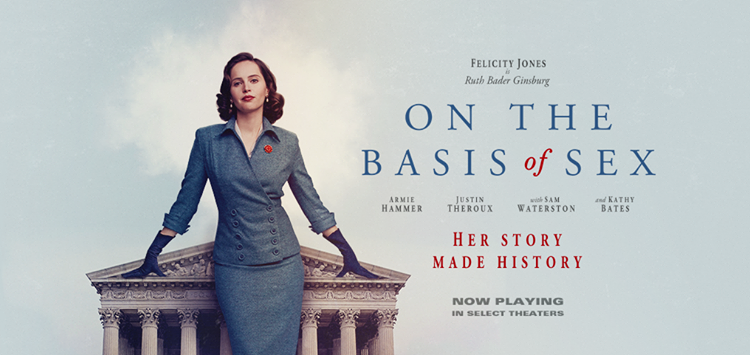
25 years after Supreme Court Justice Ruth Bader Ginsburg’s appointment to the nation’s highest Court, the biopic On the Basis of Sex tells the story of the first gender discrimination case that she argued as a lawyer, and what ultimately became the first step in her rise to become one of the nation’s leading advocates for women’s rights.

Directed by Mimi Leder, the film features Felicity Jones as Ruth Bader Ginsburg. On the Basis of Sex is currently showing at the Michigan Theater, and tickets are $7.50. If you are interested in learning more about the life of an American icon, don’t miss it!