REVIEW: The 55th Ann Arbor Film Festival — Films in Competition 7: Animation

Another year of the incredible Ann Arbor Film Festival and another year of incredible films. And I have the great honor and pleasure of sharing the night of Films in Competition 7: Animation.

As any AAFF enthusiast and animator knows, animation brings inanimate characters to life. That can be anything between 2-dimensional drawing, stop-motion photos, claymation, 3D modeling, or maybe even any wild combination of them! Animation is a constantly growing and changing field in the film industry, and we can always trust technology and innovative animators to find new ways to impress and wow the audience with never before seen styles of animation.

The 55th Ann Arbor Film Festival showcased a series of remarkable new animations for the audience. As the official website phrased it, “Ten recent animated films from near and far, featuring an artificial intelligence with the affective capacities of a kitten, memories of the ‘birds and the bees’ talk, a suburban woman who can’t stop growing fingers, a mother’s alcohol addiction, the most notorious women’s prison in East Germany, broken dolls and boiling stew, screen obsession and more.”

Friday night, I walked into the Michigan Theater with a friend. And having arrived a tad bit late, we were greeted by a packed theater of fellow film enthusiasts. We managed to spot seats on the balcony and found ourselves under the gaze of a cat on the big screen — Kitty AI.

Artificial Intelligence for Governance: Al the Kitty is an animation directed by Pinar Yoldas with the official description: “It is year 2039. An artificial intelligence with the affective capacities of a kitten becomes the first non-human governor. She leads a politician-free zone with a network of Artificial Intelligences. She lives in mobile devices of the citizens and can love up to 3 Million people.”

In other words, AI the Kitty is a computerized cat governor destined for greatness. As messy as politics can be, AI the Kitty assures the audience of her efficiency and equity, promising that she herself is far too intelligent for the chaotic nature of politics and that her level of professionalism in her field of expertise was no laughing matter. I was definitely convinced.

Artificial Intelligence for Governance: Al the Kitty is an animation that felt a little like propaganda for a kitty campaign, but as if I would ever object to that!

The following feature was a 9-minute animation directed by Alain Delannoy, called “The Talk” True Stories About The Birds And The Bees. The title did a pretty good job of describing the short film. It was just as the title advertised: a group of people discuss their experiences with their parents when they first had “the talk.”

Fun, entertaining, and hilarious, “The Talk” True Stories About The Birds And The Bees circles the topic of sex with honesty and humor. It definitely questions the humility of the subject, addressing the fact that although we as a society are embarrassed to talk about it, we accept sex to be a “normal” part of life, something that humans do in order to reproduce. Simple biology. And yet, the way parents go about teaching their children always winds up on a whole new level of crazy, ridiculous, and unnecessarily embarrassing.

Up next on the screen was director Matt Reynolds’s Hot Dog Hands, a 7-minute animation following the woes of a woman tormented for her — you guessed it — hot dog hands. This woman grows fingers at an exponential rate, and even her arms are consumed by the growing number of fingers, making her unable to use them for anything and rendering her opposable thumbs useless. The fact that this woman is pink like raw hot dogs probably didn’t help her situation either.

Pushing the boundaries of body horror, the animation is definitely not for the faint of heart. Although it is brightly colored and playful, the mischief and playfulness in color and style is juxtaposed with disturbing acts of cannibalism that take place later in the film. Of course, Hot Dog Hands Lady does end up finding happiness, by losing her fingers to the mailbox-living-underground-cannibals who desperately need to feed on her fingers to sustain themselves. As a result, Hot Dog Hands Lady loses her unwanted fingers and is worshipped by the Hot-Dog-Hands-eaters who are able to sustain themselves off her regenerating fingers. And they lived happily ever after.

After that, was Whatever the Weather, a 12-minute animation directed by Remo Scherrer. In contrast to the animation that preceded it, Whatever the Weather carried a much darker, more solemn, and somber tone. Set in black and white, the animation is driven by the play between negative and positive space, using one and the other to create depth and shadow in the characters on the screen. The lack of solidity in the animation reiterates the theme of the narration: a child’s troubles beset by her alcoholic mother.

As it is summarized on the website, “Wally’s childhood is increasingly turned upside down by her mother’s alcohol addiction. She experiences the excesses and consequences of addiction first hand. Desperately, the eight-year-old tries to keep up normality in her own life and the life of her family by any means. A roller coaster ride between helplessness, excessive demands and desperation begins. It’s a daily struggle for survival.”

Following this somber telling of Wally’s childhood, was Lauren Cook’s TRANS/FIGURE/GROUND, a 5-minute animation: “Painted 16mm film undergoes a monstrous transformation becoming neither analog nor digital. A film about uncanny valleys and the space between.”

Without definitive characters or voices, Lauren Cook’s TRANS/FIGURE/GROUND becomes strictly visual and compelling. The entire animation thrums and the entire theater tremors to the pulsing sounds of this animation, which forces the disorientation in the audience to become innate and charged with emotion.

With four films left for the night, next was a dreary and somber 7-minute animation called Broken – The Women’s Prison at Hoheneck, which shares the story of political inmates Gabriele Stoetzer and Birgit Willschuetz at Hoheneck Castle, the most notorious women’s prison in East Germany. As the official website says, “Their story is one of overcrowded cells, despotic hierarchies, ruthless everydays, and the enduring effects of incarceration. Most of all, however, it is about the crushing pressure of forced labour. Prisoners at Hoheneck manufactured millions of pantyhose, bed sheets, and other products for West German retailers, bringing enormous profits to both sides of the Iron Curtain. Part of the young animadoc tradition, the seven-minute film pairs original audio interview extracts with abstract, monochrome animation.”

Edge of Alchemy comes onto the screen after it. A 19-minute animated collage directed by Stacey Steers, “Edge of Alchemy is the third film in a trilogy examining women’s inner worlds. In this handmade film, constructed from over 6,500 collages, the actors Mary Pickford and Janet Gaynor are seamlessly appropriated from their early silent features and cast into a surreal epic with an upending of the Frankenstein story and an undercurrent of hive collapse.”

“Surreal” and “Frankenstein” are the two best words to describe the world of Edge of Alchemy. Although I was out of context and had no clue about the other two films in the trilogy, Edge of Alchemy definitely delivers a world of intrigue, science, and bees. Scientist Lady brings Bee Lady to life, much like in the classic tale of Frankenstein.

The night of animation ends on a fun note in the form of two short and sweet 5-minute films.

First is Batfish Soup by Amanda Bonaiuto, a short story that is a little too relatable about relatives coming over to visit. As it is summarized in the official website, “Wacky relatives give way to mounting tensions with broken dolls, boiling stew and a bang.” Very, very wacky, Batfish Soup definitely proves itself to be entertaining and weird, in the best way possible.

Last but not least, swiPed! Directed by David Chai, swiPed is a fun take on the modern age’s obsession with smartphones and tablets. It’s cute, short, and playful, poking fun at everyone’s inability to stay apart from our devices. Equally as funny is its playful summary: “Texters texting, tweeters tweeting, likers liking, posters posting, Googlers Googling, Amazonians Amazoning, webheads surfing, snappers chatting, pinnters pinning, tubers tubing, tenders tindering, Netflixers chilling – are we binging too much? More connected than ever, but more distant by the day. Is humanity being swiped away?”

All in all, another year of the incredible Ann Arbor Film Festival and another year of incredible films.

REVIEW: Page of Madness

For the second time since spring break, renowned Japanese benshi, Ichiro Kataoka, joined us in Ann Arbor for a special performance of a Japanese silent film, this time the avant-garde film Page of Madness.  Page of Madness revolves around man who works as a janitor at an asylum to be near his wife who is a patient there. With only 10 of these benshi, traditional narrators of Japanese silent films, left in the world this is a true treat.  I had been absolutely stunned by Kataoka’s skill the first time I saw him perform alongside the silent gangster film Dragnet Girl, and was only left more impressed by talent and professionalism this time around.  Just like last time, whenever I could tear myself away from what was happening on screen, it was fascinating just to watch him perform, his face and body language changing and emoting along with his voice.

Little Bang Theory getting up from their station

The music was done wonderfully by the trio Little Bang Theory.  I was constantly in awe by their performance, they didn’t’ seem to be working off any sheet music but didn’t miss a single note. The soundtrack matched perfectly with the visuals, both haunting and frenzied, complementing the overall tone of the film.  I was also intrigued by the vast array of instruments ranging from quite traditional to ones I had never seen before.   What I found the most amusing were the small wind up toys, similar to the kind you might find in an antique shop, that were used throughout the movie.  Each member of the band was in charge of a variety of different instruments and noisemakers and would switch back and forth as needed, seamlessly keeping the live soundtrack going as they did so.  Just watching them was worth the price of admission itself.

What surprised my friends and I was how brilliantly the story held our attention, despite having absolutely no english subtitles or translation for the entire 60 minute run.  None of us understood more than a handful of words in Japanese.  We credit this to the talent of all the performers, for providing inspiring and haunting performances that perfectly complimented the film itself, along with the film’s rich visuals and intriguing story.

Performers on stage taking a final bow.

When the show was finally over, the performers took a bow to a loud roar of applause and a standing ovation by many.  As my friends and I walked back to our dorm we were left in a state of shock and admiration, talking about the experience and our different interpretations of the movie the entire walk back.

While the film festival is over, I encourage you to see what different events are coming up in the Michigan theater, as well as start making plans for next year’s film festival! Events like these, that combine film with live performance are not one to miss!


REVIEW: The 55th Ann Arbor Film Festival — Films in Competition 5

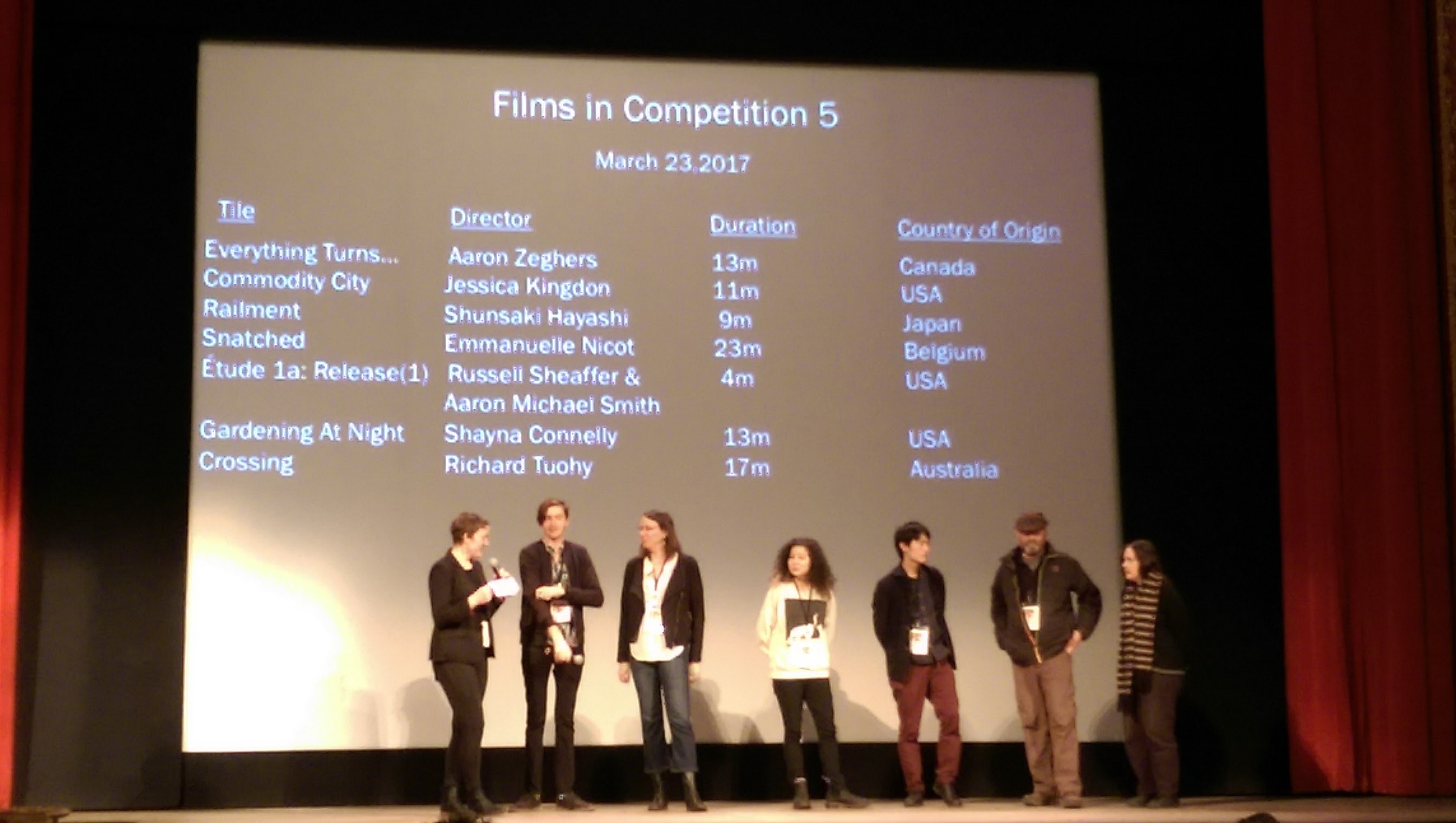
Films in Competition 5 was my very first taste of the Ann Arbor Film Fest, and it was exactly what I expected. 

Even if you haven’t been to any of the films, you may know the AAFF as something along the lines of “the one with all the weird films.”

Indeed, the very first short film–Everything Turns…–was a roller-coaster of a film that quite literally stayed true to its name. Shot on what looked like either 8 or 16mm film, Everything Turns… jolted the audience from one sequence to another without breaking stride. Nothing was static. Film manipulation caused colossal stone blocks to open and close, a wooden barn to rotate, and other structures to recede into the distance. Although the work was clearly from a talented individual, I couldn’t help but feel that it was a little too long.

Commodity City, presented the audience with a look inside the bowels of China’s New South China Mall, the largest shopping mall in the entire world. The director of the piece was clearly a photographer, as every shot of the film was static and composed like a photograph. While they were certainly all beautiful, I wish she had done more with the piece. Without crafting the hours of footage together into a coherent story, Commodity City is a collection of unrelated clips that is aesthetically pleasing, but lacking narrative thrust.

Railment was one of my favorites of the night. The filmmaker, hailing from Japan, animated a film taken from his commuting experience on Japanese railways. All tones were in blue and grey, and the protagonist stood lonely in the car, isolated despite being surrounded by thousands of other commuters. Beautifully crafted and haunting.

Snatched dealt with two French (?) girls running from a number of institutions–an orphanage, an abusive lover, and an oppressive workplace. Fighting against all of these forces draws them closer together by the end of the film. Snatched reminded me a bit of Moonlight, but with girls.

Etude 1a: Release(1)  was the perfect example of an eccentric and eclectic AAFF film. Slow motion, zoomed in shots of cowboys rounding up cattle. Screeching soundtrack. Black and white footage. No idea what the film was about.

Gardening at Night was the “biggest” film of the block in terms of production value and crew size. The film concerned a woman waiting for a phone call from the hospital regarding her friend’s battle with cancer. Autobiographical in nature, Gardening at Night also mixed in elements of horror. It reminded me a little of an M. Night Shyamalan film–one of his good films. My only wish is that the film had kept the lighting consistent throughout. I felt jarred a few times when the film went from a darkened living room at night to a bright swimming pool outside at noon.

Crossing was too long. Regardless of it’s merits, 17 minutes is too long for a film that uses a repetitive soundtrack as the only source of sound to complement blurry sequences of people crossing the street. I enjoyed the concept, but the film was too long. There’s nothing more to say about that.

Any given block of films at the Ann Arbor Film Fest will leave you with a different experience, but I would wager that the experience will be worth it. The nice thing about this fest is that the filmmakers get invited on the stage afterwards to answer questions from the audience. You don’t often get that opportunity.

PREVIEW: The 55th Ann Arbor Film Festival (AAFF)

The Ann Arbor Film Festival is the oldest avant-garde and experimental film festival in North America (from the Web Site).

The festival is full of indie and oddball films, characteristic of Ann Arbor culture. Over the course of the six day festival, viewers can choose from over 180 films from over 20 countries. Genres include documentary, fiction, animation, and experimental.

March 21 – March 26 (Full Film Schedule View)

Michigan Theater, North Quad, & The Ravens Club

Cost: $12 for adults, and $8 for Students/AAFF Members

There are also FREE Events

Facebook event page

The AAFF is popular enough to warrant an SNL sketch parodying the kind of festival it is.

REVIEW: Song of the Sea

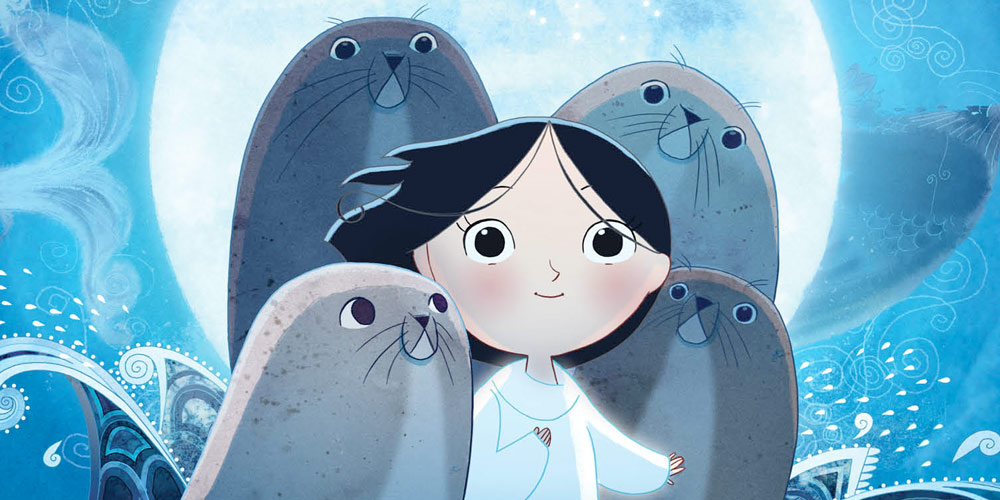
Song of the Sea is an enchanting story that addresses family, loss, and closure through the lens of an animated fantasy drama. Directed by Tomm Moore, who is known for Academy Award nominee The Secret of Kells (2009), the magical tale of Song of the Sea follows the adventure of a 10-year-old Irish boy named Ben and his mute sister, Saoirse, a selkie — a mythological creature of Irish folklore that is human on land and a seal in water.

The story begins with a little background behind Ben and Saoirse’s family. Suffering the loss of their mother, Bronagh, their family struggles to be happy. Ben blames his sister for their mother’s passing, Saoirse longs for the love of her broken family, and their father, Conor, still struggles with the loss of his wife. When Ben and Saoirse discover her magical abilities, the two find themselves on a journey to save all the faeries in the land with the “Song of the Sea,” a song of healing that only the selkie can sing.

For those of you who have seen and marveled at the beauty of The Secret of Kells (2009), Song of the Sea proves itself to be even more beautiful. Although at times the story may be a little hard to follow, the breathtaking art and intricate details of the film captivates the audience and keeps them engaged.

The animation is entirely hand drawn and 2-dimensional, playing with the depth of the scenery by overlaying parts of the background with the characters on screen. Almost like a fairy tale book in the form of animated cinema, Song of the Sea is imaginative and beautifully crafted. The animation sequences are fluid and careful, drawn with precision and a kind of gentle softness that draws our eyes, and it becomes enchanting to watch.

Apart from the art, the characters in this film are also very representative of the different ways people deal with loss. The magical characters draw parallels with human counterparts, expressing a variety of ways that people mourn and reasoning with the harmful consequences that they might bring. Macha, the owl witch, promises to take away the pain and suffering by petrifying those who are hurt, even petrifying her own son to save him from the pain. However, Song of the Sea proves that bottling up your emotions and removing yourself from your feelings is not as helpful as we hope it to be.

Song of the Sea inspires its audience to find closure during times of loss and mourning through love and acceptance. The very end of the film brings about the closure the family desperately needed. After Ben and Saoirse’s journey brings them home to their father’s lighthouse, they realize their cooperation and love for each other saves them and their family, as well as all of the endangered faeries and mythological creatures.

Here’s the official summary for the film: “In this enchanting new story from the Academy Award-nominated director of The Secret of Kells, Ben and his little sister Saoirse—the last Seal-child—must embark on a fantastic journey across a fading world of ancient legend and magic in an attempt to return to their home by the sea. The film takes inspiration from the mythological Selkies of Irish folklore, who live as seals in the sea but become humans on land.”

REVIEW: Arab Xpressions

When my friend and I arrived at the venue, over an hour before the show started and still minutes before the doors opened, we were surprised to see a long line already waiting for us. As we waited to be let into the theater to claim our seats, those around us mingled and greeted each other like old friends, immediately establishing a comfortable atmosphere.  My friend and I delighted in the fact that the event had not one, not two, but three separate geo-filters for snapchat devoted to it. By the time the show was about to begin, the theater was absolutely packed, almost every seat on the ground floor was filled.  

Finally, the show began and our three hosts for the night walked onto stage.  The show was divided into two parts with a 15 minute long intermission in between.  Each part had a good mix of performances and other various short segments, such as some vocal performances, quite a few different energetic Dabke dances, and several short, humorous video clips that were played between segments.  I also was impressed by the mix of tones they were able to balance throughout the night.  There were several touching spoken word pieces about the struggles of being Arab in America, but immediately following it would be lively dance performance.  

While all of the performances were enjoyable, there was a couple segments that particularly stood out to me.  The first one was a video clip in which the Arab Student Association asked various students on the Diag basic questions, like if they could name 5 Arab countries or name a single friendly Arab character in American media.  Only one student out of those interviewed could accurately name 5 separate countries, and everyone was stumped by the second question, revealing some real issues we have with representation in media.  The other segment that particularly stood out to me was a fashion show, where students modeled the fashions of various Arab countries.  

Overall it was a wonderful night, and I applaud the Arab Student Association for making everything run so smoothly.  I can’t wait to attend Arab Xpressions 2018!  The event was just one of the many events planned for this Arab Heritage month, you can check out the full schedule here!