When did photography become an art? At some point, people took cameras and tried to capture people and places and things not simply for the sake of capturing them, but for the beauty of it. This was the beginnings of pictorialism.
As the UMMA web site states about the early pictorialist photographers:
Their poetic compositions drawn from contemporary life, combined with the use of expensive and labor-intensive printing materials such as platinum and gum bichromate, established these photographs as complex and nuanced works of high artistic quality.
The exhibition is open now and will remain open until March 5th.
Their next FREE upcoming gallery talk/tour is:
Sunday, December 11th at 2pm
Check out their calendar here for more information on the other upcoming gallery talks:
“The Handmaiden” by Park Chan-Wook is the kind of film that can captivate you for the entirety of its run time, entrancing the viewer and drawing them into its twisted and erotic world. Based off of the novel Fingersmith by Sarah Waters, acclaimed Korean director Park Chan-Wook moved the story of this thriller into Japanese-occupied Korea. From the moment I saw the trailer I knew that this film would be one to watch, but it far surpassed my wildest expectations.
Without revealing too much of the plot, the film begins when skilled pickpocket Sook-Hee is recruited by a sly conman to pose as a handmaiden for the aloof and mysterious Lady Hideko, all in order to get at her rather large inheritance. The development and clever weaving of the story was one of my favorite parts of the entire film, and watching the threads slowly unravel had me utterly enthralled. Each of the actors and actresses delivered a praise-worthy performance, with Kim Min-hee sticking out for her layered delivery of Hideko.
One of the most fascinating aspects of the plot was the use of language. Most of the characters in the film are multilingual, speaking both Japanese and Korean. Even the decision of which language characters use with one another becomes yet another important, nuanced aspect of the plot. The languages were differentiated by the color of the subtitles, with Korean written in white and Japanese in yellow.
Some of my favorite elements of the movie were the breathtaking set design and costuming. I truly felt Sook-Hee’s envy looking at Hideko’s various dresses, jewelry and assorted finery. Additionally, a combination of brilliant cinematography, evocative lighting, and gorgeous set design drew me into every scene.
Lastly, I found the use of music to be particularly effective. There was minimal music during the first part of the movie, which lent to a sparse and oppressive atmosphere. However, as the plot developed, so did the music, and the contrast between the two halves of the movie was particularly effective.
When my friend and I left the theater we spent the entire walk home discussing the film, not able to bring up a single criticism. It has since quickly jumped to the top of my favorite movies list, battling it out with longtime favorites.
However, before you buy your ticket, I must issue a warning that this movie features several highly graphic sex scenes, and some graphic violence. Think carefully about what your limits are, and the limits of your movie-going partners, before you buy your ticket.
Show times for The Handmaiden at the Michigan theater can be found at their website (here) http://www.michtheater.org/schedule/ , tickets are $8 for students.
Images from The Guardian, A.V Club, CNN, The Hollywood News,
Attending Helicon’s Synesthesia Exhibit was definitely an experience. It was dark, cold, and stormy when my friend and I arrived outside 504 Catherine, which on its own appeared to simply be a crowded house. Then, suddenly, some unnerving music began to play, consisting of what sounded like wailing and sound static. It was hardly an enticing welcome, but we eventually decided to head inside.
Welcome to synesthesia…
There were fairy lights on the walls and the band was huddled on the ground in the corner of the main room. There was some art hung at eye level, including some installations that I enjoyed featuring bright colors that were nowhere to be found in the rest of the house.
The back corner
We progressed upstairs, where we encountered an invitation to create some hands-on, spontaneous art by a window:
Window art
This was a part of the exhibit that I enjoyed. It claimed in the event description that this exhibit would be a safe space to create and appreciate art. The invitation to create something (or something more, in the case of the featured artists) was inspiring and made me feel like a part of the arts community.
Upstairs, however, was the opposite. We were guided into a small room draped with blankets and scattered with pillows. We sat down in front of a makeshift movie screen and watched what turned out to be one of the most unnerving films I’ve ever tried to see. The camera lingered on seemingly unimportant objects, such as an outlet plug on the wall and the (infuriatingly incomplete) shaving of a man’s head. We managed to escape once the narrator began discussing her wish to have her head stuck in a wood-chipper.
After that movie, we decided to skip the film with trigger warnings (“claustrophobia” & “bodily noises” among others) posted outside on the door. We headed down to the basement, which, after taking in the previous levels of the house, sounded rather ominous. To my surprise, however, the basement ended up being my favorite location.
The basement, part 1
This was our view when we had descended the (albeit creaky) stairs. The sheets and fairly lights gave the space a, for lack of a better term, very artsy personality. The lighting framed the artwork very well, casting a golden hue on everything. Despite this, the art here was definitely of a darker sort, featuring, for example, a “Self Portrait” sculpture by Jay Moskowitz.
“Self Portrait” part 1
A closer look at this sculpture, especially when you bent down to be at eye level with it, revealed the talent present in this installation. When you moved to look at the other side of the portrait, however…
“Self Portrait” part 2
…you were faced with something else entirely.
Moving into another room, we noticed a piece by Natalie Grove. “Sit in Me” was typed out on the label, so we obliged.
Grove
Turning to our right, there was yet another film playing. The film was exceptional at displaying continuous motion, every few frames featuring the cast in different or no clothing. Despite these changes, there was never any pause. The room itself was very thought-provoking as well, with wine and milk lined up in front of clothes in a pile on the ground.
Drink one, leave the cup.
My favorite piece of artwork at the exhibit was called “Suspended Thought” by Lorenzo Lorenzetti. I very much enjoyed the literal title and the suspensions themselves. It revealed, to me, how thoughts can manifest into something physical and indeed paralyze one’s mind. It was a very geometric sculpture that reminded me of certain renaissance sculptures I’ve encountered at art museums around the world.
“Suspended Thought”
I heard about this exhibit because my photographs were also displayed. Upon looking at all the other art present in the house, my friends joked that my prints were there to serve as a break from all other the more heavy, “tortured artist” installations. My only qualm with being featured is that the labels below all three photos were incorrect, but the working theory is that it was an intentional mishap to further provoke the disorganized, artistic mind.
Let’s make one thing clear. Although I have seen all the Harry Potter movies, and maybe I went to Barnes and Noble for the midnight premiere of books 1-6, I am not a huge Harry Potter fan. To me Harry Potter always seemed a little childish and derivative, like listening to top 40 music. That’s why Fantastic Beasts And Where to Find Them was such a pleasant surprise.
Newt Scamander arrives in 1926 New York, fresh off an expedition studying and cataloging magical beasts around the world for his book. While he plans to stay only long enough to release a particular creature back into the wild, a run-in with an a No-Maj (American Muggle) leads to a number of events that make the movie run 133 minutes.
8:30 + preview + 133 minutes = 11:15
Like all the other Harry Potter movies, FBAWTFT looks gorgeous. Combining wizards with 1920’s America was a fantastic idea and someone should give JK Rowling a high-five for that. It was so much fun to see spells flying inside speak-easy’s and upending Model T’s on the street–I only wish Newt’s travels had taken him to other American cities like Chicago and San Francisco as well.
Every actor fit seamlessly into their roles so well that I didn’t miss the Harry Potter characters one bit. Eddie Redmayne as Newt played the perfect awkward scientist, but it was Dan Fogler as Jacob Kowalski that stole every scene with his charm and naivety. Unfortunately, the female characters didn’t seem as well hashed out. Queenie Goldstein, one of the two female leads, is literally nothing but an attractive secretary at the American equivalent of the Ministry of Magic. Maybe it was to add the period feel to the movie, but this series deserves better than one-sided female characters.
JK Rowling took the dark elements from the latter half of the Harry Potter series and ramped them up for FBAWTFT. Unhealthy relationships, from a neglected son to child abuse, pepper the central storyline, which also includes the DEATH SENTENCE as a plot device. I enjoyed that JK Rowling decided to write a movie that was for older audiences, but wow the movie gets dark.
At the same time, there are moments of precious comic relief scattered throughout the movie. DC Comics should study this film in terms of how to balance the light and the dark, because FBAWTFT knows how to make the audience laugh in one scene, and then pull those smiles away in the very next scene.
I left with one question on my mind: how does the movie scale up from here? The final “battle” felt almost like the end of a movie series, leaving New York in tatters (a la The Avengers) and at least two surprises. It felt like JK Rowling pulled out all of the stops as the wizards struggled to contain a dark force attacking the city. Will it be possible to make the action more exciting, or will we start to get fatigued after seeing the same spells, the same special effects, and the same CGI-creatures every outing?
In case you somehow missed the hype, here is the trailer for the upcoming film.
Here are two of the many reasons why you should be excited:
This new franchise doesn’t have a lot of source material (aside from Pottermore & the “book” that shares the same name. EVERYTHING will be new, and you won’t be disappointed by them changing or leaving anything out.
David Yates is directing & J. K. Rowling is the screenwriter! Therefore, the next generation of Harry Potter movies will look and feel just like the way you remember.
Also why wouldn’t you want to see this gorgeous man on the big screen?
Fantastic Beasts and Where to Find Them comes out November 18.
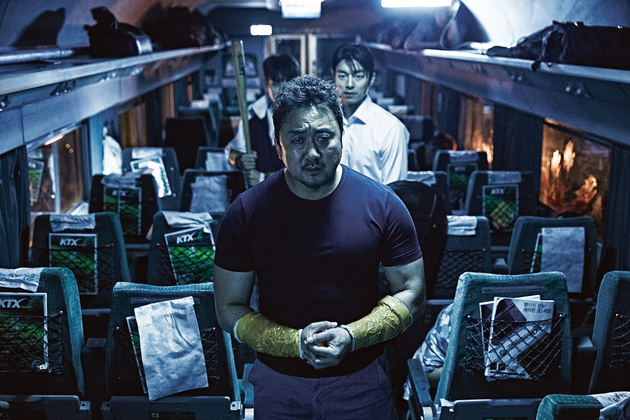
If you couldn’t figure it out from the title, Train to Busan is a movie that takes place on a train. Specifically, it’s a zombie movie that takes place on the train. When the movie ended, I was left wondering what exactly was it about trains that could make any movie, well, better. For if Train to Busan had taken place in a house or car or shopping mall, it would not have been quite as good. Furthermore, all of these train films are thrillers, when, in my experience, a train ride is anything but thrilling. Obviously, the setting shapes a film–but how exactly?
First off, there’s the constant motion. No matter what else is happening to the characters, they are always moving, something is always occurring. The plot is also tied up in this movement, for there is a destination and a timetable. Things must happen before you reach X or you will suffer the consequences of Y. Thus, there is both literal and figurative movement. This provides an easy source of intensity. In Train to Busan, utilizing this notion of plot-dependent-upon-destination, the film can be split into two parts. The earlier part is the train heading towards an intermediary city that seems unsafe and the later part is the train on its way to Busan. Here though, the movie deviates from conventional train movies, for what is important is not that they do X before reaching their destination, but that they survive on board long enough to reach said destination.
Movement, of course, is not unique to trains. Cars, planes, bikes, buses, and simple walking are all methods of getting from point A to point B. But not all movements are equal. Trains are not personal transportation–they are public, and with that, a larger and more varied cast of characters can be devised. After all, these people do not have to know one another nor like one another, and in fact, their dislike is often a path for tension and character development. For example, the cast of characters in Train to Busan is not restricted to a single family; instead, we have a single father, his daughter, a young high school couple, two elderly sisters, a selfish CEO, a young husband, his pregnant wife, and several employees of the train company. There are no established relationships among these different sets of characters and part of the plot is watching them learn how to work together (or against one another) to survive the zombies also on board with them. While other vehicles for travel allow strangers to similarly come together, such as planes and buses, these methods have much smaller space to work with. A train can be quite lengthy, but airplanes remain rather limited. We want the space the characters have to work in to be constrained, but not too constrained, otherwise we lose the ability to have well-choreographed fighting scenes.
Finally, there are several unique elements that trains alone possess. There’s the separate compartments which allow different ideas and challenges to manifest in different carts (for example, in Train to Busan a compartment of high school baseball players has significance) thus breaking the monotony of fight scenes and travel between them. Tunnels, objects blocking the tracks, and train stations are all elements made use of in Train to Busan and other train-oriented films. By using the uniqueness of trains, an otherwise standard zombie film has doubled down terror and action.
If you’re interested, Train to Busan will be playing again at the Michigan Theater at 7:00pm Tuesday.