
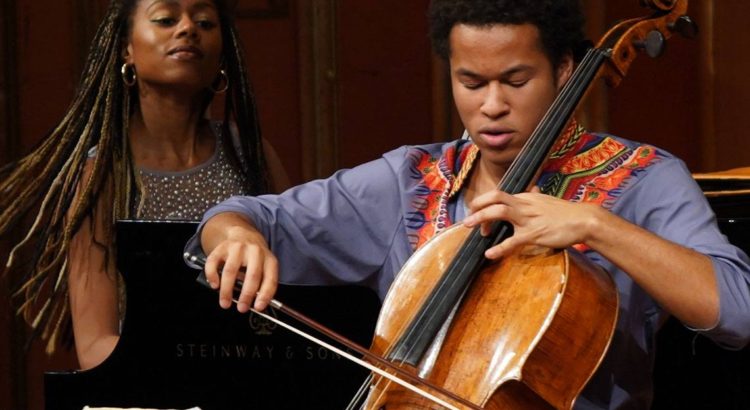
REVIEW: Sheku Kanneh-Mason & Isata Kanneh-Mason Digital Recital

Amid a crazy week, Sheku and Isata Kanneh-Mason’s joint recital was a respite from the turmoil of the news. Streamed especially for UMS audiences, the Kanneh-Mason siblings brought audience members into their Nottingham, U.K. home for an intimate and well-produced performance, and it gave me the opportunity to take time away from other distractions.

First, I was very impressed with the production of the recital. Though it was filmed from the Kanneh-Mason’s home, it still included multiple camera angles, allowing viewers a front-row seat to their superb technique. Unfortunately, video buffering (yay internet!) prevented me from enjoying the full experience, but I nevertheless was able to appreciate the camerawork.

When it came to the music, Sheku (cello) and Isata (piano) were even more impressive. Fortunately for me, the buffering on my computer did not affect the sound, and I was able to enjoy the rich sound of Sheku Kanneh-Mason’s cello entwined with Isata’s flexible and virtuosic piano playing without interruption. The recital program included two pieces: the first movement of Ludwig van Beethoven’s Cello Sonata No. 4 in C major, Op. 102, No. 1, followed by Sergei Rachmaninoff’s Sonata for Cello and Piano in g minor, Op. 19. Throughout both pieces, the musical connection between Sheku and Isata was evident, both visually and aurally. Their eye contact and movement were perfectly in sync as they took cues from one another, and this could be heard in the balance and interplay of their parts. The Beethoven caught my attention with its solo cello opening which melts into the piano part, and its boldness later in the movement. However, it was the Rachmaninoff Sonata for Cello and Piano that especially drew me. It has a wide emotional range, including an intensity that the Kanneh-Masons conveyed impeccably. I particularly enjoyed the final movement (Allegro Mosso) for its freedom – after the tension of the earlier movements, it feels like a celebration and a release, while also being tender and delicate at times. It was a fitting end to the program.

However, lucky for UMS audiences, it was not the end of the program – Sheku and Isata Kanneh-Mason also included an encore in their recital recording! Though some of the excitement of an encore is lost in a virtual setting (no thunderous applause echoing across the concert hall), the surprise of additional music was still very much enjoyable. For the encore, the Kanneh-Masons performed “The Swan” from Saint-Saëns’s The Carnival of the Animals. It was quite the contrast from the final movement of the Rachmaninoff, and I was able to revel in its peacefulness, made even better by Sheku’s and Isata’s gorgeous sound.

Even across the internet and the Atlantic Ocean, Sheku and Isata Kanneh-Mason’s artistry was not something to be missed.

REVIEW: Sheku and Isata-Kanneh Mason UMS Digital Presentation

Last week I had the opportunity to watch Sheku and Isata-Kanneh Mason perform from their living room (while I sat in my dining room…!) Originally slated to come play with the City of Birmingham Orchestra, Sheku instead recorded a very intimate duo concert with his sister, specifically curated for UMS audiences. The show ran October 25th-November 4th. I chose to watch the concert in conjunction with a UMS student committee event: a “live” watch party for students that was a rerun of the concert through facebook. It was fun to have a specific time to tune into the performance, and to see people commenting and watching live with me.

The program performed was the first movement of Beethoven cell0 sonata no.4 in C major, op.102, and the entirety of Rachmaninoff’s cello sonata in g minor, op.19. The two pieces are so different and I thought it was very insightful that they chose to do only one movement of the Beethoven. The Beethoven served as an opener, a bright bubbly piece that set the tone for the rest of the performance. The Rachmaninoff was much more serious and lush and I thought it had a lot of darker moments in comparison. The duo played with passion and as an audience member I could tell that they had a deep connection as collaborators. Isata took the lead in many instances, controlling the color changes and tempos as they made their way through the piece.

I really enjoyed the encore they chose: The Swan from Saint-Saëns’ “Carnival of the Animals.” It was such a beautiful and sweet ending to the concert:) The duo has a new album along with the rest of the Kanneh-Mason’s called “Carnival,” that features this piece. Released on November 6, 2020, the album takes listeners through the entirety of Carnival of the animals, including narration from the family as well:) It is exciting for me to watch these two perform because as a musician, it is fun to see someone my own age performing and being recognized at such a high level. I am also amazed by how in sync the family plays together and the stories they tell through their music making.


Link to album on Spotify:

Apple Music:

https://music.apple.com/us/album/carnival/1529334526


REVIEW: Nectar

From “Harlem Shake” originator and YouTube star to R&B and lo-fi singer-songwriter, Joji’s entertainment journey has been anything but predictable. Now, with the release of his sophomore studio album, Joji demonstrates that he is certainly not finished evolving and growing as a music artist. Nectar’s soulful, floating sound encompasses expressions of longing, heartache, joy, and distress.

“Ew” opens the album with a melancholy tone that seeps into every subsequent track. This track speaks directly to a former lover, and its self-deprecating lyrics contribute to the heavy feeling of heartbreak. Its soft falsetto later gives way to an intensifying instrumental section, and as the strings and piano swell, their harmonies become ominous and unsettling.

“Sanctuary” feels more hopeful and less despondent than many of the other tracks. In an album where much of the vocal performance is in a high falsetto, the lines “Not anyone, you’re the one / More than fun, you’re the Sanctuary” stand out. Joji sings these lines in a lower register with a rich vibrato. This temporary shift in vocal delivery makes these lines sound distinctly warm and loving.

The album does feature some more upbeat, lighthearted sounds, like in “Daylight,” “Tick-Tock,” and “Gimme Love.” Yet, amidst these cheerful beats, pensive and melancholy lyrics complicate their meanings. “Gimme Love” begins with a catchy, poppy sound, but the first verse reveals a sense of woundedness. Joji sings of vivid memories that are now hurting him, preventing him from healing and moving on. About halfway through the track, the beat abruptly shifts to a slow, dreamy sound that reflects the desperate tone of the lyrics. Joji paces his delivery of the last line of the song, with each word ascending higher and higher until the last word gets wrapped up in a musical crescendo. This last line, “But I can’t let you go,” feels like a candid confession.

Joji also features other artists on the album, such as Omar Apollo, Lil Yachty, and BENEE. “Afterthought,” the collaboration with BENEE, brings in more narrative storytelling than is present in other tracks. The verses reflect on moments of tension in a past relationship while the chorus recalls the joy associated with that lover. The lines “So lost in these diamonds / So lost in this paradise” speak to the beautiful memories, but they are immediately followed by the line “Don’t speed on that highway.” Perhaps it is cautionary. Joji may want to relive memories to be reminded of what blissful love feels like; but sometimes remembering how happy you used to be just intensifies how lonely you feel now.

Joji brings the album to a close with a powerful ballad. In the second to last track, “Like You Do,” Joji’s full vocals are offset by intermittent, unsettling instrumental harmonies that reinforce the desperation that comes through the lyrics.

Nectar has been critiqued for some inconsistency in instrumentals, as well as a lack of complexity in the latter part of the album. Despite this commentary, however, I think most of the songs carry a valuable genuineness that feels incredibly comforting. Joji sadness, interspersed with tainted sunny memories, serves as a reminder that heartache can feel inescapable and draining. But everyone goes through that sometimes. Nectar reassures us that these feelings are human.

PREVIEW: Sheku and Isata Kanneh-Mason Digital Recital

Watch sibling duo Sheku (cello) and Isata (piano) Kanneh-Mason perform in a special digital recital that will be streaming on the UMS website from 2 pm on October 25 through November 4! I am especially excited to watch this after seeing Sheku Kanneh-Mason’s performance of Camille Saint-Saëns’s Cello Concerto in A Minor as part of the City of Birmingham Symphony Orchestra’s 100th Birthday Celebration.

The digital recital, which was filmed specifically for UMS audiences from the Kanneh-Mason’s home in Nottingham, UK, will include an excerpt from Beethoven’s Cello Sonata in C Major and Rachmaninoff’s Cello Sonata. On Wednesday, October 28 at 8pm, there will be a watch party for University of Michigan Students on Facebook.

Visit the UMS website starting October 25 at 2 pm to stream the recital!

Sheku Kanneh-Mason and Isata Kanneh-Mason (UMS Digital Presentation)


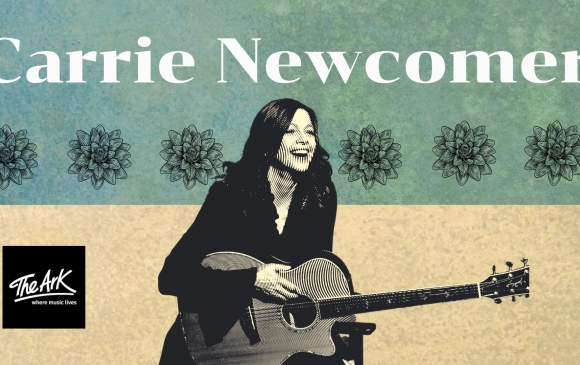
REVIEW: Carrie Newcomer at the Ark online

In these times of online-only connection, singer-songwriter Carrie Newcomer’s virtual concert this past Saturday with the Ark was what I needed. Newcomer delivered a program, entitled “The Age Of Possibility: A Moment and Movement,” that was hopeful and peaceful, as well as a lifeline of human connection delivered across time and space via electrons. She was also joined by violinist Allie Summers and pianist Gary Walters. As an existing fan of Newcomer’s music, which falls somewhere in the vein of folk and the concert was more than I could have hoped for over the internet.

As I have noted in other reviews of virtual arts events, one of the main casualties of an online concert experience, besides sound quality, is the communal experience of being in an audience. However, the format of Carrie Newcomer’s virtual concert allowed for some of this connection to take place despite the circumstances. It was presented via an online platform called Mandolin, which is like Zoom, but specifically designed for music and concerts. It has a chat feature that allows audience members to interact during the program, and the artists can even see some of the messages that are sent. At the end of the concert on Saturday, Carrie Newcomer even performed an additional song after several people typed “ENCORE!!” into the chat! Additionally, Mandolin allows users to click emoji reactions, which then float up onto the screen and can be seen by the artists. I honestly never would have thought that I would get so much satisfaction from sending a spray of floating heart and clapping emojis after a song, but I suppose that is where quarantine has brought us! It was a way to find a little bit of the connection that so many of us are missing due to the pandemic, and the best “online” arts experience that I have had since the pandemic began. In fact, I have been watching Newcomer’s website to see when her next online concert will be (one plus regarding virtual concerts – you can attend from anywhere with an internet connection!).

Newcomer’s songs, which are often focused on the small things of large importance in life, are increasingly relatable during the pandemic era where life approaches monotony. For instance, one of the songs she performed was entitled “Who My Dog Thinks I Am,” which was both humorous and true in its observations. Another song, “You Can Do This Hard Thing,” starts by describing a struggle with a math problem: “There at the table / With my head in my hands. / A column of numbers / I just could not understand. /You said “Add these together, / Carry the two, Now you. / You can do this hard thing.” Newcomer performed a mix of old favorites and new, never-performed-before compositions. The program was both fresh and, for those who know her music well, familiar.

I left the concert feeling refreshed and full of hope, a feeling that is all to rare in the current world. I will leave you with the lyrics of one of Carrie Newcomer’s most beloved songs, “The Gathering of Spirits,” because that is what this concert was. It was a true gathering of spirits, even if we were gathered over the internet, and someday, when the pandemic is over, we will all meet again.

“Let it go my love my truest,
Let it sail on silver wings
Life’s a twinkling that’s for certain,
But it’s such a fine thing
There’s a gathering of spirits
There’s a festival of friends
And we’ll take up where we left off
When we all meet again.”
– Carrie Newcomer, “The Gathering of Spirits”

PREVIEW: Carrie Newcomer at the Ark online

This Saturday at 8pm, singer-songwriter Carrie Newcomer will present a concert entitled “The Age of Possibility: A Moment and Movement” online through the Ark in Ann Arbor. She will also be joined by pianist Gary Walters and violinist Allie Summers.

I’m particularly excited for this event because I attended another one of Carrie Newcomer’s virtual concerts earlier this summer, and it was an excellent experience. Her online concerts are presented through a platform called Mandolin, which is similar to Zoom, but developed specifically for music. Though I was a little skeptical of the idea of an online concert at first, the platform has a chat through which audience members can engage with the artists, and you can even react by sending different emojis (such as hearts or clapping) throughout the performance. Even though we can’t be in person, and even though the experience was definitely a new and novel one, it was a way to feel a sense of connection and community across time and space.

To purchase tickets, visit https://www.theark.org/shows-events/2020/oct/17/carrie-newcomer. Tickets are $20 for an individual and $30 for a family, and the link to the concert is sent out after purchasing. Additionally, this concert is a way to support the Ark, a local arts venue!