
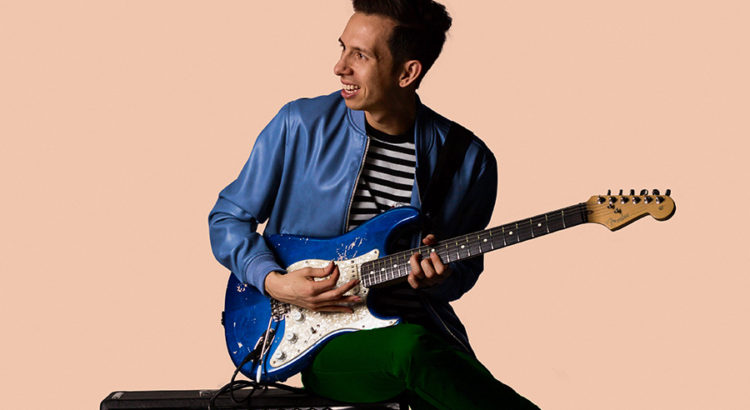
Vulfpeck is one of Ann Arbor’s greatest phenomena, and now, their funkiest guitarist is finding success with his solo project, the Cory Wong Band. Following the release of his latest solo album, The Optimist, Cory Wong is spreading his unique multi-instrumental rhythmic music across the country with his tour, which includes a stop at the Blind Pig on Saturday, January 19 at 9pm. Tickets are $20 and can be bought online at www.blindpigmusic.com.
Category: Music

PREVIEW: Carrie Newcomer
This Sunday, January 13, one of my all-time favorite artists will be performing at the Ark in Ann Arbor! Carrie Newcomer is a folk singer-songwriter, as well as a writer, and I have been listening to her for a good portion of my life, having been introduced to her music by my dad. I have seen her in concert once previously, and it was one of my favorite concerts I’ve been to. My family drove to Indiana over my high school spring break to see her perform in a small auditorium at Ball State University, and it did not disappoint.
Described as a “prairie mystic” by the Boston Globe, her music has an intimate spiritual inclination that celebrates human connection. If you have never heard Carrie Newcomer before, check out the video below for a sample!
Tickets are general admission and can be purchased online for $20 through 11 am on Saturday, January 12. After that, they may be purchased at the door on the night of the show. The show begins at 7:30 pm and doors open at 7 pm. The Ark is located at 316 S Main St in Ann Arbor.
REVIEW: Joyce DiDonato and Yannick Nezet-Seguin
This opera performance was entirely songs from Schubert’s Winterreise, so the general feeling of the performance was depressing and solemn. Joyce’s face during the whole performance looked full of grief and sorrow. Even songs with an angrier sound, Joyce would lean on the piano as if her body was weak from depression. Joyce also held a book the entire performance, I believe this was her song sheet, but having it look like a book made her feel more isolated and that she was singing in solitude.
There were English lyrics on the screen above Joyce because all the songs were sung in German, but I tried my best to not look at the subtitles to get the most authentic experience. Because there was no story, it was only opera songs not a full opera performance, knowing what was being said was unimportant. I don’t speak any German, but the sounds I heard the most often were “sh” “dot” and light tongue rolling. I also heard a lot of harsh cut-offs after consonants. I imagine that this is a close sound to American opera.
This performance didn’t have many big opera notes, the kind we think of when imaging an opera. There was no coloratura, just soft slow notes in harmony with a piano. I was surprised by how often the piano mimicked Joyce by playing the same notes she was singing but in a lower key. This showed us how powerful Joyce’s voice is, as the piano would accompany her until she would start singing notes that were too high and strong for the piano to imitate.
For an opera performance, the piano had an extremely important role because of the balance between the piano and Joyce’s voice in every song. The piano would have to get loud and quiet in sync with Joyce which would happen suddenly. The loudness of the piano was so important, and the jumping between loud and quiet notes had to be precisely done. I believe this is why Joyce was accompanied by such a famous pianist. He made every transition sound so smooth.
My favorite songs of the night were Will-o’-the-wisp and Phantom Suns. Both these songs were very slow with minimal piano playing. The slow build-ups of the songs were performed wonderfully by Joyce. Will-o’-the-wisp in particular had a poetic sound to the lyrics.
I thought the end was fitting as there was a quiet standing ovation as Joyce walked around hugging Yannick.
REVIEW: The Book of Mormon
The Book of Mormon was a wonderful production, put on by Broadway in Detroit at the Fisher Theatre. It is undeniable that the stage was almost glowing throughout the entire show. The bright lights and set decor were a defining part of the experience, giving it the livelihood that such a musical, with compelling identities and enthusiastic characters, deserves. The vibrant colors of the costumes further complemented these strong production aspects, while also playing well into building the separate identities of the characters. The animated performances of the cast were obviously doing the heavy-lifting. Between the identifiable characters, the strong choreography, or the catchy, witty tunes, the cast managed to bring life to the entire show.
For people who are unfamiliar with the show, here it is: two 19-year-old mormon missionaries, Elder Price and Elder Young, are sent out to Uganda for their first two year mission, and it’s not what they expected. Price had hoped to be sent to Orlando Florida, and follower Young just wanted to be Price’s sidekick – but instead he ends up converting many Ugandans on his own terms. Through their adventures with religion, culture, and interaction, the show expresses satire, and sometimes even deeper emotion.
My favorite parts of the show would have to be the songs “Baptize Me” and “Joseph Smith, American Moses” and the choreography. In the former, Elder Young goes through the process of baptizing Nabulungi, which is full of sexual implications. I think I loved this one because Young is such a charismatic character – he brings many laughs to the show, while also forcing the audience to empathize with him because of his low self-esteem. In the latter, the villagers put on a show for the Mormon missionaries, which is entertaining thanks to the juxtaposition between the Ugandans and the Americans reaction. The choreography is a major part of the show, paying tribute to all different genres and parts of musical history. Such complexity and variety from song to song is refreshing, fun, and completely classic. I guess it’d be foolish to expect anything but hyper-theatricality, even if it is a show focused on Mormons in Uganda.
The only issue I had with the show was, well, the show. I knew that it was somewhat controversial, but generally hailed as a brilliant production. However, as I sat through the first act, it took me some time to warm up to the jokes and feel comfortable with them. This is not because I don’t like or am not used to comedy – I love it. And beyond that, find it to be an extremely effective means, specifically when battling confusing identities, ones that are often stereotyped or oppressed. Comedy is awesome. But for some reason, the portrayal of the Ugandans, an imperative part of the show, was not cutting it for me. And despite having thought and read about the story, I still cannot put my finger on what exactly turned me off. It could be due to the current climate our world is in – one where outlandish, seemingly ridiculous ideas that appeared and functioned as jokes are finding their footing in societies that are supposed to be increasingly “progressive” and “forward-moving.” It could be a variety of reasons, objective or subjective. I’m toying with ideas here, still trying to understand why I didn’t love my matinee musical experience quite as much as I hoped that I would. Instead I’ve been left as a slightly confused google-searcher and review-hunter.
However, I saw that by the second act, as a whole, the Ugandans were more humanized and credible. They knew that everything Young was spewing to them, about kissing frogs to cure AIDS and yatta yatta, was metaphors. And by the end of the show, we’re on a positive note again, just as hopeful as Elder Price was at the beginning when he hoped to be sent to Orlando, acknowledging the importance of religion and beliefs to many people, no matter their differences. All in all, I’d say The Book of Mormon is a put-together production worth seeing, and one worth taking a more critical look at, too.

REVIEW: Handel’s Messiah
The moment that I entered Hill Auditorium for the Ann Arbor Symphony and UMS Choral Union’s performance of George Frideric Handel’s Messiah, the festive and joyful mood was evident. A double-layered border of beautiful poinsettias graced the front of the stage, and a large festive wreath seemed to float in midair in front of the pipe organ. The orchestra and Choral Union filled the stage, and anyone there could sense that it was going to be a night of merry music-making. Soprano Yulia Van Doren, countertenor John Holiday, tenor Miles Mykkanen, and bass Alex Rosen joined the ensemble as soloists.
I have listened to recordings and even live radio broadcasts of Handel’s famous oratorio, but this was the first time that I have ever been present during a live performance of it, and it certainly did not disappoint. For one thing, the performers were of very high caliber – Scott Hanoian, the director of the UMS Choral Union is the former assistant organist and music director of the National Cathedral, and several of the soloists will be performing Messiah with the likes of the Saint Louis Symphony and the National Symphony Orchestra. Additionally, a nearly three-hour work written 300 years ago, it is impressively engaging. The audience was silent throughout, only to erupt in applause, cheers, and whistles at its conclusion.
One of the most moving moments of the performance was the famous “Hallelujah Chorus.” Ushers distributed sheet music prior to the performance, and when the most well-known composition of Messiah was reached, Mr. Hanoian turned out from the stage and conducted the entirety of Hill Auditorium as the audience stood and joined the Choral Union in singing. I remember looking around during this and being overtaken by the sheer number of people singing around me and above me in the mezzanine and balcony. Centuries after it was composed, this music still has immense power to bring people together, and I honestly had chills during the chorus. It reminded me of why I love music so much, and of its most essential purposes.
I also greatly enjoyed hearing the organ of Hill Auditorium in action. Normally the pipes are merely a backdrop for other performers, but during Messiah they came to life. For most of the piece, I was aware that the organ was playing, but it was on stops that blended with the orchestra and the vocalists. However, at the very conclusion of the work, all of the stops were quite literally pulled out, and I almost jumped in my chair out of surprise! The organ’s rich sound filled the entire hall, and its grand, majestic timbre is not something that I will forget in the near future.
The Ann Arbor Symphony and the UMS Choral Union’s undertaking of Handel’s Messiah was an experience that has made me love and appreciate the work even more fully. Even if you are not typically into classical music, the melodies of the “Hallelujah Chorus” and “For unto Us a Child is Born” will stay in your head for days after. In my opinion, the chance to hear Hill Auditorium’s organ was worth it in itself!

REVIEW: Contemporary Directions Ensemble
The Contemporary Direction Ensemble’s Friday performance was emotionally powerful and also a challenge to conventional norms.
Their performance of “Die Schönste Zeit des Lebens,” or “The Most Beautiful Time of Life,” was breathtaking and haunting. The manuscript of this piece, a popular foxtrot of the 1940s, was recently discovered at the Auschwitz-Birkenau Museum by University of Michigan Professor Dr. Patricia Hall. Arranged by prisoners at Auschwitz for one of the camp’s orchestras, it was likely performed for Sunday concerts for the S.S.
As the ensemble performed this piece, the first time it has been heard in 75 years, images of Auschwitz were projected on the wall behind. The contrasts between the lighthearted music being played and the dark realities of the Holocaust in these images were stark, and for me, this highlighted the power of music and the strength of the human spirit. How could something so beautiful exist in a place of so much death? The melody, which out of the context that this arrangement was created from is carefree, took on a much more emotionally raw and evocative quality that stayed with me for long after the piece was over.
The final piece of the evening, which was vastly different from how the concert began, was the U.S. premiere of George Lewis’s P. Multitudinis. This piece, which was of “situational” form, consisted of several instrumental groups, a traveling percussionist and traveling conductor, and the “multitude.” Rather than playing music written out exactly as it is to be played on the page, the musicians reacted to what was going on around them and responded with their instruments accordingly. It was a very intriguing piece, more rhythmic and innovative than melodic, and it was fascinating to try to follow how the members of the ensemble communicated with each other throughout the piece. Music such as P. Multitudinus challenges the audience to be fully present in the moment, because the performance unfolds uniquely in a way that cannot be predicted, and it is a living, breathing form of art. Typical conventions of music performance were broken – at one point a trombone player borrowed a reed and bocal (the metal tube to which the reed is attached) from a bassoon and put it on the trombone. At other times, kazoo-like instruments were used. The piece was truly a broadening of creative boundaries.
I greatly enjoyed the Contemporary Direction Ensemble’s performance because it made me pause and really think about music and its roles in a way that more traditional concerts do not. The concert exemplified music as an interactive art form and as a means of communication.
