
Whenever I sing Handel’s Messiah, I am reminded of how lucky I am to be able to share this wonderful music with hundreds of people.
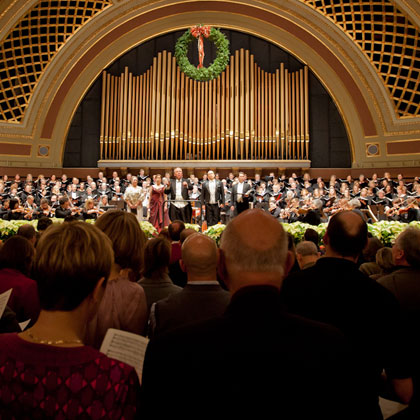
These annual performances mean a lot to audiences and performers alike. Some have been a part of these performances for decades. Some are experiencing Messiah for the first time. All of these people come into one space — none other than the historic Hill Auditorium — to enjoy this year’s performances. By experiencing Handel’s Messiah together, we are joining not only the thousands of people that have seen this performance in the Hill Auditorium for the past century, but also many more that have seen the Choral Union for more decades before, and even more — millions of people that are either involved in or watching Messiah during this holiday season across the world. We are being a part of something that is bigger than just ourselves. To me, that is a wonderful feeling of connection with people across the borders and time periods.
Messiah is rarely performed in full; here at UMS, we don’t go for anything less than full, 3-hour performance. Honestly, it could be tiring to listen to any music that long, especially if you aren’t the biggest classical music fan. However, the Choral Union, the Ann Arbor Symphony Orchestra, and the soloists have convinced us that it’s worth it to spend 3 hours out of your precious hours in the weekend. The soloists — Ms. Brugger, Mr. Daniels, Mr. Ainsworth, and Mr. Pittsinger — executed their arias with precision and virtuosity. The basso continuo players including Mr. Parmentier on harpsichord supported the soloists, the chorus, and the orchestra flawlessly. From the first chord in the Overture to the very last chord in “Worthy is the Lamb,” each and every ensemble member put out their best.
I often get asked which movement is my most favorite in Messiah. This is a difficult question to answer. As cheesy as it sounds, I like all the movements — but if I have to pick one, I might say No. 44 — “Hallelujah.” Yeah, it’s that one. Choral Union members (and anyone else that has sung Messiah) will probably laugh at me for choosing THE one that everyone knows. But the moment Dr. Blackstone hits the downbeat for “Hallelujah,” the house lights go up, and the entire audience, choir, and soloists stand up to sing together… It’s powerful, and I get goosebumps every time. I could see the soprano Ms. Brugger smile as she finally gets to sing with the fellow sopranos in the choir. I could see the old man in the audience pull out his reading glasses to follow the score and sing with us. I could see Mr. VanOrnum, our organist, joyfully accompany us. I could see the choir members singing their hearts out, perhaps to show that we actually know how to sing past the “Hallelujah, Hallelujah…” part. Every time I sing Hallelujah, I truly feel the connection with each and every one in the auditorium. This is the power of music at its finest.
May this tradition continue forever and ever. Amen.