REVIEW: La Bohème

The School of Music, Theatre & Dance’s production of the opera La Bohème was certainly a treat. Featuring the University Opera Theatre and the University Symphony Orchestra, it was a chance to go to the opera without leaving campus!

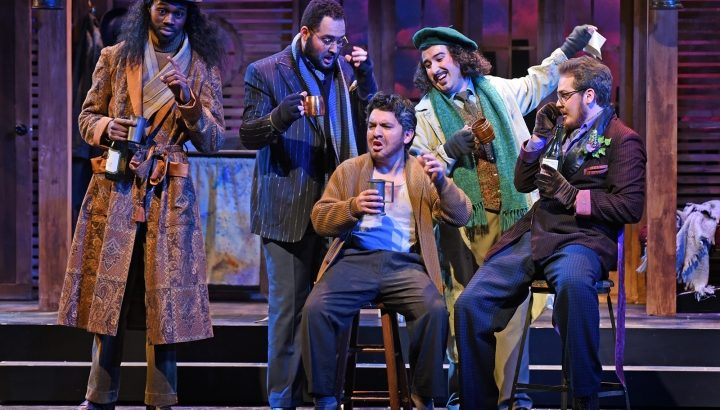
Though La Bohème was first performed in 1896 (the music is by composer Giacomo Puccini, and the libretto, or words, is by Giuseppe Giacosa and Luigi Illica), this performance was set in the post-war era. This allowed for more modern costuming and set design, and in my opinion, it also made the entire storyline seem more relatable, as the characters were not in the distant past. The addition of English captions over the stage was also a welcome addition, since the entire opera is in Italian (which, unfortunately, I am not fluent in).

If you know the musical Rent, the plot of La Bohème will be familiar, as the musical is a modern adaptation of the opera. However, though the storyline contains themes of youth, romance, poverty, and realities of the “Bohemian” existence, the plot seemed rather underdeveloped to me. In particular, the ending seemed abrupt, and I would have liked more closure (though perhaps this serves to further the opera’s themes).

That said, the simplicity of the plot allows the opera’s music to shine through. The University Symphony Orchestra performed the score spectacularly, and the leads and the chorus were also wonderful. I enjoyed the fact that the design of the Power Center allows the orchestra to be largely visible, rather than hidden under the stage. Sometimes, however, this was to my detriment, as I was watching the orchestra and listening to the music rather than watching the on-stage action and reading the captions!

In the area of set design, the opera production was also stunning. There was a short intermission between each of the opera’s four acts to allow time for elaborate set changes, and they were certainly worth the wait. I can only imagine the time and effort that goes into designing and constructing the sets. My personal favorite was the set for Act II, which took place in Paris’s Latin Quarter on Christmas Eve. Featuring a nearly full-scale two-story building façade, streetlamps, and Christmas wreaths and garlands, it was a work of art. On a separate note, this scene also featured members of the University of Michigan Marching Band, as well as the Ann Arbor Youth Chorale! I also enjoyed the set for Act III, which featured falling snow and a moving train.

The School of Music, Theatre & Dance’s production of La Bohème was an excellent opportunity to see a high-quality performance right here in Ann Arbor, and I am glad that I had the chance to attend!
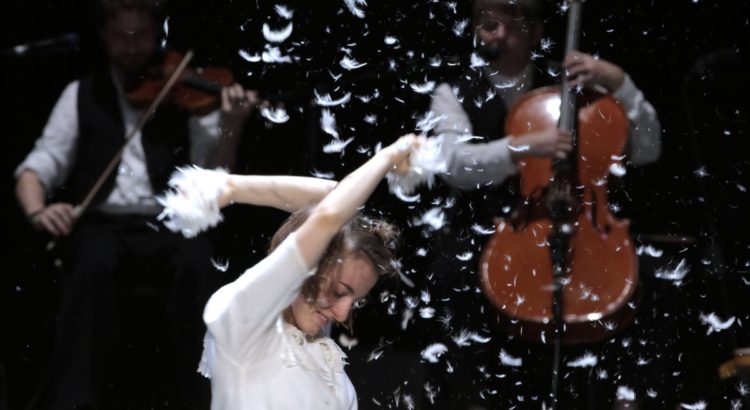
PREVIEW: Loch na hEala (Swan Lake)

Teaċ Daṁsa, winner of the Irish Times Theatre Award for Best Production in 2017, comes to the Power Center for two riveting performances of  Loch na hEala, a retelling of Swan Lake rooted in a place where ancient Irish mythology & modern Ireland meet. Michael-Keegan Dolan, founder of Teaċ Daṁsa, brought the group about as a means to forge deeper connections with the traditions, language, and music of Ireland.

Loch na hEala will be performed this Friday and Saturday, November 15th & 16th, both starting at 8PM. There will be no late seating, so drive safe and mind the time!


Teaċ Daṁsa

REVIEW: La Bohème

La Bohème is an opera full of comedy, tragedy, and singing. A lot of singing. Though I suppose that’s what an opera is, it was still a new format for me and therefore made for a really interesting experience. Drama and plays have always been up my alley, but to see dialogue converted to a consistently musical form definitely changed the way I watched this piece.  This is all to say, it was pretty fantastic. The micless performers blew me away with their performances, not only rivalling the pit in volume but delivering line after line beautifully. I found the climactic moments of multiple characters singing their own verses layered over each other especially enjoyable and impressive.

Another point that simply has to be mentioned is the set design for this production. Three intricate sets were used, each necessitating an intermission. The world-building done with tall storefronts, moving trains, and falling snow was so engaging and really added to the different moods of each of the four acts. The way characters were able to truly inhabit the stage really allowed the audience to be transported across the Atlantic to a chilly Parisian winter.


A critique I have of this work is one that has been leveled before towards it since its inception; it’s quite fluffy. The story focuses on the lives of bohemians surviving off of their artistic creation and free thought moreso than actual food, but yet the story only uses this concept for bare-bones plot developments. The bohemian lifestyle is represented through this opera with a funny opening number of burning the pages of one’s play to stay warm and a character feeling guilty for his lover’s decline in health due to his limited means. The latter plot point has some value to it, but it’s outweighed by the melodramatic romance and fun (but kind of just fun) comedic moments between characters. I don’t think there’s anything wrong with making an opera that has stellar performances and aesthetics with a more surface-level plot; I still found La Bohème to be a whole lot of fun and really a showcase of talent, but personally I’d rather see the time period of the piece used to its fullest potential thematically.


Ultimately, I’d love to go see more operatic performance through SMTD and I’d encourage anyone in the Ann Arbor area to make it out to a show. There’s a clear commitment to quality performance and theatrical design that makes these shows truly captivating.

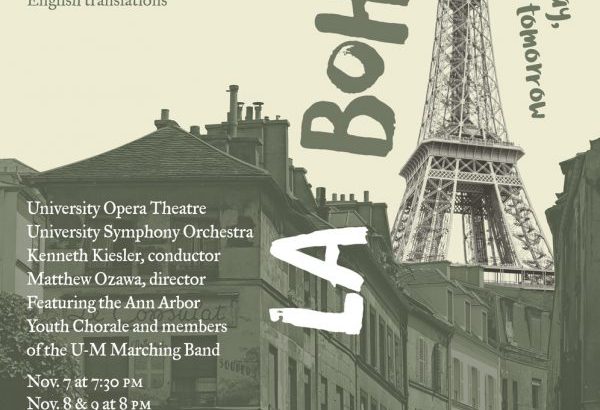
PREVIEW: La Bohème

Don’t miss the School of Music, Theatre & Dance’s production of La Bohème, featuring the University Opera Theatre and the University Symphony Orchestra. The opera’s music is by Giacomo Puccini, and the libretto (words) are by Giuseppe Giacosa and Luigi Illica. The opera, which takes place in Paris and tells a story of youth and romance, enjoys enduring popularity despite the fact that it premiered over 100 years ago in 1896: The New York Times called La Bohème “the world’s most popular opera,” and the musical Rent is actually a modern reincarnation of Bohème.

The opera is running at the Power Center for the Performing Arts from November 7 – November 10. The November 9 show is at 8 pm, and the November 10 show is a matinee at 2 pm. Tickets, which are $13 with a student ID, may be purchased at the Michigan League Ticket Office, or online.

REVIEW: Eurydice

“This is what it is to love an artist: The moon is always rising above your house. The houses of your neighbors look dull and lacking in moonlight. But he is always going away from you. Inside his head there is always something more beautiful.” – Sarah Ruhl, Eurydice


Eurydice read like bundle of freely associating thoughts and tasted, on occasion, cloyingly maudlin. Nevertheless, I appreciated the relative lightheartedness of this rendition that held it distinct from the tragic tone of the original tale of Orpheus and Eurydice, and its refreshing perspective shift to that of a female protagonist. Sarah Ruhl’s Eurydice not only rewrites but also seems to directly challenge the classic Greek myth; instead of being centered around the husband Orpheus’ (Kieran Westphal) epic journey to retrieve his wife Eurydice (Maggie Kuntz) from the depths of the Underworld, Ruhl centers the play around Eurydice’s personal experiences and the ultimate verdict she must make: returning to the living world with Orpheus or remaining in the Underworld with her father. In spotlighting her verdict, Ruhl allows Eurydice’s character the empowerment and dimensionality that the classic Greek myth denies her, whilst introducing themes beyond the frailties of human trust and spirit, such as the complexities and ephemeralities of memory, communication, language, and love.

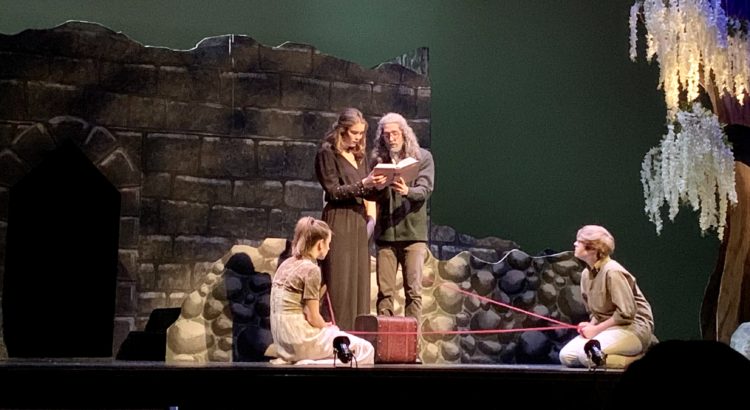
Though the Rude Mechanicals‘ cast, direction, production, and design did an overall wonderfully impressive job in effectively conveying the refreshing eccentricities of Sarah Ruhl’s play, I couldn’t help but search for more within Ruhl’s dialogue and writing, which collaterally impaired the rhythm of the production. For some unperceived reason and for the entire duration of the production, I found myself either cringing at saccharine one-liners, snickering with the audience, or passively waiting for the closing of a scene. Though it’s plain to see that Ruhl intentionally chooses to structure Eurydice in a more painterly storytelling manner marked by freely associating motifs and ideas, I saw a disconnect between the intention of emotional release from the audience and certain syrupy moments in the production that occupied a disproportionate amount of stage time. It was during superfluously long scenes such as the Father unravelling the string ‘room’ he constructs for Eurydice that I felt the most passive in my viewing, and therefore disconnected from the emotions of defeat and hopelessness that the scene is meant to elicit.

Despite the slight awkwardness in timing and emotional translations, I enjoyed the red string motif present throughout the production. Intuitively, I interpret red string as a symbol of connection and of relationships impacted by fate – I thought that this motif translated especially well in the context of Ruhl’s Eurydice, in which the miscommunication and overall character differences between Eurydice and Orpheus are highlighted. This miscommunication and hesitance on Eurydice’s part is what ultimately causes Eurydice to call out and violate the rules Orpheus’ must follow in order to revive her. This scene appeared the most impassioned and dynamic to me; both Kuntz and Westphal beautifully portrayed the hesitancies and doubts both characters’ spirits were in turmoil with in the most artistic fashion. After expressively pushing and pulling with the string in a shifting, dance-like sequence, Eurydice eventually calls out to Orpheus, who turns back as the pent up tension from the mutual string-pulling comes to an abrupt climax and subsequently two simultaneous outbursts from each character. The cast’s various interactions with the red-string were notably artful and succeeded in showcasing the tension running through Eurydice and Orpheus’ strained marriage as well as the imperishable relationship between Eurydice and her Father.

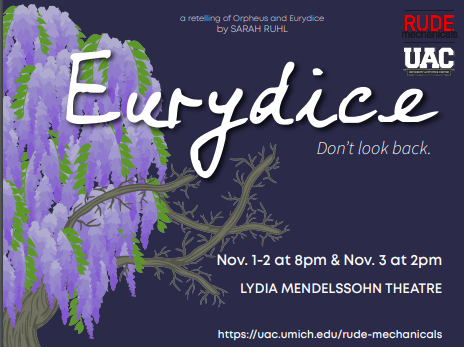
PREVIEW: Eurydice

On November 2nd at 8 pm, and November 3rd at 2 pm in the Lydia Mendelssohn Theatre, the Rude Mechanicals will be presenting the tale of Eurydice through Sarah Ruhl’s contemporary lens. The show is a rendition of the classic Greek myth of Orpheus and Eurydice – two star-crossed lovers who become tragically entrapped in a tale of trust, passion, and grief over the trials and tribulations of love. Orpheus, a skilled musician, finds himself on a journey to bring Eurydice, his wife, back from the underworld after her accidental departure from the living. What follows next is a series of trials that test both Orpheus’ faith and spirit and the frailties of the human condition that determine our behavior in the practice of love.

This event is both available for purchase and on the new Passport to the Arts voucher.

Tickets ($7 for students; $10 general)