Review – True Blue: A Tribute to Michigan!

If you have ever felt the pride of being a Michigan Wolverine, being at this event magnified that feeling by 100%.  True Blue!  A Tribute to Michigan brought together those who share the love and passion of two colors: maize and blue.  Some of the biggest celebrities were on the stage of Hill Auditorium, telling their stories of their time at the University of Michigan, and everything that they have accomplished after graduating with a U of M diploma.

Tribute to Ann Arbor squirrels (Photo Credit: Matt Weigand)

There were so many amazing performances that I will do an overview.  Many videos were played throughout the night including ones of the history of U of M, the Diag, the Ann Arbor squirrels (my personal favorite), U of M couples, Bo Schembechler’s “The Team” speech, U of M professors, and the alumni.

“The Victors” performed by the Department of Musical Theatre Majors (Photo Credit: Scott C. Soderberg)

The Jazz Ensemble played a nice medley of “Michigan Through the Ages”.  The Department of Musical Theatre Majors did a stunning rendition of “The Victors” that definitely made me tear up a little as I felt the pride of being a Michigan wolverine.  The Department of Theatre & Drama Acting Majors performed multiple pieces such as “Catholepistemiad Rap” about the history of U of M, “Clarence Darrow and the Ossian Sweet Trial” alongside Emeritus Professor of Voice George Shirley, and “Tribute to Activism”.  The Michigan Men’s Glee Club sang a chilling “Glory” from the movie Selma and “I Remember, My Michigan”.  The Contemporary Directions Ensemble played multiple pieces such as “The Little Victors”, “Concerto for Two Violins”, “Back to Michigan”, and the cellists played a “Tribute to Raoul Wallenberg”.

The Friars and Theatre & Drama Acting Majors in the tribute to the Engineering Arch (Photo Credit: Matt Weigand)

The Friars made an appearance to sing “In the Still of the Night” as a hilarious tribute to the Engineering Arch, in which Theatre & Drama Acting majors acted out couples walking through the “arch”.  The Department of Dance Troupe performed “The Little Victors”.  The RFD Boys, alumni of U of M, played a “Michigan Medley”.  Multiple professors spoke such as Ralph Williams, Kathleen Sienko, and also the chair of the Department of Neurosurgery Dr. Karin Muraszko.  “The University” was sung by the University Chamber Choir.  Shortly after, the Michigan Marching Band flooded the stage performing all of the classics: “Victors Valiant”, “The Yellow and Blue”, and “Michigan Fanfare and The Victors”.

Emcee Darren Criss (Photo Credit: Robert Buechler)

The emcees included actors Darren Criss and Jacqueline Tobini, neurosurgeon and medical correspondent Dr. Sanjay Gupta, and NBC sportscaster Andrea Joyce, all of which are U of M alumni.  Other famous alumni speakers included: Civil Rights activist Cecilia Munoz, mayor of Ann Arbor Christopher Taylor, sports legends Desmond Howard and Jim Harbaugh, Broadway producer

Alumni and football legend Desmond Howard with other U-M sports legends onstage (Photo Credit: Scott C. Soderberg)

Jeffrey Seller, space explorers Afred Worder, Kiko Dontchev, Steve Walton, Mike Hess, and Hashmita Koka, Zingerman’s co-founder Ari Weinzweig, co-founder of Americans Committed to World Responsibility Judy Guskin, and of course U of M’s President Dr. Mark Schlissel.

This event was absolutely extraordinary and I couldn’t be more proud to be a wolverine!  Go Blue!!!

Football coach and alumni Jim Harbaugh (Photo Credit: Matt Weigand)

Upcoming Bicentennial events include:

June 26 & October 26: President’s Bicentennial Colloquia

June 26-27: UMich200 Summer Festival

August 26: U-M’s 200th Birthday

September 15: Detroit Festival

October 26-28: UMich200 Fall Festival

For more information: bicentennial.umich.edu

PREVIEW: Insurrection: Holding History

 This weekend join the Department of Theater & Drama for a poignant production of the award winning Insurrection: Holding History.  The play dives into a time-traveling exploration of black history as a young grad student who shares a mental bond with his 189-year old grandfather travel through eras of US history, gaining new perspective in each one..

The show will be running from April 6th to the 9th in the Arthur Miller Theater on North Campus.  You can purchase tickets for all the upcoming show times online here.  General admission is $28 with  students only paying $12 with their M-card.  As a warning the play contains very mature films, so think carefully about who you bring.

Preview – True Blue: A Tribute to Michigan!

Words cannot express how excited I am to review one of the biggest events at the University of Michigan!  True Blue!  A Tribute to Michigan brings together past and current U of M students, fans, and families to celebrate the bicentennial.  Special guests include: actor James Earl Jones (aka original voice of Darth Vader!!!), neurosurgeon and media reporter Sanjay Gupta, Glee actor and my future husband Darren Criss, and Cecilia Munoz.  Through music, theatre, dance, and speech, faculty, alumni, and students will come together to share the past, present, and future of the University of Michigan.

True Blue!  A Tribute to Michigan will take place at Hill Auditorium on Saturday, April 8 at 7pm.  Tickets are on sale online.  For adult tickets: $50 main floor, $30 mezzanine, $25 balcony.  For UM students: $25 main floor, no mezzanine available, $20 balcony.

Additional information can be found at: https://events.umich.edu/event/38600

Review: A Midsummer Night’s Dream

I went to see the performance on the 24th. I’ll start with the composition of the opera itself. I have to confess that modern compositions are not my favorite genre of music. In this opera, the music sounded dissonant and disjointed. I’m not saying it has to have a recognizable theme, but I barely even recognized phrases within the music. Granted, it fit well with the dreamlike sense of the play, but it didn’t fit at all with the fact that A Midsummer Night’s Dream is a comedy. Furthermore, I understand that in opera sometimes phrases are drawn out, but considering that Shakespeare included so much meter in his plays, I find this a waste of good rhythm. Surely some of it could have been used in the opera. Regarding this specific interpretation, it was set in the 60s, starring Robin Goodfellow, poolboy and stoner, who dreamt he became Puck, Tytania as a yoga instructor, and Oberon as a pro golfer. This began promisingly, but I wish the 60s setting had been more integrated with the rest of the play. It was solidly set in the 60s for the first five minutes, and then it transitioned permanently into Fairyland when Tytania and Oberon stopped being a yoga teacher and a golfer, respectively. From then on, that theme was never properly carried through the show. Any references to the 60s from then on were random, like the thirty-second scene in which the players consumed some mushrooms and hallucinated, or the scene in which the fairies appeared to Bottom as garden gnomes. I also think I should mention here that I was very confused about why the pageboy, the one that sparked Tytania and Oberon’s entire spat, seemed to be a Nataraja, which is a Hindu idol. Figurines with significance like this one, if used at all, should be used very deliberately, cautiously, and sparingly as props. When Tytania was a yoga teacher, this  use made sense, because yoga often makes use of similar cultural items, but for the rest of the opera, I could see no particular (comedic) reason the Nataraja was appropriate to use there, except for the fact that the pageboy was “stolen from an Indian king,” which to me is not enough of a justification for then seeing that idol carted about like a teddy bear for the rest of the opera.

As always, though, the performers themselves did a fantastic job. Puck, I firmly believe, was born for comedic opera, and he did a fantastic job managing the interpretation he was given (I personally couldn’t quite reconcile the stoner persona with Puck’s inherent shrewdness). I loved Tytania’s voice: I can’t quite put my finger on it, but something about it was wonderful to listen to. It felt, perhaps, warmer than the timbre I’m used to hearing in opera. Helena also had a lovely voice, wonderfully suited to opera. I think Lysander acted really well, which was good especially because it balanced out the fact that Hermia was looking at the conductor far too obviously. The one thing I wish they had done was to really utilize every comedic opportunity the play provided: even I noticed several they didn’t use, and I’m not particularly experienced with this play. However, Bottom, Flute, and the rest of the players did a fantastic job. Pyramus and Thisby was the only part of the play in which I thought that every comedic opportunity was properly taken advantage of. The audience barely stopped laughing here: when the lion’s tail was a flyswatter and its mane had macaroni glued to it; when Flute casually strolled over to a barbecue and used ketchup to stain his shirt; when Flute and Bottom used a spatula as the weapon Thisby and Pyramus used to kill themselves; when the Moon wore a colander strung with fairy lights on his head; when the Wall was drunk by the time the play ended. Finally, the set design was beautiful. The moving set was a brilliant idea: all the performers had to do was roll the trees over slightly to the side to change the scene. I’ve also never seen such use of texture. The trees were done in relief, and the light gave them beautiful shadows; the steps looked like weathered stone, and the grass was made of false topiary.

Overall, I was not a huge fan of the way the opera was written. I wish I knew a bit more about the intent behind the interpretation, because I’m sure that I would think very differently about the production if I knew what kinds of thought went into it. But as always, I remain impressed with the calibre of work that SMTD students are capable of.

REVIEW: Page of Madness

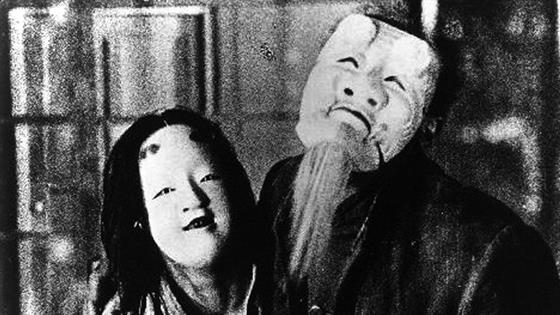
For the second time since spring break, renowned Japanese benshi, Ichiro Kataoka, joined us in Ann Arbor for a special performance of a Japanese silent film, this time the avant-garde film Page of Madness.  Page of Madness revolves around man who works as a janitor at an asylum to be near his wife who is a patient there. With only 10 of these benshi, traditional narrators of Japanese silent films, left in the world this is a true treat.  I had been absolutely stunned by Kataoka’s skill the first time I saw him perform alongside the silent gangster film Dragnet Girl, and was only left more impressed by talent and professionalism this time around.  Just like last time, whenever I could tear myself away from what was happening on screen, it was fascinating just to watch him perform, his face and body language changing and emoting along with his voice.

Little Bang Theory getting up from their station

The music was done wonderfully by the trio Little Bang Theory.  I was constantly in awe by their performance, they didn’t’ seem to be working off any sheet music but didn’t miss a single note. The soundtrack matched perfectly with the visuals, both haunting and frenzied, complementing the overall tone of the film.  I was also intrigued by the vast array of instruments ranging from quite traditional to ones I had never seen before.   What I found the most amusing were the small wind up toys, similar to the kind you might find in an antique shop, that were used throughout the movie.  Each member of the band was in charge of a variety of different instruments and noisemakers and would switch back and forth as needed, seamlessly keeping the live soundtrack going as they did so.  Just watching them was worth the price of admission itself.

What surprised my friends and I was how brilliantly the story held our attention, despite having absolutely no english subtitles or translation for the entire 60 minute run.  None of us understood more than a handful of words in Japanese.  We credit this to the talent of all the performers, for providing inspiring and haunting performances that perfectly complimented the film itself, along with the film’s rich visuals and intriguing story.

Performers on stage taking a final bow.

When the show was finally over, the performers took a bow to a loud roar of applause and a standing ovation by many.  As my friends and I walked back to our dorm we were left in a state of shock and admiration, talking about the experience and our different interpretations of the movie the entire walk back.

While the film festival is over, I encourage you to see what different events are coming up in the Michigan theater, as well as start making plans for next year’s film festival! Events like these, that combine film with live performance are not one to miss!


REVIEW: Kidd Pivot and the Electric Company

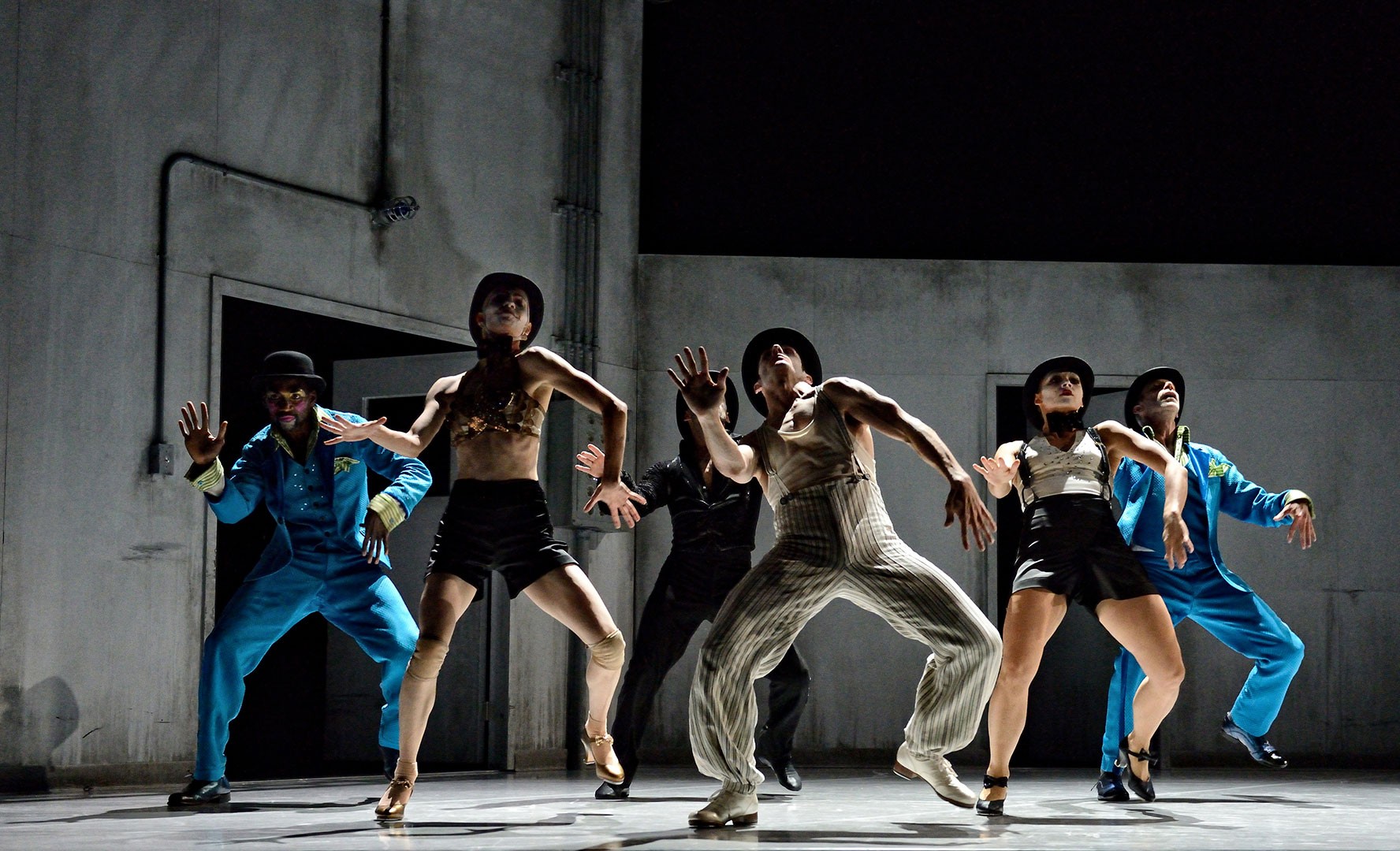
Sitting in the audience of the Power Center, I soon realized how distant this show was from any previous theater experiences I’d had before. The show began looking into the set of a vaguely warehouse-esque room with a column in the middle, and the first thing to happen was the movement of electrical cords, spreading apart to opposite ends of the stage. Almost ghost-like, they seemed to move on their own accord and there was no indication where the movement was coming from. This first minute was when I began to question what I had entered into for the next two hours. As I searched for words and footholds into this piece, something to describe and relate to it, the closest mainstream theater description I could find became the musical Chicago meets psychological-thriller-horror-movie. Think jazz numbers and spangled costumes mixed with the anticipation of brutal plot twists and fear. The lack of footholds to grasp onto in the piece, though, seems characteristic of new age-y modern expressionism. It is the interiority of the creator depicted onto the stage, meant to make the audience think and contemplate, not merely for surface-level enjoyment. A potential, and possibly more accessible, dance comparison that kept coming to mind throughout the performance was the “Slip” video that circulated the internet about while ago.

Both the slippery, interconnected choreography and the eery industrial set (with flickering fluorescents and all) is quite similar in style to that of Betroffenheit. The first act of the production mixed theater and dance together, with very little dialogue. In a premonitory twist, a strobe-light warning was issued before the show began; as it progressed, the production itself became a strobe effect. A bombardment of the senses, I continually felt that just as I had regained my balance and was beginning to understand, I was quickly thrown off, left reeling and scrambling back into the show.

Image c/o Kidd Pivot

The show was an exploration in the experience of trauma, and though it held the aforementioned eery quality, it was not exclusively a dark production. A bright and exciting cha cha-esque number was thrown in, along with a series of tap and vaudevillian pieces.

The second act was more of a dance production than theater, focusing on the choreography of Crystal Pite. Her work in Betroffenheit was mesmerizing; almost pedestrian with liquid-like partnering work that featured the breadth and skill of the performers more so than the first act had. While I struggled to grip and understand the first act’s interpretation and representation of emotional exploration, I loved the emotion and expression through the choreography.

Image c/o UMS

As I listened to the reactions of those sitting around me, many people were in love with Kidd Pivot and the Electric Company’s work. Many also seemed as though this style of performance was not outside their wheelhouse. Betroffenheit, from my interpretation, seemed like a show best suited for those saturated within the dance and experimental performance community – those who are constantly looking at and working with this genre of material. While I, as an outsider, could appreciate and enjoy pieces of it, I feel as though the powerful and soul-stirring impact was somewhat lost on my uninstructed-self.