PREVIEW: sometimes something

The  Penny W. Stamps School of Art and Design will hold their 2020 MFA Thesis Exhibition, sometimes something, from March 13th – May 2nd at the Stamps Gallery at 201 South Division St in Ann Arbor.

sometimes something will showcase projects by Sally Clegg, Kim Karlsrud, Erin McKenna, and Abhishek Narula. The art projects feature themes such as social and urban ecosystems, privacy, self pleasure, creation, and our digital world.

I am excited to see the artistic works this cohort has created. The online exhibition preview features sneak-peak images from the projects, and each artist looks like they have created work that is both enticing and stimulating.

Coming out to support these graduate students in their MFA Thesis Exhibition is a perfect way to get out of the house and escape from the strange world we are currently experiencing!


REVIEW: Hometown Hero (Chink): An American Interior

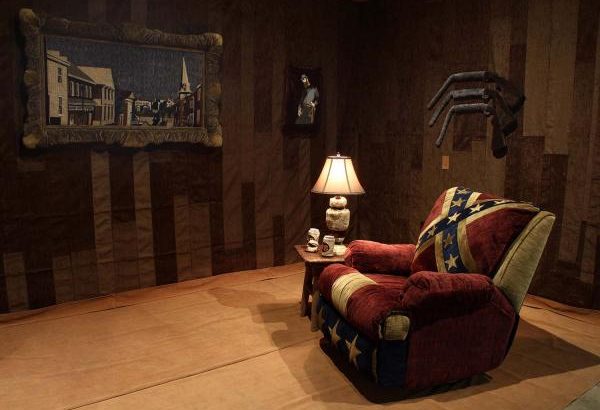
As I stepped with socked feet onto the fabric-covered flooring of installation piece Hometown Hero (Chink), I was struck with an eerie and unshakable sense of familiarity. No, not from the hand-upholstered, Confederate flag recliner, or the country karaoke sounding from the plush TV – save for the artist’s face in the video recording, the 3-part installation itself was essentially free of any immediately recognizable, East-Asian motifs. So why did my experience feel closer to a revisit rather than a shocking introduction? I told myself that it must have been the culturally ingrained, practiced motion of taking one’s shoes off before entering a living space, or maybe the intimately homey experience of padding around a carpeted floor with the TV streaming white noise.  

The fact that the entire space is hand-sewn jumps out at me; under artist Valery Jung Estabrook’s skillful hands, everyday “soft” objects turn steely, while “hard” objects are revealed to have soft and sagging underbellies. The “lazy boy” recliner decorated with the image of a Confederate flag displays these juxtapositions most prominently; though the surface is composed of velvety chenille, soft-to-touch and associated with comfort, the repellent flag imagery strongly dissuades the viewer from touching the furniture.

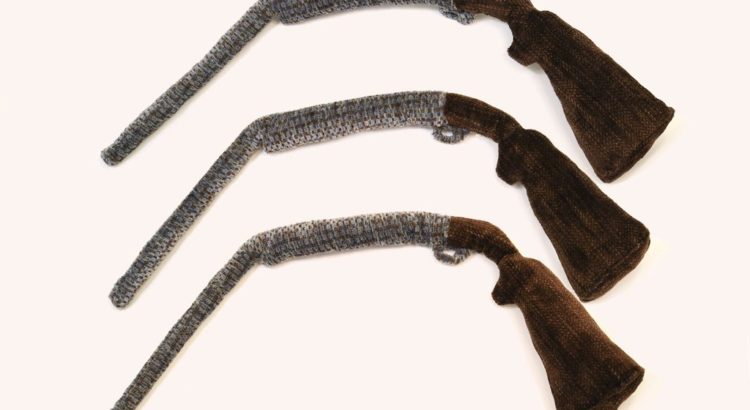
Even so, the recliner dominates the space, sending chilly tones throughout the warmly lit interior. Other striking plush components include the ‘pillow guns’, a set of three flaccid rifles mounted to the wall, and the ‘Born & Bred Beer’ beer cans casually littered on the recliner’s side-table. Chenille fabric, what the majority of the installation consists of, is immediately distinguishable through its tufted, caterpillar-like texture and iridescent appearance. These characteristics make the textile a popular choice for sofas, baby blankets, and other items that make direct contact with the skin. Needless to say, I was fascinated with the artist’s approach to materiality and her manipulation of sensory elements with chenille that served to contradict and even amplify the viewer’s psychological responses to derogatory imagery.

In a reflection about the title, Hometown Hero (Chink), Estabrook refers to the painful addition of the racial slur as a necessary component “… in order to have an honest discussion about the America that I know.” Her statement propelled me towards a question that I, and likely many others, have faced constantly while navigating ‘the Asian-American experience’: why the America that we know appears so dependent on the home that we say we know. I do not share Estabrook’s experience growing up in rural southwestern Virginia; what I do share are similar feelings of alienation upon being subjected to the white gaze – even at home, we are foreign spectacles singing along to the jaunty tunes of assimilation, while America reclines in a chenille chair, crushing ‘Born & Bred Beer’ beer cans in silent assent.


REVIEW: Hometown Hero

If you took a moment to step out of the abrasive Michigan cold and into 202 South Thayer, you might also get the feeling you were stepping into the living room of any family in America. This is the first impression that the Institute for the Humanities’ latest exhibit provides. The space of the interior is small, homey, and inviting: a worn armchair slumps before a flickering TV, nestled atop a plush rug. The area is peaceful and dim, inviting you to sit down, take a load off, relax. However, just one more look may put you on edge; something sinister swirls around the sleepy scene, something not quite right. In an instant it hits, the glaringly obvious: the well worn chair is not upholstered with plaid, or gingham, or any fabric you’d expect, but instead, horrifyingly, with a Confederate Flag.

As I came to this realization, a strange feeling settled into my stomach. The space is a portrait of middle class America gone eerily wrong, while remaining hauntingly familiar. I believe this difficult truth is exactly what artist Valery Jung Estabrook aims to capture in her installation, titled “Hometown Hero (Chink): An American Interior.” Growing up an Asian American in Virginia, Estabrook’s work seems to reflect her desire to maintain a Southern identity while acknowledging that her home state is not a universally accepting place.

Upon closer inspection, the room only becomes more unsettling. It is beautifully crafted, hand sewn by Estabrook in chenille. Everything is plush, down to the crumpled beer cans, and the rifles limply mounted to the wall. This choice in medium suggests the space as something tied down, as if the room had grown roots. Its refusal to budge seems to reflect the nature of the traditional, antiquated Old South that Estabrook hoped to portray. Sewn portraits of Confederate soldiers dot the walls, only strengthening this message. Like everything else in the room, they are slightly fantastical: General Jackson’s head floats inches above his shoulders, and Lee is adorned with a faint halo. A southern cityscape hangs as well, its innocuous presence contrasting with the eerie romanticization of the Confederacy.

While the entire room suggests nostalgia for antebellum America, scenes on the television reflect how this longing for the past affects Estabrook. Clips on the TV depict the difficult relationship Estabrook has with her race and her Southern identity; one such video is a Twinkie commercial, “Twinkie” being a derogatory nickname for Asian Americans. Perhaps the video that captures Estabrook’s question of identity best is one of the artist herself lip syncing Tammy Wynette’s famous southern ballad, “Stand by Your Man.” In a blond wig with dark roots, singing an iconic country song, Estabrook embodies the struggle of balancing her Southern identity with her Asian heritage. Haunting and hypnotizing, this performance tied together the message of the entire installation.

Even after two viewings, I don’t feel I’ve picked up on every meaningful detail that the installation includes. Although the effect of the chenille coating the room is interesting in itself, the piece only becomes more moving with Estabrook’s history and story. I highly recommend viewing this homage to an America that we wish to forget, but one that is still instrumental to our history. “Hometown Hero (Chink): An American Interior” will be on display through March 12th. A visit can save you from the chill outside while still sending a chill down your spine.

REVIEW: Photography Exhibition: Images of Incarceration


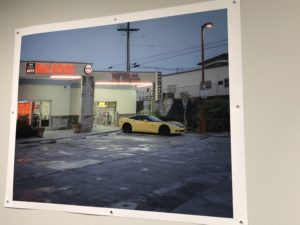
A little bit haunting, a whole lot confusing, maybe threatening. These pictures gave me the feeling of a kid from the Peanuts gang; kept from some secret like the unintelligible monotone of the adults’ voices. It was something special to be let in at all, but the opacity of the images’ meaning both disturbed and delighted me. The lighting–heavy flash going off in naturally-lit or dark indoor environments–put me back in time a bit. The images were reminiscent of the 1990s with their coldly fashionable earth tones: grays, browns, tans, beige.

The ones with captions seemed like they could have had a clearer intent. We have location and the number of inmates, but that’s about it in terms of context. I needed more from the literature if the artists wanted to include it at all. Mere numbers fail us in giving meaning to most things; I need more description of living conditions, maybe a hint at artifacts of the imprisoned life, the possessions they leave behind at the gate, art made by inmates, some little picture of influence they have on their surroundings and the lives of others.

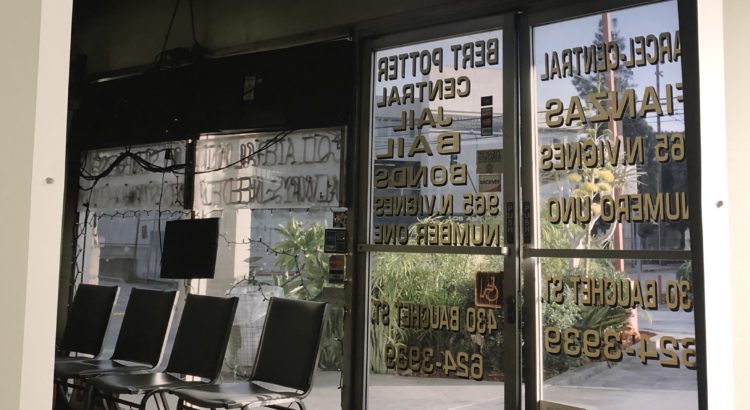
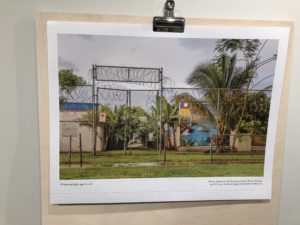
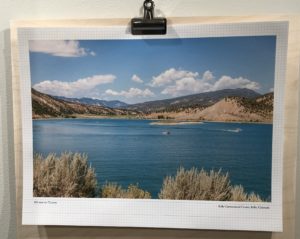
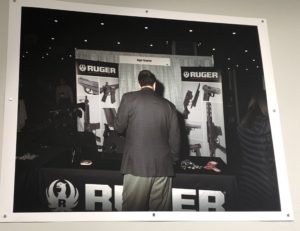
It was interesting that all the photos surrounding correctional facilities were taken from the outside (necessitated by strict no-photo policies, undoubtedly), often not including the buildings at all, but focusing on the surrounding landscape. Most of the others–bail bond shops, police gun shows–were taken from inside. Are we meant to feel a kinship with the law, or just deny ourselves a false connection with the incarcerated? To be outside is both a privilege and a curse: it grants us our continuing freedom while suffocating the possibility of real understanding.

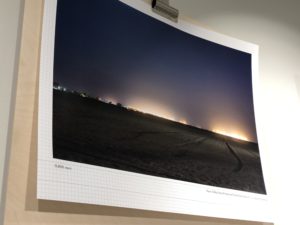
Using such majestic landscapes was a unique artistic choice for me. Many incorporated deeply vibrant colors in the sky and greenery; there was a lot of sunshine and a calming, natural glow to them. Several could have been featured on a ritzy resort’s website. They’ve taken away the images of concrete blocks and barbed wire I would normally associate with prison and replaced them with a richer depiction. “There is beauty here!” they shout. There is no longer the usual isolation of a building from the land on which it sits; instead it becomes a part of something more complete. Exactly what that is, I’m not quite sure. There is no reference to the incarcerated housed within the walls we cannot see from our vantage point, save for a mention of how many there are. Personalization is negligible, nothing more than the city and state printed below the picture. If we are not meant to focus our thought on the prisoners, what else are we supposed to consider? Or is their absence itself the point? Thus the argument is unclear. I will definitely be going to the artist talks coming up, and I suggest you all do the same after perusing the gallery. Steph Foster will give an artist talk on Friday March 27, at 4:45 PM, and Ashley Hunt will give an artist talk on Tuesday March 31, at 4:30 PM.


PREVIEW: Photography Exhibition: Images of Incarceration

Little spaces for viewing art are the best! Maybe being hidden, somewhat out of the way, tucked in a corner makes them a challenge to find, but stumbling upon is far better than being smacked in the face with a million advertisements.

East Quadrangle’s Residential College Art Gallery is a perfect example of this. They humbly exist in a small, glass studio, the work always visible from the outside but only really observable from within. I invite you to step inside for its upcoming exhibit “Images of Incarceration.”

Ashley Hunt and Steph Foster’s photographical artwork depicting the realities of the legal system will be on display beginning this Friday. There is no admission; just come on down during the hours of 10AM-5PM weekdays from February 21st to April 9th.

REVIEW: Yayoi Kusama’s Fireflies on the Water

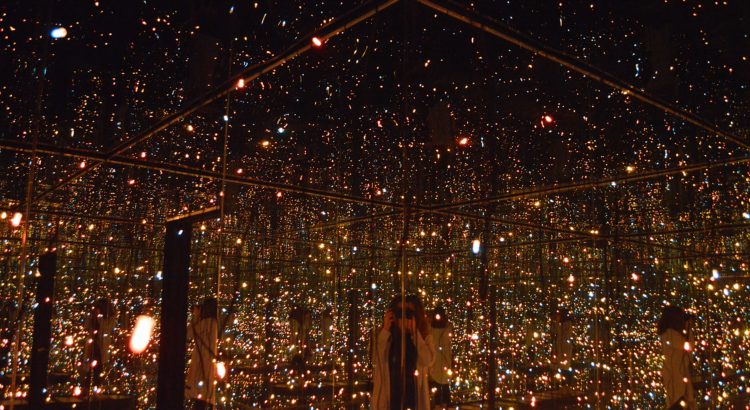
A 9 x 12 x 12 room. The walls and ceiling are mirrors, the ground water. You, the subject, are reflected over and over again against a backdrop of hanging lights: blues, reds, oranges. You are allotted 60 seconds in the room. Yayoi Kusama’s Fireflies on the Water transports you to another reality where it feels like you are at the center of that surreal universe.

Yayoi Kusama is a Japanese artist. When she was ten years old, Kusama began to experience vivid hallucinations in which she saw bright lights and endless fields of spots, which has heavily influenced her artwork throughout her life. She first became known to the public sphere as an active member of the hippie counterculture movement in the late sixties. She staged several performances, or “happenings,” in which naked participants were covered in polka dots.

I had previously seen another one of Kusama’s installations at The Broad in Los Angeles. The room was structured in a similar fashion, thought the lights were larger and more spherical. Infinity Mirrored Room – The Souls of Millions of Light Years Away had a more blue-green hue, whereas Fireflies on the Water had a warmer tone. Although both rooms are very similar, I found the two experiences to be independent of each other. The room in LA was exciting; I felt like a child, giddy, desperately taking photos in an attempt to capture the experience. This time around the experience felt more self-reflective. I was more aware of the tranquility of the scene, which was largely attributed to the fact the museum workers ask those waiting outside the room to remain silent. Inside the room, it feels like you are alone in this alternate dimension, but the experience is more soothing than frightening.

Naturally, I took an abundance of photos, but I almost felt that shattered the illusion. I wish I could return to the room and just sit on the platform surrounded by water for as long as I wanted. The logistics of allowing each visitor to stay in the room for 60 seconds makes sense, but it leaves the viewer yearning for more. Right when you enter a daze of seeing an endless number of lights and your reflection again and again, the door swings open, distorting your vision, and you find yourself back in the dingy lighting of the museum.

Still, Kusama’s installations are a very unique and unforgettable experience that I highly recommend seeing. Fireflies on the Water is currently on display at the Toledo Museum of Art and will be open until April 26.