REVIEW: Free Spirit


As I entered the Emagine Theater located in Novi, MI, I wasn’t prepared to experience a visual and musical presentation that would change my attitude and outlook on my life going forward. This experience consisted of watching the short film created by R&B artist, Khalid, called Free Spirit and listening to his newest album titled Free Spirit that played afterwards. With that being said, I would like to comment on the experience as a whole.

As the visual presentation began, the lights dimmed and the screen primarily showed Khalid himself giving an introduction to his show. He welcomed the fans that had attended the event and thanked us all for coming to experience the short film he had made. Ultimately, his comforting presence was consistent throughout the presentation and I felt glad that he was taking the time to connect with the audience in this way.

Shortly after this introduction, the short film, Free Spirit, began. It opened up with a montage of scenes depicting the vast desert-like countryside of an unsaid Southern state, the calm, small-town essence of a neighborhood on the outskirts of a big city, a high school gym with senior prom decorations, and the teenage hangout places of modern suburbia. Meanwhile, one of the songs from his album played in the background, fitting the nostalgic, emotional, and free-spirited essence of the montage perfectly. The film was constructed around these scenes and told the story of a group of teenagers who were on the brink of seizing the freedoms of true adulthood.

The story mainly follows a girl who goes by Ladybug and who joins her group of friends on a road trip after being kicked out of her intoxicated mother’s house. All the while, the group emulates the essence of teenage freedom: feeling the open air while standing outside the sunroof of the van that they stole, drinking alcohol and smoking weed, and proving themselves unstoppable against the world. Eventually, things begin to fall apart as apparent romances between some of the friends divide the group completely, and the film ends with a devastating consequence for one of the friends as a result. The ended proved to be my favorite part of the film because of how emotional it was and how unresolved it was. I believe it portrayed the struggle that young adults have to find themselves and to make it in this world as adults, and how it seems that we will constantly struggle to find ourselves completely even as we get older.

After the short film ended, Khalid played his new album, Free Spirit, before its worldwide release with visuals and commentary accompanying it. Overall, I really enjoyed this experience and felt that visuals accompanied by the music allowed me to enjoy the meaning behind the music in a better way. Ultimately, I very much appreciated how this short film portrayed the lives of young individuals. As the film showed, anyone from any background essentially experiences the same struggles as a young adult and I felt that it validated the truth about how youthful questioning exploration doesn’t quite end with our childhood.

PREVIEW: Bookmarks

If your ever wandering around the “big three” Michigan libraries this coming month, you might come across an interesting new set of artistic additions. The Penny Stamps School of Art and Design is hosting an exhibition curated by Dean Guna Nadarajan displayed across the Shapiro Undergraduate Library, Hatcher Graduate Library, and the Art, Architecture & Engineering Library in the Duderstadt.  The exhibition will feature a number of site-specific installations, performances, interventions, and events done by Stamps students and staff.


All of the related events are completely free. For more information and the event specifics please check out the link here https://stamps.umich.edu/exhibitions/detail/bookmarks_speculating_the_futures_of_the_book_and_library.  The vast majority of events are still on the horizon.  Of particular note the opening reception will be Wednesday, March 27, 5:30-7:30 PM.


The pieces will on display March 26th to May 26th. As the pieces are completely open and free to the public make sure to spice up your next study break by visiting one, or several of the installations.


REVIEW: Las Cafeteras

Having looked forward to this event for the entire week prior, I was thoroughly pleased by the impressive performance given by Las Cafeteras during the middle of last week. What I thought would be essentially another Latin pop performance was much more than that. The group experimented with vibrant, modern sounds while maintaining a traditional essence, and the aspect of their performance that was most meaningful to me was the social commentary that was emotionally striking throughout. After experiencing this performance, I couldn’t wait to write this piece and to explain how Las Cafeteras would give us a reason to listen to their music long after the curtains closed.

The style of their music was a perfect blend of modern sounds and a traditional essence. In other words, many of their songs gave a traditional Latin impression in terms of having upbeat tempos, uniform time counts, and classic instrumentation. In addition to these components, the group instilled some of their own personal flares into their songs that gave a revolutionized impression, such as rapping in some verses, filling up the auditorium with the hard and fast strumming of their guitars or ukuleles, or showcasing the baseline beat given by a full drum set. While these aspects of music composition may be more often seen in the rock genre, the group was able to utilize these techniques in their genre to make their music all the more well-rounded, far-reaching, and complete.

Part of what captivated me the most about the performance by Las Cafeteras were the personas of its members. Aside from being musicians, the three main performers were able to show us just how personable they were, expressing their vulnerability during songs about injustice or hard times and their utmost passion during songs about enjoying life and loving your family. When Hector Flores entered the stage, I immediately felt uplifted and attentive; he was the driving force behind the audience’s involvement in their performance. As Denise Carlos bellowed each song, she seemed to sing in a difficult range with ease, allowing us to feel like she could just be a passerby singing down the street. When Daniel French contributed to verses by rapping, he gave an impression that he could be my cousin or brother, writing and singing to address common social issues among our Latin community.

The most important aspect of their performance were the underlying messages in each of their songs. It was emotionally jarring when they talked about the hardships of immigration, the acceptance of diversified communities, and corruption in our nation’s highest influential powers. I believe that their attempt to bring light upon these issue was successful in the sense that everyone left the performance on the same page and forward in the same direction. In the end, what I left the performance with was a drive to achieve purpose in life. Throughout their songs, they continually asked us, “What would you do? Who are you? What are you here for?” and I will continue to support the idea that whatever we choose to pursue in life, it will only be worth doing if we make it meaningful to us.

REVIEW: Paved with Good Intentions

“The road to hell is paved with good intentions.” And from what it looks like, the foreseeable future that’s changing along with the climate is that hell. Artist David Opdyke’s exhibition changes the way you see the world and the bigger picture, both literally and figuratively.

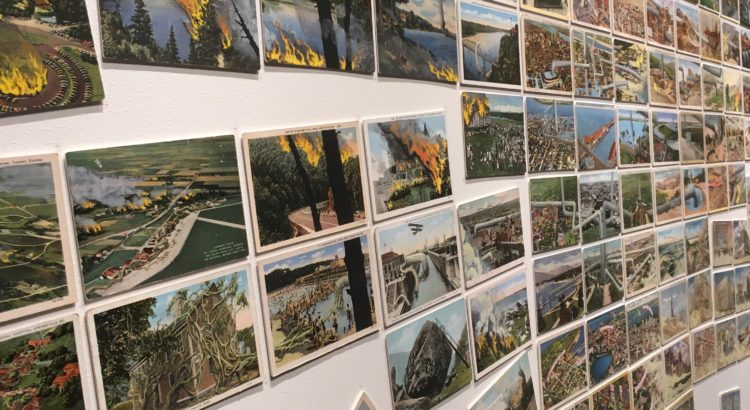
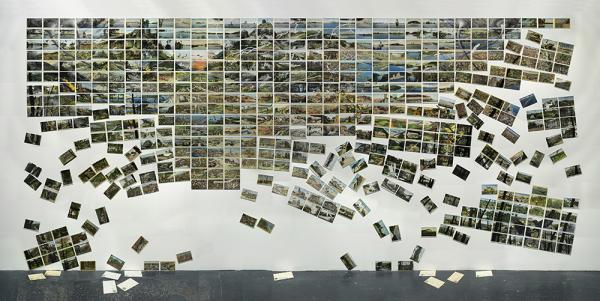
His politically-charged art attempts to stir something in you, something nostalgic yet foreign. By creating a feeling of longing for the past and reaching for the future, he grounds you in the present. There is a sense of chaotic unity in the gridded mural landscape. It alleviates the gravity of climate change through its absurd humor while leading us through an anxious journey that some people wouldn’t be able to go through by themselves. The postcards create a personal relationship with the viewer, using scenes and landscapes we may recognize and defacing the postcards with his drawings in a fashion similar to how we deface the actual landscape.

“Paved with Good Intentions” utilizes different levels of intimacy. The installation works both from a distance and up close, and the intricacy of the details pulls you in, requiring you to step closer and look at every single postcard before stepping back out to see the whole picture. This work requires more time than you think it would take to look at everything, precisely because of how much there is to see. Every postcard is interconnected, from the tornado to the fire to the flying frogs, putting a global layer to something so local. The accompanying animation of his postcards uses a slapstick humor inspired from Monty Python’s “Flying Circus.” It uses a different media to convey the same message in a more animistic way.

The world is too big to quantify and the enormity of the climate change crisis is too large to fully encapsulate, but David Opdyke tackles it through something as simple and recognizable and approachable as postcards. Set aside some time to stop by the Institute for the Humanities to experience this humorously serious exhibition through February 26.

REVIEW: The Great Tamer

As I approached the Power Center, I was surprised that its glass windows were not completely tinted black after all. As the color of the sky darkened well past the setting of the sun, I could see the golden glow of the inside of the auditorium’s atrium from the outside, my destination. I rushed inside to escape the cold and to arrive at what would become the entire experience of The Great Tamer, from the very beginning to the very end.

The Great Tamer drew people of all ages and from numerous backgrounds; some you could tell were university students who chose to live their Saturday nights in a unique way, some were elder folk who were likely experienced attendees of artistic productions like this one. In essence, this production attracted the appropriate crowd as it consisted of artistic elements, universal morals, and common humor that would appeal to the different sides of many people.

The production began before everyone was seated. Even after calmly rushing up the concrete stairs to the balcony and being one of the first people in the auditorium to take their seat, I noticed that there was already a man lying on stage with his shoes off next to him, presumably dead. As people continued to enter, he stood up, put on his shoes, and stood facing the crowd, expressionless yet observant. When the production began, his character came to life in an intricate storyline.

The entire performance consisted of humans using simple props, strong body language without direct gestures, color and the lack thereof in their clothing and in the setting, and panels that made up the stage floor to communicate various vignettes in what seemed to be a metaphorical way. It was probably not entirely correct of me to think of every action that occurred as a metaphor, but I felt that it was easiest to understand the purpose of a specific scene as an analogy to what occurs in real life, such as death and grasping onto life, letting go of a loved one, being overthrown by one’s own kind, the equity or lack thereof between man and woman.

The ten performers were masters of sleight of hand and melodramatic theatre; I would follow the movement of one particular character in a scene and suddenly witness him or her consistently pull an item out of the air that they couldn’t possibly have carried behind them or in their shadow. They carried a sporadic and vibrant essence throughout the performance, using the black floor panels to disappear and reappear in an instant, to portray the absence of a physical object in space, and to reconstruct different settings.

The final scene resonated with me the most; after some commotion, one man remained. He had a square of gold and silver foil, tossed it in the air, and kept it suspended by constantly blowing air up from beneath it. The stage was dimming, you could see him moving impossibly to keep the foil floating, and as the stage darkened completely, he gave one final breath and it was over. In this moment, I was stunned by the caliber of the performance I had just witnessed and almost felt that there would be no way to explain or justify it in the words I would write for this post. Even so, I am ecstatic that I was able to give even a glimpse of this performance to the public with this post and hope that Dimitris Papaioannou will continue to touch the psyche of many with performances like this.

PREVIEW: Paved with Good Intentions

Current U.S. culture and politics is riddled with fake news and exaggerated fearmongering. Paved with Good Intentions is a satirical installment critiquing this era with drawings on vintage postcards of American landmarks and destinations composed into a gridded landscape that mirrors today’s environmental chaos. In addition to the postcards, animated shorts and script-driven video in relation to the postcards are played. The exhibition opens on January 25 at the Institute for the Humanities with an opening reception and a panel discussion, “Good Intentions: Is Art an Effective Means of Activism?”, featuring artist David Opdyke, journalist Lauren Sandler, art historian Tara Ward, and arts curator Amanda Krugliak. This installation explores the power, or lack of power, that the arts have to address political and social issues. Open until February 26, you have a month to stop by the Institute for the Humanities to see this impactful mural.