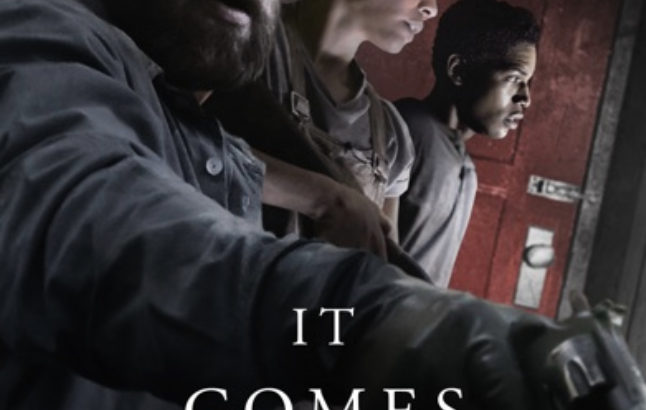
REVIEW: It Comes At Night

Why is legitimate talent wasted on awful screenplays?

Chuckling a little to myself, I chose thriller about a mysterious disease that forced families to isolate themselves from outsiders. I figured I’d finally be on the edge of my seat after weeks of watching painfully monotonous news coverage of minutely different facets of the same story. Turns out I was in for the same kind of boredom I had grown accustomed to in the past couple of months.

Horror movies (and increasingly, even the most confidently-labeled “cerebral” thrillers) have long been a genre that works with the same materials to build a plot. They use the same monsters, the same dialogue, the same archetypal characters. It is so dreadfully rare to find a horror movie that doesn’t settle for mining the same types of basic fears assumed to be common to all human beings. Sure, writers could start there for some aspects of their work, but all too often they also refuse to go further.  The next time I see another humanoid, tall, skinny shadowy figure drooling black goo from its mouth in a movie, I’m going to lose it, and not in the intended way. 

So anyways, this movie is about a family lucky enough to own property a long ways from the densely-populated city during a mass infection event of some mysterious disease. Already, the lack of context bugged me: where in the sam hill is this house located? Who is this family? What is this disease? How long has it been around? What has its global impact been? I kept waiting for the first rule of science fiction to be honored (a logical explanation of the way the world works in the story), but it never was. While some might argue that the vagueness adds to the scariness of the disease, to me it’s an excuse for lazy writing. There is such little substance in the world building the writers do that it distracts from whatever level of terror I’m supposed to be feeling, and replaces it with annoyance.

Though I shouldn’t have been surprised by the outdated, patriarchal family structure in the movie, I was. The dichotomy between femininity and masculinity was incredibly strong; it was made abundantly clear that the men were protectors, women were caregivers (and meant to be protected), and that these strict roles should be considered ideals. Men made decisions, and women made comments that could easily be dismissed. This is terribly common in horror, pulling on the legacy of the old days of female victimhood (King Kong, Creature From the Black Lagoon, etcetera, etcetera, etcetera). I’d thought we’d made it a little further past that. It’s almost like we need more female horror screenwriters. 

Going into the horror/thriller genre should not be a shortcut into movie making for unimaginative writers. There are some who are raising the standards, like Ari Aster (Midsommer), Julia Ducournau (Raw), and Yorgos Lanthimos (The Lobster, Dogtooth), but it isn’t enough yet to discourage the countless carbon copies of a basic slasher flick. Still, the future looks bright.
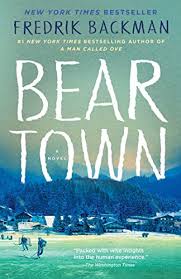
REVIEW: Beartown

Content warning: The book discussed centers around an instance of rape.

There are books that you read, then forget. And there are books that stay with you.

Beartown is one of the latter. This beautifully written book follows several residents of a hockey-crazed Swedish small town. It’s the kind of town that’s been ravaged by big businesses swooping into nearby towns. “You can’t live in this town,” they say. “You can only survive it.”

The town’s only source of pride is its hockey teams, which have faded in relevance over the years — except this year, when the junior team is good enough to make the semifinals thanks to a team built around a star player, Kevin, and a supporting cast that complements him well. But then Kevin rapes the GM’s daughter after the semifinal, and everyone in town is affected.

Beartown’s catalytic event doesn’t happen until nearly halfway through the 400-page book. This made it a bit hard to get into at first — but it was well worth it at the end, when the painstaking development of all the book’s main characters made it nearly impossible to put the book down. Every character is nuanced, and author Fredrik Backman wrote them in such a way that nearly every action is understandable, even if clearly not justified.

Backman’s writing is lyrical and full of ruminations on the meaning of hockey, family, life and loyalty. The natural flow of the writing is even more impressive considering the book is a translation from its original Swedish. Beartown also distinguishes itself from most sports books in that Backman clearly knows and loves hockey. The descriptions of the games read like they were written by a sports writer, and Backman also clearly understands the meaning of sports — and the way they can both bring people together and tear them apart.

Some books that deal with sexual misconduct come off as preachy; others are too dismissive. Beartown was neither. Backman handled the subject with empathy for the victim while also exploring the actions of those around her, both good and bad, and the forces pushing them to act certain ways. Hockey is the backdrop to all of this; in a place where the hockey team is one of the few sources of hope in Beartown and the junior team’s coaches have always stressed that the team comes before all else. That makes the fallout particularly devastating. In a town where hockey is everything, its citizens are forced to grapple with the dark side of both the game and human nature itself.

I love sports. But I’ve also seen the ways the same culture that makes them so appealing can also turn toxic, the way sports are sometimes used as an excuse to enable the horrific. In that way, Beartown was both timely and realistic. The events of Beartown are fictional, but they feel like they could happen — have happened — in so many different places.

The ending of Beartown was unpredictable and affecting. (I’ll admit I cried.) Few things in the book are as simple as they seem, and that extends to the ending. Beartown is dark, but it is ultimately hopeful. It was a poetic and poignant read that I wanted to keep reading after it was over. I know I won’t stop thinking about it anytime soon.

REVIEW: Per Petterson’s Ashes in My Mouth, Sand in My Shoes: Stories

Though he’s known primarily for Out Stealing Horses, Per Petterson’s first publication Ashes in My Mouth, Sand in My Shoes: Stories is something special.

It’s reminiscent of Winnie the Pooh for me; I’d always thought of that bear as a little old lady, thoughtful and sweet, but detached from the pains of reality as a child might be. Both Winnie and this book are able to be read by older children and adults; they’re both a little look into psychology and events that work as living memories, told through the brightness of youth.

Petterson in recent years.

Arvid, the young boy who narrates the stories, is just like this. We don’t get his age, but it’s clear he’s no more than around eight years old. Petterson works an ambivalent melancholy into his vignettes; while Arvid is a fairly optimistic, frank kid, he’s also fully aware of the significance of the events he bears witness to: his grandfather’s death, his neighbor Fatso’s addictions, his parents’ marital strife. The author does well explaining the in-between; that is, the place where coming of age has already been in the works, but the details are maybe a little vague yet. Somehow the strange, unmolded stage that Arvid occupies has its own grace.

Luckily, Petterson avoids getting too trope-y with how he approaches The Big Subjects (which are too often the same types of scenarios, barely altered by a group of tired storylines). There is no apparent theme or timeline to his stories, like some proposed common biological clock: falling in love, getting a job, having kids, death. I liked the focus he has on a single, small section of one kid’s life. This doesn’t distract the reader with looking for predetermined developments key to coming of age. Instead it is reflective of how a lot comes into semi-clarity all at once while we’re young.

My favorite of the stories (though it could probably be argued we’re meant to take the book as one cohesive story) is the sixth, called “Fatso.” It’s a sad sort of endearing to note how similar the two are, in their gentler, considerate side. In the movies, they would’ve been friends, like Tripper and Rudy in Meatballs. But here, Fatso is the town laughing stock, not a cool camp counselor. Arvid instead ignores the newfound respect Fatso has for him after they talk a bit, and it made me wonder whether there comes a time when the voice of others rings truer than one’s own.

It’s hard to say whether Petterson distorts the reality of childhood at a level that is indefensible. Anytime an adult author writes behind the eyes of a child, they are wont to add some literary character to them; a thoughtfulness that doesn’t organically spring forth from most kids. Otherwise, they simplify their thoughts past realistic limits, and the story is no longer interesting to read. Arvid is comfortably in between these two, shown to have independence but with the source of it mostly originating with his parents’ often lax attitude towards his adventuresome will.

Check out this and other books by Per Petterson via online book merchants, or at your local library.

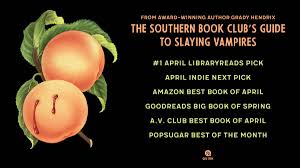
REVIEW: The Southern Book Club’s Guide to Slaying Vampires

After finishing this book, my first horror/thriller novel, I can firmly say that I will never read another one. Not because it was bad, but because Grady Hendrix wrote it so well that I was thoroughly terrified. My palms were sweating profusely while reading certain scenes, and I had to frequently take breaks from reading because the story was so intense. I won’t spoil the plot, but I’m going to explain exactly what made this book so chilling to me–and what made it so good.

The title gives away that the “monster” in the story is a vampire, so I expected a certain level of blood, gore, and other classic vampire-related themes. Hendrix delivered on all of those. What he also incorporated into the horror of this story were psychological spooks and very relevant political issues. Yes, the vampire figure is making children disappear, but what made the vampire figure so scary was that you could replace it with literally any white man (think Ted Bundy, to whom the main character, Patricia, frequently compared the vampire figure) and the entire story would still be intact.

The actual plot started out kind of slow. It was only until a third of the way through the book that the thriller action really started to pick up. The first third of the plot was dedicated to meticulously crafting a world in which the reader’s attention was drawn to all of the problems within it, without explicitly stating them in the text. It laid the groundwork for truly horrific things to take place later on in the story. For this, I applaud Hendrix.

Patricia is made aware of the first child disappearances when she visits the woman who takes care of her mother-in-law, Mrs. Greene. Mrs. Greene lives in a predominantly black neighborhood, where everyone is scared that their child will be the next to disappear. Naturally, anyone would be scared, but Mrs. Greene’s neighbors are particularly distressed because their children are black and the police don’t seem to care. On one of my breaks from the story, I was looking at Goodreads reviews, and someone said that they thought the story was tone-deaf to make the only children targeted by the predator black, and that it was wrong to create a neighborhood of poor black people and have an exclusively rich, white suburb. I feelthat this reviewer missed the entire point of the author drawing our attention to race in the story. Hendrix casually dropped little details regarding race throughout the exposition. It was this attention to detail that made me realize how good of a writer Hendrix is–part of the horror of his novel was the revelation of how black people were treated in the 90s, when the story takes place, and even more scary is that Hendrix allows his readers to recognize that America still has the same issues today. The vampire figure was able to keep using black children as his victims because nobody in a position of power would care. Patricia, who knew what was happening, was able to retreat back into her normal life and ignore the problem because it wasn’t directly affecting her or anyone in her rich white neighborhood. I don’t believe it’s tone-deaf to present race in this way, especially because the book takes place in the South. It’s both important to the plot and the construction of its horror genre.

Like the issue of race, Hendrix weaved other really important and relevant topics into the horror elements of his novel: gaslighting, drug abuse, sexual assault, friendship/betrayal, disease stigma, and MORE. I was impressed with how well Hendrix created his story. I fear that including any more details would spoil the novel, because the details are so integral to the thriller plot. However, one major issue I did have with the book was the ending. It was wrapped up very neatly, with an imaginary “we’re all safe” bow on top. While it calmed me as a (terrified) reader, I don’t think the ending holds the same value as the rest of the book. It almost felt like Hendrix didn’t want to write that ending, but was running out of time, so he wrote down the words he thought would please his readers rather than continuing to rattle them to their core. Overall, I encourage anyone and everyone to read The Southern Book Club’s Guide to Slaying Vampires, even if they don’t typically reach for horror/thriller novels. It’s written *that* well.


REVIEW: The Spell Book for New Witches: Essential Spells to Change Your Life

I should preface this review with the universal acknowledgement that just like the weird side of YouTube that many quarantined individuals may find themselves stumbling into, there exists an equally bizarre side of Amazon – and this book hardly scratches its surface. While on a similar downwards trajectory across Amazon’s vast niche book collection, I came across a plethora of modern witchcraft guides, including Ambrosia Hawthorn’s The Spell Book for New Witches: Essential Spells to Change Your Life.

For someone with no prior witchcraft knowledge besides having happened across a handful of Vox witch documentaries, this book managed to clear up any confusing spellcasting terminology. A good quarter of the book is dedicated to understanding the art of spellcasting and educating the reader on spellcasting preparation, which rings true to its intended audience of ‘new witches’, or beginner practitioners. In Part I, Hawthorn clarifies commonly confused magic terminology, such as witchcraft versus Wicca, and even briefly delves into its ethical obligations, warning beginners of the Law of Threefold Return and knowing one’s place within cosmic law. Though I personally have no plans to sew poppets or charge clear quartz under the next full moon, I’m grateful for the author’s emphasis on exercising reason, caution, and stable-mindedness under all spellcasting circumstances.

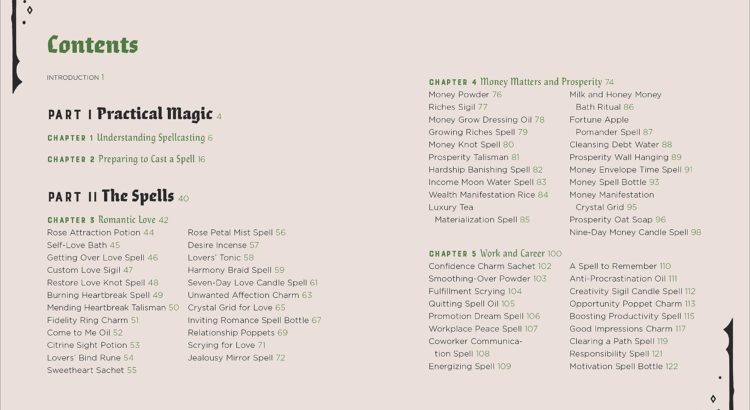
Hawthorn divvies Part II of the spell book, the spells and their recipes, into seven categories of use: ‘Romantic Love’, ‘Money Matters and Prosperity’, ‘Work and Career’, ‘Friends and Family’, ‘Health and Healing’, ‘Protection and Forgiveness’, and ‘Well-being, Success, and Abundance’. Though I expected witchcraft to require a number of obscure ingredients and esoteric performing instructions, Hawthorn’s spells stress the ‘practical’ in practical magic, with most spells requiring 10 or less ingredients and tools combined. While describing the core principles of witchcraft, which include celebrating your life and sexuality, Hawthorn explains that spellwork should be fueled mainly by “a respect for nature and the mystery of the universe”. She characterizes magic as existing all around us, therefore crystals and herbs should be drawn upon as secondary sources to harnessing our personal power and energies.

Hawthorn’s book promises a wide range of spells designed to suit your every need – whether that be finding a lost item, curing heartbreak, or designing a custom healing sigil. The performance rituals range from simply harnessing crystal energies to boiling herbs; many of the spells can double as quarantine-induced-boredom cures, as Hawthorn makes a point to include cookie recipes, soap, and other self-care spells. Some spells that might be particularly useful to unmotivated students such as myself include: ‘Money Manifestation Crystal Grid’, ‘Wealth Manifestation Rice’, ‘Acceptance Talisman Spell’, and ‘Anti-Procrastination Oil’.


PREVIEW: Tous Les Jours

Available to Stream on Amazon Prime is Nicholas Mullin’s masterpiece of a documentary, Tous Les Jours. This intimate portrait of Newfoundland artist Jean Claude Roy follows his daily activity as a landscape visionary. As he gathers his paints and sets off to seize each day, we are led into a beautiful landscape of color that is Jean Claude Roy’s world.

Receiving praise from various film festivals, this documentary will transport you into the life of a true artist.