PREVIEW: CALM by 5 Seconds of Summer

The band 5 Seconds of Summer had their big break when they opened for One Direction on three of their tours, beginning in 2013. 5SOS (pronounced five-sauce) is not to be confused with a typical ‘boy band’ — they are a shining pop rock force to be reckoned with.

Set to be released on Friday, March 27th, 2020, CALM is twelve songs and forty minutes long. The name of the record seems to be a pun, referring to both the definition of the word ‘calm’ as well as an anagram of the band-members’ names: Calum Hood, Ashton Irwin, Luke Hemmings, and Michael Clifford. Four singles have already been released from the album, titled “No Shame”, “Old Me”, “Easier”, and “Teeth”. 5SOS will be releasing another single, “Wildflower”,  on Wednesday, March 25, in anticipation of their album release.

To get a taste of 5 Seconds of Summer’s new record, I highly recommend “Easier”, a song about a conflicted heart. The band juxtaposes layered vocals and pained lyrics with a beat that smoothly pulls the listener in different directions. “Old Me”, a relatable homage to a past-self, is my personal favorite so far. I have high expectations for CALM and can’t wait to indulge my ears on Friday.

Album art for 5 Seconds of Summer’s new record, CALM.

REVIEW: Detroit Symphony Mahler 5 Facebook Stream

On March 22, the Detroit Symphony Orchestra held a Facebook Live event, hosted by their Principal Timpanist and University of Michigan LEO instructor (my professor), Jeremy Epp. Epp began the session by giving an inspirational message about the current predicament American society finds itself in and by stating how much the DSO wishes they could play live for us, but these Facebook live events will have to do instead. He then went on to give special recognition to Principal Horn Karl Pituch and Principal Trumpet Hunter Eberly for their magnificent solos in the Mahler that was about to be broadcast. He also added that the orchestra was being conducted by Rafael Payare, a young conductor making his debut with the symphony. With that we were on our way. To be clear, this performance was a recording of one of their concerts from last spring. I was fortunate enough to see that concert live and enjoyed it so much that I wanted to see it again on Facebook. Jeremy was certainly correct that Mr. Eberly’s solo in the beginning was quite spectacular. The piece begins with a solo trumpet playing a theme that quite literally sets the tone for the whole piece as it is repeated by many instruments later on. After the initial trumpet, the power of the orchestra was felt soundly as everyone else joined in for the first tutti section about 30 seconds in. The brass really stole the show for the first movement as Mahler wrote them gorgeous and powerful melodies. In contrast to the heft of the brass, were some lovely soft moments from some unsuspecting characters. Notably, the timpanist has a gorgeous solo about halfway through the movement that is very soft and echoes the trumpet solo that starts the piece. Mr. Epp executed it to perfection, of course. After the first movement died down the same way it began, with a trumpet solo, the orchestra geared up for a wild ride with the second movement. While the first movement was very in control and militaristic, the second movement was wild and almost unhinged, but in a good way. While the music was happening, Facebook holds a comment section next to the video, allowing people to give opinions on the performance. Because Jeremy was moderating, he would chime in now and then with interesting, albeit in depth and nerdy, facts about the piece, especially regarding the timpani part. In addition, many members of the DSO were in the chat hyping up their colleagues before big solos which was great to see. The sense of family that this orchestra has is truly something special. The third movement featured Principal Horn Karl Pituch who did a phenomenal job with the solo part. Many orchestras, including the University of Michigan’s USO, ask the principal horn to come to the front of the stage for this movement because their part is almost akin to a soloist in a concerto. The fourth movement is the part that gets played on its own the most because of how beautiful it is. It almost rivals Barber’s Adagio for Strings in its beauty. While the brass dominated the beginning of the piece, the strings dominated this movement. The played everything with such passion and sorrow that one couldn’t help but be moved while listening to it. The fifth movement is one of the most exciting finales of any piece, in my opinion. It truly embodies what it means to build up a movement or piece as the ending is absolutely enormous in comparison to its somewhat sparse beginning. Mr. Epp was featured again here, earning multiple action shots of him at work as he navigated this challenging movement. In my opinion, the last 3 or 4 minutes of this piece are some of the best to ever be written and make this my favorite Mahler symphony. Overall, I really enjoyed watching the DSO live version of this piece because they streamed a really high quality video and it was really cool to see everybody interacting in the chat. Their performance of Mahler’s 5th Symphony can be found here: https://www.youtube.com/watch?v=9ztalwhqBUw. Subsequent streams will keep occurring through the Facebook Live platform and I encourage everyone to check those out. In addition, the DSO is offering free access to their digital library for a short period of time in light of the coronavirus pandemic. I encourage everybody to seize the opportunity to see this great orchestra in action and attend their concerts once everything is back to normal as they are a vital part of the Michigan arts community.

REVIEW: Richard Jewell

Richard Jewell is a movie based on a true story of the security guard who found the bomb that was planted  in Centennial Park at the 1996 Atlanta Olympic Games. While the movie endured some criticism regarding its portrayal of reporter Kathy Scruggs (Olivia Wilde), I found it to be an entertaining and enjoyable picture overall. The film starts by providing the audience with some background into the mindset of the movie’s namesake and main character, Richard Jewell (Peter Walter Hauser). Richard’s dream is to join law enforcement in some capacity, but he is unable to just dive into a job as a police officer immediately. The movie takes great care to establish his relationship with Watson Bryant (Sam Rockwell) early on as well, showing that Richard worked in his office at one point and was such a good employee that he went so far as to stock his drawers with Snickers bars. They then show that Richard left his job at Bryant’s office for security work at a university. While working at this university he “overachieved” in a way and ends up getting fired for overstepping the limits of his power. All of this background is included to set up Richard’s character as someone who dreams of being in law enforcement so much that he actually tries too hard to get there. When the 1996 Olympics come to Atlanta, Richard seizes the opportunity to be hired as a security guard. After a run in with some drunk teens, Richard notices a backpack is left under his security bench. He is the only one who considers it suspicious and insists that they call the “bomb guy” to check it out. Unfortunately for everyone at the concert, Richard’s suspicion proved correct; there was a bomb in the backpack. Thankfully, because he was able to alert the other security personnel, they were able to clear the immediately surrounding area and limit the damage to slightly over 100 injuries and 12 or 13 deaths I believe. Unfortunately for Richard, the FBI is not sold on the legitimacy of his heroics and start investigating him as the bomber. The controversy surrounding the movie comes from its depiction of how the story that the FBI was investigating Jewell got out. The movie shows Kathy Scruggs seducing an FBI agent (Jon Hamm) into telling her who the focus of the investigation is. The newspaper she worked for refute the validity of this portrayal, arguing there is no evidence to suggest that this ever happened. Regardless, word of the investigation got out and Richard Jewell went from hero to public enemy number one very quickly. After realizing he might be a suspect, Richard calls “the only lawyer he knows”, Watson Bryant, to represent him. Mr. Bryant prevents Richard from accidentally incriminating himself as he is so eager to help the law enforcement officers whose ranks he aspires to join that he is willing to do just about anything they ask. Because of his eagerness to cooperate, the FBI take full advantage of him until he realizes what is going on. Finally, upon coming to his senses, the movie shows a heated exchange in an interrogation where Richard asks the officers if they have any evidence against him whatsoever and they are unable to answer. As a result, they have to drop the case, but Richard’s public persona is not out of the woods, even to this day. Some people still think he planted that bomb and treat him as a criminal instead of the hero he truly is. Overall, Richard Jewell is really well done and, regardless of whether or not it is 100% accurate, is an entertaining portrayal of a very interesting case in American history. It takes a traditional story of a person being wrongfully accused of a crime and adds the element of them helping their accusers, making for a really interesting twist.

REVIEW: Chilombo

Like the Big Island, Chilombo‘s recording location, and its steadily pulsating, molten rock phenomena, Jhené Aiko’s third album ebbs and flows with healing power while narrating the singer’s personal journey through grief and self-discovery. Musically, the album is a tranquil R&B production flooded with Aiko’s characteristic zen vocals and effortlessly savage lyricism. Though critics have described the work as excessively drawn out and maybe a little too zen, I have increasingly found Chilombo to be a calming and humanizing presence amidst such global chaos.

In addition to the Island’s volcanoes, which Aiko likens to the eruptive energy of “Triggered (freestyle)”, she cites the use of traditional Buddhist singing bowls throughout her album. Aiko has long dabbled in ‘sound-healing’ or ‘music-therapy’, a practice which we receive a full introduction to in the singer’s attempt to open up and realign the body’s different chakras. In addition to being highly soothing, Chilombo is also charged with sex and defiance – in “Pu$$y Fairy (OTW)”, Aiko riffs her way through declarations of her own sexuality, asserting “‘I got you sprung off in the spring time/Fuck all your free time/You don’t need no ‘me time'”. The track carries a hypnotic dance rhythm while detailing the give-and-take of pleasure in an intimate relationship, and is purposely set in the key of D, which corresponds to the chakra associated with sensuality and located in the pelvic area.

Other favorites of mine include “Born Tired”, “Lightning & Thunder (feat. John Legend)”, and the various interludes that serve as peaceful prefaces to the narrative-style songs that follow. In “Born Tired”, Aiko infuses acoustic instrumentals with somewhat of a musical pep talk, encouraging the listener to “Rest your weary heart/Dry your teary eyes/I know you are scarred/And torn apart inside/Darling so am I”. The message is uplifting yet grounding, a defining characteristic of Aiko’s music which I thoroughly appreciate. Instead of pushing forth a high-energy beat with unrealistically upbeat advice, Aiko aims for unfiltered empathy in “Born Tired”. This sense of self-acceptance and positivity is somewhat of a theme in Chilombo; rather than considering “Triggered (freestyle)”, and “None of Your Concern (feat. Big Sean)” as diss tracks towards her on-and-off partner Big Sean, the singer considers them more as meditative outlets for “talking shit out of frustration and passion”. “Lightning & Thunder (feat. John Legend)” sets itself apart from the rest of Chilombo with the blissfully unaware, head-over-heels sentiment conveyed by lyrics such as “What kind of spell do you have me under/What in the hell? Starting to wonder/I am not well, I’m going under”. Aiko and Legend’s voices merge to further the song’s dreamy, entranced mood, resulting in a track that perfectly encapsulates the lack of control over one’s own fuzzy headspace that inevitably arises in the process of falling in love.

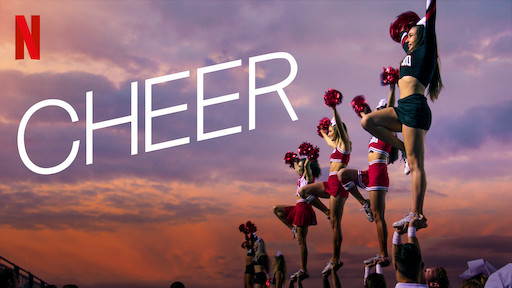
REVIEW: Cheer

Attending a high school that didn’t have its own sports teams, my concept of cheerleaders mostly came from what I saw on TV. White, pretty, mean. They cheered to make themselves popular or to date football players.

The recent Netflix miniseries “Cheer” flips all those stereotypes on their heads.

“Cheer” follows the real-life cheerleading team at Navarro College, a community college in rural Texas. The show’s arc juxtaposes two common sports movie tropes that aren’t normally seen together — the dominant juggernaut with a deep-seated desire to win and the scrappy, diverse underdogs who play above their means. The opening makes it clear that Navarro is a dominant force in the world of cheerleading and that their driven coach, Monica, will accept nothing less than another national title.

But these aren’t your typical teen sitcom cheerleaders. Many of Navarro’s cheerleaders are minorities or from low-income backgrounds. For some of them, cheerleading is literally all they have, and it’s that — the undeniably human stories of these athletes overcoming what life has thrown at them to come together and create something bigger than themselves — that makes the most compelling part of the show.

This show is not always pretty. Monica’s tactics occasionally border on abusive. There are a lot of injuries, and many of them are not handled properly. (It’s unclear if this is due to lack of adequate athletic medicine resources, negligence from coaches or both.) This is the dark underbelly of many sports, and “Cheer” presents it right alongside the feel-good narratives and lets you decide for yourself what you think. That was one of the more fascinating aspects of the show for me, especially as someone who is frequently around sports.

The show centers primarily on five protagonists — Lexi, Morgan, LaDarius, Jerry and Gabi — as they prepare for nationals with their team. All five are easy to root for. They all had different hopes and dreams and as the show reached its conclusion, I found myself cheering for them all to find success in their own ways. Throughout the documentary, you see a lot of footage from practice and information on how Navarro’s routine is coming, but you also get to hear the backstory of these five and see the impact that being part of the team has had in their lives.

I found out two episodes into “Cheer” that Navarro is one of only two teams in its division. Trinity Valley, the school it mentions as Navarro’s biggest rival, is in fact its only rival. The miniseries conceals this fact, but somehow it didn’t bother me as much as I thought it would. As the series went on, I found myself wondering more what would happen to each of the main team members rather than whether Navarro would win its championship. For that reason, I appreciated that “Cheer” doesn’t end with Navarro’s nationals performance. Instead, it goes on to show what happened to everyone after they walked off the stage — and not everything wraps up in a neat little bow.

“Cheer” is sports documentary meets sports movie, a David and Goliath story at the same time. Not everything is as glitzy and glamorous as the cheerleaders I saw on TV as a kid. And those things are what make the show so compelling.

REVIEW: Star Wars The Rise of Skywalker

A few days ago in a galaxy far far away, Disney released the 9th installment of the Star Wars sequel trilogy, The Rise of Skywalker, on Disney Plus. After receiving lots of backlash that stemmed from the questionable decisions Rian Johnson made while directing the 8th movie, Disney decided to bring JJ Abrams back in to see if he could salvage what was shaping up to be another failed spin-off series. I think he tried his best, but at the end of the day there was only so much he could do given what had already happened in the newest trilogy. The Rise of Skywalker continues to build on the “force dyad” connection that Kylo Ren and Rey share, including a few more discussions through the force as seen in the 8th movie (but without shirtless Adam Driver this time). This connection was one of the few parts of the 8th movie that was actually interesting in my opinion. As is expected in any JJ Abrams film, the movie also had some of the best action in the entire Star Wars series, featuring thrilling lightsaber battles, epic spacecraft fights, and force lightning. Abrams also did a great job of limiting the roles of annoying characters like Finn and Rose. At first I liked Finn, but after watching the 7th and 8th movies, I started to realize that his character only ever runs and yells. Once I realized that, anytime he did either or both of those things (which was a lot), I couldn’t help but cringe. Rose is an unnecessary character and I’m really not sure why Rian Johnson created her. While these aspects contributed positively to the movie and made it somewhat enjoyable, in my opinion, they were far outweighed by the negatives that accompanied them. While JJ did a good job of limiting Finn’s role, he still left him in enough scenes to have an annoying storyline. While falling through a pit of space quicksand (?) he tells Rey that he needs to tell her something important and then proceeds to never tell her even though they bring it up multiple times later on in the movie. After they fall through the quicksand, they happen to find a dagger with an inscription that tells them where to find the “Sith Wayfinder”. I really dislike the fact that they just luck into the exact information they are looking for. The 6th Star Wars starts with a well thought out plan that Luke and company execute to perfection to save Han. The use of planning as opposed to luck is one of the reasons that the original trilogy is better than all of the prequels and sequels, in my opinion. Another missed opportunity for an impactful moment came with Chewbacca’s fake death. I love Chewy as a character, but in this new sequel series, he is not important . However, because of his role in the earlier films, killing him off would have been a really powerful moment that I think would have been amazing. There were other choices that I didn’t like (such as Rey being a Palpatine, the kiss with Kylo, etc.), but they weren’t as offensive as the ones I discussed above. Overall, I felt like this movie wasn’t as bad as The Last Jedi, but was worse than The Force Awakens. In the grand scheme of Star Wars, I would rank it below the entire original trilogy, the 7th movie, and the 3rd prequel. Hopefully, when Disney tries its next spin off from this universe, a fresh set of characters will inspire them to create some better content.